

GE Invests $50 Million in Rival Pulsenmore as Handheld Ultrasound Market Heats Up

Butterfly Equity
Private Equity Firms in the Food Industry
Global healthcare giants have entered a phase of aggressive acquisitions; even GE, which has historically been cautious in its investments, invested $50 million in the handheld ultrasound company Pulsenmore.
As the global leader in medical imaging, GE has been relatively restrained in its investment activities. The large-scale medical imaging equipment market, where GE operates, has entered a period of technological stagnation, with few disruptive technologies requiring early strategic positioning.
Yet GE Healthcare, rarely an active investor, directly invested in a competitor this time. GE’s first-generation handheld ultrasound system was approved in 2009, and its enhanced offering, the Vscan Air, launched in 2021, sold 30,000 units within its first year on the market.
Why has GE, with its years of experience in the handheld ultrasound sector, chosen to invest in an Israeli competitor? Does GE Healthcare’s successive investments signal that this market segment is gradually heating up?
Handheld ultrasound was once a hot sector, giving rise to multiple unicorns. Overseas, Butterfly Network secured a RMB 700 million investment from Fosun, while several domestic companies also obtained financing.
Two years ago, an investor spent a day at a community health center in Dujiangyan, Chengdu, to validate the handheld ultrasound project by assessing how frequently primary care physicians used the device. He still recalls that one primary care physician attended to more than 80 patients that day, a figure that exceeded his expectations. However, due to doubts about whether handheld ultrasound could be successfully deployed in larger hospitals with greater paying capacity, he ultimately decided not to invest.
Subsequently, Butterfly Network has not experienced sustained growth overseas and has remained in a state of continuous losses since its inception. Although it went public via a SPAC merger in 2021, its stock price has continued to decline, with its current market capitalization standing at $680 million. For the full year ended December 31, 2021, Butterfly Network reported total revenue of $62.6 million and a net loss of $32.4 million, compared to a net loss of $160 million for the full year 2020.
The global market size for handheld ultrasound is estimated to exceed $100 billion. Currently, GE’s renewed confidence in deploying handheld ultrasound for home use, coupled with Butterfly Network’s narrowing losses, signals that the handheld ultrasound industry is gradually gaining momentum.
It has been over a year since the first batch of domestic handheld ultrasound companies obtained their registration certificates, marking their initial foray into commercialization.
Over a year after Chinese handheld ultrasound manufacturers obtained regulatory approval, they have begun to test the commercial waters. What changes have occurred among these domestic players? VCBeat (WeChat ID: vcbeat) provides an analysis.
Pulsenmore, which has won GE’s favor, was not previously the most prominent market player. Founded in Israel in 2015, Pulsenmore also received early investment from Fujifilm, in addition to GE.
Pulsenmore has earned the endorsement of two imaging giants, thanks to its innovation in breaking away from the traditional form factor of handheld ultrasound devices and successfully commercializing ultrasound products for home use.
From a business model perspective, Pulsenmore does not sell directly to end consumers; instead, it partners with Clalit Health Services, Israel’s largest HMO, to provide services to its members.Clalit Health Services has approximately 4.6 million insured members. This multi-year agreement will provide Pulsenmore’s products to tens of thousands of pregnant members, currently representing Pulsenmore’s primary source of revenue.
Although Pulsenmore remains unprofitable in terms of revenue performance, its home-based model, which integrates payment and remote consultation services, holds significant commercialization potential. Following its investment, GE will also assist Pulsenmore in obtaining regulatory approval in the United States and in distributing its products in Europe and other markets.
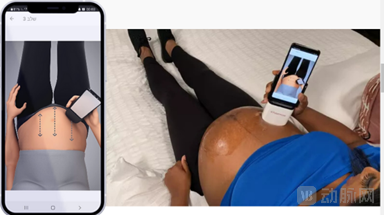
In terms of product form and design, Pulsenmore integrates an ultrasound probe with a mobile phone, lowering the barrier to ultrasound use.The Pulsenmore device connects directly to a smartphone, enabling users to perform self-scans under the guidance of a mobile app. When pregnant women experience abnormalities at home, they can use this handheld ultrasound device for examination. The results are automatically transmitted to their physician, who can then directly contact the patient to arrange a hospital visit if further intervention is required.
Although ultrasound diagnosis is a safe and efficient diagnostic tool, operators require years of training to master it, and large-scale ultrasound equipment is reserved for use by well-trained, highly specialized technicians.
Pulsenmore leverages its smartphone connectivity to lower the barrier to entry for handheld ultrasound.
Pulsenmore’s third major innovation lies in establishing a remote diagnostic system for handheld home ultrasound.
Zhang Zhizun, Co-Founder of Pulsenmore China, stated, “Pregnant women can perform examinations at home, while the ultrasound images captured can be shared with physicians in real time. Pulsenmore has established a seamless remote diagnostic system that enables pregnant women to complete initial consultations from home.”
For domestic handheld ultrasound entrepreneurs, Pulsenmore’s products and technology are not difficult to surpass; however, its remote diagnosis system, built upon a well-developed healthcare infrastructure, is the most challenging aspect to overcome.
Post-pandemic, imaging giants in the medical device industry have significantly increased their focus on the home medical device market.
Roland Rott, President and CEO of GE Healthcare Ultrasound, stated, “Healthcare providers anticipate that care delivery is shifting from traditional hospital-based settings to home environments, a trend that will enhance the accessibility and quality of home care. Meanwhile, we also recognize that patients desire greater involvement in their own healthcare.”
According to data from GE’s press release on its investment in Pulsenmore, the home care market is projected to exceed $662 billion by 2027, while the telemedicine and remote monitoring sectors are expected to grow at an annual rate of 30% by 2029.
In the future, Pulsenmore will also develop more products for home-based care, such as those targeting chronic heart failure and end-stage renal disease.
Different application scenarios impose distinct requirements on products. Taking the promising home-use scenario as an example, simply transplanting clinically used products to home settings will not succeed in capturing the market.
Cai Weizhong, CEO of Sonostar, stated: “Monitoring chronic heart failure and end-stage renal disease—two major conditions—remains a significant challenge in the medical field. These areas require continuous, long-term, real-time, and autonomous monitoring. It is difficult for handheld ultrasound devices to meet these requirements, as prolonged real-time scanning consumes substantial power, making it hard for built-in batteries to sustain adequate energy supply. Additionally, handheld ultrasound relies on manual operation for image acquisition. Further design innovations are needed to enable the application of handheld ultrasound in chronic disease monitoring.”
GE will also collaborate on the development of more ultrasound-based home medical devices following the investment. By investing in a new handheld ultrasound company, GE is bringing a new consensus to the industry: in the field of handheld ultrasound, not only is device R&D important, but the backend remote diagnostic systems and computer-aided diagnostic (CAD) systems that provide support are also critical.
However, it is evident that Pulsenmore’s remote diagnostic system is difficult to replicate in China, as there is an insufficient number of physicians to support its smooth operation. Furthermore, the payment model based on Pulsenmore’s collaboration with HMOs is also challenging to reproduce in the Chinese market.
In Israel, there is one general practitioner for every 700 people. According to 2018 data, China had 309,000 general practitioners, with the ratio rising to only 2.2 per 10,000 population. The number of doctors in China is insufficient to support the remote diagnostic needs of a large user base, as seen with Pulsenmore.
Physicians in China and abroad differ not only in numbers but also in their training systems.While physicians abroad generally possess some proficiency in using ultrasound for diagnostic purposes, ultrasound specialists in China are trained as dedicated professionals. Most specialists and general practitioners in China have not yet acquired the skills to operate ultrasound equipment for diagnostics. This reality dictates that relying solely on a seamless remote diagnosis system is insufficient to penetrate the Chinese market; what is needed more urgently are physicians who are proficient in ultrasound.
Regarding the differences between overseas and domestic markets, Cai Weizhong, CEO of Sonostar, stated: “IWe have established sales channels in overseas markets. Handheld ultrasound devices enjoy greater acceptance abroad than in China, as physicians outside China generally possess foundational ultrasound diagnostic skills, enabling a quicker learning curve..” SonoScape’s handheld ultrasound devices have obtained EU CE certification and US FDA clearance, as well as regulatory approvals in multiple countries including Japan, Russia, Australia, Brazil, Argentina, Turkey, and Indonesia.
Cai Weizhong also noted that consumers in Europe and the United States have a stronger preference for high-quality, affordable products, leading to greater acceptance of handheld ultrasound devices overseas than in China. In the future, leveraging their cost-performance advantage, the global expansion of handheld ultrasound devices may emerge as a new trend.
For the domestic market, handheld ultrasound devices face more complex challenges.
On one hand, although domestic companies’ handheld ultrasound products have all received regulatory approval, they still need to achieve breakthroughs in improving image quality and expanding the diversity of application scenarios.
Although the price of handheld ultrasound devices is less than one-tenth that of large-scale ultrasound systems, clinicians prioritize image quality in clinical practice, and even low-cost products are subject to high standards for image quality. To achieve widespread adoption of handheld ultrasound in clinical departments, further improvements in image quality are required.
According to a survey by VCBeat, handheld ultrasound devices offer significant advantages for interventional visualization guidance due to their compact size, minimal space requirements, and high portability. They are most popular in operating rooms and outpatient clinics, where applications primarily focus on superficial structures. With increased promotion and adoption efforts by academia and manufacturers across other medical specialties, handheld ultrasound is now increasingly being used for imaging of the abdomen, heart, rectum, and other areas.
An investor also pointed out, “Another advantage of interventional guidance is that, unlike in diagnostic scenarios, specialists are not required to make imaging-based judgments. This mirrors why point-of-care testing (POCT) products have failed to gain traction among clinical specialties: in large tertiary hospitals, POCT remains confined to the laboratory department due to issues of liability allocation. If handheld ultrasound were used for imaging diagnosis, while diagnostic authority resides with the Department of Ultrasound, this would hinder its acceptance by specialists. In contrast, interventional departments employ handheld ultrasound merely as a visualization tool during procedures. Therefore, interventional guidance will remain the primary arena for handheld ultrasound adoption in large hospitals.”
On the other hand, handheld ultrasound devices still need to address the challenges of difficult usability in primary care and home settings, as well as high costs.
On this issue, domestic enterprises have adopted a “two-pronged” approach. One prong focuses on enhancing market education for end users, including training in the use of handheld ultrasound devices and image interpretation. The other leverages technology enablement—specifically remote diagnostics and artificial intelligence—to address challenges related to usability and high costs.
The capabilities and pathways of technology enablement are key focuses for domestic handheld ultrasound enterprises. How to reduce costs and achieve assisted diagnosis through technology is a primary concern for Chinese companies.
In terms of cost reduction, the clinical diagnostic efficacy of any medical imaging system primarily depends on image quality. Traditionally, image quality has been improved by increasing equipment size. However, this principle is not applicable to handheld ultrasound devices.
Existing medical ultrasound imaging systems are already highly stable. The conventional approach to enhancing image quality in ultrasound products is to increase the number of array elements and channels; however, this not only results in bulkier devices but also drives up costs.
Historically, the technical barriers to handheld ultrasound were primarily reflected in three aspects: the number of physical channels, followed by algorithmic chips. To reduce component costs, Butterfly Network adopted a supply chain optimization approach.
Zhang Zhizun explained, “Butterfly has innovated the ultrasound transducer by adopting silicon-based technology. As the production volume of its probe chips increases, it achieves better cost efficiency in the supply chain. Our approach centers on computing chips, integrating deep learning and artificial intelligence throughout the entire imaging pipeline. The imaging pipeline refers to the process where analog signals are collected by sensors, converted into electrical signals, processed, and finally reconstructed into images through algorithms. We begin applying algorithms to enhance signal quality immediately after the analog-to-electrical signal conversion. By improving signal quality, we can achieve superior image quality under the same hardware conditions.”
In terms of cost control, relatively inexpensive computing power is used to replace expensive sensors. Previously, high-quality images could only be achieved through advanced sensors; now, we can achieve them through computing power.”
To address the challenge of operational difficulty, handheld ultrasound manufacturers worldwide have largely converged on a similar approach: leveraging AI-assisted diagnosis.
AI-assisted ultrasound diagnosis is primarily applied in the image acquisition domain, where AI can provide real-time guidance to users through every step of the scanning and image capture process.
In terms of product development, Caption Health’s FDA-cleared solution for enhancing cardiac ultrasound image quality is currently expanding into other disease areas.
In this regard, domestic companies are also attempting to address the challenges associated with operating handheld ultrasound devices through AI-assisted diagnosis.
Shenzhi Technology is also developing AI for ultrasound image processing and procedural guidance. Zhang Zhizun explained, “Constrained by the scarcity of medical resources, we leverage artificial intelligence models to enhance image quality. When users perform a thyroid scan with a handheld ultrasound device, the AI can inform them whether they are scanning the correct anatomical region and acquiring the appropriate imaging plane. It provides guidance on probe orientation and parameter adjustments, thereby lowering the barrier to entry for handheld ultrasound through these automated settings. Only by addressing the two major challenges of reducing costs and simplifying device operation can handheld ultrasound achieve widespread adoption in a developed country like China.”
In addition to technical challenges,Handheld ultrasound devices also need to explore better business models.
Taking Butterfly as an example, as a leading company in the handheld ultrasound sector, Butterfly has also innovated in its commercialization strategies. These include adopting a low upfront sales price followed by monthly subscription fees, which helps accelerate product adoption among a broader user base, and primarily utilizing online ordering and other sales channels, keeping it at the forefront of industry trends.
According to Butterfly’s annual report, cart-based ultrasound systems are priced between $45,000 and $60,000. The emergence of handheld ultrasound devices has reduced ultrasound costs; the average price of point-of-care ultrasound systems in the United States is approximately $15,000, with transducer probes priced between $5,000 and $7,000.
However, this model has still encountered challenges. Cai Weizhong pointed out, “Butterfly’s monthly subscription fees are relatively high, resulting in significant usage costs. Furthermore, the requirement to connect to their servers for operation and data storage has faced considerable opposition from many healthcare institutions. As a result, Butterfly has encountered challenges in its commercialization efforts, remaining unprofitable since its inception, with its stock price continuing to decline.”
Reviewing the development of China’s ultrasound industry, it took three decades for ultrasound technology to emerge from scratch and evolve into a distinct industry. This journey has been marked by numerous twists and turns, transitioning from dominance by foreign and joint-venture enterprises to the rise of numerous domestic manufacturers in the low-to-mid-end segment, and ultimately to the emergence of brands with international competitiveness. Throughout this period, the industry underwent multiple phases of expansion, competition, and consolidation. In the era of “Internet Plus,” handheld ultrasound has emerged as a trendsetting new application. How handheld ultrasound will develop in the future remains an area worthy of anticipation.