

New Patterns and Trends Driven by Technological Innovation: How Rehabilitation Medicine Contributes to Building a Healthy China
On June 17, the sessions held in the days leading up to the Top 100 Future Healthcare Companies Conference received widespread acclaim from both within and outside the industry. At the Innovation and Development Forum on Rehabilitation Robotics held that day, VCBeat brought together an International Fellow of the National Academy of Medicine (USA) and representatives from leading intelligent rehabilitation robotics companies. They analyzed the development prospects of technology-enabled rehabilitation medicine in an aging society from the perspective of emerging technologies, and explored innovative rehabilitation models in the new era of rehabilitative care.
As the integration of artificial intelligence (AI) with rehabilitation medicine deepens, technologies such as deep learning, voice interaction, and computer vision are maturing, leading to increasingly diverse AI application scenarios. These technologies are playing significant roles in AI-assisted medical imaging diagnosis, AI-driven drug discovery, medical robotics, and big data analytics. The convergence of AI with traditional rehabilitation medical devices, assessment equipment, and rehabilitation robotics has ushered in a wave of innovation within the sector. Rehabilitation medical devices are evolving toward greater simplicity and intelligence, making their widespread adoption, market penetration into lower-tier regions, and even home use increasingly feasible.
The following are the key highlights of guest opinions compiled by VCBeat:
Proactive Health and Active Aging

Li Jian’an | International Fellow of the American Academy of Medicine
Health refers to a positive state of adaptation between individuals and their environment, and it can be actively achieved. Rehabilitation encompasses a series of measures aimed at restoring health. It emphasizes not only the improvement of individual physiological functions but also environmental modifications, transforming negative interactions into positive ones, thereby restoring the harmonious state of “unity between humanity and nature.”
Professor Li Jian’an pointed out that in the context of China’s rapidly aging population, the term “elderly care” is somewhat misleading. “Elderly care” emphasizes a caregiving relationship with children, whereas older adults should first be regarded as independent individuals. They require basic necessities such as clothing, food, housing, and transportation, as well as the capacity for physical activity, decision-making, learning and recreation, and establishing and maintaining relationships. On this basis, he proposed that future intelligent rehabilitation approaches should prioritize enhancing older adults’ ability to live independently, helping those with limited functional capacity regain health and achieve independent living.
Finally, as a practitioner of proactive health, Academician Liu Jian’an advocates that “exercise is medicine” and “exercise is proactive health,” expressing his hope that everyone will embrace the concept of proactive health.
Clinical Applications of Rehabilitation Medicine Empowered by Technology
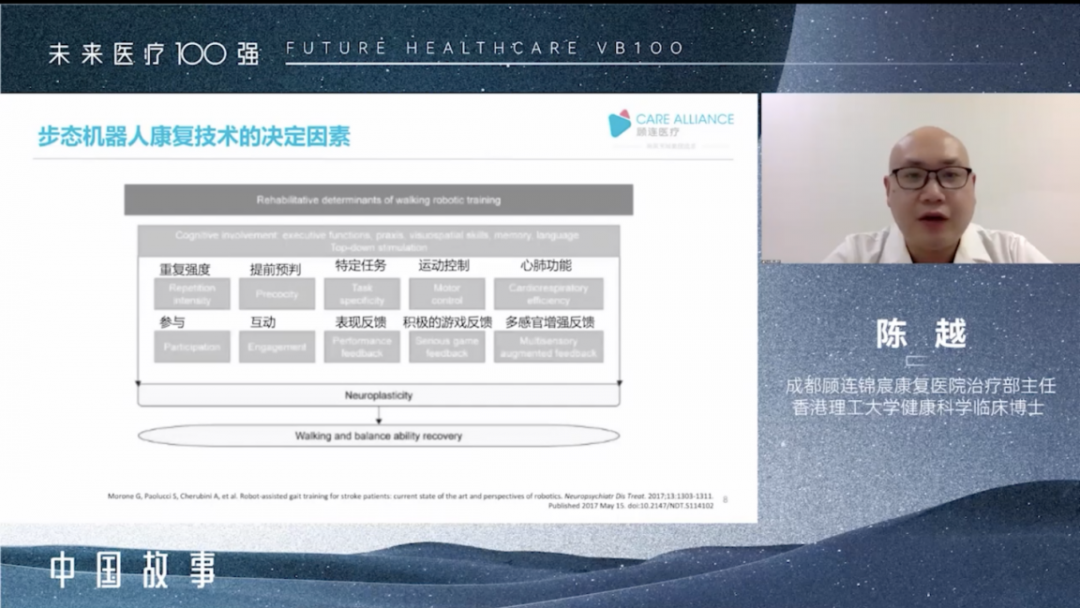
Chen Yue | Director of the Treatment Department, Chengdu GooChain Jinchen Rehabilitation Hospital; Clinical Doctor of Health Sciences, The Hong Kong Polytechnic University
How robots can be integrated into patient rehabilitation care is currently a major challenge facing clinical practice. Director Chen Yue pointed out that the topic of robot-assisted rehabilitation should be analyzed from the perspective of “4W+1H.”
First is “Who”: suitable candidates for robotic therapy include patients with multiple sclerosis, Parkinson’s disease, stroke, and other conditions. Next is “What”: what technologies do rehabilitation robots employ? The primary objectives supported by rehabilitation robotics include providing real-time movement feedback, assisting patients in initiating movements, increasing training intensity, and facilitating coordination training. Third is “When”: when does the use of rehabilitation robots yield optimal outcomes? Due to shortages of rehabilitation therapists and limited one-on-one coaching time per patient, rehabilitation robots can help intensify training and enhance therapeutic effects when patients require increased training volume for reinforcement. Furthermore, within training facilities, robots can simulate diverse “environments” to improve patients’ adaptability to different settings after rehabilitation. Fourth is “Why”: why choose gait-training robots over other technologies? Because current evidence supports their efficacy; although other technological approaches may achieve similar results, they are difficult to replicate consistently in clinical practice. Moreover, the movement feedback provided by robots enables better customization of training plans tailored to individual patients. Finally, “How”: how should they be used? Appropriate candidates must first be identified, followed by guiding patients through initial standing training. Optimal treatment plans should then be developed collaboratively by rehabilitation therapists and robotic systems, with gradual progression based on joint assessment.
“New Decade of Exoskeletons” Innovative Rehabilitation SolutionsCase
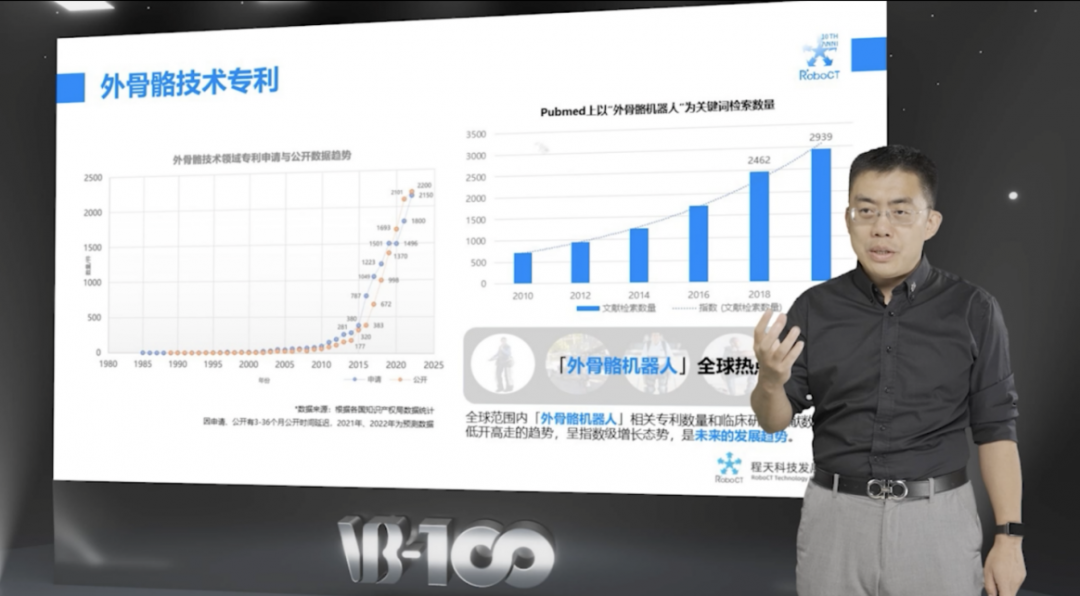
Wang Tian | Founder and CEO of Chengtian Technology
The number of search results for “exoskeleton robots” on PubMed continues to grow, while the number of patents and clinical publications related to exoskeleton robots worldwide is showing an exponential growth trend. In this regard, Dr. Wang Tian believes that, driven by portrayals in films and television series as well as coverage by news media, public awareness of exoskeleton robots is currently at a tipping point. In the future, exoskeleton robots will become a new “organ” for human–machine integration, following mobile phones, and will serve people’s lives across various aspects, including safety, industry, rehabilitation, and entertainment.
Dr. Wang Tian also pointed out that exoskeleton robots are like an iceberg; what the public sees are merely the various applications above the waterline. For enterprises, the submerged portion requires a deep industrial foundation, including core technologies, business models, and therapeutic systems. The founding team of Chengtian Technology initially gained experience in special-purpose robots, which helped them accumulate core technologies in mechanics, electronics, and materials, laying the groundwork for establishing their own factory and independently manufacturing exoskeleton robot products. The future development of exoskeleton robots will undoubtedly involve the integration of multiple disciplines and fields. As solutions continue to mature, steady growth is inevitable. Chengtian Technology looks forward to joining hands with everyone to witness the "New Decade of Exoskeletons"!
Key Technologies for AI-Powered Rehabilitation Robots and Cloud Service Platforms
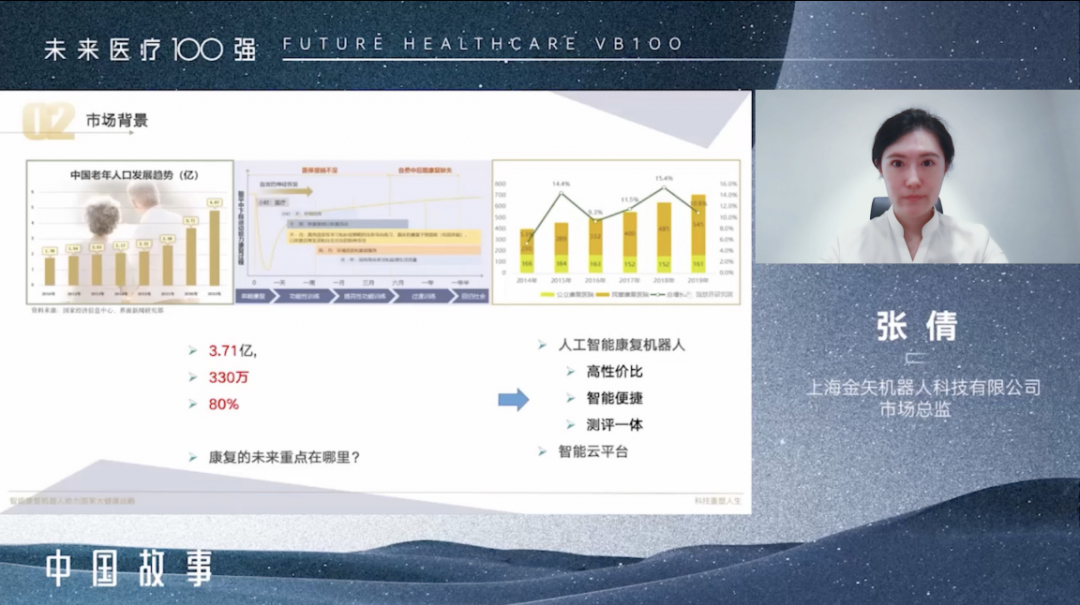
Zhang Qian | Marketing Director, Shanghai Jinshi Robot Technology Co., Ltd.
Currently, population aging is stimulating further expansion of the rehabilitation market. Meanwhile, China has the highest incidence and disability rates of stroke worldwide. However, China currently faces an insufficient total supply of rehabilitation resources, weak service capacity, and a severe shortage of nursing talent in the rehabilitation industry. The intelligent rehabilitation robotics sector in China is still in its growth phase, presenting enormous market demand and representing a trillion-yuan market opportunity.
Ms. Zhang Qian introduced that Shanghai Jinshi’s lower-limb rehabilitation robot features a proprietary full-degree-of-freedom pelvic support mechanism, which ensures natural gait movement during training, provides on-demand assistive force and body-weight support, and addresses the limitations in movement degrees of freedom associated with conventional training methods. Building on this foundation, Jinshi has independently developed and deployed an intelligent cloud platform for multi-source, multi-scale data fusion, enabling remote diagnosis and treatment as well as health data management based on patients’ historical movement data.
From Hospital to Home: How Digital Technology Empowers Rehabilitation?
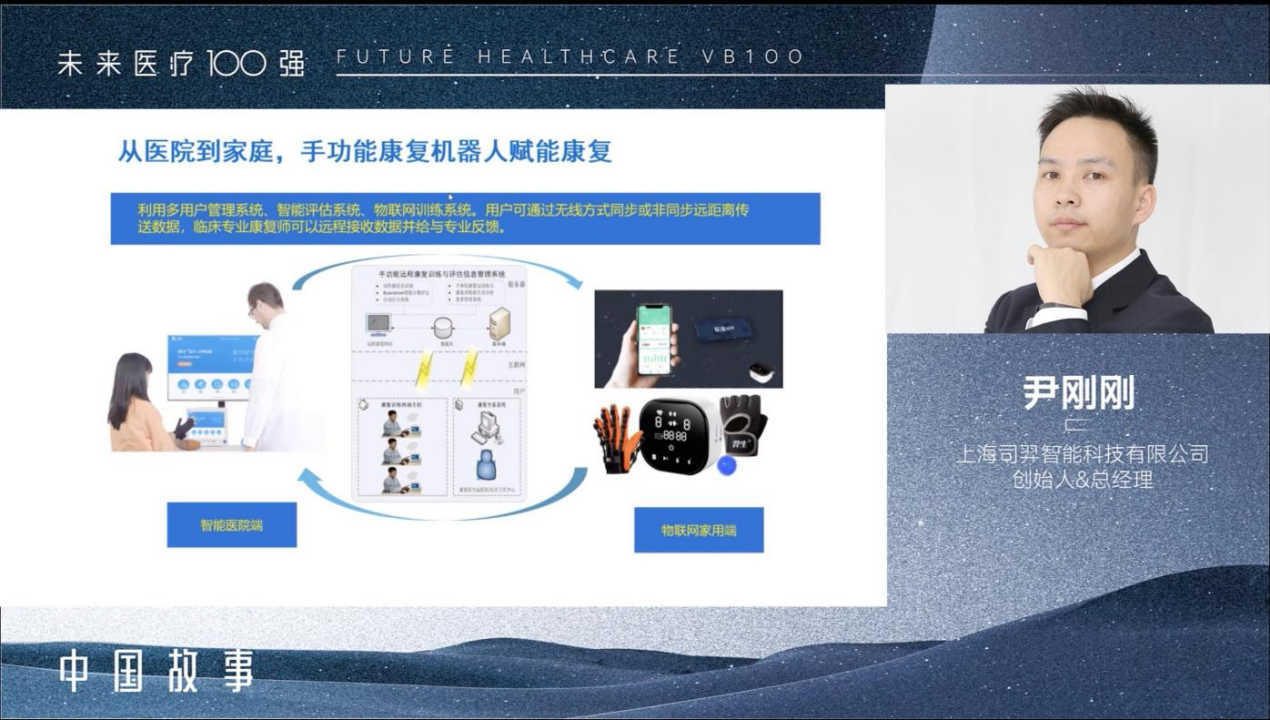
Yin Ganggang | Founder & General Manager, Shanghai Siyi Intelligent Technology Co., Ltd.
As the demand for rehabilitation therapy surges in China, an imbalance persists in its supply across hospitals, communities, and households.
Mr. Yin Ganggang pointed out that digital empowerment in rehabilitation is mainly reflected in three aspects: In terms of intelligence, intelligent rehabilitation training robots can liberate therapists from exhausting work, while engaging training methods encourage patients to participate more actively in their recovery; regarding precision, advanced sensors such as fiber optic sensors and optical positioning systems enable more precise rehabilitation training and assessment, allowing for the customization of personalized rehabilitation plans for patients; and in terms of big data and remote accessibility, internet healthcare, telemedicine, and cloud-based rehabilitation platforms make rehabilitation more convenient, enabling patients to receive professional rehabilitation services anytime and anywhere, transitioning seamlessly from hospital to home.
SiYi Intelligent’s Yisheng® Hand Function Rehabilitation Robot integrates soft robotics technology with neuroscience, offering a variety of training modes—including passive, assistive, resistive, bilateral mirror therapy, voice-controlled, and active gaming—to comprehensively meet needs ranging from the flaccid paralysis stage to the rehabilitation phase. Additionally, a home-use hand function rehabilitation robot utilizing the same technology enables patients to receive professional rehabilitation at home. SiYi Intelligent has established an intelligent rehabilitation platform that integrates “rehabilitation medical devices + services,” making innovative rehabilitation services accessible to all.
From Hospital to Home: How Digital Technology Empowers Rehabilitation?

Kang Liangjin |Senior Investment Director, Daoyuan Capital
Chen Yue | Director of the Treatment Department, Chengdu GooChain Jinchen Rehabilitation Hospital; Doctor of Clinical Health Sciences, The Hong Kong Polytechnic University
Zhang Jiyu |COO and Co-Founder of Chengtian Technology
Sun Xiaoyi |Founder of Shanghai Youfu Rehabilitation Medicine Outpatient Department
Traditional rehabilitation is confined to hospital-based, manual care models, which are costly and often unaffordable for ordinary patient families. This model suffers from low efficiency and difficulties in supervision, leading to various predicaments. The emergence of exoskeleton rehabilitation robots has disrupted the traditional rehabilitation paradigm, with the new “Rehabilitation as a Service” model gradually entering the market. What new scenarios, technologies, and trends will shape the future of rehabilitation medicine? At this forum, Kang Liangjin, Senior Investment Director at Daoyuan Capital; Chen Yue, Director of the Therapy Department at Chengdu Gulian Jinchen Rehabilitation Hospital and Clinical Doctor of Health Sciences from The Hong Kong Polytechnic University; Zhang Jiyu, COO and Co-founder of Chengtian Technology; and Sun Xiaoyi, Founder of Shanghai Youfu Rehabilitation Medicine Outpatient Clinic, participated in a roundtable discussion titled “New Scenarios, New Technologies, and New Trends in the Future of Rehabilitation Medicine,” offering insights from both clinical and industrial perspectives.
Chen Yue, Director of the Treatment Department at Chengdu Gulian Jinchen Rehabilitation Hospital, first analyzed the current challenges facing rehabilitation robots. First, there is a lack of users familiar with intelligent rehabilitation products, as the user base has yet to be cultivated. Second, upstream specialties such as orthopedics and neurology have insufficient understanding of rehabilitation robots, resulting in a lack of corresponding basic research support. Third, there is a shortage of rehabilitation professionals, making it difficult to achieve consistent rehabilitation outcomes across China. Fourth, medical insurance support for intelligent rehabilitation is inadequate, with many intelligent rehabilitation robots not yet covered by insurance schemes. He also pointed out that future intelligent rehabilitation should incorporate big data technology, enabling therapists to access training data from patients’ initial visits to tertiary hospitals, their stay at specialized rehabilitation hospitals, and subsequent outpatient rehabilitation sessions, thereby facilitating the development of more effective rehabilitation plans.
Sun Xiaoyi, founder of Shanghai Youfu Rehabilitation Medicine Outpatient Department, pointed out that effective rehabilitation is not achieved overnight. During the critical first 100 days, patients require rehabilitation therapy at least twice a week and daily rehabilitation exercises. Therefore, Youfu advocates for a tiered diagnosis and treatment model involving hospitals, outpatient clinics, and home care. Postoperative rehabilitation therapy and follow-up visits can be managed at rehabilitation outpatient clinics and centers near the patient’s home, while daily rehabilitation exercises can be conducted at home under online guidance. Although internet-based medical consultations cannot address all issues, the integration of online and offline services undoubtedly offers more benefits than drawbacks. Thus, a tiered diagnosis and treatment model combining online and offline approaches will become a new trend in the future.
Zhang Jiyu, COO and Co-founder of Chengtian Technology, stated that the majority of rehabilitation robots currently on the market primarily focus on delivering rehabilitation outputs, with few incorporating patient movement feedback mechanisms. He emphasized that every step taken by patients during the rehabilitation process requires careful monitoring. Zhang believes that future intelligent rehabilitation robots must implement a more robust digital strategy to enable comprehensive, full-cycle quantitative assessments. In terms of application scenarios, there is a need to develop lightweight, compact, single-joint home-based intelligent rehabilitation robots to serve a broader patient population. Furthermore, it is essential to integrate online and offline services, as well as bridge the rehabilitation needs between home and hospital settings.