

The Rise, Fall, and Resilience of Star Clinics: Transformation Amidst Challenges
In recent years, driven by clinic policy orientations and market demand, new types of clinics characterized by standardization and chain operations have emerged, gradually transforming the industry landscape previously marked by low diagnostic and treatment standards, outdated management, and even irregular practices in individual clinics.
Some new types of clinics are founded by doctors as entrepreneurs, among whom some doctors who have already accumulated a large number of fans on social media platforms also participate. From the perspectives of service philosophy, business model, and potential target audience, these new clinics have significant market space and naturally become favored targets for star investment institutions and major internet companies.
The rise of influencer doctors launching startups and celebrity-backed institutions investing has directly given birth to a wave of high-profile star clinics.
What is the current status of once-celebrated clinics? Are they still as vibrant and ambitious as they were in their heyday? VCBeat has conducted extensive inquiries and interviews to find out.
(Note: The clinics discussed in this article specifically refer to new types of general or specialized clinics that conduct business around disease diagnosis and treatment, excluding consumer-oriented clinics such as dental, ophthalmology, and medical aesthetics.)
VCBeat’s VBInsight collected data from over 200 clinics of various types in its “2018 Report on the Operation of New-Type Clinics.” Many of the surveyed clinics were high-profile, star clinics.
However, a review of the research list from several years ago reveals that four of the business entities have been deregistered, while others have undergone mergers and acquisitions or brand name changes.
In May 2022, a well-known pediatric clinic chain was acquired by a publicly listed company in the consumer sector. Following the acquisition, the clinic’s operations will complement and synergize with the listed company’s existing child healthcare services, potentially enabling direct upstream-downstream customer conversion. According to the company’s public announcement, after acquiring the pediatric clinics and injecting additional capital, it will hold a 68.19% equity stake in the clinics, while the founder’s shareholding will be correspondingly diluted. Meanwhile, the chairman of the clinic’s operating entity will be appointed by the listed company.
Exploring viable profit models is challenging, and the development path for new types of clinics will certainly not be smooth. Seeking mergers and acquisitions, introducing capital and resources, and divesting equity or even actual control can serve as a viable pathway for founders to sustain the operations they have diligently built.
“As far as I know, apart from those new clinics with prime locations, strong reputations, and superior technical expertise, not many are enjoying a comfortable existence,” summarized Wang Jun, founder of the Sichuan-based Physician Group.
Wang Jun’s clinic was no exception. The Sichuan-based Physician Group, established in 2016, opened a pain management facility in Chengdu; however, after several years of operation, it saw no significant growth.
“Losing money like a fool!” Although Wang Jun did not disclose the specific amount of losses, he made this self-deprecating remark. At that time, the business mainly faced two major problems: First, excessive reliance on personnel, with most costs paid to doctors and technicians; paying too little would lead to talent loss, while paying too much left insufficient profit margins for the clinic. Second, the industry had low entry barriers, with everyone from street vendors to wellness centers offering pain management services, resulting in severe customer fragmentation.
To cut losses in a timely manner, in 2021, Wang Jun restructured the pain management business under Wendo Doctor Group, retaining only a minority stake; subsequently, Wendo Doctor Group planned to upgrade and iterate the pain management business.
The vision for new-type clinics is promising, but it does not address certain practical issues.
The most critical real-world issue is, of course, the impact of the pandemic. During the outbreak, clinics were widely suspended; during periods of stability, they faced restrictions on treating febrile patients. These factors directly led to patient attrition and revenue losses.
Common conditions in internal medicine, pediatrics, and other specialties once accounted for a substantial share of clinic revenues. However, the pandemic has heightened public awareness of disease prevention and health, with protective measures such as mask-wearing and frequent handwashing becoming routine. As a result, the incidence of certain common diseases, particularly infectious diseases, has declined. For example, according to infectious disease data released by the Chinese Center for Disease Control and Prevention, the number of cases of common infectious diseases such as influenza, mumps, and hand-foot-and-mouth disease has decreased since the outbreak began in 2020, thereby undermining a key revenue driver for clinics.
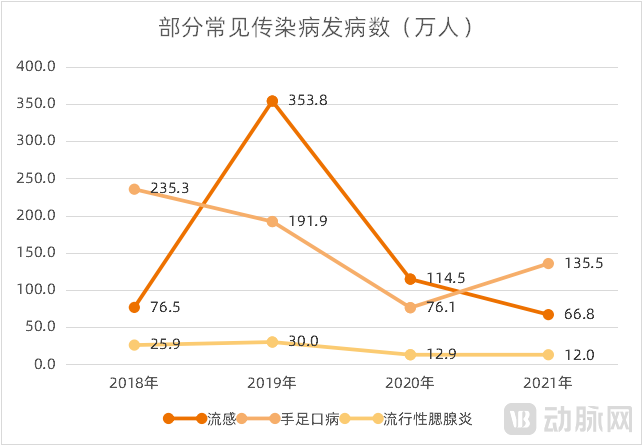
Incidence of Some Common Infectious Diseases, Data Source: Chinese Center for Disease Control and Prevention
Secondly, new-type clinics are still in the early stages of development, have not yet established a sustainable business model or acquired a sufficiently stable customer base, and thus exhibit low risk resilience.
Finally, some celebrity clinics are founded by physicians. While some doctors have amassed significant popularity on social media platforms, running a medical clinic and monetizing online traffic are two distinct endeavors. Moreover, not all physicians are adept at business management; within the public healthcare system, they need only focus on clinical practice and academic research, whereas transitioning into entrepreneurs and managers requires attention to a wide range of operational aspects. Alternatively, some physicians hold relatively “naive” or idealistic views.
“There was a prevailing belief that the value of physicians lay in mastering cutting-edge, high-precision medical technologies, and that physician entrepreneurs should adhere to the same principle,” Wang Jun candidly remarked. “After achieving some success in certain fields, I began to think highly of myself. In reality, it was simply because I had focused more intensively on those areas, not because I was superior to others. Moreover, even the most sophisticated techniques lose their significance if they garner acclaim but fail to achieve market adoption. Overall, physicians are prone to becoming immersed in self-satisfaction.”
Transformation is one of the exit strategies considered by clinics facing difficulties.
Wang Jun summarized the financial situation of his pain clinic as “a single revenue stream but numerous expense items.”
This reflects the common reality faced by clinics: expenditures on personnel, rent, utilities, pharmaceuticals, and consumables, as well as equipment leasing or depreciation. Meanwhile, revenue primarily derives from consultation fees, pharmaceutical sales, and routine laboratory and diagnostic tests. With patient volumes limited or even declining, it is naturally difficult to achieve breakthroughs in revenue. Furthermore, as chain clinics expand across regions, they face challenges not only in standardization but also in local adaptation.
Faced with a myriad of complexities, the Sichuan-based Physician Group opted for a comprehensive transformation.
During his discussions with Chongqing Yuboshi Pediatrics, Wang Jun identified growth and development services as a high-performing revenue stream for pediatric clinics and intends to pivot his business strategy in this direction.
However, the transition was not easy. Before making the final decision, Wang Jun spent several months conducting market research across China; in October 2021, he and the company’s management team held three days of strategic discussions. After deciding to pivot, another nationwide survey of clinics was conducted. The two rounds of research covered more than ten provinces and various types of cities.
Ultimately, Wang Jun pivoted his previous B2C pain management services to B2B height management services, helping medical institutions across various regions address challenges in their talent and product supply chains.
“At present, we have partnerships with more than 30 clinics in Guangxi, Jiangsu, Anhui, and other regions,” Wang Jun introduced. He projected that this year’s revenue would equal the total revenue of the past five years. “The company currently has 12 employees. Our revenue streams have become more diversified, while our expense items have become more streamlined—exactly the opposite of before.”
Of course, those who overturn their previous business models and start completely from scratch remain a minority, as this requires immense courage from both founders and investors. This is especially true for clinics with numerous shareholders and multiple locations, where a comprehensive transformation is nearly impossible. Therefore, most clinics are pursuing more proactive innovation and experimentation based on their existing operations.
How to Innovate and Experiment Amid Various Internal and External Constraints? Lessons from Some Clinics May Offer Guidance.
For example, shifting from passive patient reception to proactive intervention.
“The endless queues and the overwhelming number of patients we used to see have decreased significantly,” remarked Lv Fengping, founder of Dr. Lv Chain Clinics.
In response to the current situation, Dr. Lü’s Clinic has decided to implement refined management strategies, including the secondary “development” of historical data and extending care from intra-consultation treatment to pre-consultation prevention and post-consultation management. Currently, Dr. Lü operates a total of 31 clinics, serving approximately 200,000 patients annually.
Diagnosis, treatment, and management of chronic diseases are also among the common services offered by clinics. For many patients with chronic conditions, the saying “long-term illness makes a skilled physician” often fosters a sense of confidence, leading them to view follow-up visits merely as a means to obtain prescription refills. However, chronic disease does not imply a static condition; regular check-ups or monitoring to assess disease progression remain essential.
Dr. Lv’s Clinic provides targeted attention, telephone reminders, and management based on patients’ visit frequency, disease status, and key clinical indicators. Meanwhile, the clinic has established referral partnerships with Sichuan Provincial Fifth People’s Hospital, Chengdu First People’s Hospital, Jinxin Maternity and Child Health Care Hospital, Meinian Onehealth Healthcare, and KingMed Diagnostics, to meet patients’ needs for further specialized diagnosis, treatment, or laboratory testing.
“A patient with chronic gastritis caused by Helicobacter pylori infection showed suboptimal eradication results after a course of medication. We recommended that he undergo further gastrointestinal endoscopy, which revealed an early-stage tumor,” cited Lv Fengping as an example, emphasizing that timely and necessary examinations play a crucial role in early diagnosis and treatment.
This approach transforms patient consultations from a reactive model to one of proactive intervention, which not only helps address patients’ health and disease issues but also aids in unlocking customer value. In fact, within the tiered diagnosis and treatment system, primary care at the grassroots level is inherently the first line of defense in disease diagnosis and management.
“Despite a decline in patient volume at Dr. Lü’s clinic under a series of measures, medical staff have devoted more time and energy to individual patients, resulting in broader service offerings and improved patient adherence. ‘Overall, we are just barely able to sustain operations,’ said Lü Fengping.”
For another example, explore paid internet channels.
In 2020, the outbreak of the pandemic prompted many medical institutions to recognize the importance of online services. Consequently, they rapidly adopted tools such as online consultation platforms and WeChat groups. At that time, online consultations were primarily offered free of charge or at a low cost, with the main objective of maintaining patient engagement and minimizing patient attrition.
Subsequently, as online service processes became more streamlined and patients gradually developed usage habits, online services transitioned from being free to fee-based, or from nominal low fees to pricing that better reflects the value of physicians.
As early as during the 2020 pandemic, Dr. Zhang Qiang recognized the importance of breaking through isolation barriers and began establishing an online clinic. In February and August 2021, his Sijun Surgical Clinic launched online clinics for varicose veins and venous thrombosis, respectively.
Although the number of patients with venous diseases has not declined as it has in fields such as internal medicine and pediatrics, and Dr. Zhang Qiang’s prominence in the field of venous diseases has maintained his appeal to patients, pandemic-related barriers have indeed posed challenges for patients seeking medical care, naturally affecting income. Telemedicine consultations have emerged as one solution to this problem.
Unlike internet-based medical consultations that primarily focus on follow-up visits and prescription renewals, Dr. Zhang Qiang’s virtual clinic mainly provides video consultations to assess and observe patients’ conditions, offer corresponding recommendations, and address preoperative communication and postoperative rehabilitation management issues.
“Prior to the outbreak in Shanghai this year, virtual consultations accounted for 20% of our total outpatient volume,” Zhang Qiang stated. During the pandemic, as outpatient services in Shanghai were suspended and local physicians were unable to travel to other cities for patient consultations and surgeries, virtual consultations played a pivotal role.
The consultation fee for the virtual clinic is RMB 288 per session, which includes a 30-minute video consultation. This approach not only enhances convenience for patients but also helps offset revenue losses, while scheduling post-pandemic surgeries based on the severity of patients’ conditions as much as possible.
Based on the current online service pricing across various types of clinics, fees for general practice online consultations or follow-up visits are relatively low, while specialist consultation fees generally range from tens to hundreds of yuan. Meanwhile, “Internet+” service offerings have become more diverse. Some chain healthcare institutions with ample medical and nursing resources also provide a variety of “Internet+” nursing services, including injections, blood sampling, PICC line care, nebulization, and wound dressing changes. These services typically cost between several hundred and over one thousand yuan per session, representing innovative service models that help increase revenue streams.
Furthermore, clinic site selection can be optimized.
In 2021, Dr. Lü’s Clinic closed several outlets registered around 2018, which were primarily located in new residential areas and industrial parks where resident occupancy or corporate tenancy rates fell short of expectations. While closing these underperforming locations, the clinic also opened new ones to optimize its site selection strategy. Between 2020 and 2021, Dr. Lü’s Clinic launched two new clinics in Chengdu High-Tech Zone and Tianfu New Area, with several others still under preparation. The business expansion plan remains unchanged, albeit at a slower pace.
In recent years, Lü Fengping has developed new insights into clinic site selection: not all residential areas are suitable for opening clinics, nor are clinics exclusively located in residential neighborhoods. Currently, most of Dr. Lü’s clinics are situated in IT innovation parks and areas with a high concentration of office buildings. “These areas are predominantly populated by white-collar workers, who are quicker to embrace new developments and have a stronger willingness to pay for services.”
Accordingly, Dr. Lü’s Clinic has tailored its services to meet the needs of these groups who are more open to new approaches. Given that young people face high stress levels and are prone to sleep and emotional issues, Dr. Lü’s Clinic has ventured into offering emotional counseling and sleep management services.
Foot traffic is the primary factor to consider when selecting a clinic location, while demographic characteristics serve as key reference indicators; the suitability of a site must be evaluated in alignment with the clinic’s positioning.
Does the disappearance, transformation, and struggles of clinics mean that the industry is “no longer attractive”? Not necessarily.
According to data from Qichacha, thousands to tens of thousands of clinics are deregistered annually across China. From 2018 to 2021, the number of clinics deregistered each year even gradually decreased, dropping from 10,194 to 6,505.
Data from the Chinese Health and Health Statistics Yearbook over the years shows that the number of non-public clinics has been on an overall upward trend, with the count in 2020 remaining higher than in previous years despite the impact of the pandemic.
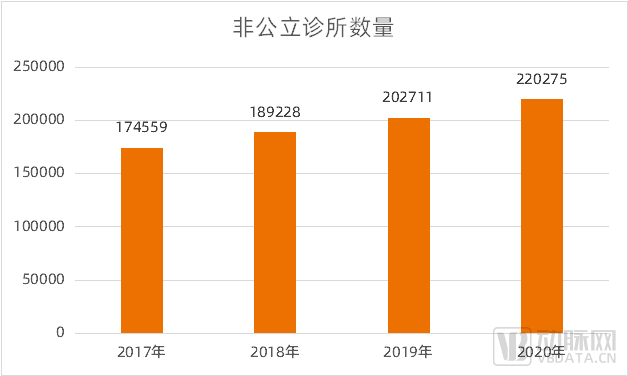
Number of Non-Public Clinics; Data Source: China Health and Health Statistical Yearbook (Previous Years)
The growth trend has remained unchanged; the industry has simply been advancing through twists and turns.
“General practice clinics serve as the gateway to community patient flow.” Lü Fengping stated that although entrepreneurship has not been smooth sailing, she still believes in the vast market potential at the primary care level, as residents’ demand for basic medical services and health management will always exist. “The key lies in effectively addressing patients’ problems, earning their trust, and providing them with a sense of security.”
The “Outline of the ‘Healthy China 2030’ Plan” states that the total scale of the health service industry will grow from RMB 8 trillion in 2020 to RMB 16 trillion in 2030. In Wang Jun’s view, whether for clinics or private hospitals, the future will undoubtedly be driven by health-oriented demand. “Judging from the service and payment models of conventional medical care, the existing RMB 8 trillion market has limited growth potential. Where will the additional RMB 8 trillion come from? From a macro perspective, it will stem from health-oriented demand primarily paid out-of-pocket. Physicians’ value can also lie in meeting the public’s needs for health and a better quality of life.”
In fact, it has become an industry consensus that clinics should not be limited to disease diagnosis and treatment alone, but should instead expand their service boundaries by focusing on family health, the health of specific populations, occupational health, and more. In the future, the types of services offered by clinics and their revenue sources will become increasingly diversified.
Of course, despite the industry’s twists and turns, Gushengtang has emerged as a listed “representative.” Who will be the next to follow? After this long journey, the answer will reveal itself in due time.