

Embracing the Future: How Prescription Drug Retail Can Achieve a Leap Forward
June 21, 2022—Following the 2020 White Paper on the Development of Prescription Drug Retailing: Rising Momentum Beyond Boundaries, Boston Consulting Group (BCG) today released the 2021 Annual Insights Report on Trends in the Prescription Drug Retail Industry. The report focuses on the current state of the prescription drug retail sector in recent years, provides insights into future industry trends, analyzes corporate development models and capability building, and systematically establishes a “Prescription Drug Retail Development Index” to offer effective recommendations and guidance for industry development.
Chen Baiping, Managing Director and Global Partner at BCG, as well as Head of the Healthcare Practice in China, pointed out that retail pharmacies, serving as another entry point to primary care, have gradually transformed their operational models toward full-chain services over the past two years. In the future, they will further strengthen capabilities in managing the entire user journey and enhancing online operations to maximize full-chain value. However, prescription drug retail still faces capability gaps in consumer stickiness, chronic disease management, pharmacist competency development, and patient acquisition. By promoting ecosystem collaboration and leveraging digital empowerment, these core pain points in prescription drug retail can be effectively addressed, thereby supporting the robust and healthy development of the industry.
The New Healthcare Reform is a critical cornerstone for achieving the Healthy China Strategy, aiming to rebalance low cost, high accessibility, and high quality. As the reform deepens, three major policy pillars have emerged: separation of prescribing from dispensing, tiered diagnosis and treatment, and smart healthcare. These developments impose new requirements on future prescription drug retail in terms of efficient coverage, disease management, and digital services.
China’s prescription drug retail market has experienced a period of rapid growth over the past three years, yet the overall market structure has not undergone any qualitative change. According to the Prescription Drug Retail Market Development Index proposed by BCG, China currently still exhibits a “two highs, two lows” pattern (see figure below): specifically, there remains considerable room for improvement in the share and scale effects of prescription drug retail in China, which still lag behind those of developed countries. However, the number of retail pharmacies per capita is gradually approaching the levels seen in developed nations, and the growth rate of the drug retail market size is expected to remain high, indicating promising future development momentum.
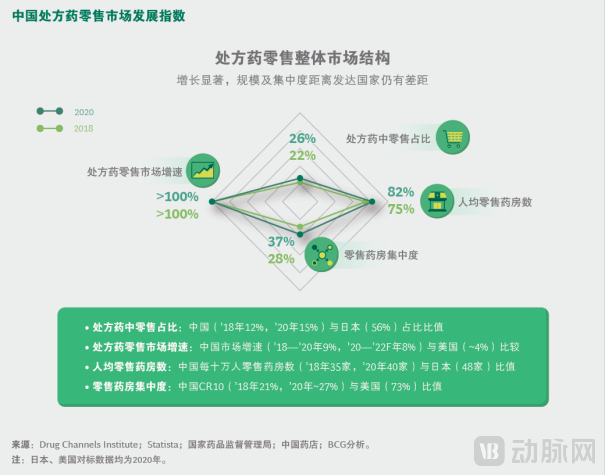
Currently, with the introduction of policies concerning “Internet +” medical insurance services, long-term prescription management, and the standardization of licensed pharmacists, the policy framework for China’s retail prescription drug industry has taken initial shape and has improved significantly over the past two years. However, more refined industry support in areas such as practitioner incentives, pharmacist standardization, and the establishment of data compliance systems still requires further improvement, and the implementation of these measures needs to be advanced.
From an industry development perspective, survey results from BCG targeting mid-to-senior-level professionals in the retail sector indicate that while the sales proportion of general medicines in retail pharmacies is already high, the share of specialty drugs remains generally low. In the future, as the trend toward professionalization in retail pharmacies continues, the proportions of both general and specialty drugs are expected to keep rising. Furthermore, as a key channel for the separation of prescribing and dispensing for prescription drugs, Direct-to-Patient (DTP) pharmacies are experiencing rapid growth, with significant increases in both the number of pharmacies and the variety of new and specialty drugs offered.
Catalyzed by the COVID-19 pandemic, online pharmaceutical sales have experienced rapid growth in recent years. As regulations governing the online sale of prescription drugs and reimbursement through basic medical insurance continue to loosen, the number of patients opting to purchase prescription medications online is expected to rise steadily. According to BCG research, from 2015 to 2020, China’s online retail sales of prescription drugs achieved a high compound annual growth rate (CAGR) of 53%. Notably, the growth rate between 2019 and 2020 was particularly remarkable, reaching 79%, with the market size attaining RMB 25 billion in 2020. Looking ahead, as the volume of online consultations continues to climb, online sales of prescription drugs are projected to maintain robust growth.
Driven by the continuous improvement of overall policies and external industry forces, retail pharmacies in China have achieved considerable development. BCG has developed the China Retail Pharmacy Model and Capability Development Index, evaluating performance across five key dimensions: end-to-end service capability, online sales share, member sales share, member repurchase rate, and licensed pharmacist staffing (see figure below). The survey reveals that while the retail prescription drug sector in China still needs further advancement in terms of retail models, the gap in retail capabilities is relatively small.
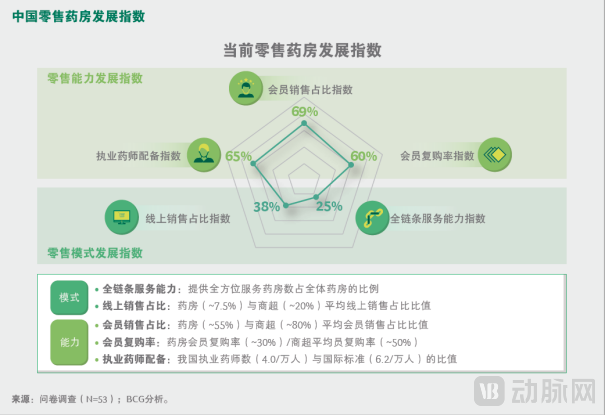
From the perspective of the prescription drug retail model, China’s retail pharmacies will gradually enter the era of Retail Pharmacy 3.0, characterized by omni-channel integration. Against this backdrop, retail pharmacies should build upon professional pharmaceutical care services to further provide patients with diversified, intelligent, and personalized services, thereby expanding the breadth and depth of consumer services. In light of this trend, we believe that the following three pathways are essential for retail pharmacies to advance into the 3.0 era:
First, by integrating diagnosis, treatment, medication delivery, and disease management, a full-chain service capability has been established. Research indicates that approximately 25% of pharmacies have already deployed new service models across the entire patient journey, forming comprehensive service frameworks. However, retail pharmacies as a whole still need to strengthen their capabilities in patient education coverage, specialized pharmaceutical consultation, and the awareness and professionalism of disease management services.
Second, integrate and consolidate online and offline new retail business platforms. Surveys indicate that approximately 90% of retail enterprises have established online sales services, yet only about 40% derive more than 10% of their sales from online channels. Looking ahead, around 70% of retail enterprises anticipate that online sales of prescription drugs will account for over 10% of their total, with approximately 40% expecting this figure to exceed 20%. Retail pharmaceutical companies generally believe that online platforms, bolstered by high traffic volumes, offer significant advantages in terms of convenience, pricing, and product variety. However, they still fall short in precisely meeting customer needs, providing pharmacist services, and managing chronic diseases over the long term.
Third, by enhancing end-to-end service capabilities and integrating online and offline channels, we can deliver intelligent, personalized disease and health management services to consumers, significantly increasing the proportion of members and repeat purchase rates, thereby improving profitability.
Model Innovation Brings New Requirements for Capabilities. According to BCG survey data, the current pain points in capability development for retail pharmacies are mainly concentrated in three areas: low repeat purchase rates, insufficient pharmacist capabilities, and difficulties in patient acquisition (see figure below).
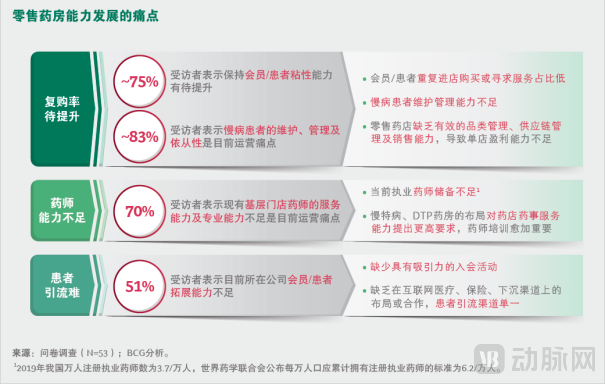
The adoption of digital solutions and tools is a critical means of effectively addressing the pain points in prescription drug retail management. Retail pharmacies should actively promote the synchronized optimization of digital tools and digital operations to achieve comprehensive empowerment. Driven by senior management, enterprises can start with data governance and analytics, collaborate with manufacturers and external think tanks, and develop digital tools and organizational capabilities to realize digital transformation across dimensions such as patient management and category management.
Furthermore, fostering comprehensive ecosystem collaboration is a critical cornerstone for building the all-around capabilities of retail pharmacies. It is understood that companies are currently actively exploring external cooperation opportunities in chronic disease management, member retention and expansion, and pharmacist training. However, prescription drug retailers still exhibit insufficient collaboration in areas such as integrating internet healthcare with retail operations, expanding insurance partnerships, penetrating lower-tier markets, and driving digital transformation. Retail enterprises can achieve healthy development of overall ecosystem collaboration by engaging in multi-dimensional partnerships with pharmaceutical manufacturers, associations/think tanks, online platforms, payers, and healthcare providers. Such collaborations will holistically empower pharmacists to deliver end-to-end services, enhance business operational capabilities, and strengthen overall integration with medical insurance systems and healthcare institutions.
As healthcare reform deepens, the pharmaceutical retail sector, a vital component of the national healthcare system, is poised to enter a new phase of rapid growth. However, amidst this transformation and innovation, the retail of prescription drugs faces multifaceted challenges, including end-to-end service capabilities, pharmacy services, and operational efficiency. Stakeholders across the industry must actively promote the development of the overall ecosystem, strengthen external collaborations, and leverage digital empowerment to help the prescription drug retail sector seize opportunities under the new healthcare reform and achieve substantial growth.
This report took over four months to research and write, involving extensive fieldwork, interviews, and analysis. BCG sincerely thanks Organon China for sharing its insights on industry trends and for its assistance during the field research, as well as the China Pharmaceutical Commercial Association for its corrections and suggestions during the writing and finalization of this report.
Boston Consulting Group (BCG) partners with business and social leaders to help them tackle their most pressing challenges while seizing exceptional opportunities. Since its founding in 1963, BCG has been a pioneer and leader in business strategy. Today, BCG is dedicated to helping clients initiate and implement holistic transformations that benefit all stakeholders—driving organizational growth, building sustainable competitive advantages, and generating positive social impact.
BCG’s diverse, international team delivers deep industry knowledge, functional expertise, and profound insights to drive organizational transformation. Leveraging cutting-edge technologies and ideas, and integrating corporate digital innovation practices, BCG tailors solutions that align with clients’ business objectives. Its distinctive collaborative model engages closely with stakeholders at all levels of client organizations, helping them achieve exceptional growth and build a better tomorrow.