

Vivasure Medical Advances Vascular Closure Innovation with One Approved Device, Two in Development, and Potential $54M Series D Financing

Vivasure Medical
Vascular Closure Device Developer
Cardiovascular intervention has emerged as a hot sector in the 21st century, and the field of vascular closure, which serves as the critical final step in cardiovascular interventional procedures, has naturally risen in prominence.
With the advancement of cardiovascular interventional technology, treatment approaches for certain diseases have expanded from the surgical domain to the medical domain, such as heart valve repair or replacement.
Valve repair or replacement is an effective treatment for severe valvular heart disease. Due to anatomical characteristics, this condition cannot be cured with medication; prior to the advent of interventional therapies, surgical open-heart procedures were the only option for valve repair or replacement. In 2002, French physician Alain Cribier performed the first transcatheter aortic valve implantation (TAVR), ushering in the era of endovascular aortic interventions.
Today, TAVR has grown from a nascent innovation into a widespread clinical practice. In 2019, the number of TAVR procedures in the United States surpassed that of surgical aortic valve replacement (SAVR) for the first time, with approximately 66,800 TAVR procedures performed throughout the year. Beyond aortic valve interventions, transcatheter treatments for the mitral and tricuspid valves are also gaining momentum.
In this hotly contested sector, most of the star companies are focused on artificial heart valves.
Vivasure Develops Sutureless, Bioresorbable Large-Bore Vascular Closure Device
On the other side of the track, Irish company Vivasure Medical (hereinafter referred to as “Vivasure”) focuses on the research and development of vascular closure devices for interventional procedures. It has one product, PerQseal, already on the market, and two products, PerQseal+ and PerQseal Blue, under development.
This device is primarily used for cardiovascular interventional therapy.
Transvascular access is the common approach for TAVR, with 95% of TAVR patients undergoing the procedure via vascular access, predominantly through the transfemoral artery route. Performing a flawless TAVR is no simpler than carrying out a traditional open-chest surgery; hemostasis at the puncture site and prevention of perioperative complications related to the puncture site are critical final steps in an interventional procedure.
Manual compression hemostasis is the most traditional method for achieving hemostasis of the femoral artery and remains commonly used to this day. However, this approach has its limitations. Due to intraoperative anticoagulation, sheath removal can only be performed several hours after surgery. Following sheath removal, physicians must manually compress the puncture site for 15–20 minutes, followed by sandbag compression for 6 hours and bed rest in a supine position for 24 hours. This process is not only time-consuming but also associated with low patient comfort. Consequently, following manual compression, auxiliary closure devices, surgical suturing, and vascular closure devices have gradually emerged as alternative methods.
Vivasure was founded in 2009 and is headquartered in Galway, Ireland, a prominent hub for medical device development. Prior to establishing Vivasure, founders Gerard Brett and Chris Martin each accumulated over two decades of experience working in medical device companies. Notably, Chris Martin devoted 20 years to the research and development of vascular closure devices. Given that vascular closure devices and various mechanical compression systems only came into widespread use in the mid-1990s, Gerard Brett and Chris Martin can be regarded as among the first generation of global experts specializing in vascular closure technologies.
Leveraging their years of R&D experience in medical device companies, the two founders have an accurate understanding of the clinical limitations of vascular closure devices.
First, vascular closure devices are mainly divided into several types: suture-based, collagen-based, and clip/staple-based.
They first ruled out suturing. Gerard Brett believes that the number of elderly patients undergoing cardiovascular surgery will continue to rise in the future. Due to arterial calcification and reduced elasticity, elderly patients are more prone to complications. Secondly, whether using metal clips or occluders made of collagen sponge, these devices leave foreign bodies in place after the procedure, which may lead to scarring or even vascular obstruction. Between 5% and 15% of vascular complications are caused by sutures and implants.
Therefore, Vivasure decided from the outset to develop a fully bioresorbable vascular closure device.
The implant is fully absorbed within 180 days, with no late major complications.
In January 2016, Vivasure’s first product, PerQseal, received CE certification. That September, Vivasure secured $18 million in Series C financing. With this funding, the company established an integrated R&D and ISO 13485-certified manufacturing facility.
In 2018, PerQseal was officially launched in Europe.
PerQseal consists of two components: a delivery system and a single-use patch device. The design of the single-use patch device is based on Vivasure’s patented PerQseal technology, which achieves internal vascular closure. According to Andrew Glass, CEO of Vivasure, the internal closure design stems from their collaboration with an international clinical team, whose pressurized modeling studies demonstrated that internal closure is superior to external closure.
When closing the blood vessel, the stent and the patch at its tip pass through the arterial incision; the soft patch conforms to the vessel wall, and the stent is released once the physician confirms hemostasis.
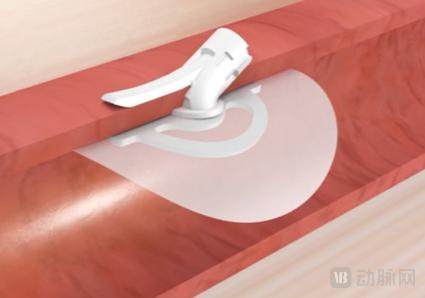
Patch Section
According to the official Vivasure website, the surface components of the patch facilitate vascular closure, and the bioabsorbable patch is fully absorbed by the vessel within 180 days. In clinical trials, the device achieved a technical success rate of 97%, with no late major complications reported.
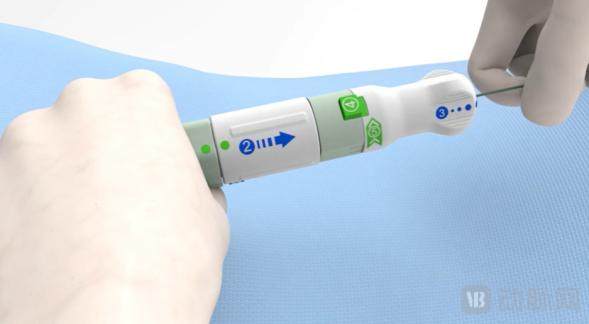
Schematic Diagram of Direction Indicators and Alignment Points
To reduce the learning curve, PerQseal features directional cues and alignment markers at every joint requiring rotation. According to CEO Andrew Glass, vascular closure with this device can be completed in just ten steps.
Vascular closure devices are categorized based on their ability to close vascular access sites with a diameter of 8 French (1F = 1/3 mm); those capable of closing diameters greater than 8F are referred to as large-bore vascular closure devices. The PerQseal device can achieve closure for diameters up to 24F.
PerQseal is indicated for interventional cardiovascular procedures requiring large-bore arterial access, primarily transcatheter aortic valve replacement (TAVR), and secondarily thoracic endovascular aortic repair (TEVAR) and endovascular abdominal aortic aneurysm repair (EVAR). The most commonly used devices for TAVR range in size from 10 to 25 French.
Two products with larger closure diameters are under development: PerQseal+ and PerQseal Blue
However, the diameter of instruments required for interventional procedures is increasing. If the vascular sheath is larger than the closed diameter of the device, the common solution is to use two patches in combination, which, however, increases the risk of procedural failure.
Vivasure is set to launch PerQseal+, the second-generation PerQseal device featuring a larger closure diameter and enhanced haptic feedback. The specific applicable diameters have not been disclosed on Vivasure’s official website. Currently, Vivasure is conducting a European multicenter study of PerQseal+ in preparation for FDA approval. Patient enrollment for this trial was completed at the end of last year.
In addition to PerQseal+, Vivasure is developing PerQseal Blue, which is specifically designed for large-bore venous vascular closure after percutaneous cardiovascular procedures, such as transcatheter mitral valve repair or replacement (TMVR) and transcatheter tricuspid valve repair or replacement (TTVR).
Following transcatheter aortic valve replacement (TAVR), transcatheter mitral valve replacement (TMVR) and transcatheter tricuspid valve replacement (TTVR) have emerged as new focal points. The procedural complexity of these three interventions has been described as follows: TAVR is akin to driving on a straight, unobstructed eight-lane highway; TMVR resembles navigating a four-way intersection; and TTVR is comparable to maneuvering on a complex interchange. The high level of difficulty associated with mitral and tricuspid valve repair and replacement necessitates larger puncture diameters, which increases the risk of vascular complications and poses significant challenges in the development of vascular closure devices.
According to its official website, there are currently no sutureless absorbable vascular closure devices for TMVR or TTVR.
The PerQseal Blue project was launched in 2020, with Vivasure aiming to make PerQseal Blue the world’s first suture-free, absorbable device for large-bore venous closure.
Like PerQseal, PerQseal Blue is also designed to seal blood vessels from the inside. According to CEO Andrew Glass, the project has made early progress.
In May this year, Vivasure announced the completion of the first tranche of its Series D financing, raising $23 million. The total amount for this round could reach $54 million, approximately RMB 360 million. If true, this would become the largest financing round in the history of vascular closure devices. Participants in this round include Fountain Healthcare Partners, LSP Health Economics Fund, and Evonik Venture Capital, among others.
Domestic Vascular Closure Devices Largely Depend on Imports
According to the “In-depth Market Research and Investment Prospect Forecast Analysis Report on the Large-Bore Vascular Closure Device Industry (2021–2026)” by New Thinking Jie, China’s demand for large-bore vascular closure devices reached 47,100 units in 2020, with a market size of RMB 428 million.
According to Frost & Sullivan data, the number of vascular closure procedures in China increased from 107,500 in 2015 to 274,300 in 2019, and is projected to further rise to 3.7821 million by 2030.
Vascular closure devices are classified as high-value medical consumables. Currently, the domestic market for vascular closure devices in China relies heavily on imports, with several foreign-branded vascular closure systems having obtained regulatory approval; Abbott holds a significant share of the Chinese market. Among domestic manufacturers, TransMedics (Guichuang Tongqiao) and HeartCare Medical (Xinwei Medical) are emerging leaders in the field of vascular closure devices.
In 2019, the number of patients in China with tricuspid regurgitation, mitral regurgitation, aortic regurgitation, and aortic stenosis was 9.1 million, 10.3 million, 3.8 million, and 4.3 million, respectively. Among these, the market for aortic valve intervention technologies is the most mature. Mitral regurgitation affects the largest patient population, and with technological advancements, the interventional markets for mitral and tricuspid valves are expected to expand gradually.
As the market expands, demand for large-bore vascular closure devices will also increase. In interventional procedures, the use of transradial catheterization is gradually rising alongside the traditional transfemoral approach, and the radial artery is easier to close than the femoral artery.
Developing radial artery vascular closure devices is also a key focus.