

WeDoctor Showcases Tianjin Digital Health Community at World Intelligence Congress, Paving the Way for Nationwide Expansion
On June 24, the Digital Health Summit of the 6th World Intelligence Congress was held online. Themed “Digital New Health, Creating a New Future,” the forum focused on topics such as “Internet Hospitals,” “Digital Pandemic Response,” “Health and Medical Big Data,” “Smart Hospitals,” and “Intelligent Medicine,” and unveiled a series of new achievements, research findings, and models in the digital health industry.
Among these, the practical achievements and mature model of Tianjin’s Primary Care Digital Health Consortium have become one of the most focal topics at this forum. At the Digital Health Summit of the 6th World Intelligence Congress, Liao Jieyuan, Founder, Chairman, and CEO of WeDoctor, delivered a keynote address titled “The ‘Tianjin Practice’ in the Digital Upgrade of Healthcare Systems.” He shared WeDoctor’s practical experience in deeply assisting Tianjin in establishing the “Primary Care Digital Health Consortium” and implementing the digital upgrade of the healthcare system through the “Three-Medical Linkage” mechanism.
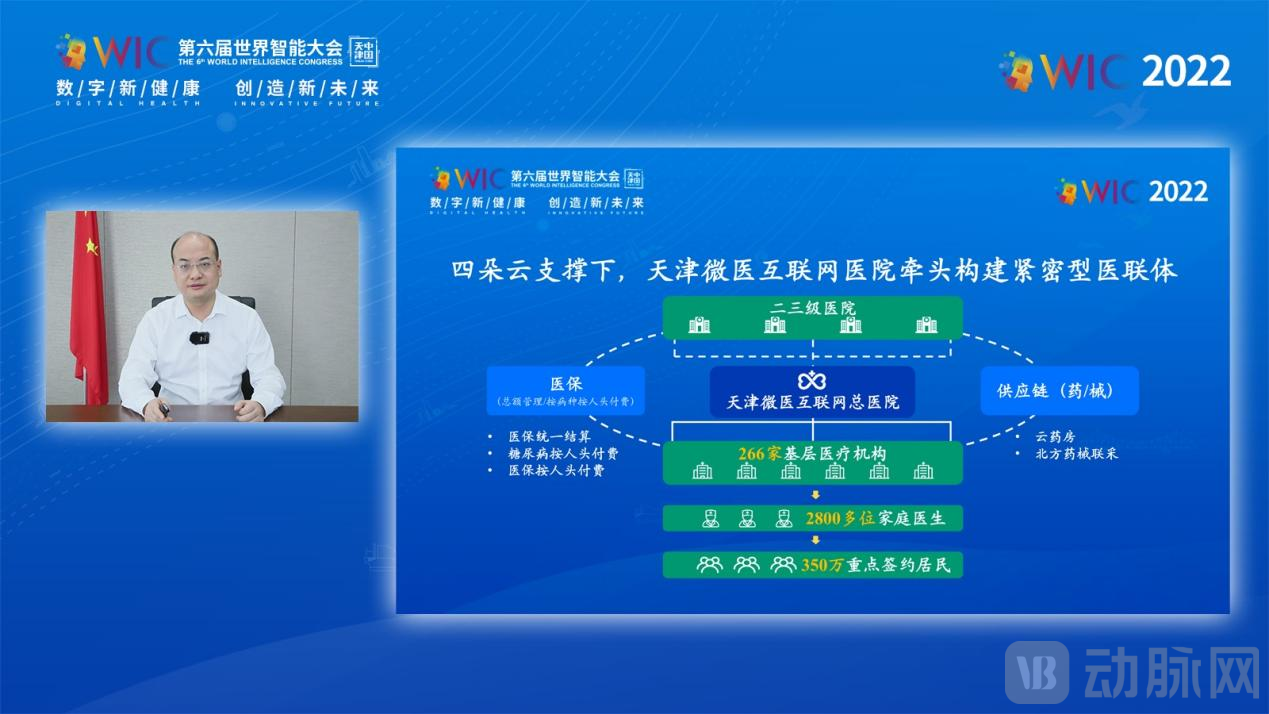 Keynote Speech by Liao Jieyuan, Chairman and CEO of WeDoctor
With five central ministries and commissions, including the Cyberspace Administration of China, the Ministry of Agriculture and Rural Affairs, and the National Development and Reform Commission, recently explicitly proposing to “guide localities in exploring the development of grassroots digital health communities,” the “Tianjin Practice”—representing the digital upgrade of regional healthcare systems exemplified by Tianjin’s Grassroots Digital Health Community—is poised to accelerate its nationwide rollout across China.
“The Tianjin Practice can be simply summarized as ‘4321’: four clouds, three medical alliances, two platforms, and one goal.”
Liao Jieyuan introduced that, with the overarching goal of shifting from a disease-centered to a health-centered approach, WeDoctor, under the guidance of the Tianjin Municipal Health Commission, has leveraged digital tools to enhance the operational efficiency and effectiveness of the “three-medical linkage” (integration of medical care, health insurance, and pharmaceuticals). This has been achieved through the “Digital Health Community Platform” serving patients and physicians, and the “Northern Pharmaceutical and Medical Device Joint Procurement Platform” serving pharmaceutical companies, hospitals, and medical insurance services. In doing so, WeDoctor has established a health management organization and system that covers residents’ entire life cycle and full spectrum of health needs.
During this process, the Tianjin Grassroots Digital Health Consortium—a tightly integrated internet-based medical consortium led by Tianjin Weiyi Internet Hospital and comprising 16 districts and 266 primary healthcare institutions in Tianjin—officially commenced its comprehensive construction in April 2020. By implementing unified “Four Clouds” platforms (cloud management, cloud services, cloud pharmacy, and cloud diagnostics) at primary healthcare institutions, along with standardized offline chronic disease management centers, the Digital Health Consortium provides community residents with integrated online-offline medical and health services encompassing prevention, diagnosis, treatment, management, and wellness.
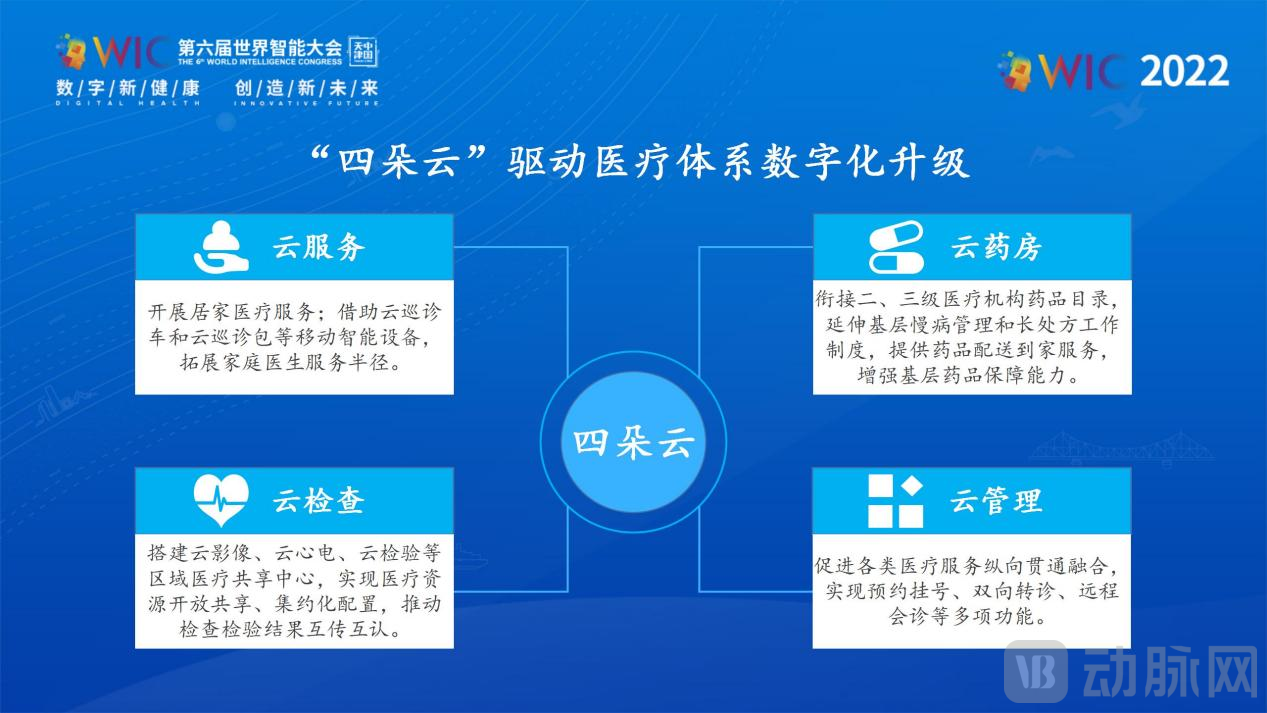 “Four Clouds” Drive the Digital Upgrade of the Healthcare System
“Under the guidance of the Tianjin Municipal Health Commission, WeDoctor has leveraged its ‘Four Clouds’ to drive the digital transformation of the healthcare system, establishing the Tianjin Primary Care Digital Health Consortium. Building on a network of 266 primary care institutions and over 2,000 family doctors, it connects upward with secondary and tertiary hospitals while serving nearly 4 million residents enrolled in family doctor contracts. This integrated approach enables standardized diagnosis and treatment, facilitates collaboration between physicians at different levels of care, provides clinical decision support system (CDSS) assistance throughout the diagnostic and therapeutic process, and ensures comprehensive disease management and health vital sign monitoring for patients.”
Meanwhile, Liao Jieyuan introduced that, in the course of implementing Tianjin’s grassroots digital health consortium, payment methods such as “global bundled payments” and “disease-based and capitation bundled payments” under medical insurance have been adopted. Under a global budget management framework, an incentive and constraint mechanism based on the principle of “retaining surpluses and providing no additional funding for deficits,” along with a health accountability system, has been implemented in accordance with performance evaluations of healthcare and health management quality. This effort is gradually establishing a new-era health stewardship system centered on health.
“This has truly driven the transition of our healthcare system from ‘fee-for-service’ to ‘value-based payment,’ achieving practical outcomes such as enhanced capabilities of primary care institutions, reduced procurement costs for pharmaceuticals and medical consumables, and improved efficiency in the use of health insurance funds,” said Liao Jieyuan. The successful practice of Tianjin’s Primary Care Digital Health Community demonstrates that a Chinese-style health stewardship organization and system—structured around medical consortia and built upon a cloud services platform—has taken shape and holds significant promise for future development.
“Tianjin’s practices have achieved significant results on three fronts: enhancing the capabilities of primary-level hospitals, alleviating the burden on large hospitals, and improving the efficiency of medical insurance.”
Liao Jieyuan introduced that, taking the management of diabetic patients as an example, Tianjin’s Grassroots Digital Health Consortium, in collaboration with 266 primary healthcare institutions and with the support of large hospitals, has been progressively providing comprehensive digital management services to over 400,000 diabetic patients in Tianjin. Among the patients under management, the blood glucose compliance rate increased by 21.58%, and the medical insurance surplus rate at primary healthcare institutions reached 16%–28%.
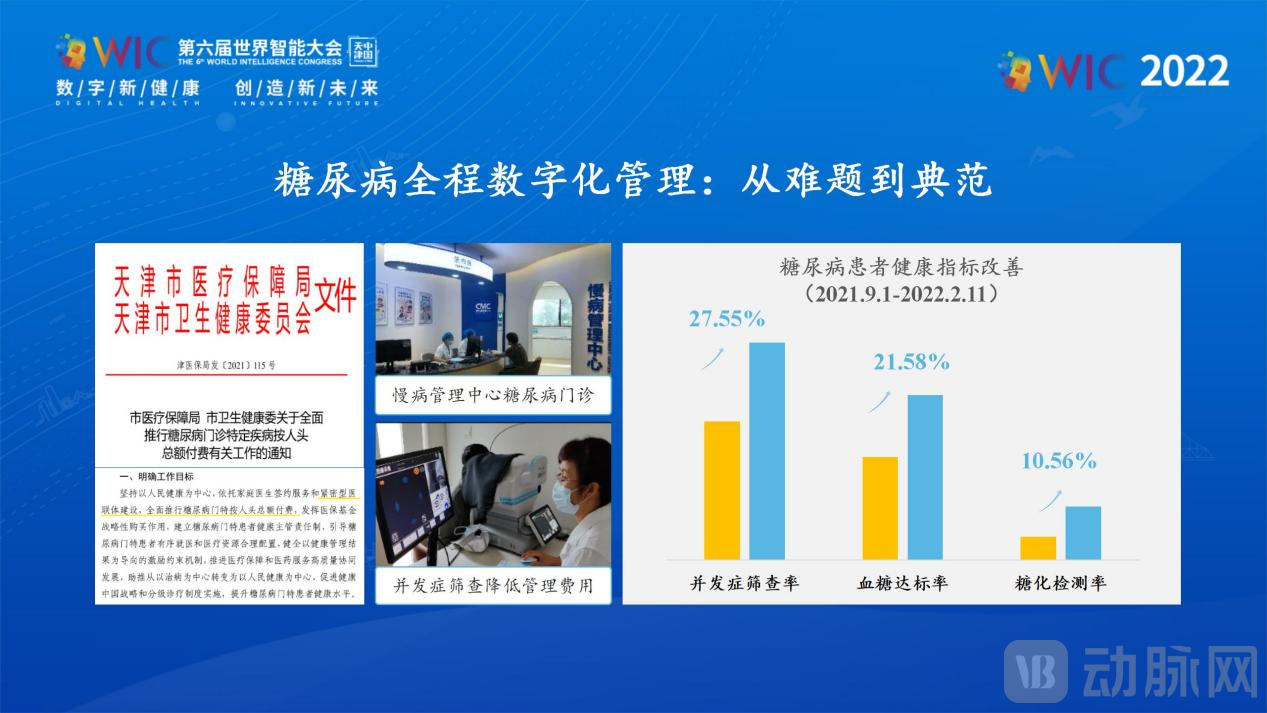 Improvement in Health Indicators for Patients with Diabetes
Regarding the digital upgrade of the healthcare system, by the end of December 2021, all 266 primary healthcare institutions within Tianjin’s Primary Digital Healthcare Consortium had completed their digital transformation. This achievement enabled full data integration and interoperability across the basic medical care system, the basic public health system, and the family doctor contract signing system, thereby establishing unified operational monitoring and management for the consortium.
Currently, leveraging the unified “Four Clouds” platform, primary healthcare institutions within Tianjin’s Primary Digital Health Consortium have achieved internal prescription circulation, intelligent prescription review, medical insurance settlement, and centralized drug supply, while also rolling out home-based medical services. Meanwhile, the Consortium has established standardized chronic disease management centers in collaboration with more than 70 primary healthcare institutions, jointly managing over 900,000 patients with chronic conditions, including those with diabetes and hypertension.
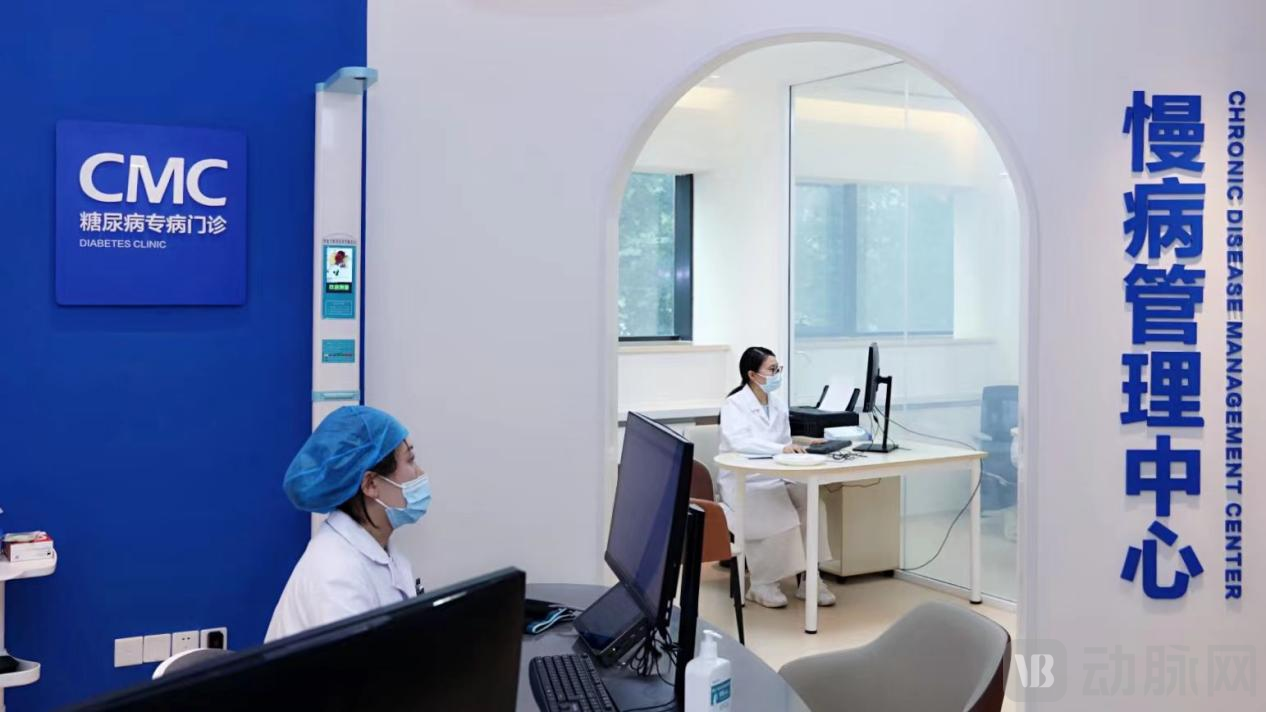 Standardized Chronic Disease Management Center of the Health Consortium
“Through the digital upgrade of the healthcare system and integrated services under the ‘Three-Medical Linkage’ model, the Digital Health Community has substantially enhanced the service capacity and quality of primary healthcare institutions, as evidenced by the increase in outpatient visits at these facilities,” introduced Liao Jieyuan. With the support of the Digital Health Community, outpatient visits at primary healthcare institutions in Tianjin increased by up to 280% at their peak.
Furthermore, during its implementation, the Tianjin Digital Primary Healthcare Community has gradually established a dual-platform service model comprising the “Digital Healthcare Community Platform” and the “Northern Pharmaceutical and Medical Device Joint Procurement Platform.” The first batch of multi-category pharmaceuticals procured through this initiative achieved an average price reduction of 19.51%, effectively lowering the procurement costs for medicines and consumables across medical institutions at all levels. Additionally, the comprehensive services provided under the “Three-Medical Linkage” framework have significantly improved the efficiency of health insurance fund utilization.
Due to its outstanding effectiveness and exemplary impact, the Tianjin Primary Care Digital Health Consortium was ranked first among the “Top Ten New Measures to Advance Healthcare Reform and Serve Public Health” at the 2021 National Conference on Promoting Experience in Deepening Healthcare Reform. Meanwhile, the Digital Health Consortium was included twice—in 2021 and 2022—as a demonstration project under Tianjin’s “Internet + Healthcare” initiative, with full coverage of Tianjin’s primary care network expected by the end of 2022.
Now, the digital health community model practiced in Tianjin is poised for further expansion across China. On April 20, the Cyberspace Administration of China, the Ministry of Agriculture and Rural Affairs, the National Development and Reform Commission, the Ministry of Industry and Information Technology, and the National Rural Revitalization Administration jointly issued the “Key Points for Digital Village Development Work in 2022” (hereinafter referred to as the “Key Points”), deploying 30 key tasks across 10 areas.
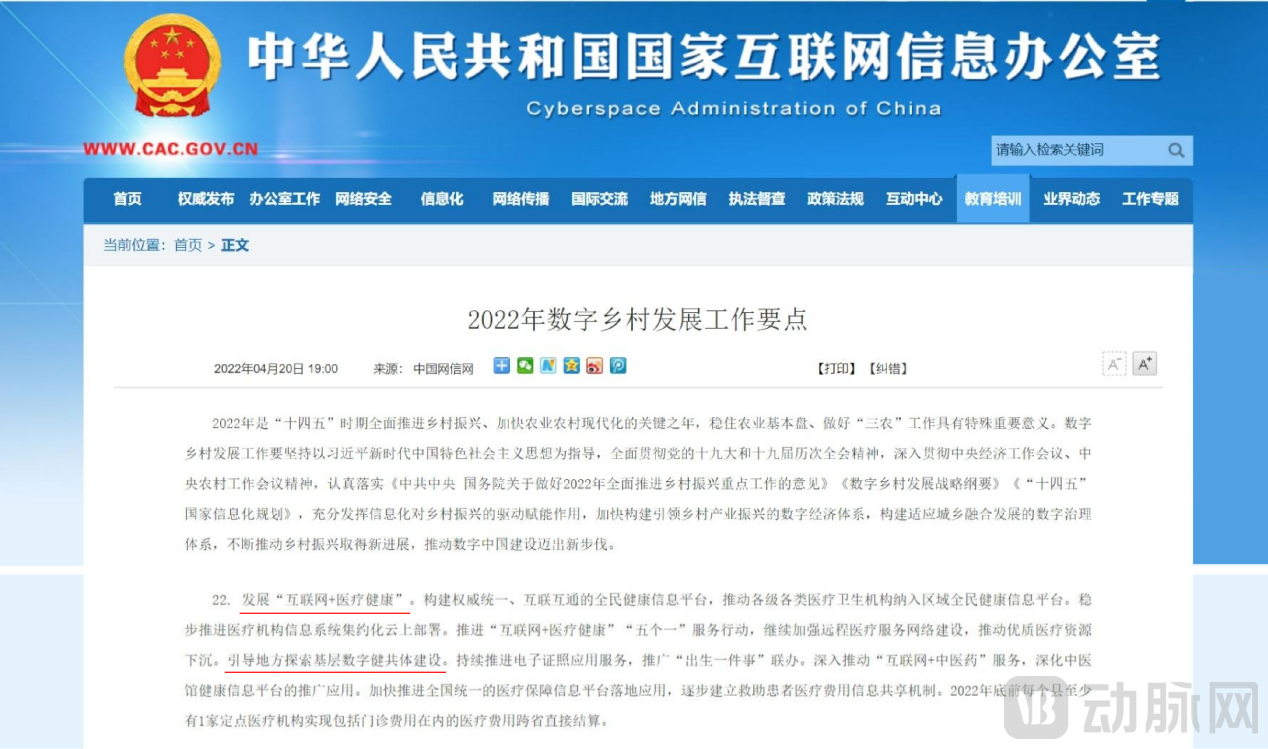
Key Points for the Development of Digital Villages in 2022
Among these, regarding the key tasks for developing “Internet + Healthcare,” the Work Points explicitly state: “Establish an authoritative, unified, and interoperable national health information platform, and promote the integration of medical and health institutions at all levels into regional national health information platforms. Steadily advance the centralized cloud-based deployment of information systems in medical institutions. Implement the ‘Five Ones’ service initiative for ‘Internet + Healthcare,’ continue to strengthen the construction of telemedicine service networks, and facilitate the downward flow of high-quality medical resources. Guide localities to explore the development of grassroots digital health communities.”
In this regard, Liao Jieyuan stated that, by aligning with the guiding principles of China’s healthcare reform documents and drawing on the concepts and operational experience of Health Maintenance Organizations (HMOs), WeDoctor’s achievements in building the Digital Health Community in Tianjin have been validated as a representative practice. He expressed hope that this “Tianjin Practice” in the digital upgrading of the healthcare system will evolve into the “Tianjin Experience” for nationwide adoption, leveraging next-generation information technologies to reshape the management and service delivery systems of healthcare.
“In the future, health management organizations in China will flourish,” said Liao Jieyuan.