

Fudan Musculoskeletal Secures Nearly RMB 100 Million in Half a Year to Advance Digital and Integrated MSK Therapy Solutions
VCBeat has learned that Shanghai Fudong Medical Management Co., Ltd.(Brand Name: Fudong Musculoskeletal) has completed its Pre-A financing round, led by Qiming Venture Partners and supported by Taifu Capital. The proceeds will be used forR&D, technological iteration, and market commercialization of digital therapeutics products, along with the continuous expansion of offline medical centers. Fudong Musculoskeletal’s self-developed Yuehang (TELEREHAB) digital therapeutic product for musculoskeletal conditions was approved by the National Medical Products Administration (NMPA) in June this year and has obtained a medical device registration certificate.
It is understood that this marks the second round of financing completed by Fudong Musculoskeletal within six months, following its first round led by Taifu Capital last September.
CEO of Fudong MusculoskeletalZhao QingyiHe stated, “Securing this round of financing is attributable to two key factors. First, our multidisciplinary talent pool: our core team comprises orthopedic and sports medicine physicians from top-tier (Grade A tertiary) hospitals, professors of rehabilitation from prestigious ‘985 Project’ universities, senior architects and algorithm experts from leading domestic internet companies, and specialists in intelligent sensing and measurement control. Second, our core team members bring over a decade of clinical practice experience, affording us a profound understanding of the clinical needs and pain points of both patients and physicians. Consequently, through collaborative R&D with orthopedic and sports medicine experts at Grade A tertiary hospitals such as Shanghai Sixth People’s Hospital and Huashan Hospital, we have developed this digital therapeutic product for musculoskeletal conditions. Compared with other offerings, it more effectively addresses critical clinical challenges.”
Fudong Musculoskeletal, established in 2018, is an innovative medical R&D enterprise dedicated to the fields of musculoskeletal rehabilitation and orthopedics and sports medicine. By leveraging three core product lines—digital therapeutics for musculoskeletal treatment, the PhysioCloud cloud service platform, and offline musculoskeletal rehabilitation medical centers—the company provides integrated comprehensive solutions for musculoskeletal care. It deeply integrates multidisciplinary scientific research and clinical applications across clinical medicine, software and hardware development, artificial intelligence, and big data processing.
Digital Therapeutics Enter the Field of Bone and Sports Medicine, Empowering the Upgrade of the Musculoskeletal Rehabilitation Industry
In clinical medicine, orthopedic surgery and postoperative rehabilitation are complementary. Restoring patient function through rehabilitation therapy or exercise therapy is an essential pathway for patients to return to daily life and resume physical activity. While China’s orthopedic surgical capabilities rank among the most advanced globally, there remains a significant gap in functional recovery outcomes compared to foreign countries. This discrepancy is primarily attributable to the inadequate implementation of postoperative orthopedic rehabilitation.
Fudong MusculoskeletalCEOZhao Qingyi believes that,First,In China, the insufficient supply and uneven distribution of rehabilitation medical personnel severely constrain industry development.Currently, China has only 50,000 practicing rehabilitation therapists, equating to just 3.6 per 100,000 population. This figure lags significantly behind the 30–70 rehabilitation physicians per 100,000 people seen in developed countries such as those in Europe and the United States, as well as Japan. Furthermore, high-quality rehabilitation medical resources are concentrated primarily in first- and second-tier major cities, leaving many patients unable to receive timely rehabilitation treatment.
Secondly, the orthopedics and rehabilitation departments in most hospitals are not systematically integrated.Orthopedic surgeons onPatient'sRehabilitation ProtocolJustProvideDirectionalityGuidance, unable to be preciseHelpThe patient is in functionalRecoveryTopStep by stepAdvanced. Rehabilitation therapists are proficient in various progressive training methods for range of motion and muscle strength, as well as surgical approaches and postoperative contraindications.andCharacteristics of Injury Recovery in Different StructuresWaitInsufficient understanding.
Additionally,Challenges in Follow-up Management for Orthopedic Patients in Public Hospitals, often facing issues such as untimely patient follow-up during the course of disease, leading to the loss of critical clinical data and affecting the implementation of subsequent treatment,Orthopedic surgeons' research also oftenTherefore,Lack of complete case data support.
Finally, for patients, rehabilitation therapy is actually a very typical chronic disease management process.Requires cyclical treatment administered in courses.It is also difficult for a single medical institution to provide patients with systematic rehabilitation services.
To address these issues, Fudong Musculoskeletal has developedYueXing(TELEREHAB)Digital Therapeutics Products, based on intelligent rehabilitation wearable devices, connecting the patient-side app and the doctor-side management backend,Interconnect devices, patients, and institutions to achieve integrated, precision rehabilitation delivery.The product can serve patients in orthopedics and sports medicine, enabling rehabilitative treatment for bone and musculoskeletal injuries of the upper limbs, lower limbs, spine, and other areas.
Meanwhile, Fudong Musculoskeletal is actively building the PhysioCloud cloud service platform and establishing a presence in offline physical medical settings, thereby delivering rehabilitation treatment plans to patients through an integrated “three-in-one” model.
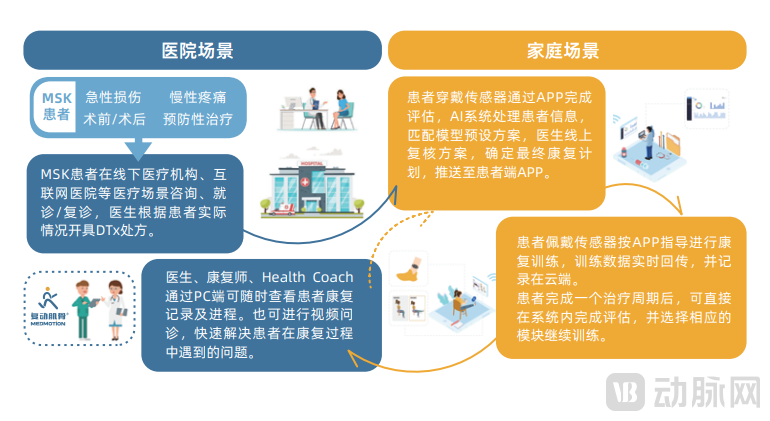
Provide Integrated Rehabilitation Treatment Plans for MSK Patients
“We aim to provide patients with care plans that are coherent and allow for seamless transitions,” said Zhao Qingyi.
In medical settings such as offline healthcare institutions and internet hospitals, physicians prescribe Digital Therapeutics (DTx) based on the patient’s actual condition during consultations or follow-up visits. In the home setting, the patient wears sensors to complete assessments via a mobile app. The AI system processes the patient’s data, matches it with pre-defined model protocols, and the physician reviews the proposed plan online to finalize the rehabilitation regimen, which is then pushed to the patient’s mobile app.
Upon receiving the rehabilitation plan, patients wear sensors to perform rehabilitation exercises as guided by the mobile app. Training data is transmitted in real time and stored in the cloud. After completing a treatment cycle, patients can conduct assessments directly within the system and select corresponding modules to continue their training. Finally, physicians, rehabilitation therapists, and health coaches can access patients’ rehabilitation records and progress at any time via the PC client, and conduct video consultations to promptly address any issues encountered during the rehabilitation process.
For medical professionals such as physicians and rehabilitation therapists, this protocolDigitize Rehabilitation Training Data and Standardize Rehabilitation Services, breaking through the limitations of traditional rehabilitation therapy models, such as shortages of qualified professionals and limited service coverage. Remote real-time tracking and recording of patients’ disease progression and rehabilitation data ensure the integrity and continuity of critical information, thereby assisting physicians in delivering more effective diagnosis and treatment and facilitating data-driven research. Multi-party connectivity among physicians, rehabilitation therapists, and patients also resolves the challenges of interdisciplinary communication.
For patients,Integrated treatment approaches can reduce rehabilitation costs, minimize time expenditures, and enhance spatial convenience.It also ensures surgical outcomes, significantly reducing complications such as poor results due to delayed rehabilitation and the need for revision surgery.
For rehabilitation institutions, Yuexing Digital Therapeutics can standardize the establishment and service delivery of rehabilitation departments and clinics.Enhance workforce productivity and service capacity,Innovate service models to boost store revenue, etc.。
Technological Upgrades Centered on Clinical Needs to Ensure More Complete and Accurate Data
According toFudong Musculoskeletal CTO Zhou KaiboIntroduction: Yuexing Digital Therapeutics leverages technologies such as inertial navigation sensors, AI algorithms, instant messaging, and cloud computing to facilitate integrated diagnosis and treatment for musculoskeletal rehabilitation, primarily includingDiagnostic EvaluationandRehabilitation Training MonitoringTwo Core Functions. “Our team aims to leverage these technologies to achieve digitalization, intelligence, and integration in musculoskeletal rehabilitation therapy, thereby helping patients regain the freedom to move with ease and live life on their own terms,” said Zhou Kaibo.
Diagnostic assessment includes sensor data, questionnaires, medical imaging, and video consultations.Multidimensional Patient Information Collectionapproach, while incorporating professional physicians and AI algorithms to evaluate patient information and ultimately generate a rehabilitation plan.
Rehabilitation training monitoring refers to the process during user training,Real-time Collection of User Action Data, transmitting data to the app via Bluetooth communication technology. The app incorporates mobile-based deep learning techniques to provide real-time correction and feedback on user movements, thereby replacing the need for physician supervision and guidance. Furthermore, all user training data are recorded on an AI data analytics platform to continuously optimize individual rehabilitation plans.
Leveraging the company’s four core systems—self-developed inertial navigation sensors, a user-facing mobile app, a physician-oriented SaaS management platform, and an AI-powered data analytics platform—this productAddresses key challenges in rehabilitation diagnosis and treatment, including doctor-patient data connectivity, remote diagnosability and monitorability, real-time training feedback, intelligent assessment, and comprehensive data recording throughout the entire rehabilitation cycle.
According to Zhou Kaibo, this product has two technological innovations.First, to enhance diagnostic efficiency and alleviate the shortage of professional medical personnel.。By employing multiple AI classification algorithms, recommended rehabilitation plans are generated based on the multi-dimensional data collected from each user during assessment. These plans are then finalized by specialist physicians before being provided to users for rehabilitation training.In clinical trials, the AI algorithm’s recommended rehabilitation plans achieved a concordance rate of over 94.7% with those devised by specialist physicians at Grade 3A hospitals.
Second, real-time correction of exercise movements enhances the effectiveness of remote rehabilitation.Employing RNN-based deep learning algorithms to evaluate the deviation between time-series Euler angle data from pose sensors and standard movements, providing real-time feedback to guide users in performing rehabilitation exercises within the standard range.In clinical trials, the AI algorithm achieved an accuracy rate of over 98.6% in motion error correction.
Product technology development relies on team support. The core R&D team of Yuexing Digital Therapeutics consists of 20+ interdisciplinary talents, including orthopedic and sports medicine physicians, rehabilitation physicians and therapists, rehabilitation faculty from renowned Chinese universities, as well as algorithm engineers, hardware R&D engineers, and software development engineers from top internet companies such as Alibaba and Tencent. The internal rehabilitation protocols are strictly formulated in accordance with domestically and internationally recognized clinical guidelines, and have been repeatedly reviewed and confirmed by clinical experts to ensure the overall regimen is safe, scientific, and effective. Meanwhile, through algorithm optimization and design improvements, the hardware R&D and algorithm teams have enhanced the accuracy of data detection and transmission from Yuexing’s posture sensors, effectively reducing the risks associated with remote therapy.
Zhao Qingyi stated that Fudong Musculoskeletal is, in fact, addressing the issues of standardization and accessibility in rehabilitation services through a more inclusive approach.The overall technical solution is, in fact, centered around people and data.“Traditional rehabilitation processes rely on healthcare professionals’ empirical judgment, lacking data-driven objective benchmarks for comparison. We have essentially translated the clinical reasoning embedded in practitioners’ minds within conventional settings into actionable clinical metrics, and leveraged these metrics to design personalized rehabilitation plans.”
Through technological means, Yuexing Digital Therapeutics not only connects patients, rehabilitation therapists, and doctors, ensuring the flow and feedback of data among different roles, but also expands the service ratio of rehabilitation therapists while improving their rehabilitation proficiency.
It is understood that,Currently, Yuexing Digital Therapeutics has conducted clinical trials at Grade A tertiary hospitals and Fudong Musculoskeletal Rehabilitation Clinics, covering more than 230 patients.Among them, approximately 142 cases were post-operative knee sports injuries, and approximately 88 cases were patients with lower back pain and chronic knee pain. The overall patient satisfaction score (NPS score on a scale of 0–10) was 9.4.
81% of Patients Achieved Expected Rehabilitation Goals, among whom 92% of patients post-operatively for knee sports injuries achieved their expected rehabilitation goals, with average Lower Extremity Functional Scale (LEFS) scores consistent with those of patients undergoing hospital-based rehabilitation during the same period; 73% of patients with chronic lower back and knee pain achieved their expected goals, with a 65% pain relief rate; over 60% of users practiced more than three times per week; during use, the overall anxiety relief rate among patients was 54%; and no patients experienced secondary injuries.
Pioneering the Patient-Centered “Five-Provider Co-Management” Innovative Model
Zhao Qingyi believes that a patient-centered approach is crucial to the design of rehabilitation programs. The term “patient” should, in fact, be deconstructed and examined as two separate characters.
“Traditional doctors often focus solely on disease issues, butIn addition to the disease condition,The individual's own needs are of paramount importance., including rehabilitation goals, financial status, and even emotional needs. For instance, a patient’s expectations for rehabilitation outcomes will influence the design of the rehabilitation plan; protocols designed for athletes certainly differ from those for the general population,” said Zhao Qingyi.
Furthermore, hospital departments are structured from the perspective of medical personnel. However, patients typically only perceive symptoms such as pain, functional impairment, and limited mobility, and cannot determine whether the underlying issue lies in the bones, muscles, ligaments, or the joint as a whole. Zhao Qingyi believes that such diagnostic judgments should not be expected of patients.
Therefore, Fudong Musculoskeletal has launched a multidisciplinary joint diagnosis and treatment program for musculoskeletal rehabilitation, pioneering the innovative “Five-Specialist Co-Management” service model to address various challenges patients encounter in remote therapy and optimize customer experience.
Center personnel includeOrthopedic and sports medicine physicians, rehabilitation therapists, nurses, orthotists, and psychological support specialists (Health Coaches) provide each patient with a "five-provider collaborative care" service.Help patients better achieve their rehabilitation goals during the recovery period.
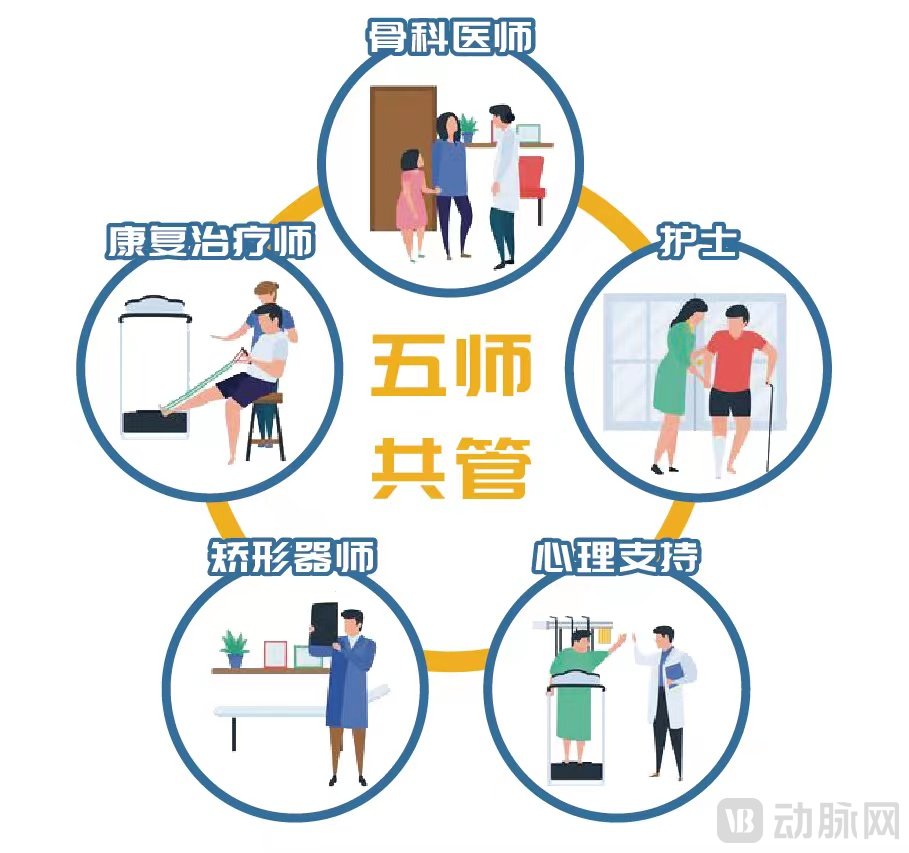
Patient-Centered “Five-Specialist Co-Management” Innovative Model for Musculoskeletal Rehabilitation Medical Services
“Five-Physician Co-Management” is, in essence, about addressing every patient need.
Based on the patient’s symptoms, physical signs, and imaging findings, orthopedic or sports medicine physicians establish the diagnosis and prescribe a rehabilitation regimen. They collaborate with rehabilitation therapists to develop a comprehensive rehabilitation plan, while orthotists provide and fit necessary braces and other orthotic devices, along with providing usage guidance.
Another major cause of musculoskeletal pain is pain induced by anxiety disorders, while long-term chronic pain may also trigger anxiety disorders; the two maintain a dynamic equilibrium. To address this need, Health Coaches provide psychological support to patients throughout the entire rehabilitation process.
Patient-Centric, Innovation-Driven: Serving More Patients
From Zhao Qingyi’s perspective, digital therapeutics for bone and sports medicine are still in their infancy in China. However, given the rapid development of internet-based healthcare and the country’s large population base, the prospects for the growth of digital therapeutics in China are broad.
“Compared with other countries, patients in China demonstrate higher levels of trust in physicians and greater treatment adherence. Under China’s payment system, patients also enjoy far greater freedom in choosing their doctors than those in European and American markets. Therefore, we believe there is greater opportunity in China to promote a patient-centered service model,” said Zhao Qingyi.
In June this year, Fudong Musculoskeletal obtained the first medical device registration certificate for digital therapeutics., and it is expected to obtain three to four additional medical device registrations for other product pipelines in the future. “We will officially launch commercialization in the second half of the year, starting by addressing the pain points of orthopedic surgeons and recommending our solutions to patients,” said Zhao Qingyi.
Regarding technological iteration, Zhou Kaibo stated that the primary technical objectives will be to enhance rehabilitation outcomes and improve user experience. Driven by clinical needs, in order to collect more multidimensional and precise data, in addition to upgrading inertial navigation sensors, corresponding layouts and development efforts will also be made in the areas of pressure sensors and visual sensors.
In terms of software and infrastructure,Fudong MusculoskeletalIncrease R&D investment in key technologies such as big data and AI to achieve better user experience and feedback outcomes.“Currently, user-end interactions both domestically and internationally remain relatively simplistic, making it difficult to provide adequate feedback for complex rehabilitation exercises. Moving forward, we will continue to enhance our technology to deliver superior user feedback. Recognizing that rehabilitation plans must be highly personalized, we will consistently iterate our algorithms to provide patients with more precise rehabilitation regimens.”
Since its inception, Fudong Musculoskeletal has been deeply committed to the treatment and rehabilitation of musculoskeletal conditions. To date, the company has established two offline medical centers in Shanghai. In the future, it plans to create “model scenarios” in other cities that enable seamless transitions between clinical and home-based care settings, thereby promoting the concept of digital-intelligent, integrated diagnosis and treatment to more physicians and patients. Meanwhile, the company seeks to collaborate with a broader range of clinics, leveraging Fudong’s Yuexing Digital Therapeutics and PhysioCloud cloud services to deliver high-quality, one-stop rehabilitation solutions to more patients.
Looking to the future, Zhao Qingyi stated that as a medical technology company, Fudong Musculoskeletal aims to continue delving deeply into the musculoskeletal field, gradually expanding into prevention and chronic disease management. With the first-generation product set to be officially commercialized in the second half of the year, the company will also initiate its Series A financing round in the near future to drive the iterative upgrading of its technology and products.
Regarding this round of financing,Qiming Venture Partnersstated: “Approximately two to three years ago, before the emergence of what is commonly referred to as ‘market hotspots,’ we invested in Demei Medical to enter the fields of orthopedics and sports medicine. We have strong confidence in the growth potential of sports medicine in China. Over the past two years, particularly against the backdrop of the Winter Olympics, it has become increasingly evident that sports and sports-related injuries have genuinely become an integral part of our daily lives. Our investment in Fudong Musculoskeletal was driven by our desire to provide a more universal and accessible solution through digital and intelligent approaches. Fudong’s digital therapeutics address the two most significant pain points in the market: limitations in the number of rehabilitation therapists and their efficiency, as well as geographical constraints. We believe that only through such innovative methods can exponential growth be achieved. Furthermore, digital therapeutics and related medical innovations ultimately deliver serious medical products. The design and delivery of these products must adhere to evidence-based medicine to demonstrate their efficacy. This is both the most fundamental and the most critical requirement. Fudong Musculoskeletal has consistently upheld this principle, which is a key factor in our strong endorsement. Currently, they are conducting rigorous clinical trials with various Grade A tertiary hospitals across China.”
Taifu Capitalstated: “In recent years, the domestic musculoskeletal (MSK) sports rehabilitation market has experienced rapid growth, with the COVID-19 pandemic stimulating substantial demand among patients and healthcare providers for remote rehabilitation and disease management. Meanwhile, digital therapeutics globally are on a steep upward trajectory, and the U.S. Food and Drug Administration (FDA) has already approved several MSK-related digital therapeutic products. Fudong Medical boasts a multidisciplinary team comprising senior orthopedic surgeons, professional rehabilitation therapists, software engineers, and marketing specialists. The company maintains long-term collaborations with top-tier tertiary hospitals such as Shanghai Sixth People’s Hospital, Huashan Hospital, and Xinhua Hospital, ensuring broad application coverage. We are highly optimistic about the MSK digital therapeutics sector and are delighted to partner with a specialized, integrated team like Fudong Medical to accelerate the company’s rapid development.”
About Qiming Venture Partners
Qiming Venture Partners was established in 2006 and has successively set up offices in Shanghai, Beijing, Suzhou, Hong Kong, Seattle, Boston, and the San Francisco Bay Area. Currently, Qiming Venture Partners manages ten US dollar funds and six RMB funds, with total assets under management reaching USD 6.2 billion. Since its inception, the firm has focused on investing in outstanding early-stage and growth-stage companies in sectors such as TMT and Healthcare. To date, Qiming Venture Partners has invested in more than 430 high-growth innovative enterprises, among which over 170 have achieved exits through listings on exchanges including the New York Stock Exchange, NASDAQ, Hong Kong Stock Exchange, Taipei Exchange, Shanghai Stock Exchange, and Shenzhen Stock Exchange, as well as through mergers and acquisitions. More than 40 of these portfolio companies have become industry-recognized unicorns and super unicorns.
About Taifu Capital
Taifu Capital focuses on venture capital in the life sciences sector, primarily investing in high-potential early-stage and growth-stage companies. Through diversified and strategic positioning, as well as by selecting high-quality partners, Taifu aims to seize opportunities arising from the rapid development of China’s life sciences industry. The investment team brings years of experience and extensive industry resources in these fields, with a commitment to achieving rapid growth alongside its portfolio companies.