

Rehabilitation Technology Breakthrough: What This Century-Old Giant Got Right

ottobock China
R&D and Manufacturing of Rehabilitation Assistive Devices
Prosthetics have long been a frontier research topic in the fields of robotics and biomedical engineering.
However, because advances in prosthetic technology require the combined efforts of microelectronics, computer control, mechanical design and manufacturing, new materials, human biomechanics, biomedical engineering, and anatomy, its iterative progress has been relatively slow. It was not until the early 1990s that products such as smart prostheses emerged, addressing pain points of traditional prostheses, including their inability to naturally follow the amputee’s movements, narrow range of speed adaptation, poor gait flexibility, and insufficient stability.
In 1997, the German company Ottobock (hereinafter referred to as “Ottobock”) developed the C-Leg intelligent bionic leg. In 2001, the Icelandic company OSSUR developed products such as bionic magnetically controlled knee joints. These intelligent bionic knee joints determine the speed and position of prosthetic swing by monitoring knee joint angle and ankle joint torque, while ensuring stability and safety during ambulation by adjusting hydraulic cylinder damping or further evaluating the gait of individuals with disabilities based on sensor-derived calculations. It was not until that time that real-time control and adjustment of joint parameters, as well as of the stance and swing phases, were finally achieved.
Among them, the C-Leg intelligent bionic knee joint developed by Ottobock was ranked 31st among Germany's Top 50 Inventions That Changed the World.
Today, with technological advancements, non-smart mechanical knee prostheses can also achieve the same functions as smart prostheses. Among them, Ottobock has over a century of experience in the research and development of related products such as prostheses, orthoses, and mobility aids (wheelchairs).Recently, the company officially launched the 3R85 DaNiu SRU Patented Hydraulic Control System Knee Joint, which combines stability with flexibility. This marks another breakthrough in rehabilitation technology.
Ottobock employs an integrated rotary hydraulic cylinder and a hydraulic switching system (Patent Nos.: CN111225636A, CN112334095A) to provide prosthetic users with dynamic support throughout the entire gait cycle. This enables a natural transition from heel strike to toe-off, resulting in a gait that mimics natural biomechanics. Thanks to this specialized hydraulic cylinder design principle, the knee joint also maintains high flexion damping during the stance phase even within the swing phase. This feature proves critical when users stumble while walking, helping them stabilize their bodies and reducing the risk of falls.
Ottobock’s launch of this product aims to deliver the key functionalities of prosthetics through non-smart means, while addressing the pain points experienced by individuals with disabilities during prosthetic use.
According to data from the Second National Sample Survey on Disability conducted in 2006, the total number of people with disabilities in China was 82.96 million. Among them, 24.12 million had physical disabilities, including 2.26 million amputees, accounting for 8% of the population with physical disabilities. Of these 2.26 million amputees, 70%, or approximately 1.58 million, were lower-limb amputees.
Nowadays, the number of lower-limb amputees caused by various diseases, traffic accidents, occupational injuries, natural disasters, and other factors continues to rise. However, due to the high cost of rehabilitation assistive medical devices such as prosthetics for restoring limb function, as well as complex maintenance procedures, patients are burdened with significant economic costs associated with using these expensive prosthetic devices.
The emergence of 3R85 further addresses this issue from a technical perspective.
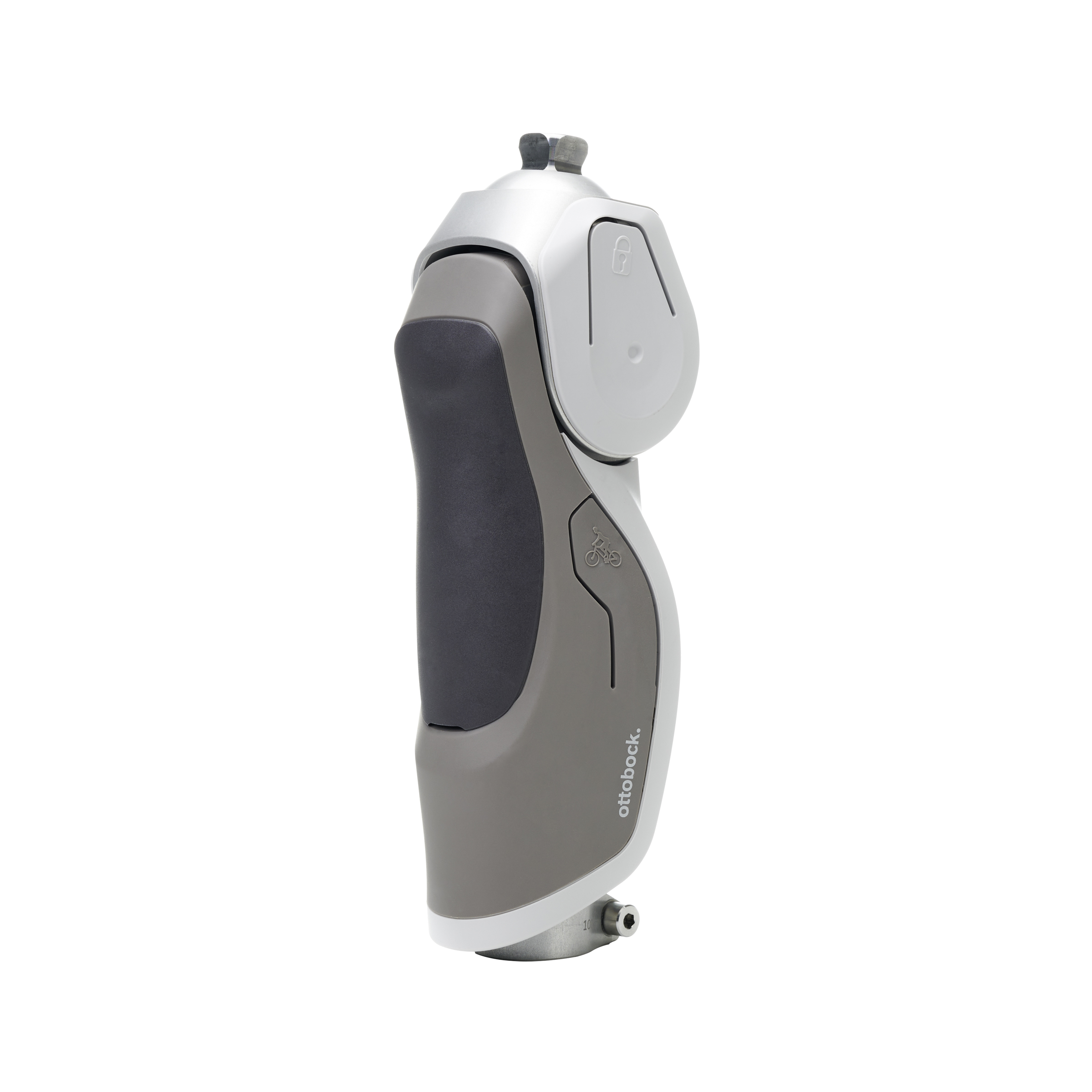
Ottobock 3R85 Genium Knee Joint
It is understood that the 3R85 "Da Niu" is currently the most functionally advanced knee prosthesis among Ottobock’s non-microprocessor-controlled product lines. With the 3R85 "Da Niu," users can descend stairs in an alternating step pattern, engage in water activities, switch between multiple activity modes, and benefit from built-in stumble recovery functionality.
Ottobock told VCBeat:“We hope to lower product prices through technological means, rather than through materials and supply chain optimization, so that individuals with disabilities can afford prosthetic knee joints.”
Prosthetic research requires breakthroughs in four key areas: knee joint structure, control mechanisms for leg movement, ankle and foot structure, and material selection. As a critical component that connects and controls daily human movement, the knee joint is central to the development of lower-limb prosthetic products. Artificial knee joints must not only replicate the motion patterns of natural joints but also maximize safety and stability during walking.
Currently, knee prostheses available on the market can be classified by control mechanism into pneumatic knees, hydraulic knees, and microprocessor-controlled (smart) knees.
Ottobock’s proprietary 3R85 heavy-duty knee joint features a patented high-strength rotary hydraulic cylinder design and an SRU hydraulic control system, enabling it to provide dynamic support to users throughout the entire gait cycle.The high-damping function during the stance phase ensures stability while standing. Hydraulic control during the swing phase provides flexibility while walking.
Multifunctional integration enables users to walk forward and backward on various terrains, while maintaining a natural and aesthetically pleasing gait.
Specifically, the 3R85 prosthetic knee joint adopts a new default stance-phase stability feature to meet users’ real-life needs. Combined with its consistently stable flexion damping during the stance phase, it enables users to descend slopes naturally with alternating steps. This design helps alleviate the difficulties faced by prosthesis users when walking outdoors.
The knee joint’s default support performance, combined with continuous and stable flexion damping during the stance phase, enables users to naturally descend slopes and stairs with alternating leg movements, eliminating the need for sideways walking. The maximum flexion angle is 145 degrees.
The specialized hydraulic cylinder design enables the knee joint to maintain stance-phase flexion damping during the swing phase. Consequently, if the user encounters ground obstacles such as thresholds or stones while walking, the stance-phase flexion damping can engage rapidly to help stabilize the body and reduce the risk of falling.
In addition, its high level of water resistance allows users to wear the prosthesis for activities such as swimming in the sea, playing in pools, and showering at home. It is understood that Ottobock has enhanced the suspension and antibacterial properties of this knee joint through measures such as the 6Y110 Schwa Silver Ion Silicone Liner with Sealing Ring. Users can wear this knee joint in seawater, freshwater, and chlorinated water (swimming pools), with a waterproof depth of up to 1 meter underwater.
In addition to swimming, this product supports various movement modes such as cycling, yoga, cross-legged sitting, and tying shoelaces. Its built-in 4R57 rotary knee unit enables 360-degree rotation of the prosthetic limb. The locking mode during the stance phase allows users to engage in activities like skiing and rollerblading. Operation is simple and convenient: users can independently switch between movement modes with a single press of the button on the side of the joint housing.
Meanwhile, the knee joint is equipped with waterproof titanium alloy shank tubes, eliminating the need for users to purchase shank tubes separately. The unique design of the shank tube connection allows for adjustable height, meeting users' personalized needs.
In terms of foot design (recommended components), Ottobock adopts the 1C50 Taleo waterproof carbon fiber foot. It offers strong rolling performance and can adapt to various terrain conditions. According to user data from Ottobock, users of this product can walk comfortably for an entire day.
Ensuring user safety and stability during the use of lower-limb prostheses, while preventing tripping, has always been a major challenge and primary concern in their development.
For technical developers, it is necessary not only to employ means such as microelectronics, computer control technology, mechanical design and manufacturing, and new materials, but also to integrate human biomechanics, biomedical engineering, and anatomy to conduct dynamic quantitative analysis of the movement and force conditions of the human lower limbs, namely gait analysis. The primary research methods include gait videography, body balance measurement, electromyography (EMG), ground reaction force measurement, and pressure distribution measurement.
Why can Ottobock’s 3R85, a non-microprocessor-controlled knee joint, achieve features such as stumble prevention?
Ottobock told VCBeat: “The hydraulic control system in the 3R85 ‘Da Niu’ is highly complex and precise. It is achieved through SRU’s patented mechanical structure, rather than intelligent algorithms.”
We have developed a highly complex design centered on rotary hydraulic cylinders and hydraulic switching systems, for which we have filed two patent applications. The technical principle of the hydraulic cylinder involves an internal default damping control system for the stance phase. Targeting the swing phase, where tripping hazards frequently occur, this system within the 3R85 prosthetic knee enables a return to the default stance phase and provides substantial damping support, thereby delivering an anti-trip function.
Zheng Hairong, Deputy Director of the Shenzhen Institutes of Advanced Technology, Chinese Academy of Sciences, once stated: “For a comprehensive modern industrial manufacturing system, high-end medical imaging equipment is not merely a medical product. Its manufacturing process can drive the development of a cluster of high-end industrial chains in China.”
The development of rehabilitation assistive devices also follows the same logic.
Ottobock, a century-old enterprise, has broken through the core technological barriers in lower-limb prosthetics, with implications that extend far beyond mere technical advancement.
References:
“Progress and Development Trends in Domestic and International Research on Artificial Legs (Prostheses)”
“Current Status and Development Trends of Intelligent Knee Prostheses”
"Advances in Biomechanical Research on Human Gait During Walking"