

XieKang Networks: Pioneering 'Internet + Healthcare' for 12 Years with Early Vision and Timely Execution
Pan Xiwen stated that to gain a competitive edge in the industry, one must make early moves and plan ahead, so as to seize the momentum when opportunities arise.
In 2011, Pan Xiwen founded Jiekang, focusing on the field of primary healthcare services by developing both medical diagnostic equipment, such as all-in-one health management kiosks, and software platforms. In its early years, Jiekang occupied a niche position in the underappreciated primary healthcare sector. However, following the release of the “Healthy China 2030” Planning Outline in 2016, the company finally experienced the advantages of operating in a high-growth market segment.
In 2018, the central government procured 1,000 “Jiekang All-in-One Health Testing Devices” as commemorative gifts for Ningxia. To date, Jiekang has provided health management solutions to over 5,000 clients, becoming one of Shenzhen’s first “Internet+“Leading enterprise in healthcare.” Annual service volume of 100 million visits, with an output value of nearly RMB 200 million.
From Cosmetics Sales to Founder of Jiekang: Building an R&D Team from the Ground Up
Before founding Jiekang, Pan Xiwen worked in sales at a cosmetics company, where he generated 90% of the firm’s annual revenue within one year. Later, when the owner shifted investments to mining and real estate, Pan took over the company and ran the cosmetics business for ten years.
In 2010, Pan Xiwen began to ponder the future direction of development. He noticed the emergence of a new category of health check-up equipment in developed countries in Europe and America, such as Germany’s self-service health screening kiosks and the American-style “Health Huts.” In contrast, given China’s vast territory, the large number of grassroots medical institutions, and their lagging development, some village doctors were still relying on the “old three” basic diagnostic tools: stethoscopes, sphygmomanometers, and thermometers.
At that time, China was in a period of rapid development in the internet industry, although “internet+“This concept has not yet gained widespread adoption, but many industries have recognized the opportunities presented by mobile internet and hope to leverage its momentum for rapid growth. While ‘Internet Plus’ has been successfully integrated into shopping, dining, and education, it has yet to make significant inroads into healthcare.”
Thus, Pan Xiwen wondered whether the internet could be leveraged to make healthcare more accessible. Drawing on the concept of “portable health,” he founded Jiekang in Shekou, Shenzhen.
“Traditional medical device companies may focus solely on hardware, while healthcare IT firms concentrate only on software, with little overlap between the two. However, Jiekang decided to integrate both hardware and software from its inception.” At that time, Pan Xiwen faced a challenge: where to find interdisciplinary talents proficient in both software and hardware?
In 2011, China’s internet healthcare industry was still in its infancy, and it was difficult to find professionals proficient in both software and hardware. The R&D department of Jiekang was built entirely from the ground up. Pan Xiwen began by targeting IT talent, focusing on established medical information websites. “I closely monitored news about the departures of founding members from these companies and visited them one by one.”
Thus, Jiekang’s software and hardware divisions were established in succession. In 2014, its products finally entered the market. The following year, Jiekang invested RMB 50 million to build a smart health device production base in Wuhan Optics Valley and established its controlling subsidiary, Wuhan Jiekang Smart Health Equipment Co., Ltd.
The product stays ahead of the market, ready to seize the opportunity when the general health and wellness sector takes off.
Logically speaking, the launch of a product should be a time to breathe a sigh of relief, but Pan Xiwen stated, “The three years following the product launch were the most difficult period for Jiekang,” because although the product was released, the market response was lukewarm.
This was primarily constrained by market demand at the time.
The development of China’s basic public health industry has undergone three stages. The first stage was before 2009, when public health informatization was just taking shape. The second stage began in 2009, when China established the National Basic Public Health Services Program to provide free basic public health services to all residents nationwide. The third stage started after 2016, when the state issued a series of policies to promote the development of the grassroots public health sector, such as the “Outline of the Healthy China 2030 Plan” and the “Guidelines on Promoting ‘Internet++Opinions on the Development of “Medical and Health Care” etc.
Prior to 2016, enterprises engaged in grassroots public health services faced significant challenges. However, as the old saying goes, “opportunity favors the prepared mind.” Following the release of the Healthy China policy, Shenzhen Jiekang Network Technology Co., Ltd. seized the moment and rapidly scaled up its product promotion.
As the public health industry experiences rapid development, Jiekang has welcomed another tailwind: the informatization of primary healthcare.
In 2019, the National Health Commission and the National Administration of Traditional Chinese Medicine issued the Standards and Specifications for Informatization Construction of Primary Healthcare Institutions Nationwide (Trial), which divides the informatization construction of primary healthcare into four parts—service operations, management operations, platform services, and information security—comprising 58 categories and a total of 212 construction items and requirements, including family doctor contracting and chronic disease management.
According to data from the National Health Commission, in 2020, China had 6.56 professional public health institution personnel per 10,000 people. The scarcity of specialized public health professionals means that primary care physicians must simultaneously handle clinical diagnosis and treatment as well as public health duties, resulting in a daily reality of “staff shortages and heavy workloads.” If doctors are still relying on outdated “old three” instruments, they find themselves in the predicament of “using a sword from a previous dynasty to execute officials of the current one,” especially since the scope of public health services has expanded alongside increases in funding subsidies. From 2009 to the present, per capita public health subsidies have risen from RMB 15 to RMB 84, while service items have increased from 10 to 12 + 19 categories.
Scalable platform device for vital signs data collection, with an estimated annual service volume of 100 million patient visits
In basic public health services, public health examinations are involved in nearly all programs.
In light of the critical role of public health examinations in primary healthcare, Jiekang has developed a series of health screening devices, integrating digital solutions to empower primary healthcare services across various testing terminals. Jiekang’s product development is guided by an “aircraft carrier” philosophy—namely, platform-based development: first establish a robust platform, then simply deploy new applications on top of it as needed.
Jiekang’s hardware devices fall into three categories: all-in-one platform-based testing equipment, highly integrated portable devices, and mobile healthcare service vehicles.
Large-scale one-stop testing equipment includes health management all-in-one machines, general practitioner diagnostic and treatment workstations, and self-service physical examination kiosks. Testing items include height, weight, BMI, ultrasound, blood oxygen saturation, blood pressure, pulse rate, electrocardiogram (12-lead), and routine urinalysis (11 parameters).
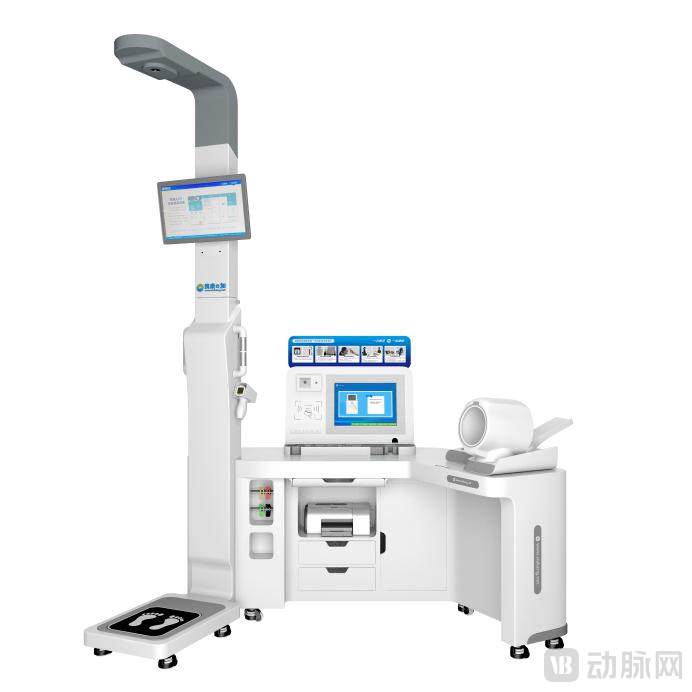
Jiekang Smart Health Testing All-in-One Machine (Photo provided by the company)
These large all-in-one kiosks, typically over two meters in height, are installed in primary healthcare institutions, enterprises and public institutions, factories, nursing homes, and other settings. To facilitate use by the general public at the grassroots level, Jiekang has built voice guidance into the devices, enabling rapid profile creation or login via ID card scanning or facial recognition.
Portable devices include mobile clinic kits, smart health service packages, and all-in-one smart diagnostic terminals. These devices can detect as many parameters as large-scale one-stop testing equipment, yet they are reduced to the size of a pillow, making them ideal for rural doctors or family physician teams conducting physical examinations in rural areas.
Finally, there is the mobile healthcare service vehicle, which primarily addresses the shortage of equipment in primary healthcare institutions. Equipped with a 5G system, the vehicle enables rapid deployment and can be utilized across multiple scenarios. In the post-pandemic era, this service vehicle can also assist in conducting nucleic acid testing in rural areas.
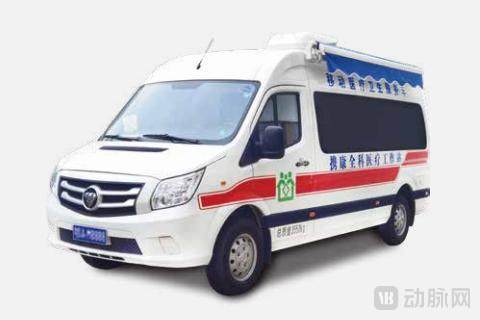
Jiekang Mobile Medical and Health Service Vehicle
All the aforementioned devices are equipped with reserved API interfaces, enabling integration with systems such as HIS, EMR, LIS, public health platforms, and county-level medical consortia, as well as with management backends and mobile terminals.
Furthermore, each device is divided into two parts: standard testing items and extended testing items, which also reflects Jiekang's platform philosophy. Medical institutions or doctors can connect other devices as needed, such as ultrasound machines, hematology analyzers, and biochemistry analyzers, to test items like blood glucose, uric acid, and hemoglobin.
According to Pan Xiwen, Jiekang’s products are primarily deployed in populous provinces such as Guangdong, Shandong, Henan, and Hubei, with an estimated annual service volume of 100 million patient visits.
8 Internet-Based Solutions, Covering Nearly All Primary Healthcare Services
Currently, the “Internet” developed by Jiekang+"Healthcare Solutions" fall into 8 categories: Internet+Medical Consortium, Smart Primary Healthcare, Smart Public Health, Chronic Disease Management System, Integrated Medical and Preventive Care System Solution, Family Doctor Contracting System, Smart Medical and Elderly Care System Solution, Student Health System Solution.
First, the Internet+Medical Consortium Solutions for County-Level Medical Consortia. The concept of “county-level medical consortium” first appeared in the Guiding Opinions on Promoting the Construction and Development of Medical Alliances issued by the State Council in 2017, referring to the sharing of medical resources within a county to establish a tiered diagnosis and treatment model.
Building “county-level medical consortia” is challenging because data in grassroots medical institutions remains isolated in “silos.” How can resources be shared if information does not flow? To address this issue, Jiekang has developed a three-tier integrated cloud platform for medical consortia spanning county, township, and village levels, integrating public health, medical insurance, and Hospital Information System (HIS) across healthcare institutions at all levels.
Similar to the Medical Community solutions, the Integrated Medical and Preventive Care System also breaks down data barriers among tertiary medical institutions, focusing on chronic diseases to enable proactive prevention and treatment.
“Smart Primary Healthcare” and “Smart Public Health” are designed to address the challenges of understaffing and heavy workloads in public health services.
Smart Primary Care integrates public health services with clinical care to address the issue of primary care physicians neglecting diagnostic and treatment tasks due to the burden of meeting public health indicators. The system centrally stores users’ health examination data from both in-hospital sources and Shenzhen Jiekang Network Technology Co., Ltd. Users can access remote consultations, two-way referrals, and appointment registration through this platform.
In 2020, Jiekang’s first smart primary healthcare project was launched at a community health center in Wuhan, Hubei Province, followed by the completion of a district-level project in Huangshi. According to Pan Xiwen, smart primary healthcare projects have currently been implemented in seven counties, cities, and districts.
Smart Public Health System Enhances Grassroots Efficiency via the Internet, Integrating Upstream with Smart General Practice Management Systems and Downstream with Jiekang Testing Devices, Family Doctor Systems, and Chronic Disease Management Systems. Physicians Are Exempt from Manual Report Entry, as Post-Test Data Is Directly Synced to Superior Public Health Information Platforms.
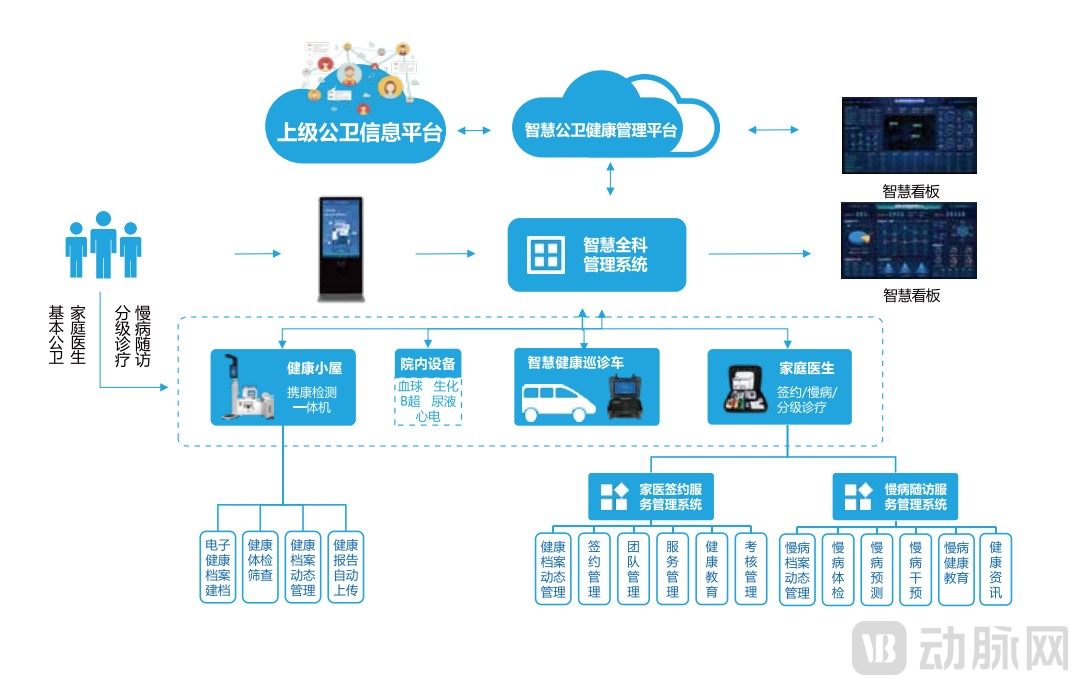
Jiekang Smart Public Health System
Chronic Disease Management Systems and Family Doctor Contracting Systems are tool-based platforms for primary healthcare institutions. The Chronic Disease Management System is provided to healthcare institutions, integrating data from all-in-one health monitoring devices. Based on this data, the platform performs initial chronic disease screening, follow-up assessments, health guidance, and two-way referrals. The Family Doctor Contracting System serves both primary care physicians and residents, enabling them to complete contracting, consultations, referrals, and other tasks on the platform.
Smart Elderly Care System and Student Health System Targeting the "Old and Young": The Elderly and Adolescents.
With the aging of China's population, the elderly care industry is entering a golden period of development, and smart medical and elderly care has risen to the policy level. The Jiekang Smart Medical and Elderly Care System provides the elderly with one-stop services ranging from self-service testing and online consultations to rehabilitation and physiotherapy.
The Student Health Management System comprises three components: students undergo physical examinations, examination data is integrated into the health management platform, and the data is disseminated to educational authorities, parents, and schools. The system prioritizes the management of myopia and obesity, with statistical analyses stratified by class, school, region, and age.
In February this year, Shenzhen Jiekang Network Technology Co., Ltd. delivered and implemented the Hubei Provincial Student Health Management Platform, covering 7 million primary and secondary school students in Hubei Province. According to Pan Xiwen, this is the first provincial-level student health management platform in China.
Bullish on the Internet's Future+Home Health Market
Regarding the future, Pan Xiwen stated that their current focus is primarily on the B2B sector. In the future, while expanding their B2B market presence, they will explore the C2C market, potentially launching home-use testing devices and a mobile app, which are already in the prototype stage. Pan Xiwen believes that future health management will be centered around the family as the smallest unit. Each household will require a health management tool to connect the health records of all family members and integrate comprehensive health services, such as chronic disease management and prenatal care. Jiekang will leverage this demand as an entry point to penetrate the consumer market.