

Canyon Oral Care Brand Shanban Files IPO Prospectus: Driving Oral Hygiene into Fast-Moving Consumer Goods through Full-Scenario, Omni-Channel, and Universal Accessibility
“Mouthwash can become a fast-moving consumer product, just like bottled water. Therefore, the biggest difference between Canban and other oral care brands is that it has ‘turned’ oral care into a fast-moving consumer affair, transforming mouthwash from a medicinal product into an FMCG,” said Zhang Yi, co-founder of Canban.
The name “Canban” is well known to end consumers as well as to investors and industry professionals who follow the oral care sector.
Beyond its rapidly surging product sales, the company’s widespread recognition is also underpinned by eight rounds of financing that have been widely discussed among industry insiders.
According to VCBeat, in 2020, Canban ranked second among the top 10 mouthwash products by sales volume on Alibaba’s platform, with an 11.3% market share and a growth rate of 42,357.369 times. The established mouthwash brand Listerine took the first spot with a 19.3% market share. It is evident that, based solely on market share, the gap between Canban and Listerine had already narrowed significantly by the end of 2020, despite Canban’s mouthwash products having been on the market for only three months at that time.
Moreover, according to Zhang Yi, in 2021, Canban sold a total of 20 million bottles of probiotic mouthwash and 30 million strips of portable mouthwash, ranking among the top in the domestic market.
Not only that, Canban’s growth potential has also been recognized by multiple investment institutions. Since its establishment in 2018, Canban has successfully completed eight rounds of financing, with investors including China Renaissance New Economy Fund (under China Renaissance), ByteDance, and Sinovation Ventures. In its Series B financing round in July 2021, the company raised RMB 400 million in a single round, demonstrating strong fundraising capabilities.
However, amid its rapid and sustained growth, Canban has also faced certain misunderstandings, with its phased successes being entirely attributed to its strong marketing capabilities.
In response, Zhang Yi told VCBeat that the logic behind the aforementioned view was somewhat putting the cart before the horse. “The fundamental reason for Canban’s standout performance in the capital markets is that we did the right things. Only with precise positioning and high-quality products can we earn users’ trust; marketing, at its core, is merely an amplifier.”
Unlike previous mouthwash brands that were developed with a pharmaceutical mindset, Canban believes that mouthwashes and even oral care products are fast-moving consumer goods (FMCG). FMCG refers to products characterized by high consumption frequency and short usage cycles.
There are two main reasons behind Canban’s judgment:
On the one hand, traditional oral care practices among domestic consumers are limited to toothbrushing, with most individuals brushing only twice daily—morning and evening. During the intervals between these brushing sessions, the oral cavity remains unattended. This “care gap” creates market opportunities for oral care products beyond toothpaste and toothbrushes.
On the other hand, in recent years, with the rapid improvement of the national economy and the successive introduction of policies such as the “13th Five-Year Plan for Healthy China” and the “Long-Term Plan for Chronic Disease Prevention and Control in China,” public awareness of oral care has been gradually shifting from traditional, extensive care to refined, multi-scenario, and multi-modal care. Driven by these various factors, the domestic oral care industry market has experienced rapid growth.
It is evident that the core of rapid consumer turnover in oral care lies in products with diversified usage scenarios, encompassing diversity in both product types and forms.
Whether in terms of product form or type, Canban’s product design has consistently been extended around full-scenario, all-around oral care.
First, let’s look at the types of Canban oral care products.
When it comes to Canban’s products, what likely comes to mind for most people is a bottle of probiotic mouthwash in blue or red packaging. This is the brand’s most “established” mouthwash product from the emerging player Canban. Centered around probiotic ingredients, the product’s key selling points are its alcohol-free formula and beverage-inspired flavors. The round bottle design complements the probiotic theme, thereby reinforcing the product’s core brand associations through both packaging and taste.
This bottled probiotic mouthwash has not only helped Canban build market awareness but also led many consumers to equate the brand with mouthwash.
However, Canban’s product philosophy is to meet users’ oral care needs across all scenarios. With this as its logical starting point, Canban has not only launched products with more pronounced home-use attributes, such as bottled mouthwash, toothpaste, teeth whitening strips, tooth powder, dental floss, and water flossers, but also introduced oral care products better suited for social situations, including portable strip mouthwash, oral lozenges, and oral sprays.
Notably, within its diverse product lineup, a key feature stands out: portability. This is a concrete embodiment of Canban’s FMCG-oriented branding philosophy for oral care products.
In the interview, Zhang Yi cited an example to VCBeat: During a business meeting, if strong-smelling foods are served at a business lunch but negotiations with clients need to continue afterward, one can only opt for products such as portable mouthwash or oral lozenges to clean the mouth and alleviate bad breath.
Consequently, portable and diversified products are becoming a fiercely contested market for oral care brands.
Furthermore, while advancing the diversification of its product forms, Canban has also introduced a variety of flavors to cater to the preferences of different consumer groups.
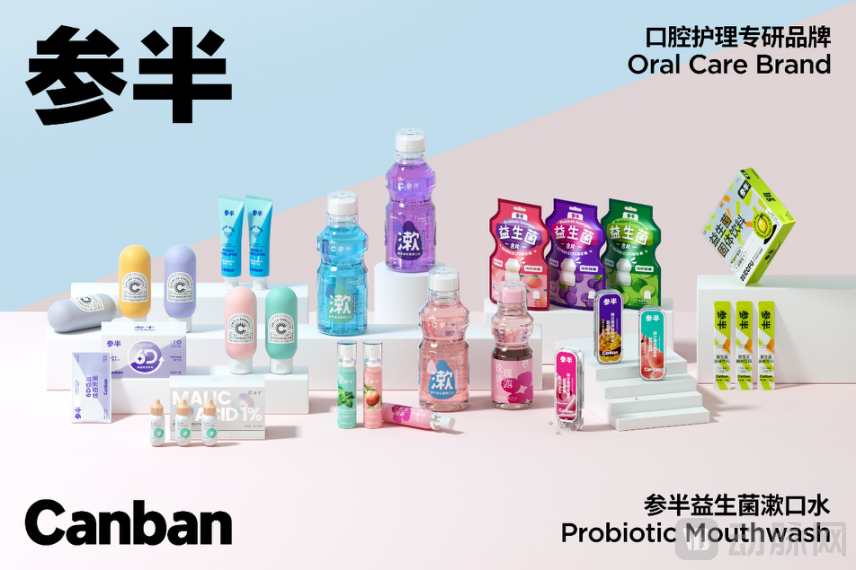
In addition to its early grapefruit, peach, and mint flavors, Canban has launched mouthwash products in grape, passion fruit, and even rose flavors. Its oral lozenges are also available in a variety of flavors, including grape, peach, lime, and coffee. Despite the diverse flavor options, all of Canban’s oral care products are alcohol-free, ensuring a mild and gentle taste.
“Previously, the relatively pungent taste of some branded mouthwashes led to a negative consumer perception of oral rinses to some extent. Milder textures and more diverse flavors can help users realize that oral care does not have to be a painful experience; on the contrary, it can be a relaxing and enjoyable one,” said Zhang Yi.
If transforming the texture and flavor of products is the first step in overturning consumers’ stereotypes about oral care, then the marketing strategy devised by Canban constitutes the second step.
Judging from Canban’s current marketing strategies—celebrity endorsements, IP collaborations, KOL partnerships, and co-created content—its approach leans more toward content dissemination, with a strong emphasis on cultivating a “relaxed and enjoyable oral care atmosphere.”
For example, in terms of celebrity endorsements, Canban officially announced Zhao Lusi as its brand ambassador in April 2021, Xiao Gui (Wang Linkai) as its oral care brand ambassador in October 2021, and Tan Jianci as its oral care brand ambassador this May.

These three brand ambassadors share certain on-screen traits: youthfulness, vitality, trendiness, and proven talent.
Take Zhao Lusi and Wang Linkai (also known as Xiao Gui) as examples. The former starred in multiple critically acclaimed and highly rated television dramas, including *The Romance of Tiger and Rose* and *Oh! My Emperor*. The latter is a Chinese mainland rapper whose original songs have won numerous awards.
The benefits of celebrity endorsements for Canban were highly evident. The mere announcement of Xiao Gui (Wang Linkai) as a brand ambassador propelled the topic onto Weibo’s trending list, ranking third on the hot search chart within the same day. Posts from Canban’s official Weibo account alone garnered 19 million views and 2.64 million interactions, with peak engagement for a single post exceeding 150,000.
Regarding the selection of co-branded IPs, Zhang Yi revealed that brand recognition is merely one consideration, with character personality traits being a more critical factor. Taking the co-branded IP for Canban mouthwash, Crayon Shin-chan, as an example, this IP has garnered a loyal fan base thanks to its mischievous, humorous, yet heartwarming “precocious child” persona.
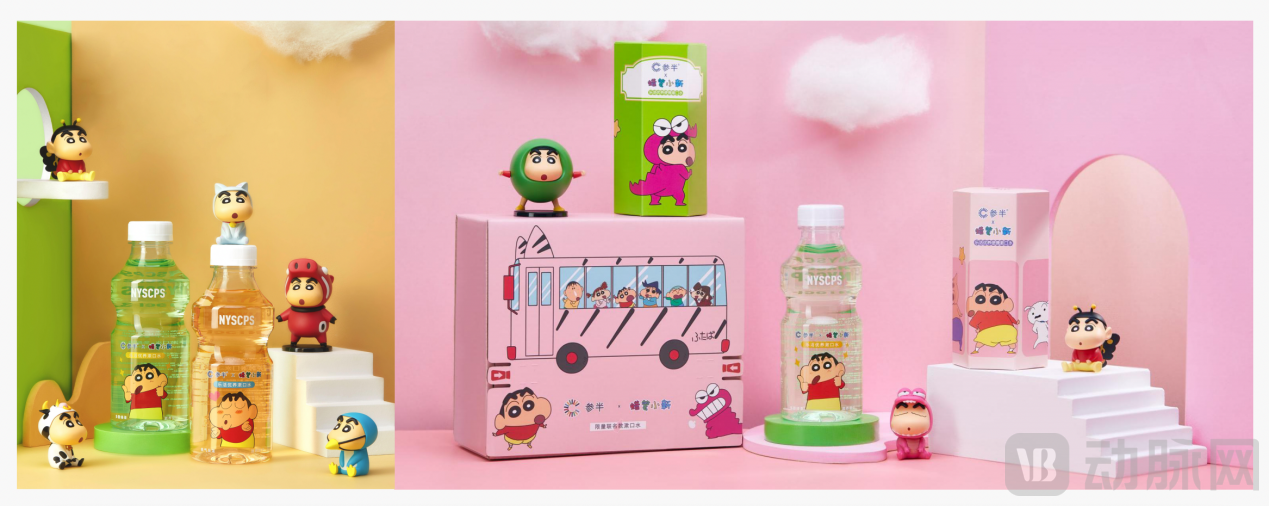
“There are three main reasons for choosing Crayon Shin-chan: first, it has a broad audience reach, spanning a wide age range of users; second, the Crayon Shin-chan character enjoys high recognition; and third, the character’s tone is cute and engaging,” said Zhang Yi. “In fact, when selecting any co-branded IP, Canban always considers the compatibility between the IP image and its products.”
In addition to co-branding with well-known IPs, Canban has also engaged in the creation and dissemination of other in-depth content. For instance, its co-branded product with the Chinese anime IP “The Legend of Luo Xiaohei” was featured in an anime work by the prominent anime influencer “Old Xian.” To date, this work has garnered 107,000 likes and 13,000 reposts, with over 5,000 comments.

Bolstered by its product capabilities and marketing prowess, Canban has achieved strong sales performance across e-commerce platforms. For instance, Canban’s mouthwash products rank first in their category on Tmall, Pinduoduo, Vipshop, Douyin, and Kuaishou, while its oral spray products are among the top three on Tmall, JD.com, Douyin, and Kuaishou.
It is evident that Canban’s online presence extends not only to established e-commerce platforms such as Tmall, JD.com, and Vipshop, but also to emerging platforms like Douyin and Kuaishou.
In April 2021, Canban officially commenced its offline expansion. To date, Canban’s products have been progressively introduced to more than 100,000 retail outlets, including Walmart, Yonghui Superstores, China Resources Vanguard, FamilyMart, 7-Eleven, KKV, Sanfu Fashion, Neptune Star Pharmacy, Laobaixing Pharmacy, and Yifeng Pharmacy.
Canban’s offline distribution channels are primarily categorized into four types: the first includes large supermarkets and hypermarkets such as Walmart and Yonghui Superstores; the second comprises convenience stores like FamilyMart and 7-Eleven; the third encompasses trendy retail stores such as KKV and Sanfu Fashion; and the fourth consists of chain pharmacies including Laobaixing Pharmacy and Neptunus Star Pharmacy.
Regarding the rationale behind achieving omni-channel coverage across online and offline platforms, as well as diversifying offline scenarios, Zhang Yi once again summarized it with a term beginning with “quan” (all/comprehensive): “comprehensive consumption scenarios.” The goal is to enable users to purchase oral care products with the same ease as buying daily necessities, ensuring that they can buy Canban’s products whenever and wherever they wish.
From the perspective of market competition, Canban’s aggressive marketing strategy stands in stark contrast to the gentle image projected by its products. As Zhang Yi revealed to VCBeat in an interview, this reflects Canban’s development ethos: “In today’s fiercely competitive market environment, a defensive stance is unsustainable; only by attacking more aggressively can we capture greater market share.”
Furthermore, Zhang Yi stated that the oral care sector tests a company’s overall organizational capabilities, including product R&D, supply chain management, brand building, and traffic acquisition. Therefore, Canban will focus its efforts on three key areas in the future:
First, expand channel coverage; second, continuously invest in R&D and collaborate with professional institutions to develop new products, thereby meeting consumers’ oral care needs across diverse scenarios through ongoing innovation; third, establish self-owned production lines to strengthen supply chain capabilities.
Beyond enhancing corporate competitiveness, Canban is also deeply committed to social welfare initiatives.
VCBeat has learned that since 2021, Canban has participated in or initiated multiple public welfare campaigns. For instance, in July 2021, upon learning that heavy rainfall in Henan Province had caused water outages, leaving local residents unable to brush their teeth with clean water, Canban promptly donated a batch of essential oral hygiene products valued at RMB 1 million through the Zhengzhou Charity Federation.
On International Women’s Day this year, Canban launched the “Honoring the Mulan Warriors of the Epidemic Fight” campaign and donated nearly one million yuan worth of oral care products to anti-epidemic sites, including the Shenzhen Women Volunteers Association and the Haitao Community Work Station in Haishan Subdistrict, paying tribute to the healthcare workers on the front lines of the epidemic response.
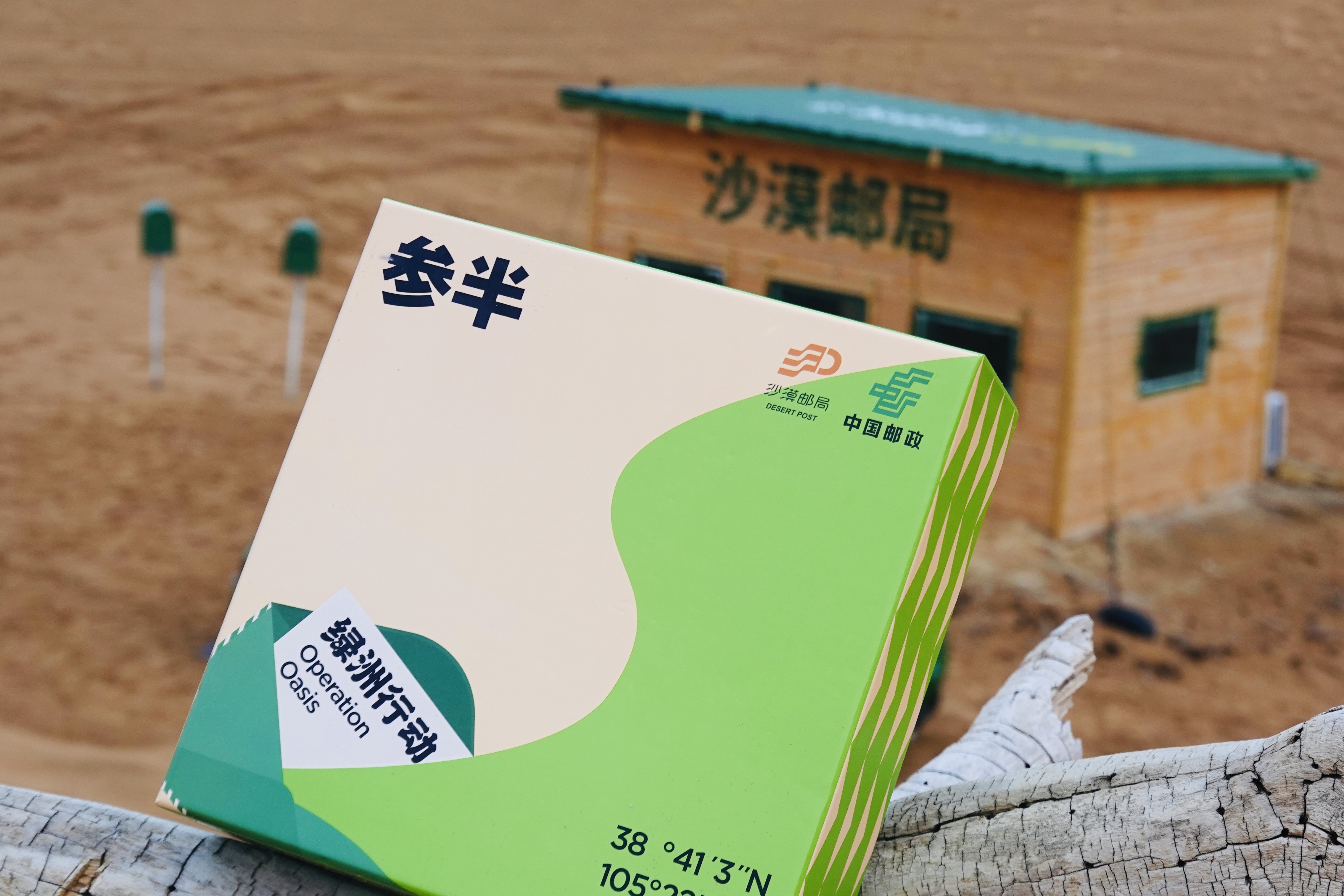
On June 20, to raise public awareness about desertification control, Canban partnered with the Desert Post Office to launch the Oasis Initiative. For every Canban Oasis co-branded gift box sold, Canban will donate 10 yuan toward desertification control efforts.
“Active participation in public welfare initiatives and the assumption of greater social responsibility reflect Canban’s commitment to creating value for a broader user base. ‘We aim to build a business that serves the public good and promotes inclusivity, rather than a niche venture catering only to an elite few,’ summarized Zhang Yi. ‘After all, Canban’s vision is to safeguard the oral health of one billion Chinese people.’”