

Y Combinator Files for IPO After 17 Years of Scaling Global Innovation

Y Combinator Continuity Fund
Early-Stage Venture Capital Fund
Airbnb, Stripe, Instacart, Coinbase, DoorDash, Cruise, OpenSea, Faire, Brex, and Reddit—these ten top global unicorn companies all share the same early-stage investor behind them: Y Combinator (hereinafter referred to as “YC”), renowned for its angel investing and incubation acceleration.
As the largest startup incubator in Silicon Valley and one of the top-tier incubators globally,YC was featured by The New York TimesHailed as “Silicon Valley’s innovation company factory,” it was named the most valuable incubator of 2012 by Forbes.

Note: Some Companies Incubated by Y Combinator
According to data disclosed on its official website, Y Combinator (YC) has cumulatively invested in and incubated more than 3,000 startups to date, building a vast community ecosystem comprising over 7,000 founders, with the aggregate valuation of all its portfolio companies exceeding $600 billion. In 2021, YC retained its top position on Crunchbase’s ranking of venture capital firms, leading with 797 early-stage investments.
YC pioneered the startup accelerator model, which has been widely replicated globally. Nevertheless, it continues to dominate the field, having long transformed its accumulated success into a series of compounding advantages that clearly distinguish it from traditional venture capital firms in the market.
So, in what aspects does YC demonstrate its distinctiveness? How has it managed to expand horizontally within Silicon Valley’s innovation circle? What implications does this hold for the entire innovation ecosystem? Looking at China, can we create a similar “myth” of an accelerator like YC? To answer these questions, VCBeat’s Orange Bureau has conducted an in-depth analysis of YC.
YC’s Beginnings: An Unconventional Team, A Tradition-Breaking Philosophy
The founding story of YC is quite legendary.
In 2005, it had been seven years since Paul Graham, Trevor Blackwell, and Robert Morris sold their company, Viaweb, to Yahoo in an all-stock transaction valued at $49 million.
Unwilling to remain in obscurity, three Harvard PhDs joined forces with their collaborator Jessica Livingston to launch a three-month startup training program. After the initial demo day, the four co-founders realized that their initiative had significant potential for expansion. Consequently, they formally embarked on building what would later become Y Combinator, the massive incubator engine it is today.
YC boasts an eclectic team. Co-founder Paul Graham is not only passionate about programming but also has a strong interest in art; after earning his Ph.D. in Computer Science from Harvard University, he went on to study painting at the Rhode Island School of Design and the Florence Academy of Art.
Graham’s close friend, Robert Morris, was a naturally gifted programming prodigy. He was expelled from Harvard University for reconnecting its network to ARPANET, later transferred to Cornell University, and wrote the code for one of the internet’s first pieces of malicious software. Driven by curiosity, the “Morris Worm” he created quickly spread across Harvard, Princeton, Stanford, and NASA.
Morris was prosecuted by U.S. authorities under the Computer Fraud and Abuse Act (reportedly the first person ever to be so charged), subsequently fined $10,000, and sentenced to community service and three years of probation. Morris’s curiosity may have landed him in considerable trouble, but his talent is unquestionable.
The third co-founder was Trevor Blackwell, who joined after Graham and Morris had launched the Viaweb project. Graham and Morris’s initial idea was to build the world’s first “web application,” enabling businesses to create and host online stores—a fairly cutting-edge concept at the time, so they needed additional support. When Graham asked Morris who the smartest person he knew from graduate school was, Morris replied: Trevor Blackwell.
The fourth co-founder was Jessica Livingston, who met Paul Graham at a party and later became his wife. Through Graham, Livingston learned more about the startup world and grew increasingly interested in it, deciding to apply for a job at a venture capital firm. However, the firm’s protracted decision-making process inadvertently gave Livingston and Graham time to reflect on the shortcomings of the prevailing VC model.
Rather than attempting to reform existing VCs from within, why not simply start your own VC firm?
Livingston, nicknamed the “Social Radar,” possesses a keen intuition for founder traits, perfectly complementing the technical analytical capabilities of the three programmer co-founders. Graham promptly invested $100,000 in the new entity helmed by Livingston.
Blackwell and Morris also decided to join as partners, each investing $50,000 into an entity initially named “Cambridge Seed.” They likely soon realized the geographical limitations implied by this name and quickly pivoted to a broader term derived from the concept of recursive functions in programming:Y Combinator。
YC was not initially recognized as an incubator. Don Dodge, a developer advocate and angel investor at Google, happened to attend YC’s early roadshow. “There were more than 20 investors present, all traditional venture capitalists and angel investors, but none were impressed by YC. No one, including YC’s founders themselves, would have predicted that YC would eventually become the world’s largest and most successful startup accelerator.”
YC adopts a “shotgun-style” (high volume, broad coverage) investment philosophy, as opposed to the traditional VC “rifle-style” approach (low volume, relatively precise)., with a focus on early-stage venture investment and supportive development strategies, it implements an investment style characterized by broad sourcing with targeted nurturing and category openness, and is regarded as a breakthrough from the traditional VC model of the 1970s.
The Development of YC: A Full-Stack Operating Model Fosters Its “Strong Roots and Flourishing Branches”
Although most people often refer to YC as a “startup accelerator,” YC’s partners are not particularly satisfied with this label. They would prefer that people view YC’s program as a type of university program.
Sam Altman, YC’s former “helmsman,” believes that this is the future of startups: “The more robust the support system we provide for innovators, the higher the quality of our projects; the stronger our alumni network, the more outstanding companies we can attract to join.”
To this day, YC has long diverged from the traditional startup accelerator model; it is a full-stack product and an enabling investment institution that supports companies through every stage, from inception to IPO. It provides founders with various resources conducive to growth, including workspace, networking opportunities, and team management support, while offering comprehensive guidance on product development, business planning, and fundraising.
So, how exactly does YC provide empowerment?
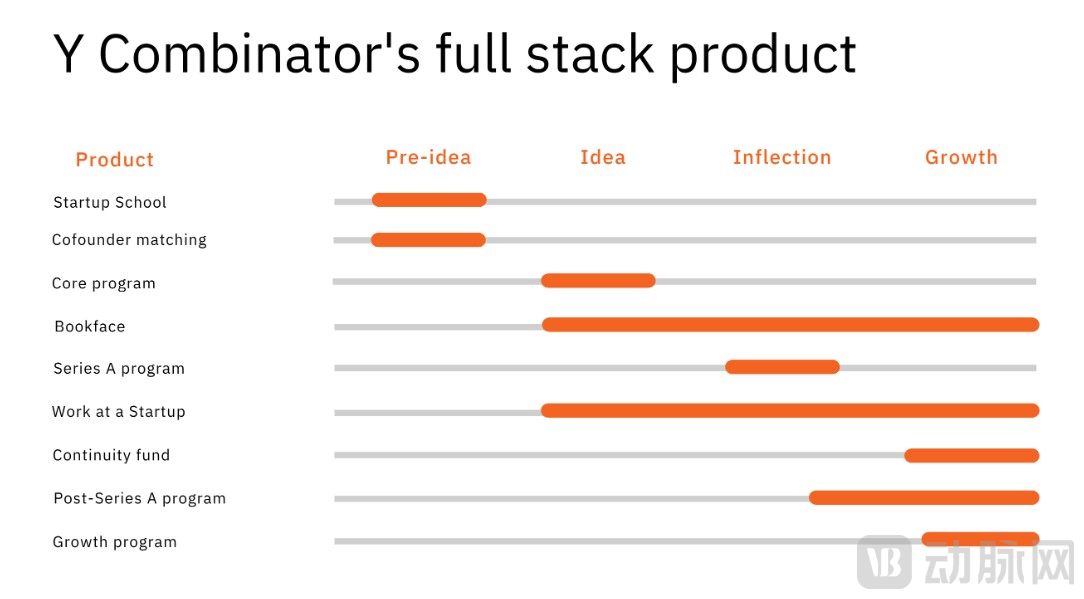
YC offers Startup School, a seven-week free online course open to aspiring founders, who can access the curriculum through an online portal. The 2021 cohort has already surpassed 40,000 participants.
In July 2021, YC launched another product targeting this stage: Cofounder Matching. After completing their profiles, aspiring entrepreneurs can connect with matched co-founders based on their interests and ambitions. To date,Facilitated over 9,000 co-creation matches. YC does not charge any fees for these services.
Unlike the lenient admission criteria of Startup School, YC’s flagship accelerator program has an acceptance rate of just 1.5%, earning it the prestigious moniker “the Harvard of Silicon Valley.”
YC invests $500,000 in each startup under standard terms, split across two separate SAFEs: $125,000 via a post-money SAFE for 7% equity, and $375,000 via an uncapped SAFE with a most-favored-nation (MFN) clause.
Founders entering the Y Combinator (YC) Accelerator undergo a three-month program training, during which they receive startup coaching and benefit from experience-sharing sessions. In addition, YC hosts weekly dinner gatherings where all teams in the current cohort come together to share insights and exchange experiences, or invite successful entrepreneurs to deliver talks. There is also a session known as “Office Hours,” during which participating teams meet directly with YC partners and undergo rigorous “scrutiny.”
YC designates one day at the end of its program as “Demo Day.” On that day, angel investors and other venture capital firms from Silicon Valley attend to watch product demonstrations by each startup.
During these three months, YC’s top priority is to help startup teams build their products and drive rapid product development. Once a startup has a launch-ready product, YC assists founders in showcasing it to users and the media, helping them secure their first customers and pitch opportunities.
“YC is akin to a training ground where you can learn the essentials of founding and managing a company in three months, putting them into practice with the guidance of the world’s top mentors and advisors,” said angel investor Dodg. “Moreover, YC’s alumni network is an invaluable resource, enabling startups and founders to access core resources such as expert advice and talent.”
YC internally operates Bookface, a platform that connects founders—a private social network encompassing the vast majority of the world’s most exceptional entrepreneurs.It is the place where YC 7000+ founders connect, ask questions, and learn from each other. Each founder has their own profile and can tag themselves as an expert in any topic. If you have questions, need introductions, or want to explore knowledge, you can post requests on the Bookface forum. This means that,Joining the YC Accelerator unlocks access to a global startup ecosystem and provides an extensive professional network.
Since 2018, YC has begun providing assistance to startups during the so-called inflection point stage, namely the Series A financing round. According to Hariharan, General Manager of YC, YC helps founders assess their “readiness” for this round of financing, leveraging its extensive data and expertise to evaluate PMF (Product-Market Fit).
The YC Continuity Fund provides detailed resources, including a full suite of material templates and assistance in evaluating investment terms. Beyond exercising pro-rata rights, YC typically does not lead Series A rounds, instead allowing the market to determine the valuation of its portfolio companies.
From this stage onward, the incubation value of YC will become increasingly significant. Startup Jobs, a platform for applying to job opportunities at YC-backed companies, was officially launched in June 2018. Job seekers need only register their profile information once to apply for hundreds of open positions on the platform.
“The quality of job applicants is truly impressive,” remarked a Y Combinator (YC) alum. “You can see highly talented engineers from major tech platforms like FAANG uploading their resumes.” According to him, 75% of the engineers at startups such as Brex, WhatNot, and Faire come from this platform, and executive-level hires receive additional recruitment services.
The Continuity Fund is dedicated to helping founders scale their companies, primarily by providing follow-on financing to Y Combinator (YC) alumni companies, while occasionally investing in non-YC companies as well. To date, the Continuity Fund has made 36 investments, with portfolio companies including Stripe, OpenSea, Coinbase, Webflow, Ironclad, and Podium.
YC tends to invest in companies that demonstrate strong product-market fit, typically during Series B or later rounds, with investment sizes ranging from $20 million to $100 million. YC states that while it does not adhere to strict valuation parameters when making investments, it seeks out startups with clear business models and customer appeal.
In addition to investment, the Continuity Fund also provides two empowerment program courses to support the business development of its portfolio companies. The first isPost-Series A Business Focus: Strengthen Product-Market Fit, Accelerate Project Progress, and Prepare for Series B Funding. Founders are “re-batched” during the six-week course to meet new peers.
The second project isFor true growth-oriented businesses, focusing on the core proposition of “How CEOs Lead Growth”Founders are taught best practices in performance management, leadership, and financial planning. YC leverages its alumni network to provide tactical advice for the program. To date, YC Continuity has run 12 cohorts of this empowerment initiative, supporting up to 200 startups annually through these two courses.
YC’s Winning Edge: People-Centric, Continuous Innovation, Recursive Loops, and Inclusive Diversity
YC has now become an indispensable part of Silicon Valley’s startup and innovation ecosystem. Treating the startup accelerator as a charitable endeavor, always putting people first, continuously pursuing innovation, and building a healthy, self-reinforcing ecosystem—along with an inclusive and diverse investment style—have contributed to YC’s current success.
YC positions itself not merely as an incubator, but places greater emphasis on delivering empowerment services, aiming to provide entrepreneurs with practical and sustainable support to meet their incubation needs.
At YC, people always come first.Founder Graham stated, “YC no longer evaluates companies based on their business models, nor does it replace founders with professional managers; instead, it selects companies based on their founders and provides them with full support.” Former “head” Altman also publicly remarked, “I firmly believe that wise and ambitious individuals will shape future trends regardless of their endeavors. Of course, I also consider it crucial to think dialectically about future development.”
“Smart people’s actions are the best guide to future trends,” said Younis, a partner at YC. “It is not venture capitalists or angel investors who shape the market, but individual founders who develop products and the choices made by the world.”
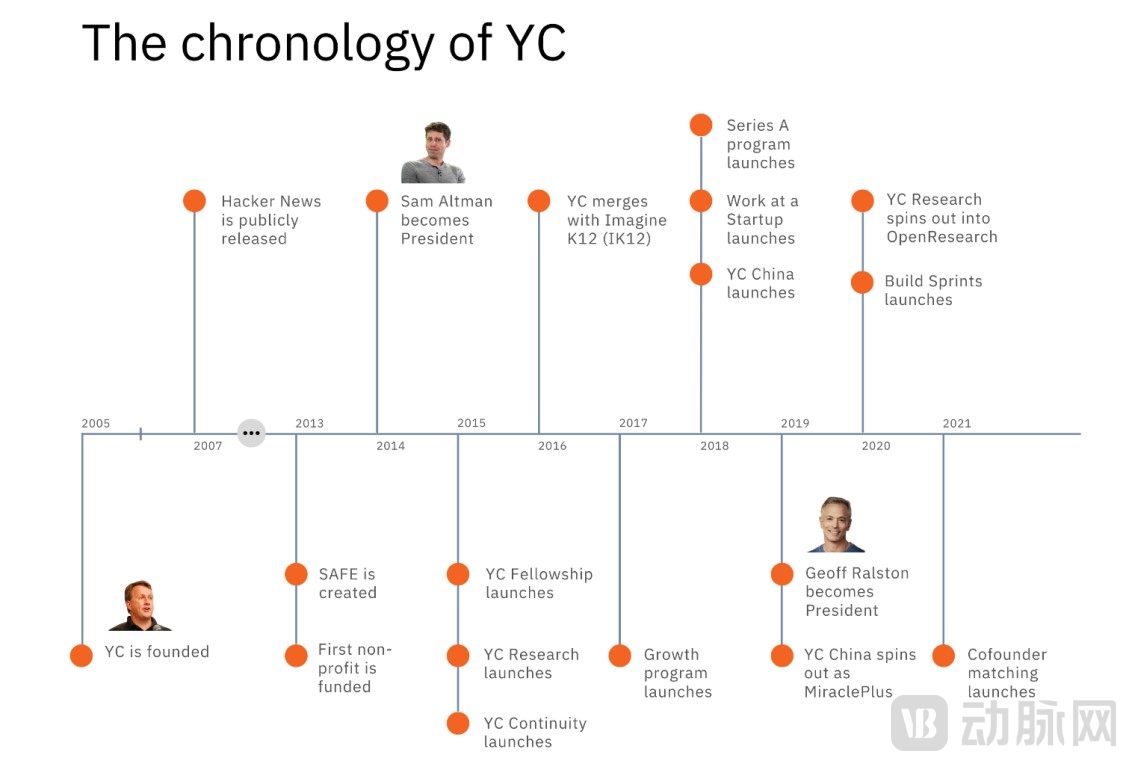
Never one to stick to convention, YC regularly explores new initiatives, such as launching Startup School and Female Founders, accepting late-stage startups like Quora into its portfolio, and introducing new incubation programs like Fellowship.
Since its launch, Startup School has attracted 13,000 to 15,000 applicants annually, with a course completion rate consistently around 50%—higher than that of online courses offered by top research institutions such as Harvard and MIT.
Current President Geoff Ralston stated in an interview, “We are a ‘filter’ for the world, aiming to drive global innovation. Undoubtedly, this also serves our own interests—we hope to attract more outstanding companies to apply to YC.”
YC has been evolving, yet its original intention and mission appear to have remained unchanged over the years—a startup that continuously creates more startups.
Teams that join YC are all labeled as YC alumni. This not only allows young teams to have close contact with companies previously successfully incubated by YC and gain opportunities for collaboration, but also enables mutual learning and exchange among companies in the same cohort.For instance, software companies that customize solutions for enterprise users can directly promote their products to previously successfully incubated enterprises and surrounding startups, which significantly boosts product promotion and development. Such collaboration fosters strong complementarity among businesses.
In an article, angel investor Dodge wrote: “YC operates like a recursive loop, continuously attracting outstanding entrepreneurs. These exceptional founders, in turn, bring in more visionary investors and achieve top-tier valuations. Such premier valuations then draw waves of experienced startup advisors, who subsequently attract cohort after cohort of entrepreneurs, creating a self-sustaining cycle.”
YC demonstrates a level of inclusivity and diversity unmatched by traditional VC firms, spanning the founders it backs, the size of each cohort, the sectors it invests in, and its geographic reach.
YC has sent a clear signal to underrepresented founders (“underrepresented” typically refers to women, Black, and Latino individuals): “You are welcome in the tech industry. We hope you feel the same here. We believe in your potential, and we are committed to D&I (Diversity and Inclusion) to ensure that you have the same opportunities as white, heterosexual individuals in the tech sector.”
According to data from PitchBook and Accenture, Y Combinator (YC) has significantly outpaced all other venture capital firms in the United States in supporting underrepresented founders over the past two years. Data provided by YC indicates that approximately 35% of startups accepted into its program in 2019 were co-founded by underrepresented entrepreneurs. In 2022, this figure rose to approximately 35.5%. Among the companies selected in 2022, Black founders accounted for at least 8%, while women and Latinx founders represented approximately 19% and 13%, respectively.
An industry-level analysis of YC’s investments also reveals a trend toward greater diversity. Since 2011, the share of fintech companies in YC’s accelerator program has grown steadily, rising from approximately 7% to 24%. Over the same period, healthcare startups have seen a significant increase, climbing from 5% to 10%. In contrast, consumer-focused startups have declined, dropping from 30% to 14%. Similar diversification is evident when examining major secondary subsectors such as B2B, fintech, and consumer.
Lessons from YC: Cultivating Community-Based Incubators Suited to China’s Context
On August 15, 2018, YC announced its official entry into China. Qi Lu, former President of Baidu Group, was appointed as Founder and Chief Executive Officer, with full responsibility for YC’s business development in China. He also serves as Dean of YC Global Research, leading the institute’s cutting-edge scientific research.
At the time, YC’s goal was not only to engage with China’s top startups but also to build a bridge linking tech companies in the United States and China.
However, more than a year later, YC announced its withdrawal from the Chinese market and stated that it would no longer establish separate overseas branches. Lu Qi led the former YC China team to establish an independent brand accelerator: MiraclePlus. According to insiders, YC’s exit from China was due to leadership changes—Geoff Ralston replaced Sam Altman in managing YC in 2019. Ralston made strategic decisions based on the global environment, with a future focus on seed-stage acceleration business.
YC believes that China’s startup ecosystem is robust, but early-stage founders often lack guidance and funding. YC partner Migicovsky stated, “It is very easy for entrepreneurs in China who are experienced, have successfully built a company, and possess strong networks to secure funding. The challenge lies at the beginning—for instance, for an engineer who has just graduated from Tsinghua University, with no experience in running a company and no access to market-oriented resources. Providing training and helping them connect with capital is where YC excels.”
Lu Qi stated that many entrepreneurs endure rigorous interviews solely to secure Y Combinator’s endorsement, which they then leverage to raise capital from Chinese investors. Given that YC invests $150,000 for a 7% equity stake and requires participation in its U.S.-based incubation program, the U.S.-centric model of Y Combinator is not entirely suited to China’s local context. Lu Qi believes that it is essential to establishEstablish incubation brands better aligned with China’s national conditions to enhance brand recognition among Chinese entrepreneurs.。
YC CEO Hariharan stated that YC is, in essence, replicable. However, if one truly intends to replicate YC elsewhere, the most critical factor is whether that location can successfully replicate YC’s DNA.
YC is, in essence, a sharing economy, with its core DNA rooted in the entire innovation and entrepreneurship community. There is often a disconnect between the perspectives of entrepreneurs and investors. “Entrepreneurship is typically a lonely journey; just imagine what it means to be able to seek help from thousands of people simply by asking,” says founder Livingstone, who believes this is precisely the value generated by the community.
The knowledge structure of the YC community is both broad and deep—its founders are outstanding experts in various fields worldwide, and many entrepreneurs have successfully collaborated or sold their products to one another on this platform.
Whenever investors attempt to influence founders’ decisions or disrupt project progress, YC negotiates with them to vigorously protect its entrepreneurs. Investors who are unfriendly toward YC startups will not be invited to Demo Day. The YC community fully safeguards the interests of entrepreneurs.
YC Partner Adora Cheung stated that China’s startup ecosystem holds tremendous potential and could even surpass the United States to become the world’s leading economy. However, regardless of future developments, Chinese business incubators must keep pace with the times and respond to the ever-changing market environment.
First, enhance reputation by addressing entrepreneurs’ long-term challenges.Reputation is crucial for incubators, as it fosters entrepreneurs’ trust in the platform—for instance, by assisting startup projects in securing financing, thereby enabling them to grow without concerns.
Second, truly understand the needs of entrepreneurs and provide them with proactive and sustainable services.Many entrepreneurs are concerned that the services provided by incubators are unsustainable, which significantly undermines their confidence in selecting an incubator. Incubators need to better understand entrepreneurs’ needs and proactively provide corresponding services.
Third, build a community platform for entrepreneurs.Many founders start from scratch; incubators should provide coaching services from the outset and introduce relevant partners to enable these enterprises to support one another and achieve rapid growth.
YC partner Younis once stated that making Silicon Valley “more survivable for founders” is YC’s enduring legacy and the goal it has relentlessly pursued. Turning our attention inward, making China a more fertile ground for innovation and entrepreneurship serves as the guiding principle and direction of effort for Chinese founders and incubators in the years ahead.