

Maxxglory Leverages Nanobiosensing Technology to Enhance Accuracy of COVID-19 Antigen Testing, Supporting High-Level Global Pandemic Response
As the COVID-19 pandemic enters its third year, epidemic prevention and control strategies both in China and abroad have undergone a series of adjustments, with significant changes occurring in areas ranging from viral characteristics and testing methods to diagnostic approaches and treatment protocols.
First, from the original SARS-CoV-2 strain to the Delta and Omicron variants, and further to the BA.4/BA.5 subvariants with stronger immune evasion capabilities and a higher propensity for reinfection, the transmissibility of the novel coronavirus has increased several-fold. Meanwhile, with the widespread administration of COVID-19 vaccines and the successive market launch of specific antiviral drugs, the rates of severe illness and mortality associated with COVID-19 have continued to decline.
In this context, the value of antigen testing has begun to be recognized. In March this year, the National Health Commission issued the "Trial Implementation Plan for the Application of Novel Coronavirus Antigen Testing," deciding to add antigen testing as a supplement to nucleic acid testing in order to further optimize novel coronavirus testing strategies and serve the needs of epidemic prevention and control.
The greatest advantages of antigen testing are its rapid turnaround time, low cost, and support for at-home self-testing. However, compared with nucleic acid testing, it exhibits relatively lower sensitivity and specificity, and thus serves only as a supplementary tool to nucleic acid testing for screening specific populations.
Zeng Weirong, Founder of Guangdong GeekLiang Technology Co., Ltd. (hereinafter referred to as "GeekLiang")It is believed that in China, nucleic acid testing currently serves as the gold standard and primary method for pandemic control, with antigen testing playing a supplementary role. The national implementation of the dynamic zero-COVID strategy relies on early detection, early isolation, and early treatment as key to success. Due to the generally low positive detection rates of antigen tests both domestically and internationally, with actual sensitivity below 80%, this low-cost, high-efficiency testing method has not yet become the primary testing approach in China.
Internationally, countries in Europe and the United States have adopted antigen testing as the primary method. While testing performance previously varied significantly, new regulations now impose stricter requirements on detection rates for both symptomatic and asymptomatic individuals: the FDA mandates a sensitivity greater than 90%, and the CE mark requires greater than 80%. This implies that products with an actual sensitivity generally below 80% will be eliminated from the market.
Zeng Weirong stated,Unlike diagnosis, screening targets individuals who typically present no symptoms of COVID-19 or suspected exposure; therefore, greater emphasis should be placed on the cost-effectiveness, timeliness, and convenience of testing methods., with the aim of identifying cases with sufficiently high viral loads in the body, rather than diagnosing COVID-19 patients. Consequently, the methodological characteristic of COVID-19 antigen tests—requiring viral levels in the sample to reach the culture threshold to yield a positive result—offers greater health economic value.
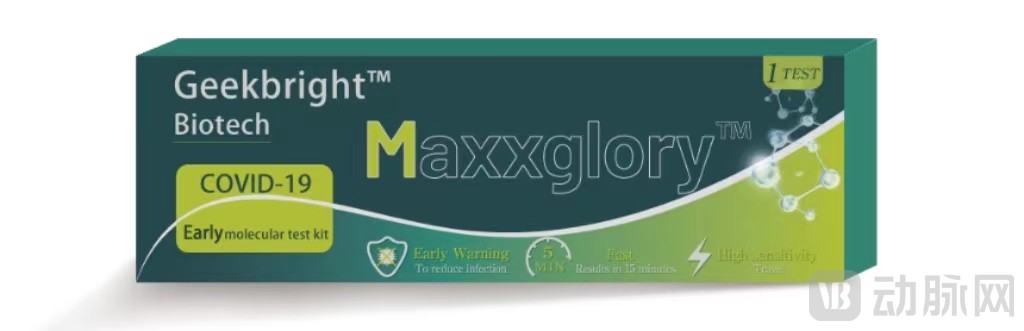
In this context, GeekBright has leveraged nanobiosensing technology to develop the Maxxglory GeekBright Test Kit, in"Enhances clinical detection rates while ensuring rapid testing speed", effectively achieving cost-effectiveness, timeliness, convenience, and accuracy in screening methods.
Leveraging Nanobiosensor Technology to Enter the COVID-19 Antigen Testing Market
GeekLiang was established in 2016, initially focusing on energy efficiency and fire safety for new energy vehicles. It addressed the need for energy conservation to mitigate driving range fluctuations, as well as the requirement for flame-retardant, fire-resistant, and high-temperature-resistant materials to prevent thermal runaway and combustion.
In the field of materials technology, Geek Bright has developed a series of innovative graphene and nanomaterials, holding more than ten invention patents. The company’s most notable achievement to date is its total internal reflection nanotechnology, which was used to create the diamond-grade logo effect on the iPhone 4 and 4S, paying tribute to Steve Jobs’ spirit of pursuing excellence and perfection.
According to Zeng Weirong, “Geek” refers to those who pursue technology, fashion, and innovation as the highest meaning of life, while “Liang” (Bright) signifies illuminating the sparks that guide human progress. The original intention behind founding GeekLiang was “to serve human health and safety with cutting-edge innovative technology.”
Guided by this original aspiration, GeekLiang was invited in 2020, following the sudden outbreak of the COVID-19 pandemic, to participate in scientific and technological research projects organized by the Guangdong Provincial Department of Science and Technology and the Guangdong Provincial Center for Disease Control and Prevention, focusing on the detection, disinfection, prevention, protection, and treatment of the novel coronavirus.
As the project advances, GeekBright has achieved a breakthrough in antibacterial and antiviral nanomaterials. The durable, washable antiviral functionality is applied to object surfaces and protective clothing, while also enabling targeted therapy through efficient antiviral drug delivery.
Zeng Weirong, founder of Geek Bright, graduated with a degree in Polymer Chemical Engineering. He has dedicated 26 years to research in chemical synthesis and has previously worked for research institutions and major international chemical companies.
Twenty-six years of research have given Zeng Weirong a profound understanding of the importance of molecular design and synthesis, as well as atomic assembly, in the development of high-performance materials, and an even deeper recognition ofThe Importance of Interdisciplinary Collaborative Research“Every single discipline faces two sides of the same coin when addressing practical problems; you can’t have your cake and eat it too. For instance, high hardness and ultra-toughness are generally mutually exclusive,” said Zeng Weirong.
Guided by this mindset, Zeng Weirong enrolled in the EMBA program at Tsinghua University’s School of Economics and Management, integrating comprehensive knowledge across society, management, marketing, finance, and the humanities, with the aim of building a higher-caliber enterprise and giving back to society through superior services.
When asked why the company chose to enter the COVID-19 antigen testing market, Zeng Weirong stated,High-precision testing and high-level technological support for pandemic response are both essential and valuable.GeekBright applies nanobiosensing technology to enhance the accuracy of COVID-19 antigen testing, supporting high-level epidemic prevention and control. “Whether symptomatic or asymptomatic, our product has achievedActual clinical detection rate >95%, specificity 100%。”
“If testing is not fast and accurate enough, requiring repeated isolation and multiple rounds of long-term testing, the social costs would be prohibitively high. Technology-driven epidemic prevention can achieve dynamic zero-COVID at the community level, buying time for China’s research on effective vaccines and therapeutics,” said Zeng Weirong.
Promoting More Efficient, Precise, and Convenient COVID-19 Antigen Testing
GeekLight CompanyLeveraging Nanobiosensing Technology, developed aMaxxglory GeekBright Test Kit.According to Zeng Weirong, this test kit has three advantages: first, it is early.Infection can be detected by testing within half a day to 3 days., results available in 15 minutes, symptoms are not necessarily required; the second test shall prevail,Specificity 100%, sensitivity >95%, CT threshold ≤35; thirdly, it is fast,Cross-Border and Cross-Regional Three-Day Quarantine Becomes Possible, for epidemic control efforts aimed at restoring normal social functioning, striving for optimal cost-effectiveness has become possible.
On June 28, the National Health Commission released the Ninth Edition of the Prevention and Control Plan for COVID-19, proposing to shorten the quarantine period for inbound travelers and close contacts from “14+7” days to “7+3” days. The following day, the Ministry of Industry and Information Technology announced the removal of the “asterisk” marker on the Communication Itinerary Card, aiming to support the efficient coordination of epidemic prevention and control with economic and social development, and to facilitate travel for the general public. The introduction of these new measures does not signify a relaxation of COVID-19 prevention and control efforts, nor does it indicate an abandonment of the “Dynamic Zero-COVID” policy; rather, they represent precisely targeted prevention and control strategies implemented in light of the current epidemiological situation.
“This aligns with our projected trajectory for epidemic prevention and control,” said Zeng Weirong.
GeekLiang’s Maxxglory Test Kit utilizes nanoprobe technology and high-efficiency riveting to achieve liquid chromatography and enhanced display. It offers a more convenient alternative to testing methods that rely on external tools, such as fluorescence, luminescence, and quantum dots.
In the future, this product will serve both consumer markets—enabling individuals to protect themselves, their families, and their employees—and government-level applications, such as ports, major sporting events, and conferences.
It is reported that GeekLiang is currently collaborating with government pharmaceutical regulatory authorities and disease control and prevention agencies to apply for NMPA Class III medical device certification and EU CE marking. The company is also in negotiations with enterprises holding FDA Emergency Use Authorization (EUA) to explore multiple pathways for market entry and adoption across various countries and regions.
According to Zeng Weirong’s forecast, over the next 5–10 years, balancing epidemic prevention with work and daily life will become a new normal, making effective protection and efficient, precise testing most critical.
Looking to the future, GeekLiang’s mid-term goal is to innovate graphene-based precise targeting carriers and detection systems for COVID-19 and cancer drugs, providing efficient delivery and sensing solutions for COVID-19 vaccines, therapeutics, and cancer treatments. By fully leveraging the Maxxglory biosensing platform, we aim to serve human health.
“GeekBright’s vision is to leverage technology to safeguard human health and enable people to live beyond 120 years. ‘Building on our long-established platform technologies in molecular synthesis, molecular design, and atomic-level assembly, we aim to attract more interdisciplinary talent, continuously advance research and development, and strive for greater breakthroughs in nanoscale smart materials and life-health technologies, thereby providing smarter technological products for biosafety protection and human health monitoring and treatment,’ said Zeng Weirong.”