

How AI-Driven Smart Medical Records Are Thriving Amid China's DRG/DIP Reforms: The Rise of Yisheng Intelligence
In recent years, the rapid advancement of national medical insurance DRG/DIP payment reforms has become a key force reshaping hospital management. The smart medical record industry, which serves as the foundation for DRG/DIP payments, has seen significant growth in recent years, attracting considerable attention from capital markets.
Recently, Probes Capital, a leading domestic boutique investment bank focused on the healthcare sector, released the "Research Report on the Smart Medical Record Industry," marking the first research report in the industry specifically targeting the smart medical record field. The report indicates that, driven by policies such as DRG/DIP payment reforms under medical insurance and hospital accreditation and evaluation, the smart medical record industry is experiencing rapid development. An emerging market worth over RMB 30 billion is expected to emerge, spanning from infrastructure for medical record quality control to typical application scenarios of medical record data.
Medical records are the complete medical charts formed after archiving. They are documented records compiled, analyzed, and organized from archived text, charts, images, and other materials generated by healthcare professionals during medical activities such as patient consultation, examination, diagnosis, treatment, and nursing care. As a type of medical documentation with records dating back to the 6th century BC, it is indispensable in modern medical services. It not only spans the entire medical process but also reflects the level of medical service and management of hospitals, playing a significant role in medical administration statistics, scientific research and teaching, legal disputes, and economic assessment.
Obviously, only accurately documented medical records can fulfill their intended value. However, due to various factors such as non-standardized documentation practices in healthcare institutions, significant interdisciplinary cognitive disparities, and a shortage of quality control experts, medical record data often deviate substantially from the actual clinical care process, or even fail to reflect it altogether. This discrepancy causes unnecessary losses for hospitals in scenarios such as health insurance settlement and accreditation evaluations.
Therefore, smart medical records have emerged as a technological solution to address quality management challenges in medical record keeping. By leveraging information technology and intelligent systems, this approach processes, analyzes, validates, and improves medical record data within healthcare institutions, creating various scenario-based applications to tackle quality management issues. It not only provides validation support to enhance the accuracy of physicians’ clinical documentation but also optimizes medical record management workflows, facilitates intra-institutional collaboration, and comprehensively improves both medical record quality and overall healthcare quality.
The quality of medical record data has long failed to see effective improvement. The root cause lies in the severe shortage of senior physicians in healthcare institutions. On one hand, senior physicians cannot be trained rapidly; on the other hand, it is impractical to expect these highly experienced clinicians, who have undergone years of rigorous training, to abandon their clinical duties to focus on medical record quality control. However, the booming development of artificial intelligence (AI) technology has brought a glimmer of hope to this dilemma. In 2017, Zhou Yutong, a graduate of University College London (UCL)—a world-leading institution in AI and the birthplace of AlphaGo—resolved to leverage AI technology to address this challenge.
However, unlike other artificial intelligence application scenarios, intelligent medical records entail an extremely high level of complexity. On one hand, medical record information consists of free text, with varying documentation habits and requirements across different hospitals, departments, and even individual physicians, making standardization and structuring difficult. On the other hand, medical records embody the clinical reasoning and diagnostic-treatment logic of physicians. Conventional health information systems, and even traditional AI systems, lack the intelligent capability to comprehend the intrinsic meaning of medical records, thereby failing to address the most challenging issue of intrinsic quality control.
In the field of artificial intelligence, Natural Language Processing (NLP) is hailed as the crown jewel of AI, precisely because natural language (human language) possesses an exceptionally high degree of flexibility and complexity, making it extremely difficult to accurately convert into information that computers can understand and process. Evidently, smart medical records involve even more specialized and complex medical terminology, as well as intricate diagnostic and treatment logic embedded in various documentation, examination and test results, and physician orders, thereby presenting an exceedingly high level of technical difficulty.
Amid high barriers to entry, participants must invest years in building robust knowledge graphs through diligent, foundational efforts. Consequently, the competitive landscape across this sector remains uncrowded, and companies that have established an early presence now hold a first-mover advantage.
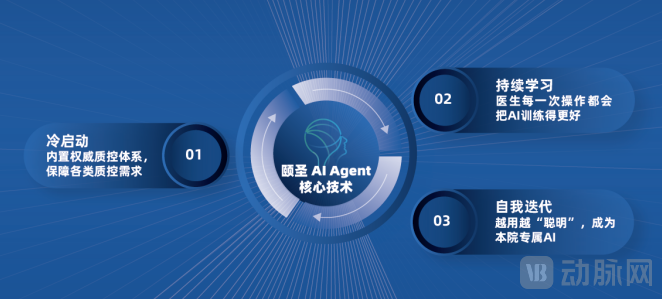
Zhou Yutong, Founder and CEO of Yisheng Intelligence, has chosen to tackle the most challenging problem in the field of medical AI. First, Yisheng Intelligence employs its proprietary specialized medical natural language processing engine to structure complex medical record data, transforming it into information that machines can understand and learn from. Then, by leveraging unique AI Agent technology, the model rapidly learns and comprehends clinical medical knowledge, medical record data, and coding standards. It can also identify issues and deficiencies within medical records by analyzing data such as patient clinical manifestations, examination and test results, surgical details, and disease progression documented in the records.
Zhou Yutong introduced that Yisheng Intelligence has breakthroughly adopted cutting-edge AI Agent reinforcement learning technology, using actual feedback from clinicians as the basis for continuous optimization of the intelligent system. This enables the system to maximize simulation of the real world, possessing strong medical logical understanding and self-learning capabilities. It can provide comprehensive, multi-perspective quality control coverage across the entire medical record workflow, including subtle connotative defects that are difficult to detect. The system has achieved a 98% clinical adoption rate in China’s top-tier Grade A tertiary hospitals, meaning that 98% of the medical record defects identified by the intelligent system were accepted and corrected by clinicians, sufficiently demonstrating the system’s accuracy and its recognition among physicians.
In November 2021, the National Healthcare Security Administration released the Three-Year Action Plan for Payment Reform Based on Diagnosis-Related Groups (DRG) and Big Data Diagnosis-Intervention Packet (DIP) (hereinafter referred to as the “Three-Year Action Plan”), aiming to achieve full coverage of DRG/DIP payment reform within three years. The issuance of the Three-Year Action Plan signaled that, starting from 2022, China had officially embarked on the comprehensive implementation of national medical insurance coverage under the DRG/DIP payment systems. As the sole data basis for DRG/DIP payments, medical record data will become the key determinant in DRG/DIP reimbursement.
DRG/DIP payment policies directly impact the actual revenue of healthcare institutions, while policies such as public hospital performance evaluations and hospital accreditation exert both “intangible” and “tangible” effects on these institutions. Many of the evaluation metrics are closely tied to medical record data. The rapid implementation of these external policies has objectively made intelligent medical record systems a critical necessity for healthcare institutions.
Furthermore, the transition of healthcare institutions from extensive to refined management, driven by the endogenous momentum for high-quality development, is also accelerating the rapid growth in demand for smart medical records. Accurate and efficient medical record data can precisely reflect the operational status, discipline construction, and clinical standards of healthcare institutions, thereby providing powerful tools and accurate data support for refined management, monitoring, and performance evaluation.
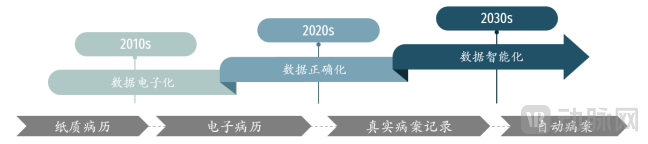
"Research on the Smart Medical Record Industry" points out that after more than ten years of electronic medical record system construction, medical institutions in China have generally completed the digitization of medical record data, but the quality issues of medical record data have not been fundamentally improved. Driven by multiple factors such as external policies and internal drivers within medical institutions, the entire industry is in a rapid development stage transitioning from the digitization of medical record data to the accuracy of medical record data.
In this regard, Liu Xingyu, Managing Director at Probe Capital, believes that the current industry landscape is characterized by rapid growth on the demand side, which the supply side has yet to fully match. On one hand, smart medical record products require long-term technological accumulation and user adaptation; on the other hand, users have urgent needs but are unwilling to allow time for product refinement and trial-and-error. This creates a high barrier to entry for the industry, posing significant challenges especially for new entrants. Although the broad market potential of the smart medical records sector has attracted an increasing number of players, the high thresholds in technology and application determine that only a few companies will ultimately seize opportunities in this market.
Over the past two years, no term has been hotter in the field of hospital management than DRG. In fact, DRG has been applied in China for over a decade. The recent surge in its popularity is primarily driven by the national healthcare security administration’s vigorous promotion of DRG-based payment reform, which directly impacts the financial revenues of medical institutions. This has also attracted numerous enterprises to enter this sector.
In essence, DRG is fundamentally a tool for evaluating healthcare quality management, rendering highly complex and difficult-to-quantify medical services measurable and evaluable. Compared with traditional fee-for-service and other health insurance payment methods, the national promotion of DRG by China’s National Healthcare Security Administration aims to leverage management tools such as DRG to quantify healthcare quality, thereby achieving standardization in health insurance payments.
Zhou Yutong stated, “Whether it is the reform of national health insurance payment or the various assessment and evaluation systems implemented by the National Health Commission for medical institutions, the underlying logic is to drive healthcare providers to continuously improve medical quality and efficiency, thereby enhancing service levels. Improving medical quality and efficiency is the fundamental basis for the future survival and development of medical institutions. For example, in its collaboration with a top-tier tertiary hospital in China, Yisheng Intelligent started with foundational medical record quality control. By leveraging intelligent technologies, it ensured that medical record data accurately reflected real clinical processes and resource utilization, without involving DRG grouping or prediction. However, rigorous controlled trials demonstrated that Yisheng Intelligent increased the average monthly health insurance surplus per case at this hospital by more than RMB 5,000, representing an improvement of over 200%.”
Tang Yinan, Managing Director at Yuanyi Capital, stated that refined hospital management is an inevitable trend, and both smart management and smart clinical practices are data-driven. Yuanyi Capital invested in Beijing Yisheng Intelligent Technology Co., Ltd. at a very early stage and has continued to follow on with additional investments, recognizing that the quality of foundational data centered around medical records will play an increasingly significant role in future hospital management and operations.
“Starting from the fundamental logic of hospital management, we help hospitals solidly implement quality control for medical record data. Without focusing on DRG grouping and costs, we can still help hospitals recover losses caused by distorted medical records, with data proving highly effective results,” stated Zhou Yutong. “In essence, we are helping hospitals strengthen their internal capabilities for quality improvement and efficiency enhancement. By mastering these core competencies, a hospital’s revenue and rankings will naturally remain strong.”
Yisheng Intelligent’s smart medical record solution focuses on underlying data, addressing the challenges healthcare institutions face in DRG/DIP reimbursement settlements under the national health insurance system while mitigating the risk of non-compliance and fraudulent claims. This approach has been recognized by the National Healthcare Security Administration (NHSA) and experts across various sectors. In March this year, Yisheng Intelligent achieved an impressive overall ranking of 4th in the “Smart Health Insurance Solution Competition” hosted by the NHSA. Notably, it was the only company in the smart medical record track among the 18 teams that reached the finals, serving as strong validation of its capabilities.
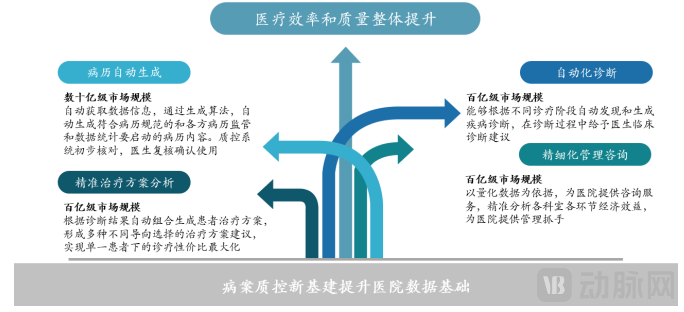
By adhering to the underlying logic of improving quality and efficiency, it becomes evident that medical record data constitutes a critical infrastructure for healthcare institutions. As the primary carrier and data source for reflecting, evaluating, and enhancing hospital medical quality and efficiency, it serves as a key lever for driving quality improvement and efficiency gains in healthcare services.
Liu Xingyu believes that in the increasingly crowded smart medical record sector, players who can grasp the essence of smart medical records are likely to go further. On one hand, focusing on helping hospitals improve quality and efficiency can mitigate the impact of policy changes on corporate product forms and market dynamics. On the other hand, ensuring the accuracy of medical record data is just the beginning; based on accurate medical record data, the smart medical record industry will spawn more application scenarios and market opportunities aimed at enhancing healthcare quality and efficiency. By taking a long-term view and not merely fixating on immediate policies and demands, companies can seize greater market opportunities.