

WeDoctor Secures Over RMB 1 Billion Strategic Investment from Shandong State Capital, Driving Dual Wins in Livelihood and Industry through Digital Health Commons
Recently, media reports indicated that WeDoctor, a digital healthcare service platform, secured over RMB 1 billion in strategic investment, led by a state-owned industrial investment fund from Shandong Province. The announcement sent shockwaves through the industry. This substantial capital injection has undoubtedly served as a much-needed boost to the digital healthcare market, which has been in a capital “doldrums” since the second half of last year, significantly revitalizing industry confidence.
WeDoctor has not yet disclosed further details regarding the financing, but the mere mention of “state-owned capital” is enough to stir sensitivities within the industry. Healthcare is a sector heavily influenced by policy; the ability to attract state-owned investment at this juncture indicates that the growth potential and value of the broader health industry have gained recognition. As a leading enterprise in the digital healthcare sector, WeDoctor has become a key target for industrial capital investment.
WeDoctor, which pioneered the concept of internet hospitals in 2015, took four years to achieve integration of online and offline diagnosis and treatment, forming a closed-loop medical service system that helped partner regions implement tiered diagnosis and treatment across municipal, county, township, and village levels. Building on this foundation, WeDoctor first proposed and began exploring the implementation of the “Digital Health Community” model in 2019. This model aims to integrate the capabilities of healthcare services, pharmaceuticals, and health insurance (the “Three Medics”), thereby alleviating pressure on large hospitals, enhancing the capabilities of primary care institutions, and improving the efficiency of payments by both public health insurance and commercial insurers, ultimately leading to an improvement in regional health indices.
Evidently, in terms of its value proposition, the Digital Health Community is fully aligned with local governments’ goal of deepening healthcare reform with a focus on “people’s health.” At that time, effective implementation tools were still lacking across various regions, which provided WeDoctor with the confidence and opportunity to comprehensively upgrade its business model and rapidly scale its operations.
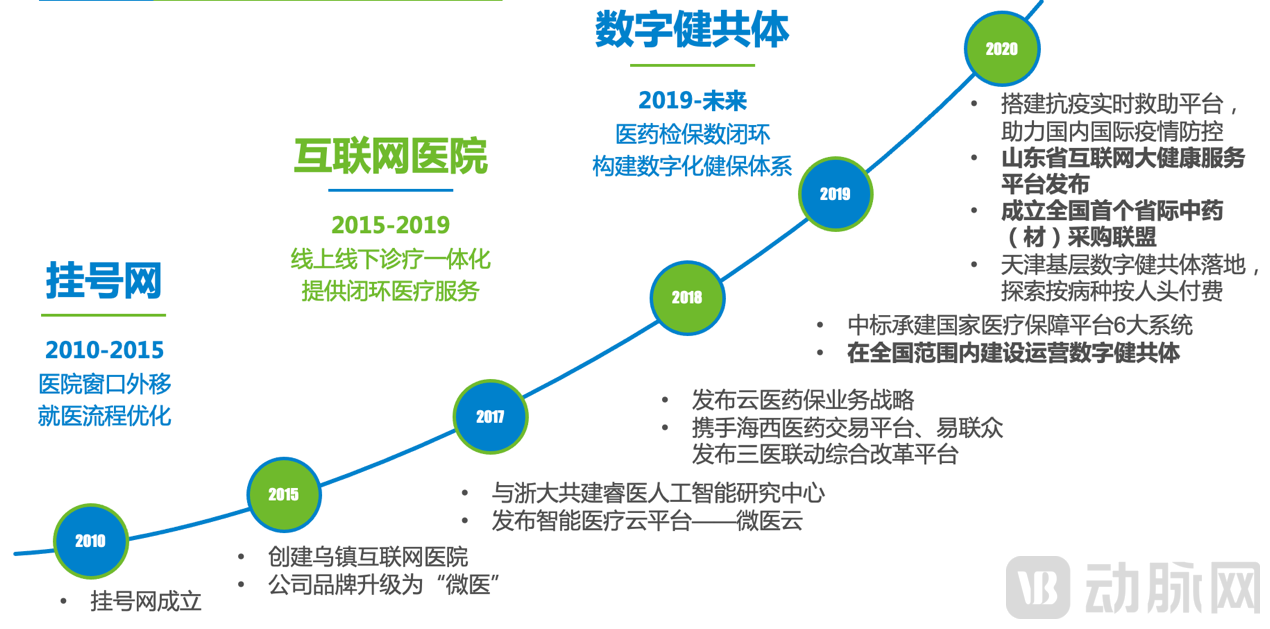
WeDoctor’s Journey in Digital Health Exploration (Source: Compiled from Public Information)
Tai’an, Shandong Province, served as the inaugural site for WeDoctor’s implementation of its Digital Health Community model. In September 2019, WeDoctor entered into a strategic partnership with the Tai’an Municipal Government to jointly establish the Tai’an Digital Health Community and China’s first internet hospital dedicated to chronic disease management (the Taishan Chronic Disease Internet Hospital). By focusing on chronic disease management as a breakthrough point, the initiative leveraged digital technologies to comprehensively empower the coordinated reform of healthcare, health insurance, and pharmaceuticals (“Three-Medical Linkage”). Within just over a year, WeDoctor successfully developed an end-to-end chronic disease management model integrating “Internet + Health Insurance + Healthcare + Pharmaceuticals.” Notably, online health insurance reimbursement—previously considered by the industry as an insurmountable barrier—was made available for the first time in China to platform-based internet hospitals. The “Tai’an Experience” has received high recognition from both national and Shandong provincial governments and is now being promoted across all 16 prefecture-level cities in Shandong Province.
Leveraging the internet hospital as a carrier, WeDoctor’s Digital Health Community has pioneered an innovative and effective new path for healthcare reform in Tai’an. By establishing dedicated chronic disease management zones—Chronic Disease Service Centers—within member hospitals of the Chronic Disease Internet Medical Consortium, it has achieved full-process “in-hospital + out-of-hospital” and “online + offline” services encompassing chronic disease diagnosis and treatment, health management, and medical insurance payment. This initiative has reduced patient visit times from the previous 2–3 hours to just 20–30 minutes and diverted over 20% of the outpatient pressure from hospitals. Relying on the Tai’an Health Community platform, 101 medical institutions in Tai’an have been integrated into the digital intelligent supervision platform for medical insurance, enabling whole-process supervision through pre-event reminders, in-process warnings, and post-event audits, thereby effectively saving medical insurance expenditures. Meanwhile, chronic disease management services have extended to vast rural areas. WeDoctor utilizes its self-developed “Vehicle, Kit, and Station” model (cloud mobile clinic vehicles, cloud mobile clinic kits, and medical and health workstations) to help grassroots facilities achieve online diagnosis and treatment, remote consultations, two-way referrals, and online prescribing. This also facilitates the better delivery of basic public health examinations, free clinics and screenings for “three highs and six diseases,” family doctor contract services, and health management.
As can be seen, the WeDoctor Digital Health Community model is no longer merely an internet healthcare business; from its inception, it has carried a mission aligned with government healthcare reform objectives. This model, which requires deep cultivation, demands a steadfast commitment to long-termism.
No pain, no gain—this is especially true for digital health, a sector characterized by its gradual development. After pioneering a representative model through arduous exploration, WeDoctor’s Digital Health Community has achieved rapid expansion in provinces and municipalities such as Shandong, Tianjin, Fujian, and Shanghai. In multiple prefecture-level cities within these regions, the business scale and revenue of the Digital Health Community have reached levels comparable to those of tertiary hospitals.
In Shandong Province, WeDoctor’s core business model, centered on the Digital Health Community, has expanded to cover all 16 prefecture-level cities across the province. It has established more than 50 chronic disease management centers, cumulatively serving insured individuals 18 million times, with over 8 million online consultations and nearly 2 million service encounters for patients with chronic conditions. Behind this substantial scale of services, WeDoctor has collaborated with the Shandong Provincial Healthcare Security Administration and other departments to create the nation’s first provincial-level internet-based comprehensive health service platform—the Shandong Internet Comprehensive Health Service Platform. This platform is also China’s first open, integrated service platform operating under a model of “government support, integration of advantageous resources, and market-oriented operations.” By achieving dual value in both public welfare and industry development, the platform was selected as one of the “China Reform 2021 Case Studies.”
By establishing an integrated healthcare security service system encompassing “Internet + medical insurance + healthcare + pharmaceuticals,” the platform provides one-stop services—including online consultations, chronic disease prescription renewals, medical insurance settlements, home delivery of medications and nursing/testing services, and assisted agency services—to individuals with disabilities or partial disabilities, chronic disease patients, disadvantaged groups, and the elderly across the province, thereby forming an efficient health management and care system. In October 2020, the platform also launched “Qilu Bao,” an inclusive supplementary medical insurance product. With 716,000 enrollees and an enrollment rate of 8.9%, it serves as an effective supplement to basic medical insurance, significantly enhancing the level of healthcare coverage in the region.
Notably, WeDoctor is also aggregating resources to comprehensively support the development of Shandong’s health industry. Shandong has designated the integrated medical and elderly care health industry as one of the key sectors in its initiative to replace old growth drivers with new ones. In this context, WeDoctor has helped Shandong establish China’s first inter-provincial alliance for the procurement of traditional Chinese medicine (TCM) materials. The supporting project, the Shandong Internet TCM Materials Trading Center, has grown into a key project under Shandong’s “Five-Year Breakthrough” initiative for replacing old growth drivers with new ones, emerging as a significant achievement in Shandong’s efforts to promote the integrated development of the integrated medical and elderly care health industry and the internet economy.
Amid the multifaceted backdrop of the pandemic’s impact and economic transformation, state-owned capital has shifted its investment focus toward industries with higher growth potential. The WeDoctor Digital Health Community model, by generating multidimensional value in serving public welfare, aggregating industry resources, and demonstrating scalability, has become a “preferred choice” for state-owned industrial funds. This strategic investment accelerates the integration of digital healthcare platforms with local medical and health service systems, thereby promoting the development of the local digital health industry and enhancing the quality of public services.