

Zhiyun Health Goes Public on HKEX, Validating Its Chronic Disease Management Model and Entering Rapid Scaling Phase
Today, Zhiyun Health, known as the “first stock in digital chronic disease management,” listed on the Hong Kong Stock Exchange, with an opening market capitalization exceeding HK$17 billion.
As one of the earliest enterprises in China to engage in digital chronic disease management and internet healthcare, Zhiyun Health has witnessed the trajectory of a large cohort of startups during that period—from the prosperity fueled by capital enthusiasm to their eventual disappearance after their business models were proven unviable. After decisively abandoning its B2C approach, the company firmly implemented a B2H2C strategy, leveraging SaaS solutions for hospital-based chronic disease management as its entry point.
To date, Zhiyun Health has established a multi-sided value network encompassing patients, hospitals, pharmacies, and pharmaceutical companies through its in-hospital solutions, pharmacy solutions, personal chronic disease management solutions, and other business lines, thereby promoting the sustainability of its business model. The company has achieved rapid performance growth: total revenue increased from RMB 524 million in 2019 to RMB 1.757 billion in 2021, representing a compound annual growth rate (CAGR) of 83%, with a year-on-year growth rate of 109% in 2021. In the first quarter of 2022, despite the comprehensive impact of the pandemic, the company still generated revenue of RMB 553 million, a year-on-year increase of 78%.
Behind its survival amid the industry’s fierce competition, its perseverance to the present day, and its successful listing on the secondary market lies Zhiyun Health’s continuous process of breaking through key industry challenges and validating its own value.

For companies in digital chronic disease management and internet healthcare, attracting precise doctor and patient users is the foundation for establishing their business models.
In traditional customer acquisition models, enterprises attract patients through free consultations, product promotions, and advertising campaigns. However, these approaches entail high acquisition costs, yield uncertain results, and fail to deliver precisely targeted users from public-domain traffic pools.
Some companies have also invested significant manpower to recruit doctors individually within hospitals, leveraging these physicians to acquire patients. However, this approach may face resistance from hospitals or doctors, as some institutions believe that internet healthcare platforms consume physicians’ time and “poach” their patients. Although collaborations between internet healthcare platforms and public hospitals have increased over the past two years, changing these perceptions will take time. This is particularly true given that public hospitals are now vigorously developing their own internet hospitals and are more intent on retaining both physicians and patients.
Currently, leading platforms in the industry have emerged. However, as the number of internet hospitals has surged over the past two years, becoming an essential infrastructure for the sector, it remains a critical task for enterprises to secure access to a larger and higher-quality pool of physicians and patients.
How to Acquire Customers with Higher Efficiency and Lower Costs? Zhiyun Health adopts a “Hospital-First” strategy, aligning with the reality that the primary diagnosis and treatment scenarios for diseases remain in offline hospitals, especially public ones. Since 2016, Zhiyun Health has been deploying its self-developed Zhiyun Yihui SaaS system in hospitals to assist departments in managing chronic diseases.
To further expand its collaborative ecosystem, Zhiyun Health began deploying the Zhiyun Teleconsultation SaaS system in pharmacies in 2019, facilitating follow-up visits, prescription renewals, and new retail initiatives.
In other words, Zhiyun Health serves both hospitals and pharmacies while leveraging them as customer acquisition channels. When hospitals use the SaaS system to provide diagnostic, treatment, and management services covering both in-hospital and out-of-hospital care, both doctors and patients become Zhiyun Health users; similarly, when patients use the pharmacy SaaS for follow-up visits and prescription renewals, they also become Zhiyun Health users.
Benefiting from the rapid expansion of its two SaaS systems across hospitals and pharmacies, Zhima Health has seen a corresponding surge in its user base. From 2019 to 2021, the number of hospitals deploying Zhiyun Yihui increased from 377 to 2,369, while the number of pharmacies deploying Zhiyun Wenzhen rose from 3,002 to 172,000. During this period, the number of registered users grew from 8.4 million to 23.8 million, with the number of registered physicians reaching 87,000.
According to the prospectus, in the third quarter of 2021 alone, 95% of Zhiyun Health’s new users, representing approximately 1.2 million individuals, came from organic traffic, i.e., users converted from hospital and pharmacy scenarios.
In this model, both patient and physician user acquisition can be achieved with greater efficiency and lower costs, eliminating the need for additional resource investment in customer acquisition. More importantly, patients referred from hospital departments specializing in chronic disease management and those seeking follow-up consultations and prescription refills at pharmacies are predominantly high-precision chronic disease users, aligning closely with the platform’s business positioning.
Furthermore, given Zhiyun Health’s close collaboration with hospitals—helping them enhance the efficiency of chronic disease management within hospital settings while leveraging digital technologies and pharmacy resources to extend hospital services beyond the hospital walls—there is no “poaching” of doctors or patients; rather, both parties jointly serve patients. In a healthcare delivery system dominated by public hospitals, this model is more likely to gain recognition from relevant stakeholders and prove replicable and sustainable.
As the industry has evolved, extensive infrastructure has been built around internet hospitals, yielding significant improvements in patient convenience. Services such as basic health data monitoring, online follow-up consultations and medication purchases, and home delivery have become standard offerings.
However, if the industry only addresses a small fraction of peripheral healthcare needs, its significance will be greatly diminished. Only when digitalization truly permeates clinical pathways across medical specialties, and online and offline services are better integrated, can limited medical resources be utilized to their fullest potential. Therefore, while convenience is important, addressing patients’ real-world problems is even more critical, which hinges on the effectiveness of the services provided.
The industry is also continually reflecting on how to break through the bottleneck of service capabilities, rather than merely staying at the level of providing convenience.
After six years of cultivating chronic disease management in hospitals, Zhiyun Health has continuously iterated its SaaS system and service workflows based on clinical needs and feedback from healthcare professionals and patients, thereby achieving multidimensional optimization of outcomes.
In Zhiyun Health’s chronic disease management solution, both the digital infrastructure and process design are integrated with hospital clinical workflows, thereby delivering value that extends beyond basic health data monitoring and online follow-up consultations with prescription services. The service capabilities demonstrate not only convenience but also, more prominently, effectiveness.
In terms of convenience, the Zhiyun Yihui SaaS system enables functionalities such as consultation and prescription issuance, automated health record entry, health analytics, digital management of medical supplies, and cross-departmental collaboration within hospitals. Meanwhile, Zhiyun Health has developed AIoT devices compatible with its SaaS system, which can connect to most mainstream chronic disease medical devices, helping hospitals and physicians collect patient health monitoring data in a secure and confidential manner.
Chronic disease management often requires regular, high-frequency health monitoring and data recording. In traditional management models, these tasks are performed manually by healthcare professionals or patients, thereby increasing the workload of medical staff or reducing patient adherence to self-management. Zhiyun Yihui, along with its corresponding AIoT devices, automates numerous tedious processes, enhancing operational efficiency.
It is worth noting that Zhiyun Yihui can seamlessly integrate with hospitals’ existing information systems, requiring minimal modifications to those systems. This enables deep integration of digital chronic disease management with healthcare professionals’ established offline workflows, which is also a key factor in enhancing hospitals’ willingness to adopt the solution.
Owing to its significant convenience, which fosters willingness among healthcare providers to adopt the system and improves patient adherence, the effectiveness of Zhiyun Health’s chronic disease management is increasingly evident, primarily reflected in dimensions such as the control of key patient indicators and hospital operational efficiency.
In 2019, a Grade A tertiary hospital deployed the Zhiyun Yihui SaaS system, enabling medical staff to monitor patients’ health indicators in real time and formulate and adjust management plans based on system analytics. Zhiyun Yihui also integrated with other hospital information systems to facilitate information sharing across departments, thereby better serving chronic disease patients with multiple comorbidities.
On the one hand, the system improves the work efficiency of medical staff; on the other hand, compared with patients in the control group, diabetic patients using Zhiyun Yihui’s chronic disease management demonstrated better treatment outcomes: the average length of hospital stay was reduced by 3.2 days, the rate of blood glucose within the normal range increased by 20%, and mean blood glucose levels decreased by 3.3 mmol/L (fasting) and 4.1 mmol/L (postprandial).
Furthermore, a clinical study conducted by Shanghai East Hospital demonstrated that Zhiyun Health’s management solution achieved substantial improvements across various metrics compared with a product developed by a well-known U.S. diabetes management company. This study has been published in the prestigious journal Journal of Diabetes Investigation.
The management outcomes are significant, which will further enhance the willingness of hospital medical staff and patients to adopt the system.
In its “2021 Internet Hospital Report,” VCBeat reviewed more than 250 academic papers centered on internet hospitals. Among the authors, managers from hospital information departments accounted for the largest proportion, while hospital administrators (primarily presidents and vice presidents) were also major contributors; clinical physicians represented a relatively small share. An analysis of keywords revealed that, in addition to high-frequency terms related to epidemic prevention and control, information systems, and electronic prescriptions, chronic disease management and service quality emerged as prominent research hotspots.
Overall, although research on internet hospitals still primarily focuses on infrastructure construction such as informatization, it is increasingly extending toward areas such as the clinical value of services.
This background and trend also indicate that focusing on clinical presentation and demonstrating tangible outcomes in disease diagnosis, treatment, and management will become the fundamental orientation for building industry service capabilities.
Profitability models are a perennial topic of discussion in the industry, with endless debates centered on businesses that rely on “drug sales” for their livelihood. Before sustainable profitability models are established, sales of pharmaceuticals and medical devices to consumers (C-end) indeed constitute a significant revenue source for many companies in the sector. Beyond this, what other avenues exist for generating revenue?
As indicated by the preceding analysis, Zhiyun Health has established a chronic disease management model that combines convenience with efficacy through deep collaboration with hospitals and integration of out-of-hospital pharmacies. This model creates value for multiple stakeholders—including hospitals, pharmacies, pharmaceutical companies, and patients—thereby generating diversified revenue streams.
Specifically, Zhiyun Health provides SaaS services to hospitals and pharmacies, meeting their procurement needs for chronic disease management products, thereby generating revenue from the sale of these products. By precisely reaching chronic disease departments in hospitals and physicians, it offers digital marketing services to pharmaceutical companies, thus earning revenue from digital marketing. Additionally, chronic disease management services are also directly available to individual users, generating revenue from user-paid services.
A further breakdown by product revenue and service revenue reveals that, in recent years, the proportion of product revenue for Zhiyun Health has been declining, while the share of service revenue has risen rapidly.
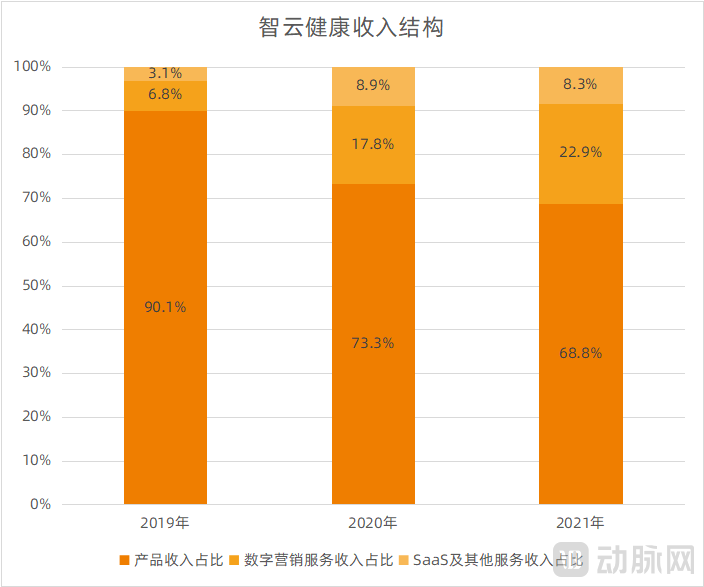
Changes in Zhiyun Health's Revenue Structure, Source: Prospectus
Product revenue, derived from sales of supplies to hospitals and pharmacies as well as personal chronic disease management products, decreased its share from 90.1% in 2019 to 68.8% in 2021. Service revenue comes from digital marketing, SaaS, and other sources; among these, the share of digital marketing revenue increased from 6.8% in 2019 to 22.9% in 2021.
Service revenue boasts a high gross profit margin, with costs decreasing as business scale expands, serving as a key indicator of the company’s core competitiveness and irreplaceability. Therefore, an increase in service revenue and its proportion signifies enhanced profitability for Zhiyun Health.
As SaaS services serve as a key vehicle for Zhiyun Health’s resource expansion but do not constitute the core of its service offerings, digital marketing services tailored to pharmaceutical companies are poised to become the primary driver of Zhiyun Health’s revenue growth in the short to medium term.
Driven by multiple factors, including the diversification of revenue streams, expansion of business scale, and an increased proportion of high-gross-margin revenue, Zhiyun Health’s losses have narrowed rapidly. According to the prospectus, the company’s adjusted net loss margin declined sharply from 75.8% in 2020 to 25.3% in 2021. In the first quarter of 2022, the loss margin stood at only 15.5%, and it is expected to fall below 10% for the full year of 2022.
Notably, Zhiyun Health is strategically positioning itself at the intersection of chronic disease management and commercial health insurance.
As the primary payer in China’s healthcare service system, the national basic medical insurance faces a grim situation due to the rising expenditure driven by population aging. In recent years, cost-containment measures have been increasingly intensified. In fact, the medical insurance system also aims to better manage patients with chronic diseases and reduce complications to curb fund expenditures, and has implemented specific medication reimbursement policies for certain chronic conditions. However, given its limited scope for further intervention, more comprehensive management approaches and broader disease coverage require supplementation by commercial health insurance.
Among Zhiyun Health’s investors are insurance companies or investment firms with insurance backgrounds, such as Sunshine Insurance, Ping An Ventures, and Taiping Life Insurance, providing resource support for initiatives that leverage health insurance to empower chronic disease management.
Currently, Zhiyun Health has launched its insurance brokerage business. In the long term, it will continue to explore and validate the role of health insurance within the medical payment system, drawing on international commercial insurance payment models for chronic disease management to further optimize its revenue structure.
Looking back at the “War of a Hundred Glucose Meters” of those years, Zhiyun Health has successfully completed its IPO, reaching a milestone that many companies have strived for but failed to achieve. Nevertheless, this also marks the starting point of a new stage of development, with the journey still ongoing.
As a cornerstone investor in Zhiyun Health, Dr. Pius S. Hornstein, President of Sanofi Greater China, stated, “The 14th Five-Year Plan proposes accelerating the construction of Digital China and fostering a new ecosystem for digital development. Through the collaboration between Zhiyun Health and Sanofi, we will fully leverage our respective professional strengths to co-build a new ecosystem for internet healthcare in China, ushering in a new era in chronic disease management. In the future, both parties will join hands to explore innovative healthcare solutions across the entire patient journey, pursue scientific breakthroughs, and ultimately fulfill our commitment to improving the health of patients in China.”
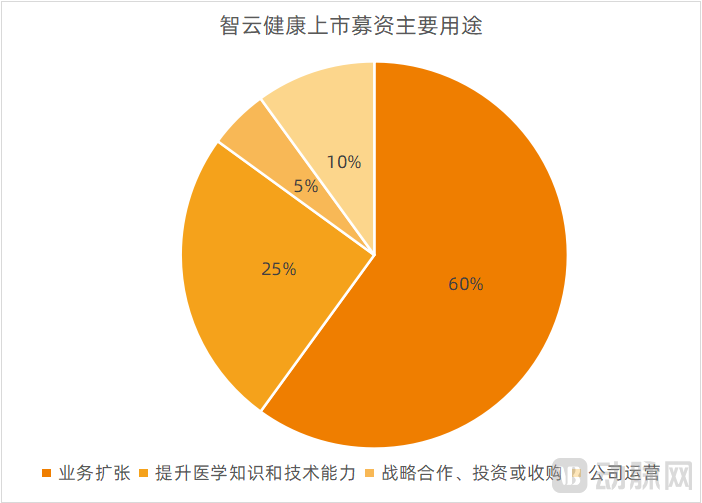
Primary Use of Proceeds from Zhiyun Health’s IPO; Data Source: Prospectus
What are Zhiyun Health’s next strategic priorities? According to the use of proceeds disclosed in its prospectus, business expansion accounts for the largest share at 60%, with a primary focus on continuously expanding hospital and departmental coverage. The company aims to broaden its hospital network across China, leverage this network coverage, and further connect with more industry participants along the value chain. Strengthening its capabilities in digital technology, medical expertise, and product innovation is also a key initiative.
This means that over the past few years, the validation of its business model and the verification of its product and service capabilities have been completed. In this new phase, Zhiyun Health will rapidly replicate its chronic disease management model to achieve economies of scale.
In this process, Zhiyun Health will further demonstrate its own value, as well as the industry value of digital chronic disease management and internet healthcare.