

Visby Medical Files for IPO: Pioneering Handheld PCR Tests with 99.2% Sensitivity and $300M in Funding Over a Decade

Visby Medical
PCR Diagnostic Test Product Developer

Lightrock
Early-stage Venture Capital Firms
On June 29, 2022, medical diagnostics company Visby Medical announced that it had secured $35 million in funding, bringing the total size of its Series E financing round to $135 million.This funding round was led by Lightrock, with participation from John Doerr, Cedars-Sinai Medical Center, ND Capital, Artiman Ventures, Pitango Venture Capital, Blue Water Life Science Advisors, and J Ventures.
Visby Medical was established in California, USA, in 2012.To date, the company has secured funding from 17 institutions, including the NIH, Ping An Global Voyager Fund, and the Biomedical Advanced Research and Development Authority (BARDA),Accumulated financing exceeds $288 million(Data source: Crunchbase).
The ability to secure nearly $300 million in financing from investors worldwide over a decade is becauseVisby Medical Achieves Rapid, Portable PCR Testing Without Laboratory Instruments。
The story of Visby Medical began to take shape in 2010. That year, founder Adam de la Zerda served as an entrepreneur-in-residence at Artiman Ventures, where he developed a concept:PCR Diagnostic Devices Simple Enough for Anyone to Use, Anywhere. After conducting market research, no relevant key technologies or companies were identified; therefore,Adam founded Click Diagnostics in 2012.。
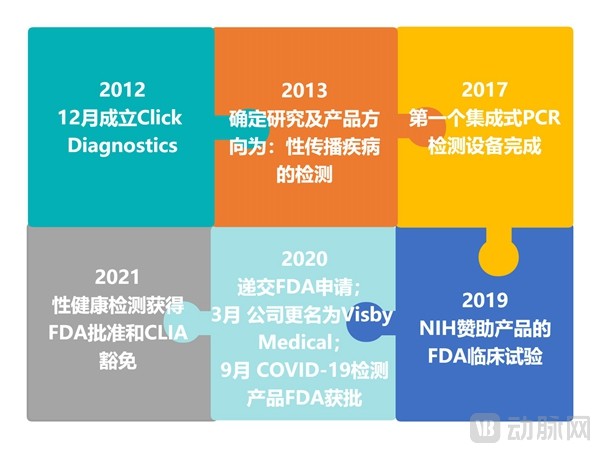
Key Milestones in the Development of Visby Medical
In 2013, given the high prevalence of sexually transmitted infections among women in the United States, along with the substantial medical costs and long-term health burdens they entail,Click Diagnostics Decides to Focus on Women’s Health, began to deploy work on testing for sexually transmitted infections. Four years later,In 2017, the first palm-sized integrated PCR detection device was completed.。
2019,NIH Sponsored FDA’s Clinical Study of This Product, and helped Click Diagnostics complete its FDA application submission in 2020. In March of the same year, the outbreak of the COVID-19 pandemic prompted the team to rapidlyInvested in the development of equipment for PCR testing of COVID-19. Four months later, the product passed internal testing and wasApproved by the FDA for market launch in September. The following year,Sexual Health PCR Testing Products Also Receive FDA Approval and CLIA Waiver。
Click Diagnostics was renamed Visby Medical in 2020.From Click Diagnostics to Visby Medical, it all hinges on Dr. Adam’s extensive experience in molecular diagnostics and translational research.Dr. Adam, during his undergraduate studies at the Technion – Israel Institute of Technology, he built a solid professional foundation in electrical engineering, computer science, and physics; he then pursued a Ph.D. in the Department of Bioengineering at Stanford University, followed by postdoctoral research in chemistry and biochemistry at the University of California, Berkeley, andBecame one of the youngest tenured professors at Stanford University School of Medicine in 2012.。

Founder & CEO: Adam de la Zerda Chief Medical Officer: Gary Schoolnik
Another contributor to Visby Medical’s product technology is its Chief Medical Officer, Gary Schoolnik.。Dr. Schoolnik is also a Professor of Medicine (Emeritus) at Stanford University School of Medicine, an Attending Physician in Internal Medicine and Infectious Diseases at Stanford Hospital, and the Deputy Director of the Stanford Institute for Immunology, Transplantation, and Infection. He is furthermoreChair of the Advisory Committee of the National Institute of Allergy and Infectious Diseases (NIAID) at the National Institutes of Health (NIH), Co-Chair of the NIH Blue Ribbon Panel on Bioterrorism, Founding Editor of the journal Molecular Microbiology, and Associate Editor of the Journal of Clinical Investigation.
As of now,Visby Medical has developed two integrated portable PCR testing devices, designed for the detection of sexually transmitted diseases and COVID-19, respectively.. Through this device,PCR testing no longer requires large-scale equipment in central laboratories; the turnaround time has been reduced from approximately 6 days to 28 minutes, with a detection sensitivity of up to 99.2%.。
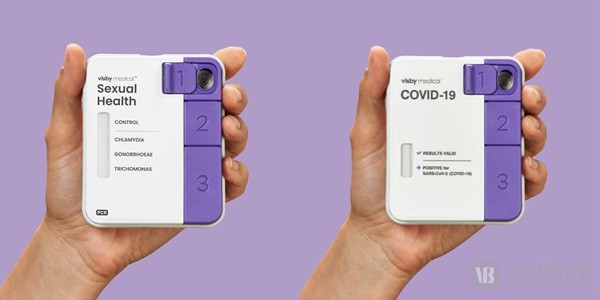
Visby Medical’s Two Integrated Portable PCR Rapid Testing Devices
Visby Medical's sexual health diagnostic device primarily targets the three most common sexually transmitted pathogens in the United States:Chlamydia trachomatis、Neisseria gonorrhoeaeandTrichomonas. Failure to promptly detect and treat this type of pathogen may cause permanent damage to the female reproductive system, including infertility and ectopic pregnancy, and may also increase the risk of HIV infection.
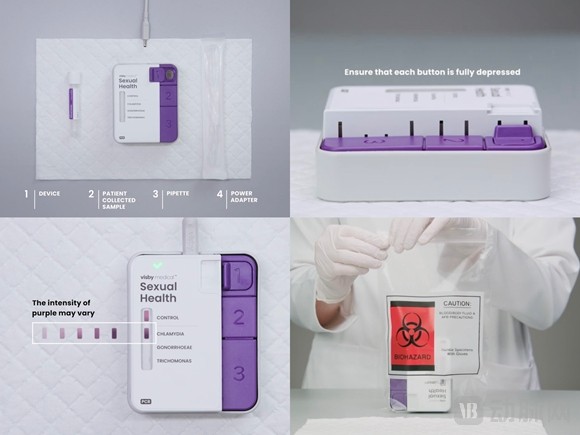
Selected Operating Procedures for Visby Medical’s Sexual Health Testing Device
The device will be equipped withDisposable Sample Processing Solvents and Plastic Droppers. The patient uses a cotton swabAfter self-sampling, willSoak the swab in the sample processing solvent., and sample using plastic drip irrigationInstill into the sample inlet of Device No. 1。After sliding to close Inlet Port 1, press the three buttons in sequence, then connect the power supply to begin testing.After the test,CONTROLA purple indicator will appear in some cases (if it does not appear, the test is invalid; replace the device with a new one and retest; samples can be stored for 4 hours at both room temperature and under refrigeration), ifCHLAMYDIAA positive result is indicated by staining at the corresponding site; ifGONORRHOEAEandTRICHOMONASStaining at the site indicates a negative result, which remains valid for 2 hours.
Clinical trial data published in The Lancet demonstrate that the device exhibits a sensitivity of 97.4% for Chlamydia trachomatis, 97.6% for Neisseria gonorrhoeae, and 99.2% for Trichomonas vaginalis.
The device began shipping against purchase orders in the summer of 2021. This isThe only rapid PCR testing device on the market that requires no laboratory instruments, this portable technology and its result accuracy expand the possibilities for applications in clinical settings, point-of-care, and mobile laboratories. On the other hand, as a disposable integrated testing device, it eliminates costs associated with maintenance, consumables, and space required by traditional instruments.
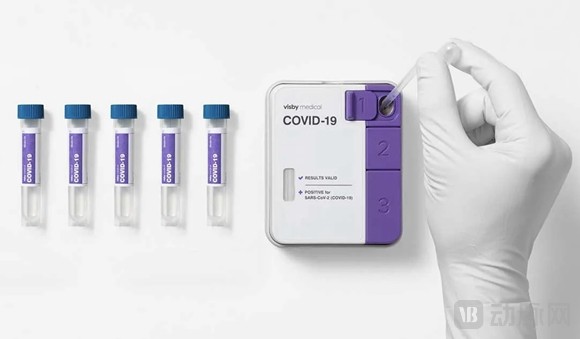
Schematic Diagram of Visby Medical’s PCR Testing Device for COVID-19
Based on the core technologies of sexual health diagnostic devices, Visby Medical has developedFor COVID-19another testing device,It took only six months from the start of R&D to FDA emergency use authorization.. This device retains the same operational procedures as sexual health testing devices, but is capable of meetingConduct pooled testing on five test samples, while ensuring detection accuracy and shortening detection time, it reduces the consumption cost of testing equipment. Furthermore, sample processing reagents developed specifically for the COVID-19 virus can enable sampleStore at room temperature for 45 minutes; refrigerate for 24 hours., withAddressing the issue of sample degradation caused by prolonged waiting times to accumulate five test samples。
Visby Medical’s rapid deployment of its COVID-19 product demonstrates the flexibility and adaptability of its integrated, rapid PCR testing device across diverse testing scenarios. The company also plans to leverage funding from its Series E round to expand manufacturing capacity and advance product development for respiratory pathogen testing and antimicrobial resistance (AMR) detection.
Visby Medical hopes to bring its productExpand into More Disease Areas, empowering healthcare providers such as communities, physician clinics, surgical centers, and nursing homes, as well as other CLIA-waived laboratories. The PCR test, which takes only 28 minutes, significantly enhances the efficiency of clinical treatment for both patients and healthcare professionals.
Visby Medical’s two instrument-free PCR testing devices now fall within the molecular POCT segment. Similar to the launch trajectory of its COVID-19 testing products,Since the outbreak of the COVID-19 pandemic, the market demand and prominent advantages of molecular POCT products have prompted a large number of medical device companies to enter this sector.。Companies Currently Deploying Molecular Diagnostic POCT in the Domestic MarketIncluding Wondfo Biotech, Sansure Biotech, Ustar Biotechnologies, Naidi Biotech, Jincai Biotech, Jingyin Biotech, and Cayudi (Source: Essence Securities Research Center).
As pandemic management becomes normalized, some European countries have begun promoting at-home COVID-19 self-testing. The consumer trend toward self-test products has directly driven growth in the COVID-19 point-of-care testing (POCT) market. Companies planning to enter the molecular POCT sector are well-positioned to leverage the momentum of at-home COVID-19 testing to advance their technological capabilities in COVID-19 POCT products, thereby accumulating R&D strength and technical expertise for future expansion into additional disease areas.
References:
Sheldon R Morris, Claire C Bristow, Michael R Wierzbicki, Mark Sarno,Lenore Asbel, Lenore Asbel,Audrey French, Charlotte A Gaydos,Lydie Hazan, Leandro Mena, Purnima Madhivanan,Susan Philip, Saara Schwartz,Constance Brown,David Styers, Toni Waymer, Jeffrey D Klausner. Performance of a single-use, rapid, point-of-care PCR device for the detection of Neisseria gonorrhoeae, Chlamydia trachomatis, and Trichomonas vaginalis: a cross-sectional study. The Lancet, 23. 11. 2020. <Online:https://doi.org/10.1016/S1473-3099(20)30734-9 >