

Phalanx Biotech: Pioneering an Open Ecosystem in IVD from Core Raw Materials to Integrated Solutions
Post-Pandemic Era, ChinaIVDThe tone of the industry has undergone subtle changes.
For a long time, the global in vitro diagnostics (IVD) industry has been monopolized by foreign brands, with imported players such as Roche, Danaher, Abbott, and Siemens capturing the majority of market share in secondary-level and above medical institutions. An easily overlooked logic is that IVD giants have gradually consolidated market barriers through closed systems, where only reagents validated on their platforms can be used for testing on the corresponding hardware equipment. This technology-bundling model based on closed systems continues to dominate the competitive landscape of China’s IVD market, even as leading domestic brands increasingly penetrate the segment of innovative IVD products. As a result, start-up IVD companies with relatively weaker comprehensive strength find it nearly impossible to compete through technological innovation. Consequently, the level of innovation within China’s IVD industry remains low, and there have been few disruptive, star-caliber clinical diagnostic products emerging from breakthrough innovations.
Meanwhile, as medical resources continue to be decentralized toward primary care settings, the accessibility of clinical laboratory testing has faced unprecedented challenges. Closed in vitro diagnostic (IVD) systems, which dominate the market, are characterized by their large footprint and high costs, making them more suitable for large healthcare institutions with concentrated testing demands. In contrast, although the volume of clinical laboratory samples in primary care settings has been growing year by year, their highly dispersed distribution pattern is evident, posing new requirements for clinical laboratory instruments and reagents.
From the perspective of FAPON BIOTECH, deepening engagement at the grassroots level has provided a rare opportunity for domestic IVD brands to replace imported manufacturers. However, in a market competition characterized by shifts in demand structure, a shared ecosystem based on open platforms may emerge as a more effective solution for enhancing the efficiency of the IVD supply chain.
Under the monopoly of industry giants, the efficiency of China's IVD sector remains low.
On one hand, although the R&D pressure is not as intense as that for innovative drugs, within relatively closed technical systems, it often takes 3–4 years for IVD reagents to go from R&D and mass production to compatibility with instrument platforms. Substantial capital investment is also required before commercialization, and the fierce competition for key technical talent deters most IVD manufacturers with weaker comprehensive strength. In this process, closed technical platforms become a significant constraint. Typically, the first year of innovative IVD reagent R&D is dedicated to developing the reagent itself. Starting in the second year, instrument platform involvement becomes necessary. The cumulative investment—covering reagent-instrument integration, scale-up of reagent manufacturing, regulatory submission, later-stage optimization of instrument processes, and engineering-based instrument registration—amounts to hundreds of millions of yuan. In this sense, reagent development companies are often burdened by the high costs associated with instruments.
On the other hand, there is still significant room for improvement in the accessibility and reliability of domestically produced IVD reagents. With the exception of a few traditional, simple tests, samples from primary care institutions must be sent to higher-level hospitals for testing and analysis. This relatively limited test menu fails to meet the clinical laboratory demands arising from the decentralization of medical resources. Furthermore, within this inefficient closed-loop system of reagents and instruments, the substantial challenges in implementing centralized volume-based procurement (VBP) for IVD products leave limited room for reducing high testing costs, thereby placing sustained pressure on medical insurance payments.
Since 2021, as a leading upstream life sciences company in China and a globally prominent upstream platform enterprise for in vitro diagnostics (IVD), FAPON BIOTECH has been progressively building an IVD development ecosystem platform. Amidst fragmented market opportunities and siloed technological approaches, the company is helping more stakeholders join in fostering symbiotic growth and shared prosperity within the industry.
In fact, in the IVD industry, which is characterized by a complex array of individual products, platformization has long been a relatively ideal development strategy, yet it remains difficult to define and implement. As can be seen in FAPON BIOTECH’s open ecosystem platform architecture, innovation in IVD reagents—from conceptualization to commercialization—is broken down into six mutually supportive key elements, including raw materials, testing platforms, application reagents, CXO services, distribution, and terminal operations and services.
Specifically, in line with the underlying logic of FAPON BIOTECH’s platform ecosystem development, raw material providers are no longer merely the starting point of a closed loop but have become integral components of the system. They need to strengthen their basic research capabilities, continuously overcome technical bottlenecks and achieve self-iteration through independent R&D, thereby feeding stronger innovation back into the entire ecosystem. The open testing platform serves as the foundation for stable, precise, and efficient reagent iteration, and is a critical element in shortening the R&D cycle and reducing costs for innovative reagents. At the application level, the open platform ecosystem will provide solutions that empower reagent development, helping a broad range of reagent developers complete the development and rapid commercialization of innovative products at lower costs and faster speeds.
Meanwhile, professional CXOs are being integrated into open platform ecosystems, further lowering the barriers to commercializing innovative products and shortening market cycles. At the distribution level, the channel systems of participants in open platform ecosystems are interconnected, helping ecosystem partners rapidly link their innovative reagents to various application scenarios. Furthermore, the development ecosystem should encompass terminal operations and services, enabling rapid response by staying close to user needs. This approach facilitates large-scale customer acquisition while further shortening the commercialization cycle for partners.
In this sense, the optimal state for the IVD industry ecosystem may be one in which each segment of the industrial chain fulfills its respective role and collaborates effectively, enabling the conversion of innovation and energy across all links.
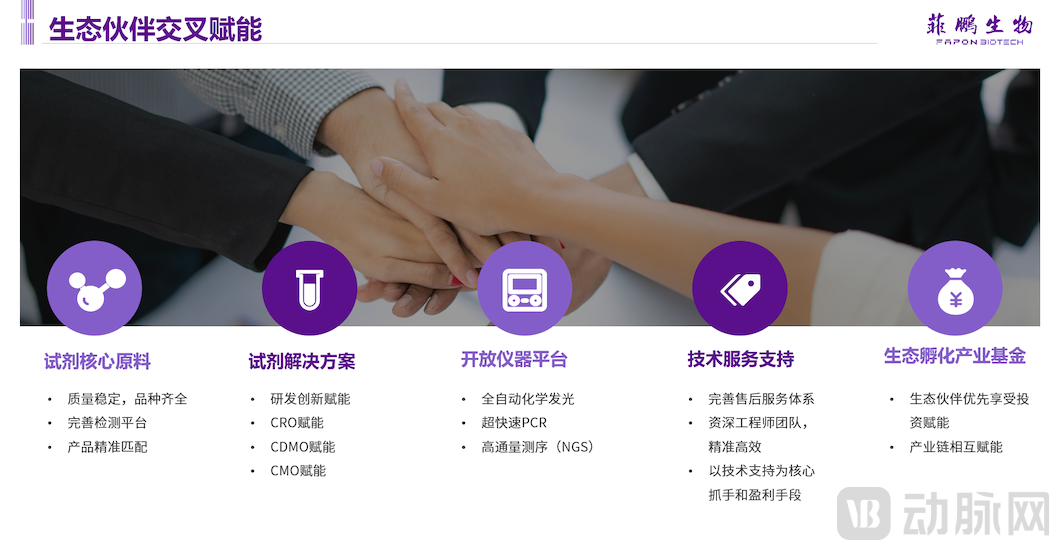
Within the aforementioned logical framework, FAPON BIOTECH has continuously expanded its capabilities. It has established foundational competencies within its IVD open platform—built upon core reagent raw materials, reagent enablement solutions, and an open instrument platform—and has successfully implemented multiple service projects in application ecosystems primarily centered on chemiluminescence and nucleic acid testing.
On the one hand, FAPON BIOTECH continues to deepen its cultivation in the traditional area of strength: core raw materials for reagents.It is well known that the quality of core raw materials largely determines the quality of in vitro diagnostic (IVD) reagents and the accuracy of final diagnostic results, serving as the “chip” of the IVD industry. In the early stages of development of China’s IVD sector, domestic reagent core raw materials relied heavily on imports due to high technical barriers. Over the past two decades, FAPON BIOTECH has deeply cultivated raw material manufacturing processes, successively developing more than 1,300 types of reagent raw materials, including antigens, antibodies, and diagnostic enzymes. With over 30 new product iterations introduced annually, the company has established a diversified product system characterized by comprehensive categories, extensive test items, continuous upgrades of legacy products, ongoing refinement of new offerings, and synergistic development between old and new products, thereby laying the foundation for the domestic substitution of high-end IVD reagents. Currently, the core reagent raw materials provided by FAPON BIOTECH empower the vast majority of IVD manufacturers across China in clinical application areas such as major infectious diseases, respiratory infectious diseases, tropical diseases, cardiomyopathies, tumors, and inflammation.
On the other hand, FAPON BIOTECH has made significant strides in building its capabilities for IVD reagent solutions., focusing on chemiluminescence, molecular diagnostics, and clinical chemistry diagnostics, it creates an open “operating system” through its proprietary instrument platform, supporting developers in the innovation of reagents and semi-finished reagent products.
In its specific solutions, FAPON BIOTECH has created an organic integration of “core reagent raw materials, reagent solution enablement, and open instrumentation,” further empowered by its after-sales service system and industrial investment fund through cross-functional synergy. For customers, reagent raw materials and reagent solutions that have been validated on instruments are more closely aligned with actual needs, facilitating the rapid development of diagnostic reagents. Furthermore, bundled solutions encompassing raw materials, reagents, and instruments can reduce redundant R&D investments by downstream customers, accelerating industrialization. The comprehensive product portfolio of raw materials and robust solution-provisioning capabilities are applicable across all mainstream in vitro diagnostics (IVD) technology platforms, significantly reducing transaction costs. This approach fully meets customers’ diverse and customized demands for raw material products, enhances customer stickiness, and thereby establishes positive, long-term, and stable cooperative relationships. Research conducted by FAPON BIOTECH indicates that this process helps customers substantially compress the timelines associated with product R&D, regulatory approval, clinical trials for registration, facility construction, and personnel recruitment, while simultaneously delivering significant cost savings.
Taking chemiluminescence reagent solutions as an example, FAPON BIOTECH has launched a medium-throughput (200 tests/hour) and a low-throughput (120 tests/hour) chemiluminescence platform. These platforms are compatible with mainstream detection systems, including direct chemiluminescence and enzyme-catalyzed chemiluminescence, and can accommodate reagents from clients of various brands. As of December 31, 2021, since its launch, the chemiluminescence platform had deployed more than 1,270 instruments, enabling over 100 partners within the ecosystem to efficiently reach multi-tiered medical institutions. Currently, FAPON BIOTECH continues to vigorously advance its developer ecosystem strategy, encouraging a broad base of chemiluminescence reagent developers to join the ecosystem, empowering them to accelerate product development, commercialization, and clinical implementation.
Having established a development ecosystem platform in the rapidly growing field of chemiluminescence, FAPON BIOTECH is now extending this enabling model to other technology platforms such as PCR and NGS.
Taking the PCR platform as an example. Since the outbreak of the COVID-19 pandemic, large-scale and rapid nucleic acid testing has become an essential requirement. FAPON BIOTECH promptly launched a comprehensive solution featuring automated nucleic acid extraction reagents and detection systems. This solution integrates open instrument platforms, reagent solutions, and core reagent raw materials, thereby meeting the needs for large-scale population screening, rapid triage, precise diagnosis and treatment, and point-of-care testing across various scenarios and phases of the pandemic.
Notably, leveraging its years of expertise in the research, development, and production of raw materials, FAPON BIOTECH innovatively launched a comprehensive high-throughput gene sequencing solution in 2021. This solution encompasses instrument platforms, library preparation kits, core reagents for library preparation, and other products and services, offering an end-to-end workflow from sample processing to sequencing. Committed to becoming a foundational builder of the gene sequencing ecosystem, FAPON BIOTECH provides comprehensive support to users. Among its offerings, the SeqQ100 high-throughput sequencing system, a flagship product developed by FAPON BIOTECH, is compatible with mainstream library types and data analysis pipelines available on the market. It features dual-specification sequencing flow cells and sequencing read length modes to meet diverse testing requirements.
From core raw materials to comprehensive solutions, FAPON BIOTECH has traversed the long journey from “chips” to “operating systems.” This continuous process of self-evolution mirrors the ongoing iteration within China’s IVD industry, driven by genuine clinical needs. It is understood that over the next three to five years, FAPON BIOTECH will further complete its layout of an all-encompassing ecological testing platform in the IVD sector through independent R&D, mergers and acquisitions, and team investments. We also look forward to witnessing a prosperous ecosystem in China’s IVD industry, characterized by mutual support and a flourishing array of new products.