Hansoh Pharma's B7-H3 ADC HS-20093 Granted Breakthrough Therapy Designation for Metastatic Castration-Resistant Prostate Cancer
Hansoh Pharma
Pharmaceutical Research, Production, and Sales

On April 21, the CDE website showed that another application for Hansoh Pharma's injectable HS-20093 was included in the breakthrough therapy public announcement list. The indication is for patients who have previously received novel endocrine therapy and taxane-based chemotherapy.Advanced Castration-Resistant Prostate Cancer。HS-20093 is the fastest progressing domestically producedB7-H3 ADC, already in Phase III clinical stage.
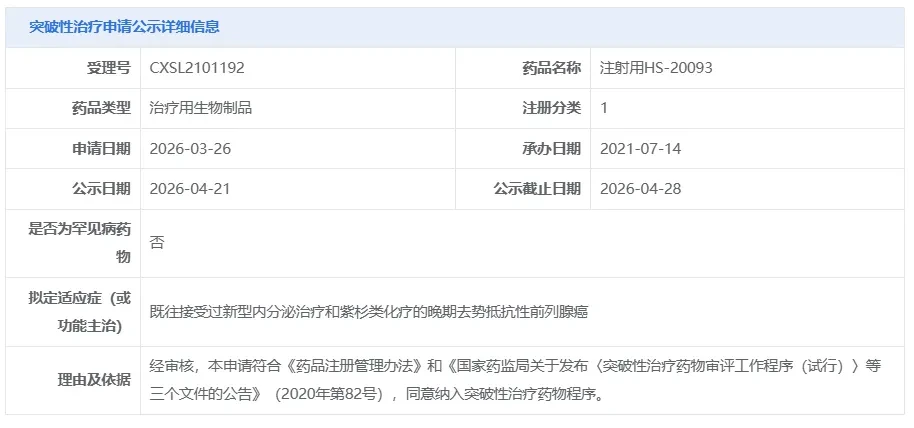
Screenshot source: CDE official website
HS-20093(Risvutatug rezetecan)It is an antibody-drug conjugate targeting B7-H3 developed by Hansoh Pharma. (ADC), composed of a fully human B7-H3 monoclonal antibody and a topoisomerase inhibitor (TOPOi) The payload is covalently linked and is currently being studied for the treatment of various solid tumors. In December 2023, GlaxoSmithKline(GSK)The drug has been obtained.(GSK R&D code GSK5764227)Outside Greater ChinaGlobalExclusive license in other regions.
Previously, HS-20093 had been granted Breakthrough Therapy designation by the CDE for multiple indications, including progression after standard first-line treatment.Extensive-Stage Small Cell Lung Cancer, used to treat patients who have progressed after at least two lines of therapyOsteosarcoma Patients, Locally Advanced or MetastaticNon-squamous Non-small Cell Lung Cancer。
This public notice refers to a new indication: for the treatment of patients who have previously received novel endocrine therapy and taxane-based chemotherapy.Advanced Castration-Resistant Prostate Cancer。
The American Society of Clinical Oncology Genitourinary Cancers Symposium held in February 2026(ASCO GU)At the annual meeting, Hansoh Pharma announced the data from the Phase II clinical ARTEMIS-003 study of HS-20093 for castration-resistant prostate cancer. This is an open-label, multi-center Phase II clinical trial.(NCT06001255), aimed to evaluate HS-20093 in metastatic castration-resistant prostate cancer that has progressed after at least one prior line of systemic therapy. (mCRPC) Efficacy and safety in patients.
In the study, the dosing regimen for the HS-20093 group was 8.0 mg/kg once every three weeks until disease progression or meeting other discontinuation criteria. The study aimed to evaluate its efficacy, safety, pharmacokinetic characteristics, and immunogenicity, with the primary endpoint being the objective response rate assessed according to the combined criteria of RECIST v1.1 and PCWG3.(ORR)。
The study results showed that HS-20093 demonstrated encouraging anti-tumor activity in patients with metastatic castration-resistant prostate cancer, both in those previously treated with taxanes and those untreated with taxanes:
In patients previously treated with taxanes, the cORR was 38.9%, and the cPSA50 response rate was 40.7%.
In patients who have not received taxane-based treatment, the uORR was 41.7%, and the uPSA50 response rate was 23.8%; as of the data cutoff date, enrollment in this cohort is still ongoing, and updated results are pending publication.
Safety data show that the safety profile of HS-20093 is consistent with previous reports in other solid tumors. The most common ≥3 grade treatment-related adverse events with an incidence rate ≥20% are mainly neutropenia and anemia.
Currently, HS-20093 has entered Phase III of clinical development in China for osteosarcoma and small cell lung cancer. Meanwhile, multiple PoC (Proof of Concept) clinical trials are ongoing for the treatment of non-small cell lung cancer, head and neck cancer, prostate cancer, esophageal squamous cell carcinoma, colorectal cancer, and other indications. Overseas, GSK is also advancing several clinical trials for this drug.
SubmissionWeChat: insightxb; Email: insight@dxy.cn