

IP Group: Transforming University Innovations into World-Changing Enterprises

IP Group
Venture Capital Firms
Where do great ideas for innovation and entrepreneurship originate? “Universities” are a very compelling answer.
Whether they are well-known star companies like Google and Facebook, or innovative enterprises focusing on cutting-edge technology fields such as Oxford Nanopore and Avacta, they all originated from universities.
So, how do universities unleash their innovative potential? Full-chain and precise incubation services are particularly crucial.
Based on this,IP Group Focused on Intellectual Property OperationsUndoubtedly seizing the “"Transform Great Innovation into a World-Changing Enterprise"the first-mover advantage.
Leveraging its horizontal innovation ecosystem and vertical accumulation of resources and technology, IP Group has helped universities worldwideOver 300 companies have been incubated, with a total investment of £900 million in start-ups. The invested companies have collectively raised over £5 billion, and their current aggregate valuation has exceeded £7 billion.。
So, how does IP Group tap into first-hand innovative resources from universities? And how does it successfully polish the “raw materials” of university innovations into “finished products” recognized by the market? To unravel this mystery,VCBeat Orange BureauIn-depth Analysis of IP Group.
Collaboration with Universities: Uncovering the Investment Value of Intellectual Property
Only by seizing the source of innovation can we establish technology companies that impact the world.
IP Group has recognized this deeply, partnering with universities in the UK, the US, Australia, and New Zealand to cultivate and strategically position intellectual property within academia and incubate technology-based enterprises.
Taking the UK as an example. IP Group pioneered the concept of establishing long-term partnerships with UK universities and spinning out companies based on university intellectual property. Meanwhile, IP Group holds stakes in Oxford Sciences Innovation and Cambridge Innovation Capital, providing convenient pathways for the subsequent translation of scientific research achievements at these two universities.
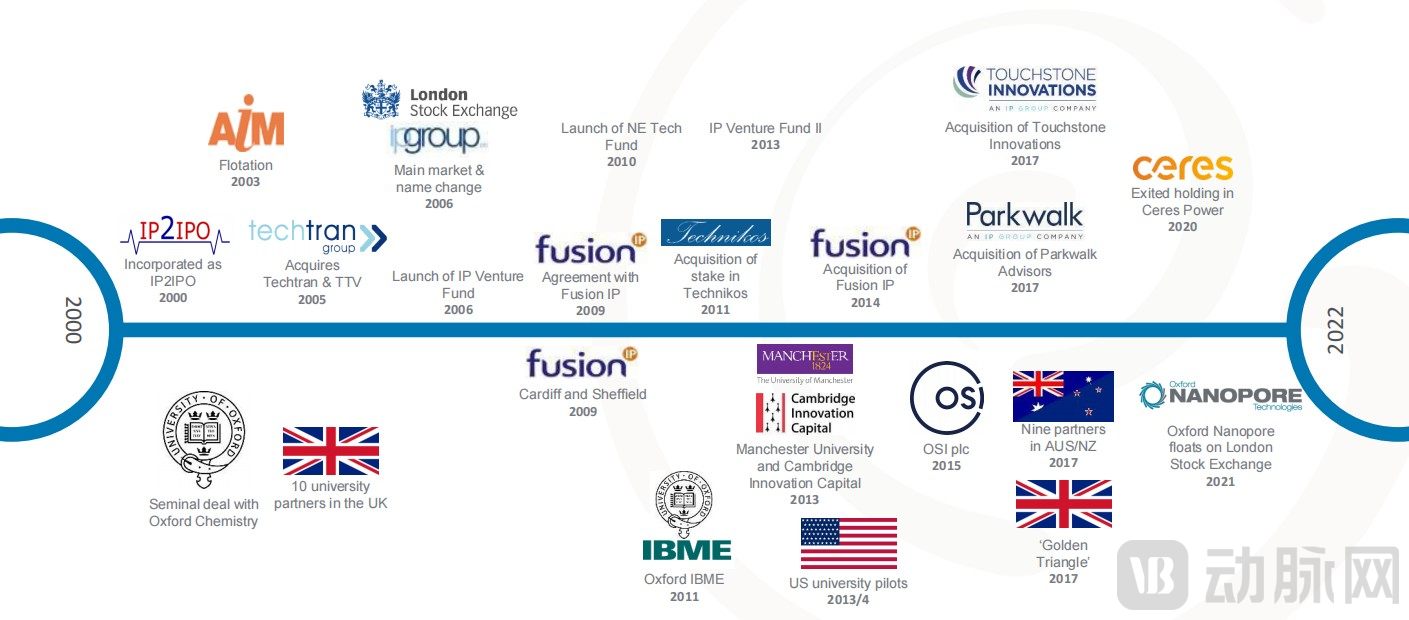
As shown in the figure above, over the 22 years since its establishment, IP Group has not only precisely addressed the global demand for original innovation by replicating and expanding its university collaboration model to the United States and Oceania, but has also been dedicated to transforming academic achievements into rapidly growing technology companies.
As of now,IP Group has already secured resources and networks from 32 top-tier universities, covering nearly 17% of the world’s most cutting-edge scientific research achievements, with its spin-off companies spanning various high-tech sectors.。
So, how exactly does IP Group collaborate with universities?
Taking the University of Southampton in the UK as an example。
In March 2002, IP Group entered into a partnership with the University of Southampton, covering all departments across the university, with a validity period of 25 years.
Under the cooperation agreement, IP Group will invest £5 million in seed funding into multiple companies affiliated with the University of Southampton and acquire equity stakes in these companies over a four-year period. Additionally, IP Group will provide specialized advisory services on the commercialization of intellectual property to the University of Southampton. In return, the University will pay IP Group 20% of its passive income and hold equity positions in several of its subsidiary companies.
Such a treaty means that, IP Group’s intellectual property operations have transcended transactional value to become investment value.. Compared with general intellectual property service agencies, IP Group has greater potential for profitability.
This is indeed the case. In the past year alone, IP Group has obtained34% return on net asset value (nearly £500 million) and after-tax profit of nearly £450 million。
Robust investment returns have further strengthened IP Group’s incubation capabilities, enabling it to continue partnering with highly innovative spin-offs and generating greater profits and resources.
As a result, IP Group’s incubation cycle is now fully integrated.
From Selection and Incubation to Value Enhancement: Diversified Resource Supply
IP Group possesses unique market insight.
It targets high-tech and focuses onHigh-Tech, Clean Technology, General Health, Life SciencesEarly-stage projects in four industries, with high requirements for intellectual property barriers.
For instance, Oxbotica, a spin-out from the University of Oxford’s robotics team that was “selected” by IP Group, has now grown into a leading player in the UK’s autonomous driving sector. Additionally, RAGE Biotech, a biopharmaceutical company jointly invested in by IP Group, Monash University, and the University of Western Australia, has become a top-tier enterprise in the treatment of chronic inflammatory lung diseases.
So, how does IP Group incubate these great enterprises? It is mainly divided into the following four stages:
Phase I: Selection,Conduct initial screening assessment. IP Group’s team of experts first identifies promising research outcomes and technologies at academic and research institutions. Professional technology transfer managers then evaluate the underlying technologies and analyze their potential commercial viability.
Phase 2: Incubation,Incubate Selected Scientific Research Achievements. At this stage, the inventors began to establish a company, with ownership divided through shares, and intellectual property transferred or licensed to the company.
Benefiting from the collaboration between IP Group and universities, the efficiency of intellectual property transfer has been significantly improved, streamlining the lengthy internal review processes at universities and thereby accelerating the commercialization of scientific research outcomes.
In addition to leveraging its efficiency advantages, IP Group has partnered with the European Investment Fund (EIF), a leading European venture capital institution, to establish the IP Venture Fund II. This fund will co-invest with IP Group in its spin-out startups at a 4:1 ratio, addressing the companies’ early-stage funding needs.
Moreover, IP Group provides a range of “soft support” services, including management and marketing, fully demonstrating its vision to facilitate the long-term development of enterprises.
Phase III: Operations,Building a Bridge to the Market. As incubation proceeds smoothly, the company requires additional capital infusion to accelerate its commercial operations. During this phase, IP Group assists the enterprise in identifying and engaging with potential clients, leveraging their feedback to guide the startup’s subsequent development.
Phase 4: Value Addition,Transforming Startups into Great Enterprises. As startups mature, IP Group will adhere to the principles of continued scaling and active management, proactively expanding into other investment channels, including specialized funds, financial institutions, and wealth advisors.
Meanwhile, IP Group will continue to play an active role in the company by providing support in areas such as business models, licensing information, industry collaborations or M&A, and IPO development strategies, and will exit at an appropriate time.
IP Group’s dual-pronged incubation strategy, combining both “hard” and “soft” strengths, ensures that startups secure funding for technological R&D while achieving robust commercial operations.
The specific incubation process is shown in the figure below:
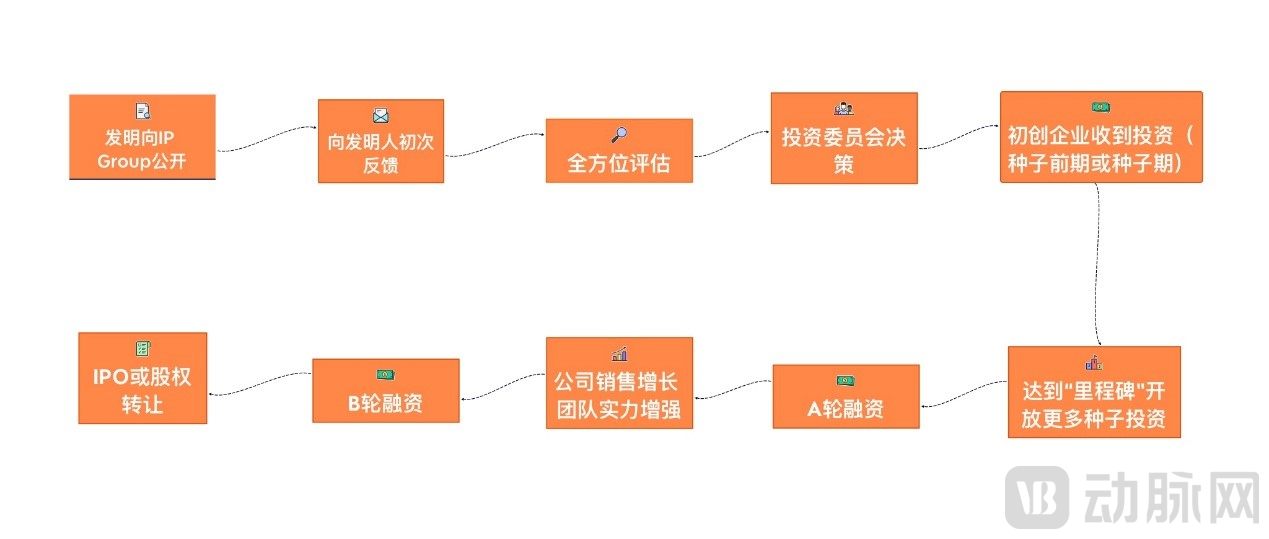
Notably, IP Group is not confined to this single incubation model but appropriately adjusts its process based on the specific circumstances of each project.
For instance, Nanopore, which developed nanopore sensing technology, took 15 years of accumulation to achieve its IPO. Fifteen years is a timeframe far beyond what traditional venture capital firms are willing to accept, yet IP Group resolutely chose to stand with Nanopore through thick and thin, helping it complete a multi-billion-pound listing transaction last year.
However, not all investment institutions are capable of supporting the commercialization of innovations with long development horizons.
Only “evergreen” structures like IP Group, with ample funding and specialized commercialization teams, have the capacity to pursue ventures that follow non-traditional timelines.
Lessons from Others: Extending the Intellectual Property Service Chain
Undoubtedly, universities possess more factors that stimulate the “wild growth” of scientific research and innovation—from brand reputation and professional networks to cutting-edge technology and dynamic entrepreneurial talent. As a result, university research achievements have long been favored by the market and investors.
Within this context, intellectual property, as the core of university achievement transformation, is bound to receive special attention from relevant stakeholders.
Where there is demand, there is supply. According to the “2021 National Statistical Survey Report on Intellectual Property Services” (hereinafter referred to as the Report) released by the China National Intellectual Property Administration, the number of intellectual property practitioners in China has shown a sustained growth trend.
As of the end of 2020, there were approximately 73,000 institutions engaged in various types of intellectual property (IP) services across China, with around 865,000 practitioners in the IP service industry, representing a 5.6% increase compared to the end of 2019.
However, the report also reveals that agency services constitute the primary form of investment and revenue for intellectual property service firms in China. It is evident that the current scope and forms of services offered by these institutions remain limited, with insufficient depth of integration with investment firms.
Benchmarking against IP Group, which leverages intellectual property as its core strategy, effectively managing IP operations is an inevitable path for truly capitalizing on Chinese universities as hotbeds of scientific research and innovation.
Specific measures include: continuously expanding the team of intellectual property service professionals; broadening the forms and scope of services offered, such as legal support, training, and operational assistance; and strengthening two-way integration with universities and the market to deepen involvement in the process of translating scientific and technological achievements into practical applications.
Riding the momentum of translating university research achievements into practical applications, today’s “shortcomings” will ultimately become tomorrow’s “sources of potential.”