

ATTEC Biologics Completes Pre-A Financing Round Led by Sequoia China
Recently, Attek announced the completion of its Pre-A financing round, led by Sequoia China. The funds will be used to continuously advance the research and development of next-generation protein degrader drugs based on ATTEC technology, including upgrading the drug target screening system, expanding the professional R&D team, and advancing the structural design, modification, and validation of small-molecule drugs.
Ataike is a company dedicated to the research and development of first-in-class, next-generation protein degraders. Pioneering a unique approach, the company focuses on novel small-molecule molecular glues that target the autophagy-lysosome pathway for degradation, aiming to provide innovative therapeutic solutions for “undruggable” disease-causing proteins or targets previously considered “untargetable.” Addressing significant unmet clinical needs, Ataike has built a robust pipeline of multiple investigational products, all protected by independent intellectual property rights.
Currently, Aiteke has secured investments from multiple leading domestic venture capital firms, and its core technology platform and pipeline have gained recognition and fostered collaborations with top-tier international pharmaceutical companies.
Targeting “undruggable targets” has emerged as one of the key directions for original drug development in recent years.
Traditional drug development is based on the “occupancy-driven” model of classical receptor pharmacology, which involves discovering and identifying small molecules that directly interact with the active site of target proteins, including agonists that enhance their function or inhibitors that suppress their activity. This approach requires relatively high drug concentrations to ensure sufficient occupancy of the target protein and thereby exert therapeutic effects.
However, classic target proteins that fit the “occupancy-driven” model account for only about 15% of the total proteome. More than 80% of disease-associated scaffold proteins, transcription factors, and other non-enzymatic proteins cannot have their functions inhibited through occupancy; nevertheless, their dysregulated expression leads to various diseases. Such targets have long been considered “undruggable,” leaving substantial unmet clinical needs.
Protein degradation technology is particularly favored in tackling the challenge of "undruggable targets."
Small-molecule drug development technologies that induce protein degradation have ushered in a new era of “event-driven” protein degradation. Compared with the “occupancy-driven” model, the “event-driven” model no longer focuses on occupying the active site but instead drives the degradation of target proteins, offering unparalleled advantages in drug development for “undruggable targets.”
Currently, protein degradation technology has become the new favorite in small-molecule drug development. Numerous companies worldwide are strategically positioning themselves in the protein degradation space through independent research or commercial collaborations, driving a surge in capital investment. In 2020, three overseas protein degrader companies—Arvinas, C4 Therapeutics, and Kymera Therapeutics—successfully went public.
In terms of clinical research progress, according to statistics from VCBeat Institute, as of May 2022, there were over 100 protein degrader projects globally that had completed proof-of-concept and were in the preclinical stage, with 31 having entered clinical trials. These therapies are primarily applied in the oncology field, with some pipeline candidates already in Phase II clinical trials.
China’s research and development in protein degradation started relatively late but has advanced rapidly. The “14th Five-Year Plan for the Development of the Pharmaceutical Industry,” released on January 30, 2022, designated frontier core technologies and drugs—including PROTAC-based targeted protein degradation technology—as key areas for priority development.
There are 20–30 companies in China developing protein degraders, with most focusing on PROTAC technology.Ataike is one of the few protein degrader companies focused on ATTEC technology. Its ATTEC small-molecule glue screening platform enables high-throughput, highly efficient, and cost-effective target identification.
It is reasonable to believe that protein degraders represent the latest frontier breakthrough in small-molecule drugs, following nucleic acid therapeutics and gene therapy, and will serve as the key to unlocking the next golden age of small-molecule therapeutics.
Targeted protein degradation leverages the body’s two naturally occurring protein degradation systems—the ubiquitin-proteasome system and the lysosomal system—to achieve highly efficient and precise degradation of disease-causing proteins. Based on these two systems, there are currently more than 10 technological approaches for protein degradation, including the most well-known PROTAC, as well as ATTEC, AUTAC, and LYTAC.
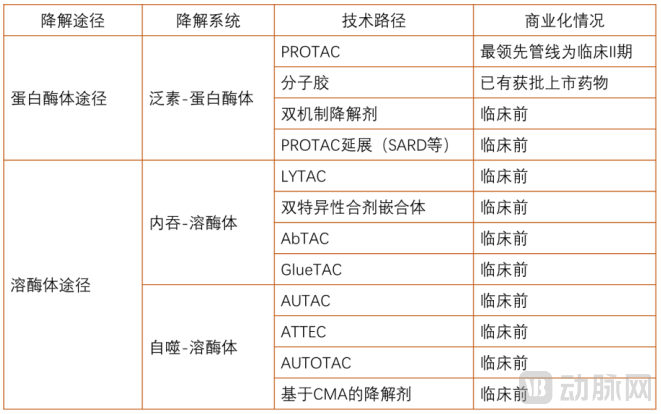
Overview of Protein Degradation Technology Pathways, Source: *Signal Transduction and Targeted Therapy*
PROTAC is the fastest-growing protein degradation technology, with a 20-year history. It has completed proof-of-concept and entered the initial translational stage. Arvinas’ two PROTAC drugs in Phase II clinical trials, ARV-110 and ARV-471, are among the first to enter clinical development. Multiple pipeline candidates are being developed for last-line cancer treatment, showing promising preliminary efficacy.
In the past two years, several PROTAC drugs have successively entered Phase II clinical trials. Furthermore, statistics indicate that more than 20 companies in China are actively developing PROTAC-based therapies.Both overseas and in China, the PROTAC technology sector has entered a phase of intense activity.
However, PROTAC technology still has certain limitations. For instance, PROTAC molecules tend to have high molecular weights, typically ranging from 700 to 1200 Da, which deviates from Lipinski’s Rule of Five for drug-likeness. This results in poor cell permeability, complex ADME (absorption, distribution, metabolism, and excretion) profiles, and increased challenges in drug development. Furthermore, the variety of E3 ligases expressed in many cell types is limited, and since the mechanism of action of PROTACs relies on E3 ligases, their applicability is constrained. Additionally, existing studies have shown that cancer cells treated with certain PROTAC compounds may downregulate or bypass the relevant E3 ligases, ultimately leading to drug resistance.
More importantly, nearly 1,000 international patents related to PROTAC technology have been filed, attracting over $10 billion in investment, with large foreign companies, particularly in the United States, holding a monopolistic position. If domestic enterprises merely follow PROTAC technology for industrial layout, they risk having core intellectual property rights monopolized by foreign entities, facing difficulties in circumventing relevant foundational patents and encountering constrained development.
Therefore,The industry urgently needs to discover and develop alternative degradation technologies based on non-ubiquitin-proteasome pathways, pioneer new frontiers, and secure a commanding position in the field.
Emerging technologies such as ATTEC have attracted attention from the industry. ATTEC is a lysosomal degradation pathway that induces protein degradation. In a study published in Nature in October 2019, Professor Lu Boxun’s team at Fudan University developed a “small-molecule glue” capable of binding to both LC3, a key protein in autophagy, and mutant huntingtin (mHTT), thereby tethering the target protein to autophagosomes for degradation. Further studies have demonstrated that ATTEC may not only be effective in treating Huntington’s disease but also applicable to other polyQ diseases.
In a commentary published in the same issue of Nature, Huda Zoghbi—a member of the U.S. National Academy of Sciences, a Breakthrough Prize laureate, and a renowned scientist in the field of neurodegenerative diseases—highly praised and endorsed this study on ATTEC. The research was subsequently selected as one of Nature’s Top 10 Outstanding Papers of 2019.
In 2021, the cover article published by Lu Boxun and Ding Yu’s team in Cell Research demonstrated that ATTEC technology can degrade not only proteins but also non-protein biological macromolecules, including lipids, by targeting the autophagy-lysosome pathway, and that ATTEC can also adopt a spliced bifunctional compound design strategy. This study achieved, for the first time, the targeted degradation of non-protein biological macromolecules, thereby marking a breakthrough in targeted degradation technology from proteins to non-protein substances.
In a concurrent commentary, Cell Research stated that this study “firmly establishes the bifunctional mode of ATTEC as a rising star in the field of targeted degradation; ATTEC opens the stage for the degradation of non-protein cellular components, such as other macromolecules and organelles; it will rapidly generate countless tools that will change the way biological processes are studied and reveal a major new direction for novel therapeutic approaches.”
In summary,Distinct from PROTAC technology, which degrades pathogenic proteins via the proteasome pathway, ATTEC technology develops novel drugs for pathogenic protein degradation through the autophagy pathway, offering multiple advantages.
First, the small-molecule compounds identified through ATTEC technology have lower molecular weights, better drug-likeness, and greater potential for later-stage optimization. Second, since ATTEC technology leverages autophagy—a cellular process present in all cell types—it is not constrained by the availability of specific E3 ligases, thereby enabling broader application in targeted protein degradation. Furthermore, potential therapeutics discovered via ATTEC can degrade not only soluble small proteins but also pathogenic entities such as protein aggregates, damaged organelles, lipid droplets, nucleic acids, and exogenous pathogens, thus expanding the range of treatable diseases.
ATTEC is the new hotspot in the field of protein degradation after PROTAC, but its maturity and commercial progress are very limited at present, all still in the preclinical stage. Fortunately, a domestic company—Atac has already made an early layout for ATTEC.
Professor Ding Yu, founder of Aiteke Science, is a professor at the School of Life Sciences, Fudan University. He has published more than 40 SCI papers in internationally renowned journals such as Nature, Cell Research, and Trends in Pharmacological Sciences.Professor Ding Yu successfully developed the ATTEC technology and used it to selectively reduce mutant huntingtin protein. The related findings were published in Nature and selected as one of Nature’s Top 10 Papers of 2019.
It is reported that Professor Ding Yu is currently conducting three-dimensional structural analysis of protein–small molecule interactions. Previously, in the absence of knowledge regarding the three-dimensional structures of small molecule–protein complexes, drug discovery relied heavily on empirical experience. Professor Ding’s research will significantly enhance the efficiency of drug development.
Atek adoptsSmall-Molecule Glue Technology, Professor Ding Yu introduced: "PROTAC molecules have a high molecular weight and complex synthetic routes, posing challenges in later-stage drug development regarding druggability, oral bioavailability, and other aspects. In comparison,"Small-molecule glue technology screens for smaller target molecules., with significant potential for future optimization.”
The core of small-molecule glue technology lies in the screening system, AtacAuthorized use of the oblique-incidence reflectance difference technique developed by Associate Researcher Fei Yiyan of Fudan University, has mastered the ATTEC small-molecule glue screening technology and possesses an advanced optical screening platform. Leveraging the ATTEC small-molecule glue screening technology, the company can screen and validate tens of thousands of small molecules on a single chip.
Currently, Aitek has established a highly specialized industrialization team comprising three departments: high-throughput screening, drug design, and pharmacology. The company’s pipeline is advancing steadily, with the first batch consisting of four projects, all targeting difficult-to-drug targets with high clinical demand.
To fully leverage the potential of its core ATTEC technology, the Company has actively established extensive R&D partnerships with leading global pharmaceutical and biotech companies. In 2020, it entered into a strategic partnership with an internationally leading pharmaceutical company to develop novel molecular glue therapies.
Currently, Aiteke's pipeline is in the lead optimization stage. In addition to advancing its pipeline, the companyMoving forward, we will continue to focus on deepening our proprietary ATTEC technology platform: the team will further upgrade the screening system to enhance screening efficiency; expand the exclusive small-molecule compound library; and establish an end-to-end technical platform spanning from target validation to drug screening and optimization. We aim to screen and validate more ATTEC compounds targeting disease-causing proteins deemed “undruggable” as well as non-protein entities, thereby discovering innovative therapeutics.
“Protein degradation is a key direction in new drug development. The prospects of emerging technologies such as ATTEC are promising and warrant greater participation from companies to accelerate their advancement,” said Hu Wei, CEO of Attec Therapeutics. “The critical factor differentiating next-generation protein degrader companies lies in the quality of their targets—specifically, selecting high-quality targets well-suited for the ATTEC platform. Attec places strong emphasis on external collaborations: by partnering with leading international pharmaceutical and biotech companies, we aim to advance drug discovery against high-value targets, leveraging complementary strengths to fully unlock the potential of our technology platform in discovering innovative molecules.”
Cao Yibo, Managing Director at Sequoia ChinaHe stated, “Sequoia China has consistently supported the early-stage development of companies with global first-in-class opportunities. Attek’s unique optical screening platform and ATTEC technology offer differentiated advantages in the field of protein degradation, creating opportunities to advance a range of novel targets addressing unmet medical needs into clinical stages, thereby providing new therapeutic options for relevant patients.”
Xu Dilong, Partner at Shulan Junjie Capital, the Angel Round InvestorStatement: Shulan Junjie Capital emphasizes the capability to translate scientific and technological achievements into clinical applications. We believe that Ataike possesses a globally original, independently intellectual property-owned high-throughput protein degradation drug screening platform, as well as unique non-ubiquitin-proteasome pathway degradation technology. Furthermore, the team combines excellent expertise from both the scientific and industrial sectors. With support from top-tier institutions such as Sequoia China, Ataike is poised to achieve even greater success in the development of novel drugs targeting “undruggable” disease-causing proteins or “intractable” targets.
About Sequoia China
Sequoia China is committed to helping entrepreneurs build enduring, great companies by bringing rich global resources and valuable historical experience to its portfolio companies. As “entrepreneurs behind entrepreneurs,” Sequoia China focuses on investment opportunities in three sectors: technology, consumer, and healthcare. Over the past 17 years, Sequoia China has invested in more than 900 companies with distinct technological features, innovative business models, and high growth potential.
About Shulan Junjie Capital
Shulan Junjie Capital was co-founded by early investors in Shulan Medical Group. It leverages clinical resources to facilitate the commercialization of medical technologies, promoting the integrated development of clinical practice, scientific research, and industry through community services, fund investments, and research incubation, thereby supporting medical professionals in technological innovation and entrepreneurship. Since the establishment of its first fund in 2017, it has supported the rapid growth of more than thirty platform-based technology enterprises in fields such as innovative drugs, novel medical devices, and research services, with the cumulative valuation of these projects exceeding RMB 10 billion.