

Precision BioSciences Partners with Novartis on In Vivo Gene Editing Therapy for Hemoglobinopathies, Secures Over $1.4 Billion Deal

Osage University Partners
Venture Capital Firms

Agent Capital
Agent Capital is a biotechnology venture capital firm.

Ziegler
A Comprehensive and Innovative Financial Services Company

Baxter Ventures
Venture Capital Firms

F-Prime Capital
Healthcare Venture Capital Firms

RA Capital
Life Sciences Venture Capital Firms

The Longevity Fund
Venture Capital Firm

Gilead Capital
Investment Management Company

Precision BioSciences
Gene Editing Technology Developer

VenBio Partners
VenBio primarily provides financial support to promising companies at various stages of development.

Amgen Ventures
A venture capital firm based in California
On June 22, 2022, Precision BioSciences, Inc. (NASDAQ: DTIL), a gene-editing company based in North Carolina, USA, announced that it had entered into an exclusive global collaboration agreement with Novartis Pharma AG, one of the world’s top three pharmaceutical companies, for the research and development of in vivo gene editing therapies.Precision BioSciences (hereinafter referred to as “Precision”) will, through itsProprietary ARCUS Genome Editing TechnologyCustomize a solution for one-time conversionNucleases for the Treatment of Hemoglobinopathies (e.g., Sickle Cell Disease and β-Thalassemia), Novartis will be responsible for all subsequent research, development, manufacturing, and commercialization activities.Through this collaboration, Precision will receive payments exceeding $1.4 billion., upon successful commercialization of the product, the Company will also receive tiered royalties from product sales.
This is not the first time Precision has partnered with major healthcare companies through its exclusive ARCUS genome editing technology. Previously, the company has engaged in deep collaborations with large healthcare enterprises and academic institutions such as Eli Lilly, Duke University, and the University of Pennsylvania, achieving significant results in research on Duchenne muscular dystrophy, relapsed/refractory (R/R) multiple myeloma, and hepatitis B virus.
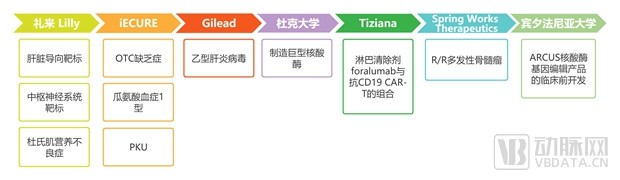
Precision BioSciences: Selected Corporate, Academic, and Research Project Collaborations
How exactly does ARCUS genome editing technology work, and what advantages does it offer that continue to attract new research collaborators to fund their own participation? This story begins with Precision’s two founders"Seeking Genome Editing in Nature"Start.
Dr. Derek Jantz and Dr. Jeff Smith from Chlamydomonas reinhardtii (Chlamydomonas reinhardtii) I-CreI endonuclease was discovered in.Unlike ZFNs, TALENs, or CRISPR/Cas9, I-CreI is aNatural Enzymes, it can be evolved to edit large and complex genomes. In nature, it is responsible for modifying specific sites in algal genomes by inserting genes through the HDR process.

Dr. Derek Jantz, Co-Founder and Chief Scientific Officer Dr. Jeff Smith, Co-Founder and Chief Technology Officer
The two researchers discovered the natural advantages of I-CreI endonuclease, including precise target editing, a compact and simple structure, and ease of DNA repair., thus they continuously re-engineered I-CreI,Endowing I-CreI with Distinct DNA Recognition Specificity, and named this protein engineering approach the ARCUS genome editing technology, designating the resulting product as the ARCUS nuclease.
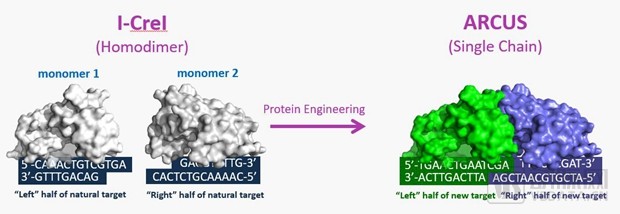
I-CreI endonuclease was re-engineered into the ARCUS single-strand nuclease
Specifically, the natural I-CreI target sites discovered by the two doctors arePseudo-palindrome: The first half of the base sequence is approximately a mirror image of the second half. Since palindromic DNA sites are rare in most genomes, additional techniques need to be developed to overcome the resulting limitations on DNA target diversity.
The ARCUS platform is designed to generate two reprogrammed I-CreI proteins for each target, which are then linked together to form a single protein expressible from a single gene—the ARCUS single-chain endonuclease.This process enables ARCUS nucleases, like the native I-CreI, to recognize and cleave non-palindromic target sites via endonuclease activity, while offering the advantages of small size and ease of delivery.
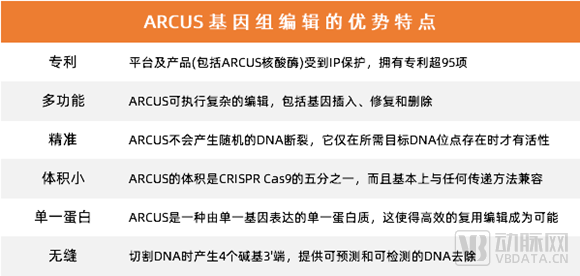
As of December 31, 2021, Precision had developed six ARCUS nucleases that were either granted patents or pending patent applications worldwide.Over 290 patents。
Given the superior comprehensive capabilities of ARCUS nucleases, such as their precision and ease of delivery,Precision BioSciences has decided to apply it to precise and efficient allogeneic CAR-T immunotherapy.。
Manufacturing allogeneic CAR-T cells requires two rounds of gene editing on T cells from healthy donors.First, the genes encoding the T-cell receptor (TCR) must be deleted to prevent donor-derived T cells from inducing graft-versus-host disease (GvHD) in patients. Second, the chimeric antigen receptor (CAR) specific to a particular cancer must be precisely integrated into the T cell’s DNA, enabling the T cells to recognize and kill those cancer cells.
Precision BioSciences Develops “One-Step” Method to Simultaneously Achieve Two Genetic Modifications, specifically using ARCUS to directly insert the CAR gene into the gene encoding the α subunit of the TCR. This approach increases the DNA encoding the CAR while simultaneously disrupting the DNA encoding the TCR,Replaced one gene with anotherThis method is protected by nine patented technologies in the United States, and trials conducted by Precision BioSciences have demonstrated that T cells treated with ARCUS exhibit reduced graft-versus-host reactions and complications.
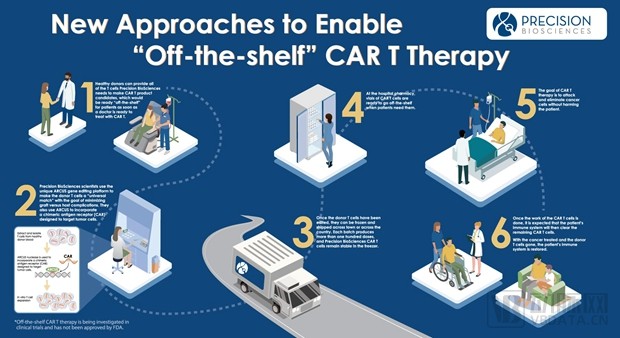
Flowchart of Allogeneic CAR-T Therapy Involving AECUS Technology
Edited T cells will be cryopreserved in canisters and distributed to hospitals nationwide, enabling immediate administration to patients upon initiation of CAR-T therapy, thereby eliminating the need to wait for manufacturing.Meanwhile,CAR-T therapy can attack and eliminate cancer cells without harming the patient.. Once the CAR-T cells have completed their function, the patient’s immune system will clear the remaining CAR-T cells on its own. As treatment progresses in cancer patients and the donor T cells disappear, the patient’s immune system gradually recovers.
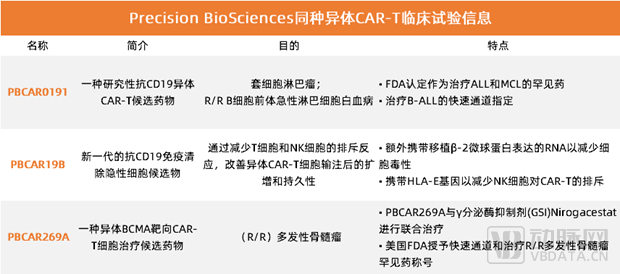
Currently, Precision BioSciences is developing multiple off-the-shelf allogeneic CAR-T cell therapy candidates, aiming to provide potential treatment options for patients with hematologic disorders and blood cancers.The candidate drugs that have entered the clinical stage mainly target mantle cell lymphoma, relapsed/refractory (R/R) B-cell precursor acute lymphoblastic leukemia, and R/R multiple myeloma. Among them, PBCAR0191 and PBCAR269A are currentlyHas received FDA Fast Track Designation and Orphan Drug Designation, PBCAR19B'sThe Investigational New Drug (IND) application was also accepted by the FDA on January 19, 2021.。
As a research and technology-driven company, Precision BioSciences has consistently maintained R&D expenditures significantly higher than general and administrative expenses since its establishment in 2006, accounting for 75% or more of total operating costs. Except for 2021, when R&D spending was comparable to the company’s revenue, R&D expenditures from 2018 to 2020 exceeded four times the annual revenue each year.
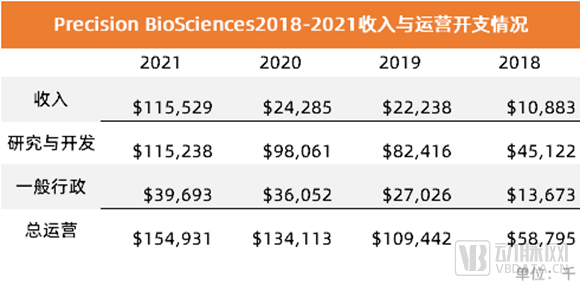
Precision BioSciences’ Revenue and Operating Expenses, 2018–2022 (Source: Company Annual Reports)
Substantial R&D expenditures naturally rely on support from investment institutions. To date, Precision has raised nearly $400 million through financing and public stock offerings. In its Series B financing round in 2018, it secured $110 million provided by 38 investment firms. The company completed its IPO the following year, raising a total of $145.4 million.
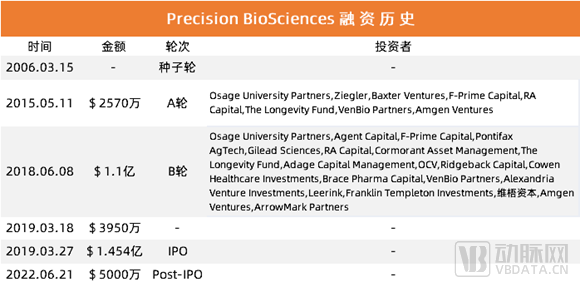
Precision BioSciences Historical Financing Overview (Source: Crunchbase)
Hard work pays off: Precision was named “Top 10 Gene Editing Companies Worldwide”. To facilitate the transition from laboratory research to commercialization, Precision has also equipped its cGMP-compliant, dedicated manufacturing facility, MCAT, with over 33,800 square feet of space and four cleanrooms for the production of CAR-T cells, mRNA, and AAV, as well as for the development of its allogeneic CAR-T immunotherapy platform.
Through this collaboration with Novartis, Precision has extended its cash runway into the second quarter of 2024. We are confident that the precise tunability of ARCUS nucleases and the high efficacy of CAR-T therapy will unlock greater possibilities in the future, and we look forward to seeing more CAR-T candidate drugs for various cancers gain FDA approval for market launch.