

Seizing the Billion-Dollar Opportunity in Precision Healthcare Management: How a Niche MedTech Player is Pioneering China’s DRG/DIP Reform Era
At the end of 2021, the National Healthcare Security Administration issued the “Notice on Printing and Distributing the Three-Year Action Plan for DRG/DIP Payment Method Reform,” accelerating the advancement of DRG/DIP health insurance payment reforms. Health insurance reimbursement has begun to shift from fee-for-service assessment to value-based assessment, from passive purchasing to proactive cost containment, and from paper-based management to digitalized (refined) management, making it truly possible to achieve a balance between cost reduction and quality improvement among hospitals, health insurance providers, and patients.
The frequent implementation of healthcare reform policies has fueled the sustained boom in the multi-billion-dollar market for refined healthcare management.
Concurrently, external pressures such as tiered diagnosis and treatment, zero-markup policies for drugs and consumables, and DRG/DIP payment reforms, along with internal pressures including advances in medical technology, multi-site practice, and rising social wage levels, have become the sustained internal drivers propelling public hospitals to enhance medical standards, increase medical value-added, improve quality and efficiency, reduce costs and control expenses, and transition from extensive, scale-driven expansion to refined management.
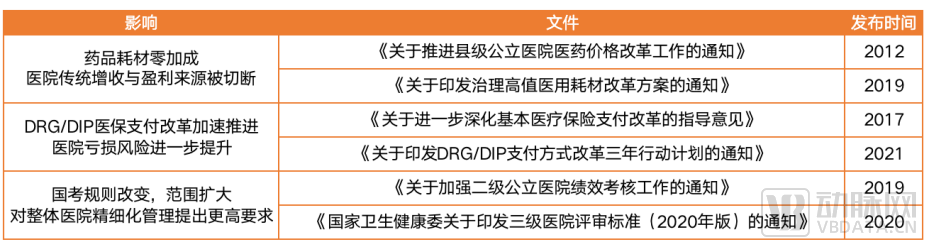
Relevant Healthcare Reform Policies for Advancing Refined Management in Healthcare
Where Do the Opportunities Lie in the Phase of Refined Management of Medical Insurance Cost Control?
If payment method reforms can guide medical institutions to shift from an extensive, scale-driven operational model toward a more intensive approach that emphasizes internal cost control and the technical value of medical services, these institutions may find new growth momentum within the DRG framework.
However, despite the continuous promotion of standardized hospital management by multiple factors such as policies and informatization development, and the iterative advancement of medical data analysis methods during healthcare reform, in-depth medical data analysis technologies are rarely applied to hospital management—particularly in health insurance management. This is due to the complexity and high entry barriers of hospital management systems, the lack of linkage between cost reduction and efficiency gains through refined management and the performance evaluation of hospital administrators, and the inability of existing assessment indicators to stimulate team motivation.
The scarcity of this technology’s application in hospital management will enable tech companies that are first to enter this field to rapidly secure a data advantage and establish industry barriers.
Zhongke Houli Information Technology (Chengdu) Co., Ltd. (hereinafter referred to as “Zhongke Houli”) specializes in AI-driven, case-specific differentiated DMIAES for refined hospital management, providing solutions for precision healthcare administration. Grounded in evidence-based hospital management models, the company facilitates the “soft landing” of DRG/DIP payment systems within hospitals. It effectively alleviates internal and external conflicts, enhancing operational management through the integration of clinical and financial operations.
Mr. Li Tao, Chairman of the Board, has many years of experience in clinical practice, management decision support, and hospital information management.
He earned his bachelor’s degree in Clinical Medicine from the Medical School of Fudan University, and later obtained master’s degrees in Information Management and Hospital Administration from Carnegie Mellon University and the University of Houston, respectively. Furthermore, Mr. Li Tao has served as a Senior Analytics Expert and Visiting Professor at Vizient (formerly the University HealthSystem Consortium) in the United States, as well as a Healthcare Performance Improvement Specialist and Chief Project Manager in the Decision Support Department at Memorial Hermann Hospital, Texas Medical Center. He possesses over ten years of hospital management experience in the U.S.
In discussions on the refined management of hospitals, Li Tao shared numerous valuable insights with VCBeat, along with Zhongke Houli’s solutions, offering reference ideas for the future development of refined hospital management.
The difficulty in integrating case-based medical records with financial management—commonly referred to as “business-finance integration”—along with the lack of refined cost control, is one of the fundamental causes of declining healthcare quality.
With traditional revenue and profit sources for hospitals being cut off, the accelerated advancement of DRG/DIP health insurance payment reforms, and changes in the National Performance Evaluation rules, hospital profit margins will be significantly squeezed. If fundamental structural reforms are not implemented, the cost of medical services will remain high under the ongoing healthcare reform. Therefore, in the current process of refined hospital management, it is essential to ensure the quality of care while improving speed and efficiency by utilizing minimal resources.
How to Improve?Li Tao shared with VCBeat his insights, drawing on years of hospital management experience in the United States, and distilled the optimal optimization pathway into three key points.
First, adjust the case-mix structure, increase the proportion of high-level surgical procedures, and raise the Case Mix Index (CMI) value; improve medical record quality, optimize the core grouping rate under the Diagnosis-Intervention Packet (DIP) payment system, and further increase reimbursement levels.
Secondly, optimize the cost structure by controlling expenditures on pharmaceuticals and consumables while increasing fees for medical services, all without raising the total cost.
Finally, regulate medical practices that lead to abnormal resource consumption to mitigate losses in a timely manner;
“The core logic behind DRG must be the standardization and normalization of medical practices. Management should not rely solely on rigid assessment methods based on simple binary classifications; rather, hospitals must effectively persuade clinicians to voluntarily control waste and increase surpluses starting from each individual case. By accumulating these small gains, both hospital and physician revenues can be enhanced. This is the true path to healthcare reform, ultimately making us all beneficiaries of such reforms.”Li Tao added.
Zhongke Houli leverages DRG-based AI disease risk models as its core technology to enable refined case-level cost management, establishing benchmark and standard costs for individual cases through innovative technological development.Meanwhile, guided by the clinical management philosophy of “matching resources to risks,” it provides a practical tool for comprehensive hospital decision-making. It drives healthcare institutions to shift from volume-driven growth to quality- and efficiency-driven improvement, encouraging healthcare providers—particularly clinicians—to proactively control costs and achieve high-quality hospital development.
“The Complexity and Heterogeneity of Clinical Conditions” is an analytical challenge that hospitals cannot avoid in their pursuit of refined management, while disease risk prediction serves as a critical process in risk adjustment. Only by leveraging disease risk modeling to conduct big-data statistical analysis on each case, and by developing separate models and analyses for different management dimensions such as medical quality, efficiency, and cost, can the specific requirements of medical professionalism and the multidimensional needs of hospital refined management be truly met.
It is reported that risk adjustment has long been regarded by U.S. hospitals as a core component of management. Currently, this management model has been widely applied in the quality supervision of U.S. hospitals, comprehensive hospital rankings, and internal hospital management. It has become a recognized standard for evaluating healthcare service quality, encompassing assessments such as the cost-control models of the U.S. Centers for Medicare & Medicaid Services (CMS), hospital management capability evaluations, Newsweek’s Best Hospitals, and Healthgrades’ Top Doctors.
Zhongke Houli leverages mathematical statistics and artificial intelligence-based modeling to accurately predict disease outcomes for hospitalized patients, conduct comparative analyses of results, and perform disease risk prediction in the context of China’s healthcare reform.
Specifically, this involves classifying and grouping historical data on inpatients’ demographic information, severity of illness at admission, admission pathways, surgical procedures, prior comorbidities, and selected clinical ancillary tests to construct sophisticated neural network models. These models are then employed to accurately predict risks for current patients while performing disease risk adjustment. By leveraging effective medical data analysis and management evaluation methods, this approach transforms passive management into proactive management, thereby further standardizing clinical medical practices.
Achieve precise profiling of resource consumption (case-based costing) centered on “patient-centricity,” break through the traditional purely financial model, address the clinical challenge of “high variability among individual patients,” and drive the transformation from traditional accounting to management accounting.
The future model of medical insurance reform will inevitably be one focused on volume reduction.That is, to meet greater healthcare demands with the highest efficiency and the most limited bed capacity, while ensuring medical quality—thereby practicing value-based healthcare.
Based on this understanding, Zhongke Houli has developed an intelligent MDSS (Hospital Management Decision Support System) built on the “DRGs + Disease Risk Model,” thereby delivering a specialized solution in this field.
Unlike traditional hospital management, the most distinctive feature of Zhongke Houli’s management model lies in its “precision” and “leanness.”
“Fine” refers to analysis based on individual case studies, while “Benefit” denotes the enhancement of profitability. This approach not only addresses the “average value trap” caused by simple weighted averages but also ensures that management is evidence-based and grounded in data through refined disease classification, individual case tracking, and medical risk analysis. By aligning with clinicians’ thinking patterns, it achieves an evidence-based management model characterized by traceable causes, verifiable sources, and conclusive proof.
Zhongke Houli’s solution integrates medical statistics, DRG grouping, and disease risk models. By conducting fine-grained patient analysis, it separately models and analyzes different management dimensions, including medical quality, efficiency, and costs. This approach ultimately enables cost accounting based on individual cases and the tracking of abnormal medical behaviors on a case-by-case basis, rather than relying solely on the level of expenses.
Tailored to the varying management needs of different hospitals, this solution can be customized and adjusted, achieving 90% standardization at the application level. Project deployment requires only 1–3 months and can be completed by a team of 1–2 individuals, enabling rapid implementation.
Zhongke Houli is currently the sole technical support provider for the disease risk models introduced by the National Health Commission. It is reported that its intelligent Medical Decision Support System (MDSS), built on a “DRGs + Disease Risk Model” framework, has been deployed by regulatory bodies such as the National Health Commission’s Information Center’s National Population Health Platform, as well as by top-tier hospitals across China—including The First Affiliated Hospital of Sun Yat-sen University Cancer Center, The Third Affiliated Hospital of Sun Yat-sen University, and Zhongda Hospital Southeast University—as well as enterprise-level hospitals, district- and county-level hospitals, and traditional Chinese medicine and maternal and child health hospitals.
Leveraging its robust data analytics capabilities and a refined cost allocation system, Zhongke Houli developed the “Hospital Case-Based Cost Analysis and Benefit Management System” for Sun Yat-sen University Cancer Center, which ranks fifth globally and second in Asia. In October 2021, the hospital was recognized by the Hospital Management Capacity Building and Continuing Education Center of the National Health Commission as a “Typical Case of Refined Hospital Medical Insurance Management.” Its comprehensive evaluation and decision-making system based on disease risk adjustment has been promoted and applied to hospitals across China.
Centered on the disease risk adjustment model, this case aligns cost-control measures with standards for health insurance payment management. It transitions from the traditional four-tier, three-level allocation framework to a five-tier, four-level allocation framework, thereby achieving a refined transformation of hospital case-based cost control under the health insurance cost-containment model. For Sun Yat-sen University Cancer Center, this approach reduced the average cost per visit by 13% in 2021, led to year-on-year declines in pharmaceutical and consumable expenditures, optimized the cost structure, increased revenue, and has become a core component of the hospital’s daily operational management.
Currently, Zhongke Houli has established the DMIAES (Intelligent Analysis and Evaluation System for Hospital Management) and completed a disease risk adjustment model based on neural network transfer learning. The system conducts multi-dimensional analysis and evaluation of medical quality, efficiency, safety, cost control, drug utilization, and consumable usage across various dimensions, including hospitals, departments, physicians, and disease types. The evaluation results are applied to hospital management processes—such as quality control, operational efficiency improvement, cost-benefit analysis, and performance management—in alignment with contemporary hospital management principles.
Results from pilot regions implementing DRG/DIP payment reforms indicate that value-based healthcare and a return to the essence of medical practice represent the future trend.
As the DRG/DIP payment systems are accelerated, medical practices in both public and private hospitals will further return to their core essence, squeezing out room for unreasonable overtreatment. In-hospital information systems are poised for further upgrades, ushering in an explosion of growth in the billion-dollar market for refined healthcare management.
Hospitals will establish robust management and dynamic adjustment mechanisms, continuously refine technical standards and procedural norms, and drive the DRG/DIP payment reform toward comprehensive coverage, universal applicability, and greater precision. In this context, only innovative products and services that offer superior cost-effectiveness and high clinical value are poised to benefit.
“Although China’s payment-side reforms have been underway for a relatively short period, innovative technologies and products will continue to advance as the payment system is further refined. ‘Drawing on decades of international experience in health insurance payment reform, we leverage advanced hospital management models and big data technologies to delve deeply into medical big data, promote refined hospital management, and help domestic hospitals narrow the gap with developed countries in healthcare management in the shortest possible time. This is the enduring aspiration pursued by all employees at Zhongke Houli. Only standardized medical practices and a harmonious healthcare environment can give rise to true value-based healthcare,’ Professor Li added.”