

Bridging Innovation and Industry: How Technology and Commercial Sides Achieve Resonance in Medical Transformation
Currently, the market for innovation and translation in the medical field is experiencing a surge in enthusiasm. In reality, this fervor cannot be sustained without the collaborative efforts of various innovation drivers, including research institutions, enterprises, and capital.
However, this is not easy to achieve, mainly for two reasons: first,China's medical innovation and translation are largely in their infancy., there are few scientific research achievements with genuine translational value, andLow Conversion Success Rates Are Common。
Second, the various stakeholders in the chain of scientific and technological achievement transformation are still constrained by the differing discursive systems of research institutions and industry players. Their understanding of their own needs and cooperation models remains relatively vague, which is highly likely to lead toInnovation elements are not precisely linked., thereby missing valuable opportunities for conversion.
So, how should various entities driving innovative transformation break through the impasse? During the roundtable discussion at the recently concluded “Orange Growth Initiative” launch event, Distinguished Professor at the University of Shanghai for Science and Technology and Dean of the Medical Device Industry Research InstituteFan XiaodongDeputy Director, Industry Management Office, Peking University Health Science CenterShen JuanExecutive Vice Dean, Suzhou Medical Device Research Institute of Southeast UniversityGe JianjunDirector, Technology Transfer Center, Shanghai International Human Phenome InstituteChen Hua, Executive Director at Legend CapitalQi Fei, Vice President of Sequoia ChinaChen XuanzeDirector, AstraZeneca International Life Sciences Innovation ParkChen Kai, Co-founder of VCBeatBi YuanfengRegarding "Distinct Needs and Collaboration Models Between Research Institutions and Industry Stakeholders"This topic was explored in depth."
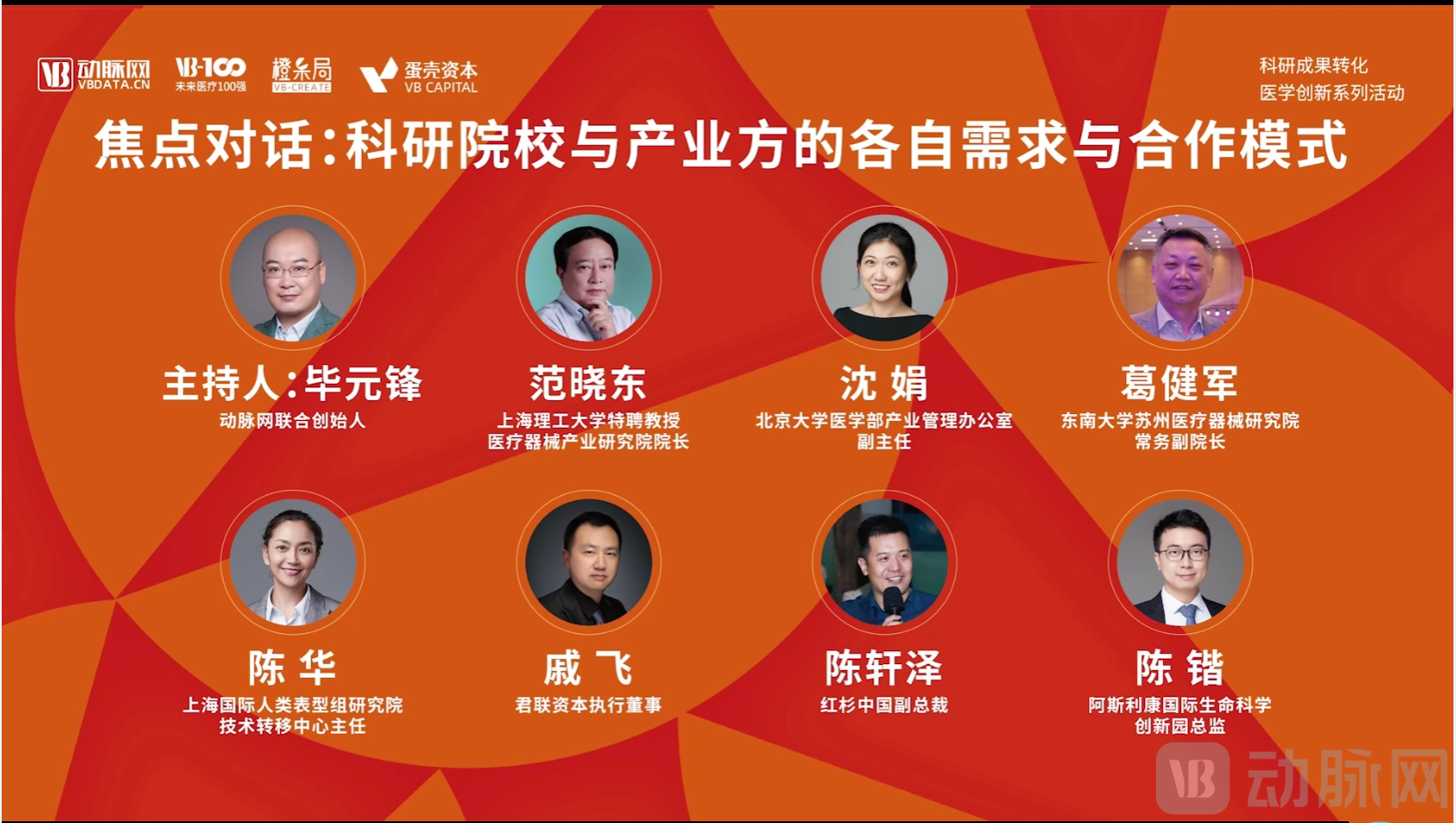
The following is a transcript of the speech, provided for the convenience of readers.VCBeat Orange BureauTextual edits were made without altering the original meaning:
Research Institutions: Eagerly Seeking Talent for Technology Transfer
Bi Yuanfeng (Moderator): What key elements and issues of the current technology transfer model are reflected in the commercialization cases from research institutes and universities?
Fan Xiaodong:My current work focuses on industrial policy, including the commercialization of scientific and technological achievements.
We note that the State Council’s executive meeting on June 29 decided to select a number of high-level hospitals to pilot initiatives aimed at enhancing their clinical research and technology transfer capabilities. In five key areas—implementation of research autonomy, compensation incentives, ownership and distribution of proceeds from scientific and technological achievements, and procurement of research instruments and equipment—these hospitals will be granted policies equivalent to those supporting innovation in universities and research institutes. Particular emphasis will be placed on increasing funding for clinical and translational research, as well as streamlining administrative approvals and reporting requirements related to research projects and fund management.
In fact, national policies encouraging the translation of research achievements into practical applications are emerging one after another, soHow to implement these policies is our primary concern,The following points are worth considering:
First, the role of clinical institutions as primary innovators deserves greater attention.Currently, we are emphasizing the central role of enterprises as innovation drivers. In fact, in the healthcare industry, particularly in the medical device sector, hospitals serve as one of the most important entities for innovation. However, the positioning of clinical institutions as primary innovation actors remains unclear.
Second, we hope that the policy coverage of the State Council Executive Meeting held on June 29 will be broadened.Specifically, it isThe Threshold Should Not Be Set Too High, otherwise it would be difficult to balance the diversity, complexity, and coverage of medical devices. Furthermore, in the approval process for medical devices, clinical evaluation is a time-consuming and labor-intensive step.Strengthening Capacity Building at Clinical Trial Institutions, which undoubtedly serves as a significant boost to the translation of medical device achievements and their rapid market entry.
Ge Jianjun:In fact, to accelerate the commercialization of scientific and technological achievements, universities and research institutes must not only align with market demands and local industrial requirements to help enterprises achieve technological upgrading, but also attract talent and provide continuous, in-depth incubation for companies dedicated to translating these achievements into practical applications.
Established by usJiangsu Aiwei Biotechnology Co., Ltd.Taking the VCBeat Research Institute as an example, since its inception, we have leveraged the disciplinary strengths of Southeast University in biomedical engineering, closely followed global research trends, and strategically laid out“Organ-on-a-Chip”This cutting-edge drug screening technology.
During the specific commercialization process, the “Organ-on-a-Chip” project was officially initiated in early 2018 following evaluation by the Institute’s Technical Committee. After more than three years of research and development, the project has established collaborations primarily focused on scientific research with large pharmaceutical companies and hospitals. For instance, in partnership with a well-known pharmaceutical company, we first conducted drug efficacy studies on cardiac tissues using our heart-on-a-chip platform, followed by toxicity testing for multiple drugs. Both phases yielded favorable results.
Therefore, the company was officially established in November 2021 and received support as a key “grant-to-equity” project from the Jiangsu Industrial Technology Research Institute (JITRI) and the High-Tech Zone government. This means that JITRI and the government initially provided grants to support the project’s continued development, with the grants converted into equity investments at market-based valuations during future financing rounds. After more than six months of development, the company has secured social capital financing led by Fosun Pharma, achieving a valuation of over RMB 300 million.
Overall, the application of technology to products exists to address practical problems in specific use scenarios; therefore,Researchers must establish strong collaborative partnerships with technology transfer professionals., it is not too late to strive for research and development after truly understanding what technologies the industry requires.
As a research institute within a university, our institute has adopted ““Frontier technologies are researched at universities, applied technologies are developed at research institutes, and industrial technologies are implemented in enterprises.”methods.
The objective is to house cutting-edge basic research within academic institutions, whereby the research institute selects relatively mature technologies to prioritize for applied development. Once the resulting technical products meet market requirements, they are either launched onto the market or used to establish spin-off companies; alternatively, collaborations with established companies may be initiated at the outset of development. Ultimately, industrial enterprises carry out practical promotion and implementation, thereby forming“A Virtuous Cycle of ‘Developing One Generation, Translating One Generation, and Applying One Generation’”, effectively accelerating the transformation of scientific and technological achievements.
Chen Hua:During the process of technology transfer, especiallyIncubated CompanyandIntroduction of InvestmentThese two aspects still exhibit certain shortcomings on the part of research institutions and universities, primarily manifested inScientists Struggle to Transition into Commercial Roles. This is because scientists possess keen scientific judgment and excel at solving technical problems, yet they often struggle to understand the market, including how to translate technology into a profitable product.
Therefore, research institutions and universities are particularlyLack of Industry Talent with Business Acumen, from projects to startups, industry professionals are needed to drive product design and corporate development planning, helping scientists secure more funding opportunities.
Currently, we have two projects that are facing the same issue. The first isAI-Assisted Diagnostic ProductsDuring the product promotion phase in collaboration with hospitals, we found that most individuals with similar professional backgrounds in the same field lacked experience in cooperating with hospitals and academic institutions, which led to obstacles in project advancement during actual communications.
The second category comprises ventures directly founded by scientists. These scientist-entrepreneurs may remain entrenched in their original research-oriented mindset, for example, inNew Diagnostic Reagent ProjectDuring the commercialization process, scientists were largely unfamiliar with key aspects such as product promotion, strategic planning, and hospital collaborations, ultimately leading to numerous issues in the company’s initial organizational structure.
Shen Juan:The translational projects at Peking University Health Science Center are relatively early-stage; therefore, it remains uncommon for university professors to directly operate companies. The vast majority of academic researchers still commercialize their innovations through technology transfer and licensing agreements.
This is closely related to the distinctive characteristics of the medical discipline: first,The R&D cycle is relatively long, the commercialization timeline is overly extended, and risks increase accordingly.. This is particularly true for university professors, who, in becoming entrepreneurs, must not only bear the high costs in time and energy but also rationally arrange their research and teaching responsibilities—a balance that many find difficult to achieve.
Furthermore, for university professors,How to effectively bridge the research and industrial sectors is also an inevitable challenge.. We have found that the translation of achievements in universities and collegesThe absence of a platform that simultaneously integrates various innovation factors, such as government and capital., university professors consequently lack the funding and incentive to gather market intelligence, leading to a disconnect between original innovation and market demand.
In addition, there is the issue of consensus. At present, policies promoting the commercialization of research findings are emerging in abundance, but they are primarily incentivizing in nature and have not truly ignited university professors’ enthusiasm for translating their research into practical applications. In reality, shifting the mindsets and awareness of university professors may require broader societal engagement, with more industry leaders spearheading participation in commercialization efforts to foster an ecosystem that generates meaningful impact.
Enterprise Side: Forming a Co-Creation Model with Universities and Research Institutes
Bi Yuanfeng (Moderator): How does AstraZeneca collaborate with research institutions and universities on the commercialization of scientific achievements? What are some best practices in this process?
Chen Kai:From the perspective of translating original innovations, it is itself a relatively complex collaboration model that requiresBridging Technology and Clinical Practice for Co-Creation。
In practice, the interface for communication and collaboration among diverse stakeholders largely transcends mere technology transfer. In particular, investment requires extensive refinement and negotiation during both pre- and post-investment phases, necessitating closer engagement between scientists and the market. Meanwhile, AstraZeneca places special emphasis on establishing a mutually beneficial co-creation model with research institutions.
Actually,Co-creation ModelAn ecosystem has taken shape, in which communication and collaboration across all stages of translation are integrated with greater specialization. However, to achieve this level of maturity, the primary task isBridge the gap between the technology and industry sectors, and increase the frequency of communication between both parties.For example, the frequent occurrence of roundtable discussions may facilitate effective cross-sector communication.
Nowadays, under policy guidance, research-oriented hospitals and institutes have raised higher requirements for cross-disciplinary communication in scientific research translation. Taking the AstraZeneca Shanghai R&D Center as an example, since its establishment, the center has engaged in exchanges and learning with leading experts from major public hospitals in Shanghai. Furthermore, it has shared insights and introduced its work to capital investors and digital clinical startups.
It is also crucial to establish a robust ecosystem for the commercialization of scientific and technological achievements.In the disease-specific domain, under the academic leadership of Academician Ning Guang, the International Life Science Innovation Park (I·Campus), initiated by AstraZeneca, Zhizhong, and the Wuxi Municipal Government, facilitates horizontal collaboration ranging from basic research to early-stage companies, promotes industry-academia-research exchanges and matchmaking, and ultimately achieves industrialization. Particularly in early-stage investment, it is essential to establish a collaborative framework involving government, capital, and industry stakeholders to build bridges and foster a co-creation partnership model.
Investment Side: Building a Platform to Bridge the Communication Gap
Bi Yuanfeng (Moderator): What is the biggest challenge investors face when interacting with research institutions and universities? What models can facilitate smoother communication among all parties?
Qi Fei:In the translation of scientific research,The gap between scientists and industry is quite significant.
On one hand,Differences in Thinking Patterns Between the Two. In simple terms, scientists primarily focus on the latest global technological advancements and are often unfamiliar with market dynamics and application scenarios. In contrast, industry operations are governed by specific market rules and demands, placing a high premium on execution capabilities. This disconnect often makes it difficult for advanced technologies developed by university professors to gain industrial adoption due to a lack of viable application scenarios.
On the other hand,China’s industrial and capital sectors are not yet mature.. Taking the biopharmaceutical industry as an example, the involvement of scientists is required only when the field advances to the stage of original innovation. In previous years, China was in a phase of rapid follow-up, both in terms of technological platforms and therapeutic targets, and lacked proficiency in original innovation.
This is also reflected in investment institutions, namelyIt is also challenging for investors to absorb original innovative technologies., they not only need to devote substantial time to acquiring technical knowledge but also face higher demands in terms of professional expertise, particularly regarding their understanding and cognition of technology as well as market positioning.
Nowadays, research institutions and the industrial sector are showing a trend of moving toward each other, but the comprehensive alignment between the two still requires time to mature, which necessitatesEstablishing a Communication Platform, to help scientists, industry players, and investors understand each other and become familiar with one another’s discourse.
Chen Xuanze:Currently, China’s translation of scientific and technological achievements is still in its nascent stage, with the overall mechanisms, systems, and cultural environment still under development. Encouragingly, we are currently in a phase of growth. One observation from collaborating with research institutes and academies is thatBarriers to Collaboration Persist Among Clinicians, Scientists, and Industry. Therefore, we also launched the Sequoia China Brain Science Incubation Center in Zhangjiang, Shanghai, with the primary aim of bridging physicians, scientists, and entrepreneurs.
Taking the medical device sector as an example, from a scientific and technological perspective, researchers must consider whether medical devices align with market demands and physicians’ usage habits. From a corporate development standpoint, during China’s era of intense “involution” in the medical device industry, a consistently high-performing supply chain is manifested in two key areas: first, product quality control, and second, reduction in material costs. These two factors constitute the core of competition across the entire industry.
So, how can these barriers be broken? This requires starting fromBuilding Ecosystem Resources Across Multiple Dimensions, because scientific entrepreneurship requires not only cutting-edge technology but also a team of talented individualsPartners, thereby enabling startups to go further. For example, this year, Sequoia China and VCBeat jointly hosted a Brain Science Forum,Bringing together professionals from the research, industry, and clinical sectors, to jointly explore the optimal pathways for technology translation.