

Smart Beam Breaks Foreign Monopoly with Fully In-House Developed Liquid Metal Bearing CT Tubes

SMARTBEAM
CT Tube Manufacturer, Vacuum Electron Device Technology Products and Service Provider
The X-ray tube, a core component of CT scanners, can be described as the lifeline of the hundred-billion-dollar medical imaging market.
Its advantages and disadvantages not only determine, to a certain extent, the overall performance level of CT systems, but have also long been regarded as the key to narrowing the gap between high-end domestic products and imported brands.
However, due to the technical complexity and stringent manufacturing requirements of core CT components such as X-ray tubes, along with challenges like the need for customized production equipment, full localization of these components has not yet been achieved. For a considerable period, most domestic imaging manufacturers have lacked the capability to independently develop and manufacture core components, with those in high-end products being predominantly imported.
In April this year, Beijing Smartbeam Technology Co., Ltd. (hereinafter referred to as “Smartbeam”) achieved a key breakthrough by obtaining the first medical device registration certificate for a domestically produced CT X-ray tube with liquid metal bearings., and possess mass production capabilities. Currently, the liquid metal bearing X-ray tube independently developed by the company has entered the pre-installation phase for complete systems and is about to undergo certification for配套 supply.
It is reported that SMARTBEAM has established a comprehensive design and R&D system covering all stages from design, materials, processing, and assembly to reliability testing, and has acquired full capabilities in product development, iteration, and manufacturing.
As the first company in China to obtain approval for CT X-ray tubes with liquid metal bearings, SMARTBEAM recently sat down for an exclusive interview with VCBeat. Hu Yinfu, founder of SMARTBEAM, addressed key topics including development trends and critical technical aspects of CT X-ray tubes, as well as pivotal issues in the R&D of liquid metal bearing tubes.
From the historical development of X-ray tube technology, traditional CT X-ray tubes typically employed ball bearings. However, the emergence of liquid metal bearing technology in the 1990s gradually replaced ball bearings, becoming the mainstream solution in high-end CT systems during the first two decades of the 21st century.
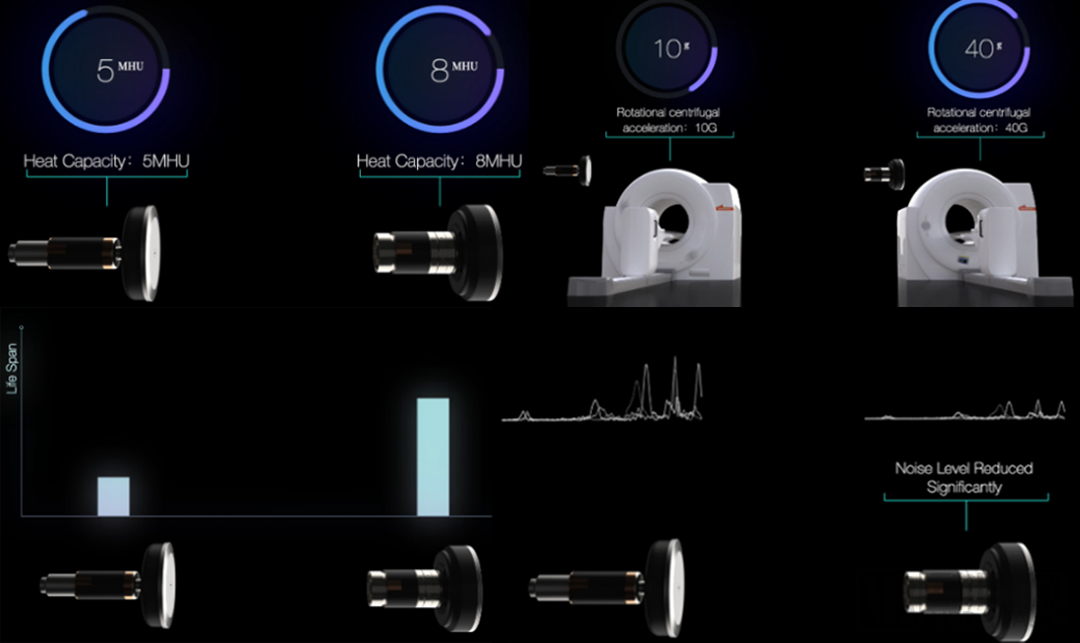
Compared with traditional ball bearings, the adoption of liquid metal bearings offers at least four advantages:
(1) Significantly enhance the heat dissipation rate. That is, under the same physical heat capacity of the target disk structure, the equivalent heat capacity can be greatly improved;
(2) The gantry rotation centrifugal force that liquid metal sliding bearings can withstand reaches 30–40 g, enabling faster gantry rotation and imaging rates, which offers significant advantages for cardiac scanning;
(3) Since the bearing core and the bearing outer sleeve do not come into direct contact during operation, wear is minimal, and its service life is at least twice that of ball bearings;
(4) Liquid metal sliding bearings operate without contact, resulting in completely silent operation.
With the continuous maturation of liquid metal bearing technology and the decline in mass production costs in recent years, the application of liquid metal bearings is no longer limited to high-end CT scanners but has begun to extend to mid-range models. Their application scenarios and market potential have become increasingly extensive.
However, the manufacturing of key components for liquid metal bearing x-ray tubes involves over 30 process steps. Key technical challenges span design, materials, machining, welding, vacuum technology, surface treatment, and precision assembly, making it particularly difficult to overcome these critical technological hurdles.
By integrating technologies including 3D design of X-ray tubes (proficient in Inventor, SolidWorks, Pro/E, etc.), electron optics design and simulation (proficient in OPERA, CST, etc.), electromagnetics, design simulation (proficient in CST, Ansys), structural mechanics and thermal design simulation (proficient in Ansys, Fluent, etc.), and rotor dynamics design and simulation, SMARTBEAM achieved key technological breakthroughs in liquid metal bearing X-ray tubes within just three years of its establishment, breaking the technological monopoly held by foreign manufacturers in this field.
With the iteration of SMARTBEAM's manufacturing processes, the first-pass yield for its liquid metal bearing CT X-ray tubes has reached over 90%.
Hu Yinfu shared SMARTBEAM's bearing manufacturing process with VCBeat, stating that“Taking the key component technology of liquid metal bearings as an example, its manufacturing involves complex process steps and requires addressing numerous critical technical issues, with each step being interrelated. You need to evaluate the overall process effectiveness as a whole, rather than assessing the feasibility of any single step in isolation.”
During the process validation of our ZS502L liquid metal bearing, we underwent dozens of iterative cycles of process optimization. Process stability has improved significantly, evolving from initial sporadic samples that could fully pass testing to a current batch production first-pass yield exceeding 90%.
“In the future, we hope to further narrow the gap with companies such as ‘GPS’ that possess mature R&D capabilities for CT X-ray tubes through process optimization, and ultimately achieve domestic surpassing of CT X-ray tube technology via independent innovation.”
As a core component of CT scanners, X-ray tube development not only involves lengthy process routes, heavy equipment investment, long R&D cycles, and slow returns, but also represents a highly typical field requiring multidisciplinary integration. Therefore, the development of CT X-ray tubes demands exceptionally high comprehensive capabilities from the team. It requires a team with a profound understanding of process optimization and iteration, capable of conducting rigorous research and design, meticulously examining every technical and procedural detail, and strictly controlling each operational step.
Hu Yinfu studied at Wuhan University and Tsinghua University, where he earned a Ph.D. in Physical Electronics. After graduation, he served as Vice Chair of the IEEE China Council and as Chair of the MDC for the IEEE Beijing Section. He has published more than 50 academic papers in domestic and international journals and conferences, and possesses nearly 20 years of R&D, production, and management experience in the field of vacuum electronics.
“As technical professionals with a background in vacuum electronics, we felt a lingering sense of unwillingness to accept the foreign technological stranglehold on our products. In the medical field, which is closely tied to people’s life, safety, and health, being able to resolve key technical challenges for the development of China’s domestic industry gives all our team members a strong sense of achievement and fulfillment.”
“I am immensely proud of the resilience and tenacity demonstrated by our R&D and process engineers. At SMARTBEAM, it has become commonplace for our R&D team to work through the night while optimizing and iterating CT tube manufacturing processes. A cot placed beside a computer workstation is a familiar sight; engineers would lie down for a brief rest when exhausted, only to rise again shortly thereafter to evaluate the results of process optimizations. Therefore, if there is any secret to overcoming R&D challenges, I believe it lies in our unwavering determination and refusal to give up when confronting these technical hurdles,” said Hu Yinfu.
Currently, SMARTBEAM has two products that have obtained medical device registration certificates, and five CT tubes under development are expected to be approved successively in 2022.Its independently developed ZS402L, in conjunction with the registration of a domestically manufactured 32-slice CT system, has passed type testing and on-site quality system assessment. It is expected to obtain the complete system registration certificate in October 2022, making it the first CT system to incorporate a CT X-ray tube with a domestically produced liquid metal bearing.
It is reported that SMARTBEAM is currently expanding its product pipeline. The first liquid metal bearing manufacturing center in China will officially commence operations this year, with a designed annual production capacity of 2,000 liquid metal bearings. Its CT X-ray tube products under development are expected to cover mainstream models on the market.
Meanwhile, the Company has established in-depth collaborative relationships with enterprises such as Kuanteng Medical, Synovision, Kaiying Medical, Boying Medical, and Wandong Medical, covering areas including product customization, new product development, and joint registration of complete systems. Furthermore, it has laid the groundwork for future cooperation with United Imaging Healthcare, Neusoft Medical, and Mingfeng Medical.
In the future, supported by favorable policies, technological upgrades, equipment supplementation, and capital infusion, SMARTBEAM will continue to increase its R&D investment. Meanwhile, through sustained efforts, the company aims to provide domestic CT OEMs and third-party maintenance service providers with a full range of premium CT X-ray tube products, striving to achieve comprehensive coverage of major liquid metal bearing tube models on the market within three years.
Establish a competitive edge through high cost-effectiveness, and collaborate with domestic enterprises to advance the localization of CT X-ray tubes. Continuously enhance the autonomy and controllability of the industrial and supply chains, thereby truly achieving the goal of self-reliance and controllability in core component technologies.
In 2018, the “Catalogue for the Administration of Licensing for the Allocation of Large-Scale Medical Equipment (2018)” redefined the allocation framework for large-scale imaging equipment: CT scanners with 16 slices or fewer no longer require administrative approval; while the authority for managing the allocation of large-scale medical devices with a unit price of RMB 10–30 million for initial configuration, as well as CT scanners with 64 slices or more, was transferred from the National Health Commission to provincial-level health commissions.
Following the policy implementation, primary healthcare institutions began widely procuring 16-slice CT scanners, leading to substantial growth in both the OEM and replacement markets for X-ray tubes. Meanwhile, demand for high-end CT systems has also become increasingly diversified.
On the one hand, as the annual revenue of tertiary hospitals across various regions has increased significantly, the financial pressure associated with purchasing CT scanners has been markedly reduced; on the other hand, the rise of independent imaging centers has also sparked a wave of high-end CT acquisitions. By the end of 2019, the total number of installed CT systems with 64 slices or more in China had nearly doubled.
Today, the domestic X-ray tube market has achieved a breakthrough from "0" to "1," with numerous outstanding manufacturers of core components for imaging equipment beginning to emerge.
Finally, Hu Yinfu stated: "With the advancement of domestic production of high-end medical equipment, achieving full localization of core imaging components is crucial. Although CT X-ray tubes represent a highly specialized niche within the medical device sector, their market size is substantial. According to our estimates, the global market for CT X-ray tubes reaches $8 billion, while the domestic market in China amounts to RMB 8 billion. Among all categories of high-value medical consumables, its market size is second only to orthopedics and vascular intervention."
"In the future, with the continuous popularization of domestic CT whole-machine equipment applications, policy encouragement and guidance, as well as the development of the X-ray tube industry, X-ray tubes, high-voltage generators, and detectors will usher in a period of rapid development. SMARTBEAM will also expand its product pipeline from materials and supply chain ends to various technical types of X-ray tube technologies."