

Rehabilitation Therapists Reclassified as Service Personnel: Five Industry Transformations and Three Strategic Reflections
"Every trade has its master."
Beyond encouraging individuals to strive within their respective fields, this proverb carries an implicit meaning: fostering identification with one’s industry and profession, as well as establishing a sense of belonging among practitioners, is crucial to the development of the industry.
In the field of rehabilitation medicine, in addition to traditional physicians and nurses, rehabilitation therapists who are responsible for patients’ rehabilitation treatment processes also play a crucial role. However, there was previously no clear occupational classification for this position.
In the National Occupational Classification (2015 Edition), there is no detailed classification for rehabilitation therapy practitioners; they are merely categorized as rehabilitation technicians. Within the healthcare industry’s four major occupational categories of “medicine, pharmacy, nursing, and technology,” they fall under the category of medical and health technical personnel.

Changes in the Occupational Classification of Rehabilitation Practitioners
In the draft for public consultation of the newly released National Occupational Classification Directory (2022 Edition), the most significant change for rehabilitation practitioners is the subdivision of their occupation into three distinct roles: Rehabilitation Therapist, Rehabilitation Assistive Technology Consultant, and Respiratory Therapist. For rehabilitation practitioners, this clarification of professional identity is a positive development.
At the broad category level, former medical and health technical personnel have been reclassified as health, sports, and leisure service providers. At the secondary classification level, rehabilitation therapists and rehabilitation assistive technology consultants are categorized as rehabilitation and corrective service providers, while respiratory therapists are classified as medical support service providers.
Rehabilitation Therapists: From Technicians to Service Providers!
This change has triggered a significant backlash among rehabilitation practitioners. However, emotional expressions cannot substitute for rational thinking; perhaps we should focus more on what impact this shift will have on the development of the rehabilitation industry?
The gap between rehabilitation needs and the supply of rehabilitation treatment is widening.
Currently, the scarcity of rehabilitation professionals is a bottleneck hindering the development of China’s rehabilitation industry. As China enters an aging society, and with social development leading to an increase in accidental disabilities and chronic disease patients, the demand for rehabilitation services is growing. However, the current situation is characterized by a significant talent gap and weak training capacity.
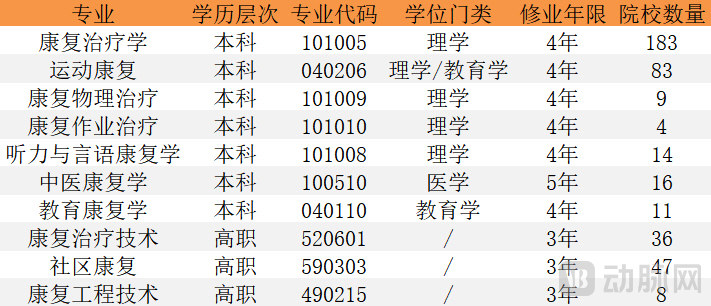
Rehabilitation-related majors at Chinese universities; data sourced from CHSI and Gao3.com
As shown in the table above, there are currently approximately 10 rehabilitation-related majors offered by Chinese universities and colleges, comprising seven undergraduate programs and three vocational (associate degree) programs. Among these, only one falls under the category of medicine, while the rest are primarily classified under science. Although this diverse range of pathways for training rehabilitation therapists helps address the shortage of rehabilitation professionals, it also gives rise to concerns regarding insufficient professional specialization and standardization.
The workforce composition is complex, with limited professional specialization; educational backgrounds and overall competencies still lag behind international standards.
Current rehabilitation therapy students at colleges requesting to switch to other majors; undergraduate rehabilitation therapy graduates pursuing postgraduate studies in non-rehabilitation fields—these common phenomena indicate that the training of rehabilitation therapists in China faces numerous challenges.
This current situation has arisen due to the influence of the employment environment.
Data from multiple recruitment websites indicate that the average income for rehabilitation therapists in China is approximately RMB 5,000, although there are significant disparities across different regions and medical institutions. In first-tier cities, monthly incomes range from RMB 6,000 to RMB 15,000; in second-tier cities, most rehabilitation therapists earn between RMB 3,000 and RMB 6,000 per month; while some rehabilitation therapists in third- and fourth-tier cities have even lower incomes.
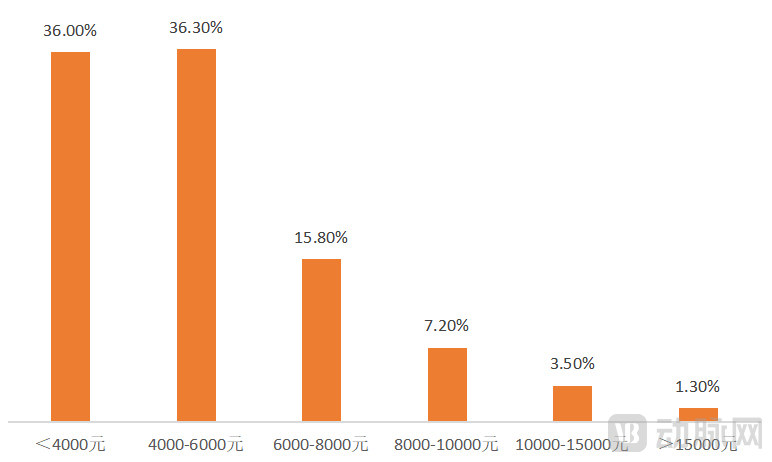
Monthly Income Distribution of Rehabilitation Physical Therapy Practitioners, Data Sourced from the Chinese Journal of Rehabilitation Medicine
According to data from Issue 3, 2022 of the Chinese Journal of Rehabilitation Medicine, it is evident that the overall income of rehabilitation therapists is not high, with more than 70% of practitioners earning a monthly income of less than 6,000 yuan.
Low income levels, significant income disparities, and the perception of heavy workloads with low pay are common impressions among students regarding the industry.
From an industry perspective, rehabilitation needs are genuinely present and increasing year by year.
In 2020, the population of elderly individuals aged 60 and above in China reached 264 million; the number of people with disabilities, as reported by the China Disabled Persons’ Federation, stood at 37.8069 million; meanwhile, there were 12.0345 million live births annually, and the total number of hospital admissions for surgeries nationwide reached 66.6374 million person-times. Behind these figures lie significant rehabilitation needs among various groups, including the elderly, patients with chronic diseases, individuals with disabilities, postpartum women, and postoperative patients.
Despite the continuous growth in rehabilitation demand, the supply of rehabilitation services has consistently failed to keep pace.
In recent years, the state has placed increasing emphasis on the development of rehabilitation medicine and encouraged the entry of private capital. With the rise of private specialized rehabilitation hospitals, a larger platform could have been provided for rehabilitation therapists who were previously undervalued within the public healthcare system. However, due to limitations in technical expertise, there is a scarcity of highly competent professionals capable of thriving in this environment.
Private rehabilitation hospitals aiming for large-scale operations are currently facing a shortage of talent. Consequently, many private rehabilitation institutions need to invest in their own talent development programs, as seen with United Family Healthcare and Samsung Medical Center, among others. To some extent, the scarcity of rehabilitation professionals is one of the key factors constraining the development of the rehabilitation industry.
Previously, rehabilitation practitioners aspired to align their professional positioning more closely with that of physicians, clarify career development pathways, and enhance professional identity. However, the latest edition of the National Occupational Classification not only fails to categorize these roles under the physician category but instead places them within the service sector. What implications will this have for the rehabilitation industry?
Just as the introduction of Tesla stirred up China’s new energy vehicle industry, the new occupational classification may serve as the catfish that disrupts and revitalizes the rehabilitation sector.
01. Expand the Coverage of Rehabilitation Services
In recent years, leveraging favorable policy tailwinds, private rehabilitation hospitals have emerged as a significant force, taking on specialized rehabilitation services such as neurological, geriatric, and pediatric rehabilitation. However, overall, the rehabilitation hospital sector operates under an asset-heavy model, typically requiring approximately 5 to 8 years from inception to reach break-even.
Take the listed company Sanxing Medical as an example. It has established more than 20 rehabilitation hospitals across various regions, but only about ten have commenced operations. Investment in the rehabilitation sector is a long-term endeavor. However, from the demand side, many rehabilitation needs do not require highly advanced therapeutic techniques or equipment, remaining at a relatively basic level.
Taking lumbar disc herniation, a common condition among urban white-collar workers, as an example, such rehabilitation needs are more consumption-oriented in nature. Historically, few professional institutions have catered to these demands, and traditional tuina massage and physiotherapy have shown limited efficacy in addressing them. As policies reclassify rehabilitation therapists as service personnel, further lowering the industry’s entry barriers, numerous small-scale rehabilitation facilities are expected to emerge to meet primary community-based rehabilitation needs.
These institutions adopt a compact, high-quality operational model to address the current rehabilitation needs of their communities. While serving the public, they also provide education on rehabilitation awareness.
02. Rehabilitation Therapists May See a Wave of Entrepreneurship
If they fail to gain recognition within the public healthcare system, where their professional classification does not even qualify them as technical personnel, their status becomes further marginalized. Some experienced rehabilitation therapists may choose to establish independent practices.
For a significant proportion of rehabilitation therapists, the public hospital system and its work environment are key factors attracting them to join. Although their professional status is not comparable to that of physicians and career development pathways remain ill-defined, the rehabilitation sector has shown sustained long-term growth, and there have been ongoing calls within the industry to improve the professional standing of rehabilitation practitioners.
For practitioners, the poetic ideals and distant horizons are now within sight, allowing them to temporarily disregard the immediate hardships. Once the new occupational classification is implemented, they may place greater emphasis on economic considerations in their personal career development.
Experienced and competent rehabilitation therapists who have worked in public hospitals possess established professional networks that enable them to attract a portion of the patient base, while also demonstrating expertise in delivering high-quality rehabilitation services. They can hire less-qualified rehabilitation therapists or recent graduates and operate as micro or small enterprises, making such small-scale rehabilitation facilities relatively easy to establish and manage.
Once this path is successfully navigated, it will deliver a profound ideological impact on rehabilitation practitioners within the hospital system, potentially heralding a wave of entrepreneurship among rehabilitation therapists.
03. Favoring the Development of TCM Rehabilitation
In recent years, the state’s stance on supporting the development of Traditional Chinese Medicine (TCM) has been clear. Recent policy documents issued in regions such as Shanghai, Fujian, Chongqing, Shandong, and Sichuan have all included provisions aimed at enhancing TCM rehabilitation service capabilities and increasing the supply of TCM rehabilitation services at the primary care level. Coupled with the recent lowering of entry barriers for rehabilitation practitioners, TCM is poised to assume a more prominent role in primary-level rehabilitation services.
Traditional Chinese medicine (TCM) services, such as tuina (therapeutic massage) and acupuncture, have long held considerable appeal for the elderly and patients with chronic diseases. Due to regulatory requirements, rehabilitation therapists launching their own practices are highly likely to operate under the TCM clinic model. From a cost perspective, TCM clinics require lower initial investment compared to specialized rehabilitation institutions, while offering more reliable revenue streams.
For the traditional Chinese medicine (TCM) industry, in addition to conventional rehabilitation services such as moxibustion, acupuncture, gua sha, cupping, and traction, the scope of rehabilitative indications can be further expanded by recruiting additional rehabilitation professionals and introducing interventions such as functional training, manual therapy, and physical agent modalities.
From the perspective of public demand, if TCM clinics distributed throughout communities can offer a wider range of rehabilitation services at reasonable prices—thereby saving the time and effort required to visit hospitals—and given the traditional belief that TCM is more effective for holistic regulation, the public would be willing to accept TCM rehabilitation services.
04 Diverging Development Paths for Rehabilitation Institutions
In the future, rehabilitation institutions will evolve into two distinct development pathways: specialized rehabilitation and primary-care-based rehabilitation.
For specialized rehabilitation institutions, their primary scope of business is critical care rehabilitation, including neurological rehabilitation, musculoskeletal rehabilitation, cardiac rehabilitation, postpartum rehabilitation, and pediatric rehabilitation. These services demand high technical expertise and cannot be provided by primary-level rehabilitation facilities.
Lowering the entry barriers facilitates the expansion of primary-level rehabilitation services, making it easier for grassroots rehabilitation institutions to survive. However, constrained by technical capabilities and cost investments, they can only address basic rehabilitation needs and are ill-equipped to handle more specialized requirements. Nevertheless, grassroots rehabilitation institutions contribute to the effectiveness of tiered diagnosis and treatment to some extent; by increasing patient concentration at the primary level, they enable professional institutions to allocate their rehabilitation resources to the patients with the most critical needs.
It is worth noting that as critical care rehabilitation services become more focused, professional rehabilitation institutions will not lower their talent requirements; on the contrary, these requirements will be further elevated.
For such institutions, the business model of critical care rehabilitation determines the required technical competencies of talent; the logic of scaled expansion dictates the quantity of talent needed; and the higher compensation levels, relative to rehabilitation departments in public hospitals, determine their attractiveness to talent.
The implementation of the new occupational classification standards will broaden the scope of talent acquisition for institutions, providing them with greater flexibility in selection. Meanwhile, it also raises higher requirements for practitioners. How to rapidly enhance their technical competencies, adapt to institutional development needs, grow into core business personnel, and achieve higher economic income are critical issues that practitioners must address in the future.
In a nutshell, competition for talent in the specialized rehabilitation field will intensify in the future.
05 The Rise of Standardized Residency Training Programs
“Although many rehabilitation therapists joke that they pull all-nighters like medical students, study the knowledge of physicians, and take exams for medical technologists, only to end up being dubbed ‘waiters,’ from an industry perspective, rehabilitation graduates currently produced by universities are not yet job-ready.”
For rehabilitation therapists, the core competency lies in the ability to independently assess patients’ conditions and formulate rehabilitation treatment plans. Implementing rehabilitation plans and assisting patients with rehabilitation exercises are merely basic requirements. If this core competency is lacking, and therapists fail to assess patients’ physical status during the rehabilitation process and adjust training intensity accordingly, it can easily lead to disputes and cause troubles for the institution.
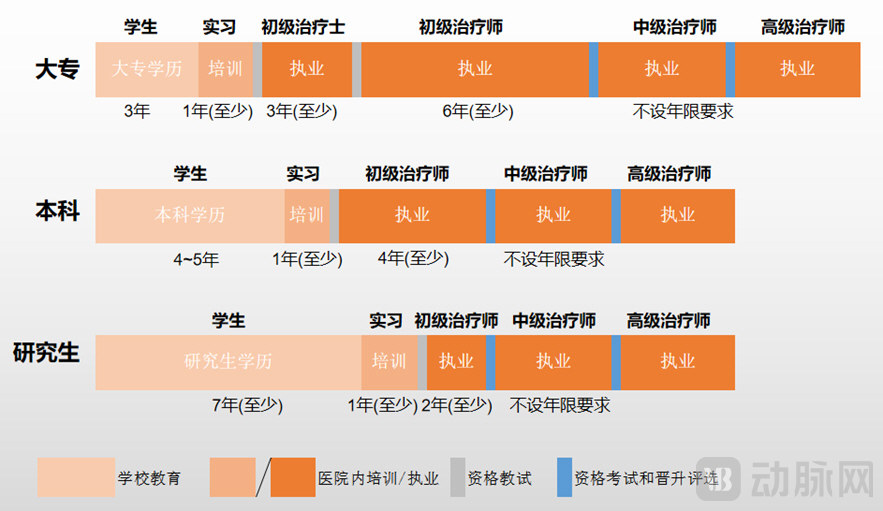
Rehabilitation Therapist Training Pathway
A significant proportion of graduates from current training programs remain confined to execution-level roles, lacking a systematic understanding of rehabilitation therapy. Although a few universities, such as Tongji University and Kunming Medical University, have obtained accreditation from the World Confederation for Physical Therapy (WCPT), aligning their educational models with international standards and emphasizing the cultivation of students’ comprehensive competencies, their share remains insufficient.
Therefore, many institutions have chosen to conduct their own standardized residency training programs. For instance, Qingrun Academy, in collaboration with United Family Healthcare, the China Non-Public Medical Institutions Association, and the Dutch Society for Physical Therapy, jointly launched the “Standardized Residency Training Program for Rehabilitation Therapists.” The aim is to facilitate a smooth transition for graduates from student roles to professional workplace roles. In addition, numerous sports rehabilitation institutions have also established training programs aimed at addressing the industry’s talent shortage.
Whether referred to as medical technical personnel or service staff, the technical requirements for rehabilitation therapists remain unchanged.
If recent graduates remain willing to pursue careers in the rehabilitation industry, such training is highly necessary. Standardized residency training was originally established by rehabilitation institutions to address their own talent shortages, not as a revenue-generating business line. In the future, the rising demand for rehabilitation services will undoubtedly be accompanied by an increased need for professionals. Lowering entry barriers will attract a broader pool of candidates into the field, and standardized residency training may play a more significant role in the rehabilitation industry, potentially becoming a key component that determines the core competitiveness of rehabilitation institutions.
If the new occupational classification merely serves to promote industry development in a positive direction, it would clearly not trigger resistance from numerous rehabilitation practitioners; mere emotional venting will not resolve practical issues. We should reflect calmly, identify the core contradictions, and take solid steps toward resolving the problem.
First is the professional identity of talent.
Currently, national vocational qualification certifications in China can be broadly categorized into two types: market-entry qualifications and skill-level assessments. Professions that significantly impact public interest, such as physicians and lawyers, fall under the market-entry category, which carries greater professional weight and prestige. In contrast, skill-level assessment certifications focus more on evaluating vocational competencies, involve less direct public interest, and are relatively easier to obtain.
Taking musculoskeletal rehabilitation as an example, physical therapists require a solid foundation in anatomy, neuroscience, physiology, and specialized rehabilitation knowledge, whereas a Tui Na practitioner only needs a basic understanding of human muscle composition. Consequently, their respective levels of control over patients during the musculoskeletal rehabilitation process differ significantly. This is the key distinction between rehabilitation medicine and Tui Na massage.
Setting aside the issue of “official title,” the core contradiction lies in determining what type of certification rehabilitation practitioners should undergo following the adjustment of occupational classifications: licensure-based or competency-based?
If the former is the case, the industry will have certain entry barriers. Industries with such barriers tend to have higher growth ceilings, stronger professional identity, and are more likely to attract top-tier talent. If the latter is the case, however, the scope of practice and career development for rehabilitation professionals will be somewhat restricted, making it less conducive to attracting high-caliber talent.

Core Courses of the Rehabilitation Program at Kunming Medical University, Sourced from the Official University Website
From the perspective of university curriculum design, rehabilitation programs are distinctly technical in nature, making it entirely reasonable to classify graduates as healthcare professionals. If students endure coursework with a level of difficulty comparable to that of clinical medicine, only to be relegated to the occupational status of service personnel, it will be extremely difficult for the industry to foster professional identity and attract talent to the field.
A profession’s appeal is closely tied to its nature. For specialized technical roles, attractiveness increases, career advancement pathways broaden, and professional pride strengthens. Survey results also reveal that rehabilitation therapists’ self-identification lags behind that of patients and departmental colleagues. To some extent, this reflects a lack of confidence stemming from their occupational classification being perceived as inferior to that of physicians.
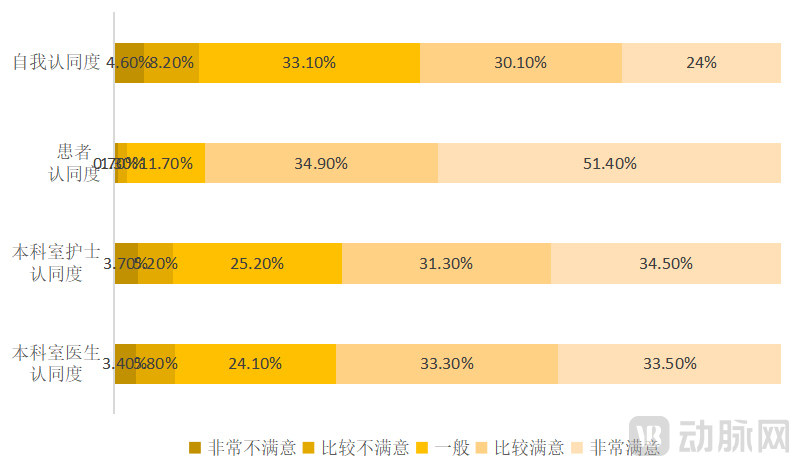
Survey on Professional Identity of Rehabilitation Practitioners, Data Sourced from the Chinese Journal of Rehabilitation Medicine
The original intention behind adjusting occupational classifications was to promote industry development, yet the outcome has left this professional group confused. The underlying cause lies in the absence of supporting policies, which fails to safeguard their legitimate rights and interests. Talent is the cornerstone of industry growth; both reasonable occupational classification and the improvement of supporting policies are indispensable factors in ensuring professionals’ sense of occupational identity.
Secondly, how to balance the breadth and depth of the rehabilitation industry.
Lowering entry barriers will propel the rehabilitation industry into a period of rapid growth, enabling a swift expansion in service coverage. However, the healthy development of an industry requires depth as well as breadth. Specifically, for the rehabilitation sector, the rapid advancement of rehabilitation technologies demands a substantial influx of high-caliber professionals to keep pace, thereby narrowing the gap with international counterparts.
Taking physical therapists (PTs), who constitute a significant proportion of rehabilitation practitioners in the United States, as an example, although PTs are classified as allied health professionals rather than physicians, the U.S. training system has primarily adopted the Doctor of Physical Therapy (DPT) program since 2005, thereby ensuring the quality of professionals.
Furthermore, the United States mandates that physical therapists (PTs) undergo continuing education and complete a specified number of coursework credits every two years after entering practice. This requirement ensures they keep pace with advancements in rehabilitation medicine and maintain their technical proficiency. It is precisely this tiered workforce, led by highly qualified professionals, that guarantees the effective operation of the extensive social rehabilitation system in the United States.
Can the new occupational classification attract high-level talent, ensure in-depth industry research, and promote the healthy development of the rehabilitation sector?
During this year’s Two Sessions, Professor Ling Feng, Chief Expert in the Department of Neurosurgery at Xuanwu Hospital of Capital Medical University, proposed expanding the traditional four healthcare professions—medicine, pharmacy, nursing, and medical technology—to five by adding rehabilitation, and granting rehabilitation therapists limited non-pharmacological prescribing authority.
These recommendations are all aimed at promoting the healthy development of the rehabilitation industry. The purpose of adjusting occupational classifications is likewise to legitimize the profession, safeguard industry growth, and attract talent. Balancing the breadth and depth of the industry to ensure its sustainable development is also a key consideration in this adjustment process.
Finally, whether the supply side has fully adopted a market-oriented approach.
Current resistance stems from the rehabilitation sector’s continued reliance on the healthcare system, under which practitioners must join the ranks of physicians to secure better compensation and career advancement opportunities. Is the logic behind this recent occupational classification a signal encouraging the rehabilitation industry to accelerate its market-oriented transition? A practitioner shared his perspective with VCBeat.
Rehabilitation medicine is undervalued within the healthcare sector, placing significant pressure on practitioners. It is inherently difficult to pit rehabilitation therapists against physicians in competition. Within the hospital system, the dominant position of clinicians is unshakable. Consequently, rehabilitation therapists cannot compete with physicians in terms of career development, professional title evaluation, or personal income, as the standards have long been established, leaving latecomers with little opportunity to benefit.
If rehabilitation services are spun off as independent entities, operated under market-driven models, and allowed to pursue their own professional trajectories free from the constraints of the traditional healthcare system, could this present a rapid growth opportunity for the rehabilitation industry? Adjustments to the occupational classification of rehabilitation practitioners have effectively lowered entry barriers, making it easier to deliver rehabilitation services. This will attract more capital inflows and let market forces determine outcomes, weeding out the weak and retaining the strong.
Taking sports rehabilitation, a niche segment within the rehabilitation industry, as an example, it leans more toward sports than medicine. From a business perspective, it is more consumer-oriented, operates independently of medical insurance, and follows a purely market-driven model. Therefore, the recent adjustment to occupational classifications caused little ripple in the sports rehabilitation sector.
“For the sports rehabilitation industry, this may actually be a positive development, as lower barriers to entry will attract more professionals into the field. For instance, many coaches and athletes possess extensive hands-on training experience. If they acquire rehabilitation skills through targeted training and integrate these techniques with their practical expertise in real-world settings, the effectiveness of functional training and recovery outcomes can be better ensured,” said Ran Lingjun, founder of Ranran Sports Rehabilitation, in an interview with VCBeat.
Apart from sports rehabilitation, other niche segments within the rehabilitation sector still lack the objective conditions necessary to operate independently outside the medical healthcare system. If the rationale behind adjusting occupational classifications is to marketize rehabilitation services, it is first essential to create an environment conducive to their survival and development; both supporting policies and industry regulations need to be gradually refined.
Overall, if the new occupational classification is implemented, the group most affected will be rehabilitation professionals who aspire to develop their careers within the public hospital system.
As for classification into service categories, the words of one practitioner to VCBeat can represent the voice of most practitioners: "Professional title is very important, as it determines why I strive. To meet industry needs, I can continue learning and devote all my energy to helping patients recover, simply because I am a health professional technician. But if I were merely a waiter, why would I put in so much effort?"
From the perspective of the rehabilitation industry’s development, the recent adjustments to classification may not necessarily be a negative development in the short term. Lowering entry barriers is conducive to increasing the number of rehabilitation institutions, as quantitative growth is a prerequisite for qualitative transformation within the industry. However, whether the sector can accumulate sufficient talent to sustain long-term development remains to be seen.
The controversy sparked by adjustments to occupational classifications is merely a superficial manifestation; the underlying cause lies in the inadequacy of supporting policies for the rehabilitation industry. While official recognition is important, comprehensive industry regulations are equally critical.