

RuDi Bio Files for IPO: Pioneering Nanosecond Pulsed Electric Field Technology Set to Disrupt Thermal and Cryoablation Markets
Pulsed Field Technology Gained Significant Momentum from 2021 to 2022.
According to VCBeat, since September 2021, multiple innovative companies deploying pulsed field technology have completed financing rounds, backed by prominent investment firms including Cowin Capital, DaoTong Investment, Taikun Fund, JiFeng Capital, Mifang Capital, Yansheng Venture Capital, Shunwei Capital, and CAS Star.
The reason it is highly favored by investment institutions is thatPulsed Electric Field TechnologyCapable of selectively destroying cells while ensuring the safety of other normal tissues, such as blood vessels and nerves, thereby enhancing surgical safety and efficacy and reducing postoperative complications.
In fact, pulsed electric field technology has evolved through three generations to date.
Specifically, the first generation isMillisecond PulseElectric field technology is used in scenarios such as gene transfection, electroporation-based drug delivery, and electrochemotherapy; the second generation isMicrosecond PulseElectric field technology is used in scenarios such as tumor ablation and atrial fibrillation ablation; the third generation isNanosecond PulseElectric field technology is utilized in dermatology, oncology, cardiology, respiratory interventions, endoscopic interventions, and other clinical settings.
Millisecond pulses, microsecond pulses, and nanosecond pulses: the three generations of pulsed electric field (PEF) technology each have distinct characteristics and respective applications in the medical field. Millisecond PEF technology is highly mature with low technical barriers; microsecond PEF technology faces intense competition and has limitations in therapeutic applications;Nanosecond pulsed electric field technology is mastered by few companies, and the market remains a blue ocean.。
Pulsed electric fields with different parameters elicit distinct bioelectric responses in biological tissues. For instance, millisecond pulses can induceReversible Electroporation Effect, microsecond pulses can induceIrreversible Electroporation Effect, nanosecond pulses can induceSuper Electroporation Effect。
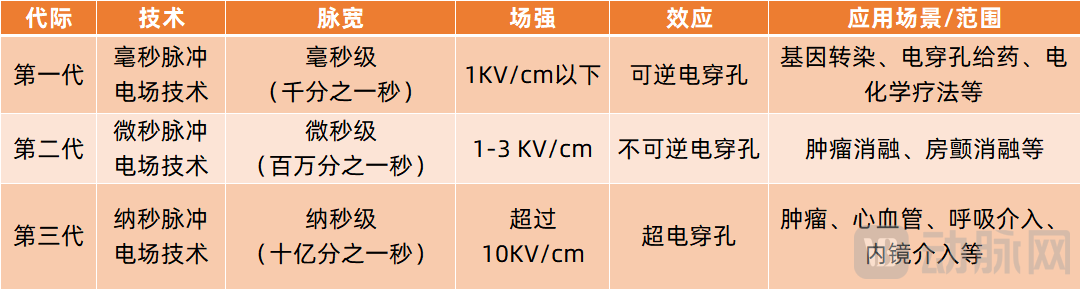
According to the introduction,Reversible Electroporation EffectRefers to the application of pulsed electric fields with millisecond-level pulse widths and field strengths below 1 kV/cm (i.e., millisecond pulsed electric fields) to biological cells,Transient hydrophobic or hydrophilic nanopores form in the cell membrane, and the cells return to their natural state after the electric field is removed.。
The reversible electroporation effect of millisecond pulsed electric fields facilitates the cellular uptake of chemotherapeutic agents such as bleomycin and cisplatin, as well as macromolecules including DNA, RNA, antibodies, and fluorescent probes. Leveraging this characteristic, the medical industry has applied pulsed electric field technology in scenarios such as electrochemotherapy, gene transfection, gene therapy, DNA vaccination, and drug delivery.
Currently, millisecond pulsed electric field technology has become a standard competency that companies researching genes and cells must master, with relatively low technical barriers.
Irreversible Electroporation Effectrefers to when a pulsed electric field with a pulse width in the microsecond range and a field strength of 1–3 kV/cm (i.e., a microsecond pulsed electric field) acts on biological cells,Permanent pores form in the cell membrane, leading to increased exchange of substances between the intracellular and extracellular environments, disruption of homeostasis, and ultimately cell death.。
In the medical field, second-generation microsecond pulsed electric field technology has been applied to ablation therapy for tumors and atrial fibrillation. However, further clinical data are still needed to validate its long-term safety and efficacy.
Currently, more than 50 companies in China claim to have mastered microsecond pulsed electric field technology and are exploring its application in the treatment of atrial fibrillation or tumors.
Unlike millisecond pulses and microsecond pulses,Nanosecond pulse technology, which has emerged in recent years, is mastered by only a few companies worldwide.。
Nanosecond pulses are on the nanosecond scale (1 nanosecond = one billionth of a second), causingSuper Electroporation Effect:When pulsed electric fields with nanosecond-scale pulse widths and field strengths exceeding 10 kV/cm (nanosecond pulsed electric fields) act on biological cells, the high-energy, sharp nanosecond pulses exhibit the capability to cross the cell membrane and enter the nucleus.Ultra-Electroporationoccurring intracellularly (Nucleus, mito-GranulePores appear in cellular substructures such as organelles),thusInduce programmed cell death, i.e.,CellApoptosis。
withMicro-Compared with microsecond pulse ablation,Nanosecond pulses feature high energy and high energy density, enabling more thorough destruction of diseased cells. The nanosecond pulsed electric field acts directly on cellular substructures to induce apoptosis in diseased cells, thereby reducing electromyographic twitching and electrocardiographic risks caused by cytoplasmic leakage following cell membrane rupture, minimizing micro-explosions, and alleviating the electrical side effects associated with wide-pulse stimulation.
Meanwhile, the boundary between the ablation zone and the non-ablation zone of nanosecond pulses is clear and sharp. For tumors located in the thermal ablation-excluded zone at the hepatic hilum, this technique demonstrates a high success rate, with extremely low rates of recurrence and adverse events.
Distinct from the cellular necrosis induced by microsecond pulses, nanosecond pulses induceApoptosis: During local ablation, the retained tumor antigens on the cell membrane can stimulate an immune response.and can promote the regeneration and repair of normal tissues through phagocytosis, thereby restoring normal function at the lesion site.
In multicenter clinical trials in the United States, nanosecond pulses have demonstrated unique advantages: based onTissue Selectivity + Supra-Electroporation Effect,Nanosecond PulsewithA More Robust Dose-Response Relationship、Superior TissueSelectivity,More PureNon-thermal injury andMore PrecisePhysical targeting significantly broadensPulsed Electric FieldIndications for Ablation Technology.Therefore, nanosecond pulses are considered to be aDisrupting Traditional Ablation Methods.
Nowadays, given the safety and efficacy of nanosecond pulsed electric fields (nsPEF) in cellular ablation, this technology is being explored for application in various medical scenarios, including oncology, cardiovascular interventions, respiratory interventions, endoscopic interventions, and chronic brain diseases. For instance, an overseas publicly listed company has applied nsPEF technology to tumor ablation and aesthetic medicine.
In fact, beyond its application in ablation therapy, the nanosecond pulsed electric field can also be utilized in numerous scenarios, including electric field-mediated delivery of immune factors, electric field sensitization for chemotherapy-resistant tumors, acceleration of stem cell division and growth by pulsed electric fields, electrochemical control of drug release, microfluidic intervention of biomolecules, and pulsed electric field treatment for thrombosis and cardiovascular diseases.EstimatedThird-Generation Nanosecond Pulse TechnologyThe "Catalyst" SeriesBreakthrough Innovative Devices Addressing Clinical Pain Points。
In China, Hangzhou Ruidi Biotechnology Co., Ltd., founded in 2014, is also a platform enterprise specializing in electric field energy control. Established by scientists returning from the UK and the US, the company leverages third-generation nanosecond pulsed electric field technology as its core, integrating electromagnetics, imaging, and other technologies to develop innovative medical devices tailored for clinical applications.
In the field of innovative medical devices, independent intellectual property rights are often a hard indicator for measuring the "technological content" of a company. In this regard, Ruidi Biotechnology has turned its independent intellectual property rights into a competitive barrier, avoiding homogeneous R&D and patent disputes among medical device companies.
Ruidi Biotechnology stated, “Unlike many companies that are fixated on imitation and replication, we place a high priority on scientific and technological innovation, adhering to the less-traveled path of ‘fundamental technological innovation and iterative optimization.’”
Currently, Hangzhou Ruidi Biotechnology Co., Ltd. holds the largest number of nanosecond pulse patents globally, ranking first in the industry. Behind its more than 100 core patents lies the company’s unwavering commitment to independent innovation, building technological barriers, and promoting original domestic innovations.
After a decade of dedication, Ruidi Biotechnology has emerged as a global leader in the nanosecond pulse industry.
Observations indicate that Ruidi Biotechnology’s pulsed electric field (PEF) platform technology demonstrates significant scalability and growth potential. On one hand, Ruidi Biotechnology’s medical-engineering integrated team possesses substantial expertise in technological research and development. On the other hand, the company meticulously refines its products and steadily establishes a robust production and quality management system, thereby building its core competitiveness across technology, R&D, product development, and production quality.
From a technical perspective, the “Key Laboratory for Medical Translation and Application of Pulsed Electric Field Technology,” led by Ruidi Biotechnology, encompasses interdisciplinary fields including hardware, software, algorithms, chips, high-power pulses, and clinical medicine, thereby providing the hardware foundation necessary to break international technological monopolies.
In terms of its product portfolio, Hangzhou Ruidi Biotechnology Co., Ltd. has established R&D pipelines spanning oncology, atrial fibrillation, and chronic brain diseases, and has gained access to the Special Approval Channel for Innovative Medical Devices.
In terms of product development pace, nationwide multicenter prospective clinical trials are being vigorously conducted. The nanosecond pulsed tumor ablation system has completed all clinical enrollment, the pulsed field ablation system for cardiac atrial fibrillation has initiated clinical trials, and multiple clinical trials for other products are also advancing rapidly.
Based on existing clinical data, nanosecond pulses demonstrate superior tissue selectivity. In tumor clinical trials, the nanosecond pulse tumor ablation system was used to ablate tumors in hundreds of cases located in ablation-restricted zones, such as the hepatic hilar vascular region, gallbladder and bile ducts, and diaphragm, thereby validating the iterative technological advantages of nanosecond pulses.
With the approval and market launch of the nanosecond pulsed tumor ablation system, cancer patients worldwide—particularly those with tumors located in ablation-restricted zones—are poised to welcome a disruptive ablation therapy.
As a platform-based enterprise, Hangzhou Ruidi Biotechnology Co., Ltd. will leverage its electric field energy control platform to develop more breakthrough innovative devices centered on third-generation nanosecond pulsed electric field technology, addressing critical clinical challenges.