

Shangyi Zhixin Files IPO Prospectus: Empowering Integrated Healthcare IT for Over 5,000 Medical Institutions

Tomorrow HealthCare
Integrated SaaS Product Provider for In-Hospital and Out-of-Hospital Solutions
The Past Decade: A Decade of Soaring Informatization in the Healthcare Industry
Not only have governments successively introduced various policies, including regulatory standards and incentive-based support, to drive industry development, but medical IT companies have also entered the field, providing innovative solutions to issues such as information silos, data security, and the strain on medical resources.
Driven by the joint efforts of government, enterprises, and medical institutions, informatization has moved from the periphery to the center, becoming a vital link in hospital development.“National Health Informatics Survey Report—Regional Health Informatics and Hospital Informatics (2021)”It shows that the construction rates of regional health information platforms at the provincial, municipal, and county levels in China have reached 100%, 62.8%, and 46.4%, respectively.
Despite the increasing maturity of information systems, underlying issues persist, including insufficient intelligence, underdeveloped specialty-specific functionalities, imperfect system architecture, inadequate external integration, and the absence of a comprehensive, unified data center.
Xue Wanguo, former director of the Big Data Research Center at the Chinese PLA General Hospital, once pointed outCurrently, most Hospital Information Systems (HIS) adopted by the industry are modified and improved versions of legacy systems. In the current environment of continuous development and growth in hospital informatization, simple patches and fixes are no longer sufficient to meet demands. Traditional HIS needs to undergo upgrades in terms of system functionality, architecture, external integration, and data management, returning to its positioning as a "core hospital information system." On the premise of ensuring stability, it should possess the capabilities to serve as foundational business support, the backbone for system integration, and the carrier for the data center.
In response to industry developments, Beijing Shangyi Zhixin Health Management Co., Ltd. (hereinafter referred to as “Tomorrow HealthCare”) shares the same observations.
Tomorrow HealthCare is an integrated provider of comprehensive solutions for the healthcare industry. Since its inception, the company has been dedicated to effectively addressing the informatization pain points of medical institutions by developing a new generation of healthcare industry solutions. Throughout its development, the enterprise has continuously attracted top-tier talent from the healthcare sector and other industries, and secured angel-round investment from CICC Capital.
Zhao Yongguang, CEO of Tomorrow HealthCare, told VCBeat:“Currently, healthcare informatization is plagued by common issues such as a proliferation of in-hospital IT vendors, numerous functional modules, a large number of machine terminals and self-service printing devices, complex operations, and high maintenance difficulty. Since many products from traditional vendors are outdated, with uninnovative technical architectures and product concepts, the market has failed to deliver adequate supply. We aim to focus on tangibly serving doctors and patients and addressing hospital management challenges, thereby providing truly valuable solutions that enable the genuine realization of cloud-based hospital infrastructure.”
Based on the current product offerings of various enterprises, the vast majority possess the capability to build information management platforms, and some can assist hospitals or medical consortia in implementing prescription circulation systems to facilitate the reallocation of medical resources. However, only a few enterprises are able to provide comprehensive data, end-to-end process, and full-lifecycle management platforms that span pre-hospital, in-hospital, and post-hospital care, as well as online and offline services.
Tomorrow HealthCare precisely addresses this core focus, achieving integration of clinical services, front- and back-office operations, and intra- and extra-hospital workflows from the foundational design stage.
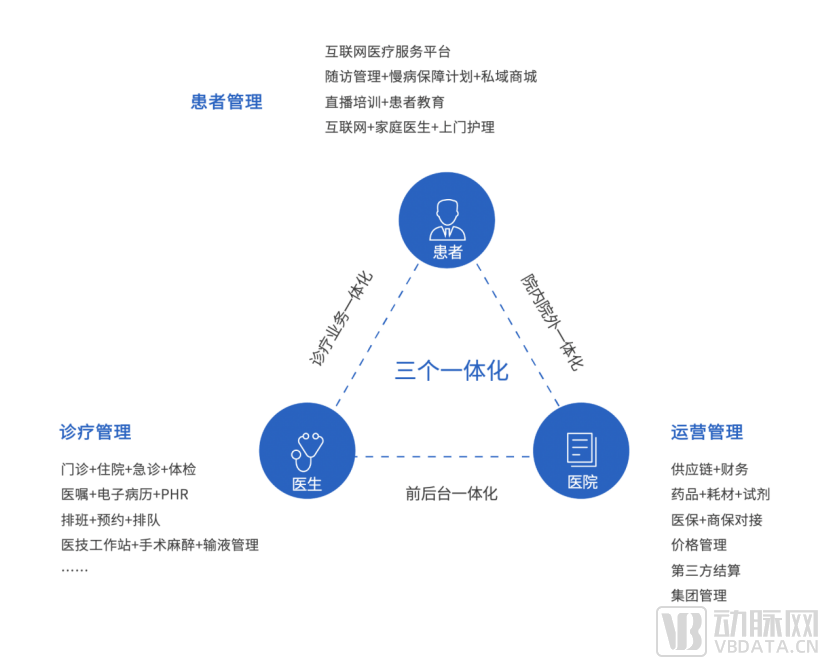
It is understood that Tomorrow HealthCare is built on a public cloud platform, adopts a SaaS architecture model, and is designed with a microservices-based distributed architecture.Provide the essential technologies for hospital informatization, ensuring system flexibility, scalability, and openness, while implementing standardized interfaces. Enable tenants to fully and independently configure required functional modules, thereby facilitating the smooth delivery of offline medical services.
Tomorrow HealthCare’s “THC” information system highly integrates functions such as HIS, LIS, PACS, EMR Level 4, ERP, PHR, supply chain management, financial management, and internet hospital services. By employing a unified underlying control hub, it ensures data interoperability among different business functions at the system architecture level. This truly enables end-to-end patient data flow, guaranteeing the integration of in-hospital clinical operations, front- and back-office processes, and online and offline services, thereby providing patients with healthcare services throughout their entire life cycle.
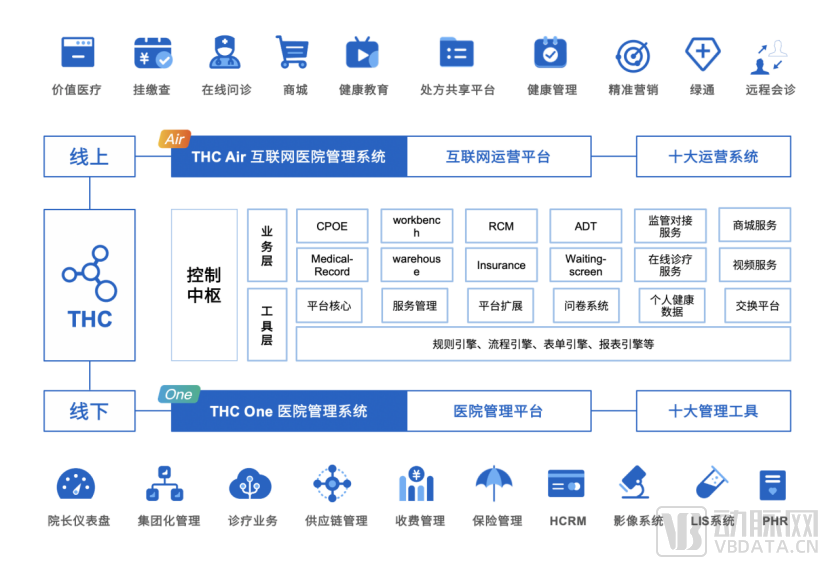
Discussing the logic of product development, Zhao Yongguang stated:“Hospital operations are complex and involve numerous processes. Often, developing or providing solutions requires looking beyond individual business units to the underlying logic of the overall operation. Tomorrow HealthCare’s products are redesigned from the ground up to truly achieve data interoperability. They are patient-centric, offering operational support solutions that cover the entire patient lifecycle.”
It is understood that Tomorrow HealthCare’s products are built on an “order-driven workflow” architecture that integrates various business modules and systems, thoroughly resolving issues such as data fragmentation and process inefficiencies inherent in traditional systems. By establishing standardized data elements and information exchange mechanisms, the platform achieves compliance with Level 4 for electronic medical records upon deployment, Level 4-B for interoperability, and Level 3 for smart healthcare services. Meanwhile, its modular product design and standardized interfaces cater to the diverse needs of different clients.
In the product development logic of Tomorrow HealthCare, the universality of solutions in complex environments is a particularly crucial aspect. Therefore, its software itself comprises two layers.
The underlying layer is the engine layer, while the upper layer is the application layer. Through this architectural division, enterprises ensure that their foundational tools possess strong flexibility, allowing users to customize the product based on specific application scenarios and user roles.
Supported by the “application layer + product foundation,” its product line has expanded rapidly, creating broader market opportunities for the future development of Tomorrow HealthCare.
From single-entity institutions to group-based management, from clinics to tertiary hospitals, from specialized hospitals to general hospitals, from medical services to public health, and from healthcare to integrated medical and elderly care, the company has currently established a comprehensive suite of solutions covering in-hospital systems, internet hospital platforms, public health institution solutions, and an integrated “institutional (nursing homes)–community (elderly care stations)–home-based” elderly care solution. By conducting in-depth research into cloud architecture, healthcare-specific browsers, localized disaster recovery front-end server platforms, and electronic medical record (EMR) editors, the company continues to drive ongoing product iteration and innovation.
"Take a Long-Term View."
While providing tools for the healthcare informatics market, Tomorrow HealthCare also recognizes that many medical institutions face numerous challenges and difficulties during their digital transformation, and that some lack any operational experience after completing the transition.
Leveraging its deep understanding of the healthcare industry, Tomorrow HealthCare has expanded into consulting and operational services while providing medical informatics tools, thereby delivering end-to-end solutions to support institutional transformation.
Since its establishment, Tomorrow HealthCare has provided professional consulting services to CITIC and Taikang Group. With the accumulation of data generated by future IT tools, the company will further assist hospitals in conducting in-depth analysis and diagnosis of their operational strategies, thereby improving their management systems.
Tomorrow HealthCare’s assisted operation services provide medical institutions with continuous service and data platforms that span both in-hospital and out-of-hospital settings, facilitating in-depth operational management. This not only reduces costs and improves efficiency at the institutional level but also continuously expands user reach and impact.
The “Tools + Consulting + Operations” business model has enabled Tomorrow HealthCare to expand its scope from standalone software product services to include consulting and operational support. In the future, the company will achieve long-term growth by continuously providing comprehensive services to healthcare institutions at various stages of development.
Currently, the healthcare IT sector features numerous vendors and low market concentration. New entrants often struggle to overcome technical barriers and gain market traction due to a lack of mature products and business models, as well as an inadequate understanding of clinical needs.
Since its establishment in 2017, Tomorrow HealthCare has built a “SaaS technical architecture + tool-based product” ecosystem from the ground up, leveraging technological innovations to continuously reduce the costs of informatization construction and enhance the operational efficiency of medical institutions. The company has steadily strengthened its competitiveness in terms of product functionality, completeness, and granularity, thereby accelerating the expansion of its market share. Currently, its enterprise clients are distributed across nearly 20 provinces in China, covering more than 5,000 medical institutions, with contracted sales exceeding RMB 100 million in 2021.
Meanwhile, the company has extensive collaborations with Sino-US Healthcare Group, Huayi Big Health, JD Health, Philips, Sunshine Insurance, CITIC Healthcare, Changfeng Hospital Group, and others in areas such as IT solutions, operations, and consulting. It has also established partnerships with cloud platform providers including Tencent Cloud, Alibaba Cloud, Kingsoft Cloud, and China Unicom Cloud in the healthcare sector.
On how innovative enterprises can further penetrate the market, Zhao Yongguang shared his views:“The establishment of the National Healthcare Security Administration has reshaped the industry landscape, necessitating localized and timely advancements in health information technology products. This requires looking beyond surface-level medical needs to identify the root causes of issues, clearly understanding what patients, physicians, and hospitals truly require, and then addressing these needs through technological solutions. Only integrated products, forward-thinking concepts, and comprehensive services can benefit healthcare institutions of suitable scales. Currently, we primarily target secondary hospitals and those at lower tiers, aiming to firmly secure the grassroots market before steadily expanding upward.”
In summary, while supporting traditional on-premises deployment architectures, Tomorrow HealthCare has prioritized a SaaS+ model that integrates cloud-native technical architecture with deep expertise in healthcare operations. This approach enables a nuanced understanding of the varying business needs across different medical institutions, resulting in the design of a highly tool-based, configurable software system that has secured partnerships with numerous clients. Furthermore, by combining this with a SaaS sales and service model, the company reduces customers’ costs and investments in IT infrastructure, thereby achieving mutual benefits for both parties.
The Construction of Next-Generation Hospital Information Systems Unlocks New Growth Points in the Healthcare Market. As cloud computing, big data, and artificial intelligence technologies are increasingly integrated into clinical practice, cloud computing platforms will become the foundational infrastructure for operating China’s distinctive healthcare service system. Healthcare information systems will also comprehensively migrate to cloud platforms, driving the development of healthcare services toward intelligent and digital transformation.
The time has come for health IT enterprises to deliver innovative solutions from the user perspective, encompassing healthcare professionals, medical administrators, and patients.
This not only means that healthcare IT enterprises need to pay attention to the hospital's operational aspects, such as personnel, finances, and materials, and design solutions more from the patient's perspective. It also implies that these companies must delve into clinical practice and design system workflows based on the practical needs of physicians.
After all, standing at the forefront of digital healthcare, lacking any one of core technologies, innovative thinking, or predictive capabilities makes it difficult to survive through the past decade and the next.