

Steinbeis Technology Transfer AG: Pioneering Networked Incubation with 14 Daily Tech Transfer Deals
While most technology transfer institutions in China are still contemplating how to commercialize research outcomes,Steinbeis Transfer GmbHhas already delivered a satisfactory performance: completing approximately each year5,000+Technology transfer project, with total turnover in 2019 reaching as high as€162 million.
Such a high transaction frequency and such robust revenue conversion are achievements that many technology transfer institutions can only dream of.
In terms of industry standing, Steinbeis Technology Transfer Company is not onlyEurope's Largest Technology Transfer Organization, and alsoOne of only two publicly listed companies in the technology transfer sector worldwide. Furthermore, it collaborates with over 10,000 clients annually, with its business spanning all segments of the innovation ecosystem, including R&D, consulting, training, and technology transfer.
So, how did the Steinbeis Technology Transfer Center grow? How does it efficiently incubate scientific research projects? Looking at China, what methods and models can our technology transfer institutions learn from? To uncover the answers to these questions,VCBeat Orange BureauConducted in-depth analysis.
Growth History: Originating in Baden-Württemberg, Rejecting Government “Support”
From a “child” under mandatory government protection to an “adult” operating fully in a market-driven manner, Steinbeis Technology Transfer Center has completed its 27-year journey.
In 1971, the operational headquarters of Steinbeis Transfer GmbH—Steinbeis Foundation for Economic Promotion(hereinafter referred to as the “Foundation”) was re-established at the initiative of the Ministry of Economic Affairs of Baden-Württemberg.The state government provides the foundation with approximately 180 million Deutsche Marks annually through non-repayable grants and procurement to support its technical consulting and technology transfer services,These technology transfer activities, conducted with government support, formed the foundation of Steinbeis Technology Transfer GmbH.
1983, the First Government Technology Transfer CommissionerJohann LöhnDr. [Name] was appointed as the Chairman of the Foundation’s Board of Directors and spearheaded a landmark reform—Steinbeis technology transfer activities began to combine government support with the market.
Specifically, the foundation began to operate within universities of applied sciencesEstablish a Specialized Technology Transfer Center, meanwhile,The state government, by prioritizing support for infrastructure development or purchasing its services, to support the establishment of the Professional Technology Transfer Center.
After 15 years of trial and error, in 1998,Steinbeis Technology Transfer Company was officially established, marking its transition from passively accepting government support to proactively forgoing annual financial subsidies from the state government.Operate entirely in a market-oriented manner.
However, the government, which was forced to “withdraw,” did not wish to be sidelined. It also sought various ways to participate in the commercialization of research outcomes, primarily by encouraging the activities of the Steinbeis Technology Transfer Center through preferential tax policies in the later stages.
Success Story: Seizing the Three Highlights of “Management, Incubation, and Talent”
Growth is no easy feat, but success is even harder to come by. It was only after adopting a fully market-oriented business model that Steinbeis Technology Transfer GmbH faced its true challenges.
To address these challenges, the Steinbeis Foundation for Technology Transfer has honed three core “competencies” in technology transfer and commercialization.
It is reported that Steinbeis Technology Transfer Company currently has more than 1,000 affiliated institutions, includingTechnology Transfer Center, Research Center, Consulting Center, Steinbeis University, investment companies, and asset management companies, with a total workforce of 6,000 employees, undoubtedly, this is a vast and complex organizational structure.
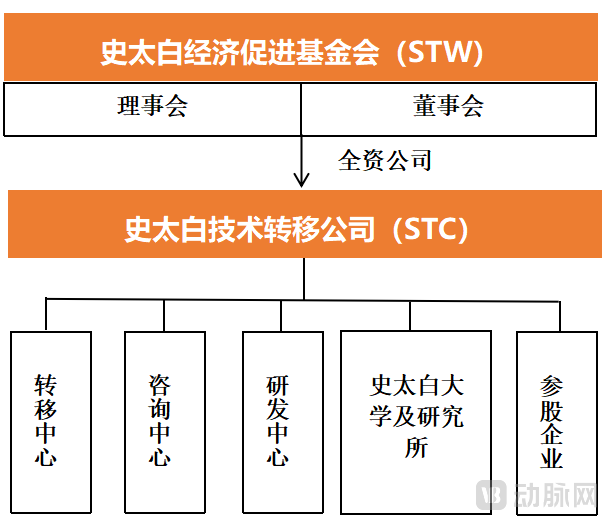
Figure: Organizational Structure of Steinbeis Technology Transfer GmbH
Therefore, in terms of overall management, Steinbeis Technology Transfer GmbH has adopted a strategy of simplification by abandoning the traditional pyramid-shaped hierarchical structure in favor of a flat management model. By integrating centralization with decentralization, the company maximizes benefits in two key areas: first, unified planning to steer the overall direction of technology transfer activities; and second, enhanced efficiency to better align with market-oriented operations.
The centralization here is primarily about “unification,” namely,Establish “standardized procedures” during the process of translating research findings into practical applications.
All technology transfer centers and affiliated institutions under Steinbeis Transfer GmbH adhere to the same development philosophy and objectives as the Foundation’s headquarters, with their names prefixed by “Steinbeis Germany.” As the “headquarters,” the Foundation is responsible for unified branding, as well as establishing customized service principles and standards for its affiliated entities.
In the practical implementation of technology transfer, Steinbeis Technology Transfer GmbH assumes the management responsibilities for regional technology transfer centers, primarily encompassing three aspects: first, providing support to regional transfer centersSeeking Enterprises as Technology Investors and Assignees; secondly,Establishing a Capital Platform, assist transfer centers in various regions with applications for commercial loans and project funding from the German government or the European Union, and provide financial guidance; thirdly,Responsible for the preparation of large-scale projects and coordinating the division of labor and collaboration within the Technology Transfer Center.
Decentralization emphasizes market-oriented operations, whereby local technology transfer centers develop independently based entirely on market conditions.
In other words, the various technology transfer centers operate with considerable autonomy. Although Steinbeis Technology Transfer GmbH bears managerial responsibility for its branch offices, it does not interfere arbitrarily, conducting only periodic performance evaluations.
“Freedom” is mainly reflected in two aspects. On one hand, Steinbeis GmbH Technology Transfer does not adhere to rigid criteria for the establishment of its technology transfer centers. Regarding application thresholds, entities such as university research centers, independent research institutes, technology-based enterprises, or teams may serve as the basis for establishment; even individuals applying voluntarily can establish a technology transfer center.
This is also reflected in their specific operations: each technology transfer center operates independently as the primary entity and independent legal person responsible for completing technology transfers, managing its own business and bearing sole responsibility for its profits and losses. This structure enables them to secure projects and tasks through the foundation, thereby mitigating project risks, while also allowing them to independently explore the market, directly undertake client-commissioned projects, and provide targeted commercialization services.
Government and internal management mechanisms have paved the way for the development of Steinbeis Technology Transfer GmbH, but it is market demand that truly drives a company’s growth. In fact, Baden-Württemberg has proven to be a fertile ground for Steinbeis’s endeavors in translating scientific research achievements into practical applications.
As Europe’s leading innovation region, Baden-Württemberg offers Steinbeis Technology Transfer GmbH distinct industrial and R&D advantages, particularly in the life and health sector. The region boasts abundant educational and scientific resources, with numerous universities and research institutions, and serves as Germany’s largest hub for medical technology and pharmaceuticals. The health industry has become the state’s third-largest export sector.
The huge market demand has stimulated the business development of Steinbeis Technology Transfer Company, which is deeply involved in various transformation stages such as R&D, consulting, training, and transfer, thereby establishing an operational model for industry-academia-research collaboration.
So, how exactly does the Steinbeis Technology Transfer Center link the technology side with the industrial side?
First, establishing a strong presence in universities and research institutions. The various technology transfer centers under Steinbeis Technology Transfer GmbH areDeveloped from various universities and research institutions, It is reported that university professors and researchers account for approximately 10% of the total staff at the Steinbeis Technology Transfer Company. These expert professors from various fields are capable of undertaking the center’s technology transfer projects, as well as completing projects through collaboration with experts and professors from other technology transfer centers.
Meanwhile, leveraging the robust and comprehensive expert network of universities, Steinbeis Technology Transfer GmbH is able to respond rapidly and flexibly to clients’ specific needs.
This is particularly evident in its consulting services. Steinbeis Technology Transfer Center categorizes the content and format of its consulting into various types—including general consulting, expert consulting, management consulting, and expert assessment reports—to evaluate technologies within specific fields based on client needs.
Secondly, prioritize R&D efforts by industry players.Technology transfer platforms serve as intermediaries between research institutions and industry, but this is not their sole role. At Steinbeis Technology Transfer GmbH, there is a large team of experts.Directly provide first-hand high-tech solutions to industry partners, assisting them in achieving technological innovation.
Meanwhile, the R&D centers under Steinbeis Technology Transfer GmbH leverage a large pool of technical experts and talent to conduct in-depth development of existing technologies, ensuring they align more closely with customer needs. In this process, Steinbeis not only provides a comprehensive suite of services for new technologies—ranging from development, testing, and patent application to production implementation—but also optimizes and improves existing technologies and products based on market demands.
Finally, strengthening ties with the capital market. As the saying goes, “provisions before troops,” funding is a critical element in the process of translating scientific and technological achievements into practical applications. In light of this, equity-participating enterprises under Steinbeis Technology Transfer Center maintain close connections with venture capitalists., thereby opening up channels for the monetization of technology itself.
The underlying logic in the field of technology transfer is similar to that of scientific research and development: talent precedes the activity of technology transfer. Professionals in technology transfer serve as lubricants for the commercialization of scientific achievements, facilitating effective communication between researchers and industry stakeholders.
In addition to building a technology transfer workforce primarily composed of university experts and establishing win-win partnerships with professors and scholars, Steinbeis Technology Transfer Center is also committed to knowledge dissemination and talent development.
Let us begin with the output of knowledge. In 2005, Steinbeis Technology Transfer GmbH established transfer centers and transfer agencies; additionally, it began setting up research and innovation centers as well as consulting centers, with the aim of delivering expertise in market-oriented and transfer-oriented research and development.
Next is the cultivation of talent, which primarily refers toTechnology Transfer Talent. 1998,Steinbeis Technology Transfer Corporation invested in and established Steinbeis University, implementing a dual-track educational philosophy and committed to “achieving the transfer of knowledge and technology into commercial value through cultivating individuals’ innovation and entrepreneurship capabilities,” thereby continuously supplying the society with professionals specialized in technology transfer.
It is reported that Steinbeis University also customizes educational programs in technology transfer and innovation management—covering areas such as technology transfer, knowledge innovation, marketing, corporate finance, and financial management—for world-renowned companies like Siemens and IBM, as well as for tens of thousands of small and medium-sized enterprises (SMEs) and hidden champions.
Reflections and Insights
Some industry insiders believe that Germany’s system for translating scientific and technological achievements is built upon its research foundation, with its greatest advantage beingClosely integrate technology transfer activities with the upstream scientific research system.
In fact, a significant reason for the success of Steinbeis Technology Transfer GmbH lies in its adherence to this development path: relying on universities and research institutes to establish an industry-academia-research integrated technology transfer model, thereby facilitating the conversion of more cutting-edge achievements into market economic value, all under a framework of “moderate” overall management.
Steinbeis Technology Transfer GmbH is acutely aware that, as a technology transfer institution, if it were “tightly bound” to the government and entirely reliant on governmental support, it would lack independent market-oriented capabilities. It would also be constrained by inaccurate market positioning and cumbersome procedures for translating research outcomes into practical applications, causing many technologies under its purview to miss optimal opportunities for commercialization and ultimately remain confined to the laboratory.
Currently, the commercialization of scientific research achievements in China is still in its nascent stage. Most mainstream technology transfer institutions currently operate with government endorsement and exhibit relatively weak market-oriented capabilities.
However, the commercialization of scientific and technological achievements is not an exercise in “working behind closed doors”; rather, it is a market-oriented endeavor. Therefore, relevant technology transfer institutions should consciously enhance their self-sustaining capabilities during subsequent explorations and refine their “core competencies” in achievement commercialization based on market demands.