

HEIMDALL: The World’s First AI-Powered Machine Vision System for Full-Scale Parkinson’s Disease Assessment
On July 23, 2022, the launch event for Ruijin Hospital’s One-Stop Specialized Center for Parkinson’s Disease 2.0 and the HEIMDALL AI Assessment Technology was held in Shanghai.
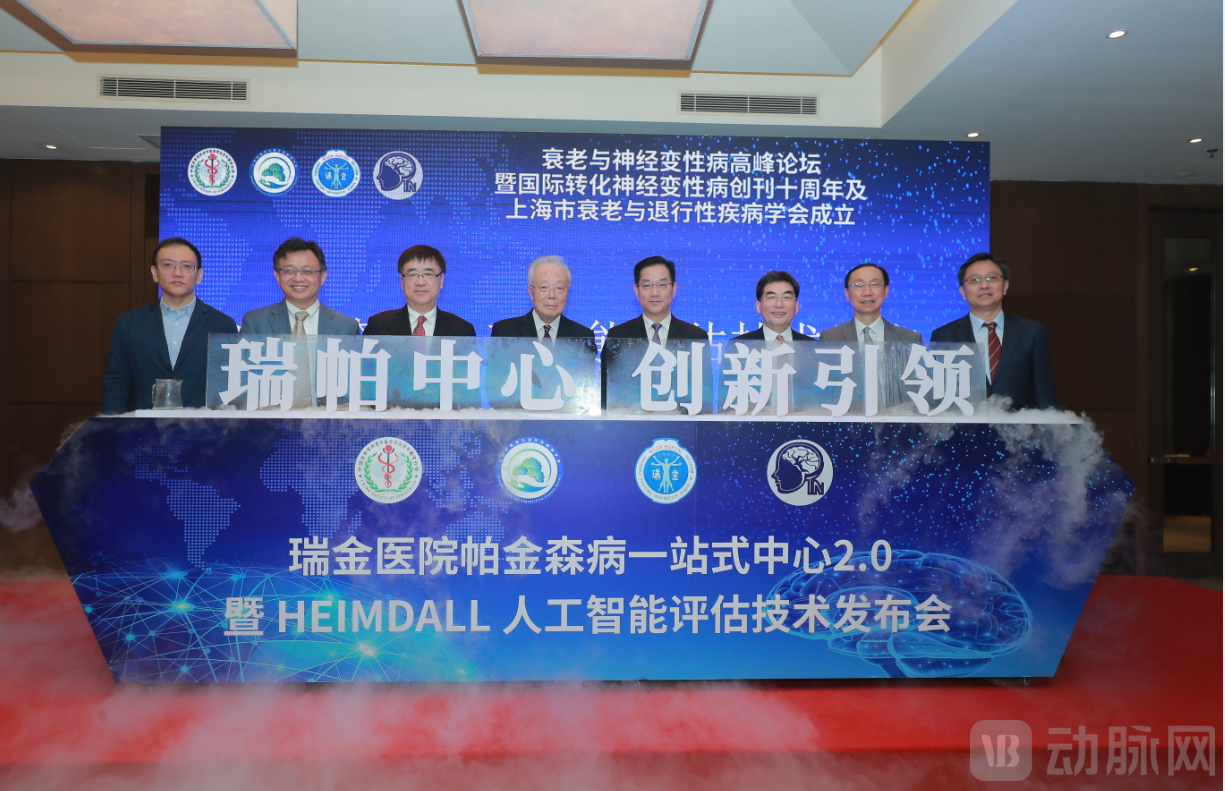
From left to right: Dr. Ren Kang / Professor Zheng Jialin / Academician Ning Guang / Academician Yang Xiongli / Academician Fan Xianqun / Professor Chen Hongzhuan / Professor Chen Shengdi / Professor Liu Jun
To better serve patients with Parkinson’s disease, China’s first one-stop diagnosis and treatment center for Parkinson’s disease was launched at Ruijin Hospital in Shanghai on April 11, 2020. With the continuous advancement of comprehensive treatment, multidisciplinary care, and whole-course management for Parkinson’s disease, the 2.0 model—integrating “Internet + Healthcare” with online-offline one-stop specialized disease centers—has emerged accordingly.
HEIMDALL AI Assessment Technology is a key component of the 2.0 model for One-Stop Specialty Centers for Parkinson’s Disease. Independently developed by Zhenluo Science, an innovative medical technology and services company specializing in central nervous system disorders, and refined through in-depth collaborative clinical research with Ruijin Hospital, this technology is the world’s first to fully enable AI-based scoring of Parkinson’s disease rating scales. In the future, by leveraging cameras and motion-sensing technologies as its “eyes” and AI algorithms as its “brain,” the system will assist specialists in precisely assessing the condition of patients with Parkinson’s disease. This represents a significant advancement in revolutionizing clinical management models for Parkinson’s disease.
Parkinson’s disease is a neurodegenerative disorder commonly affecting middle-aged and elderly individuals, for which there is currently no cure. China is home to 4 million Parkinson’s patients, with an overall prevalence of approximately 1.7% among those aged 65 and older, causing significant distress to many sufferers. Under the traditional model of diagnosis and treatment, patients often need to navigate between multiple departments for consultations, examinations, and therapies, posing considerable inconvenience to those with mobility limitations due to Parkinson’s disease.
Professor Chen Shengdi from the Department of Neurology at Ruijin Hospital stated that Parkinson’s disease is a lifelong condition, and its treatment is a long-term chronic process. Treatment should not only address immediate needs but also emphasize long-term management. By adopting the 2.0 model that integrates “Internet + Healthcare” with online-offline one-stop specialized disease centers, high-quality in-hospital diagnosis and treatment can be provided to Parkinson’s patients while enabling personalized, dynamically tailored therapy without the need to leave home. This approach offers greater flexibility and convenience, facilitating the implementation of comprehensive, whole-course disease management.

Professor Chen Shengdi
Professor Liu Jun from the Department of Neurology at Ruijin Hospital introduced that the one-stop center provides comprehensive, multi-dimensional, and integrated management services for Parkinson’s disease patients. The previous 1.0 model emphasized the human-centered design features of the hospital’s offline services, while the 2.0 model has upgraded from a solely offline approach to an integrated online-offline model. Among these advancements, HEIMDALL technology, a groundbreaking “black tech” solution introduced for the first time that leverages AI to replace physician assessments of Parkinson’s disease symptoms, will significantly facilitate the development of this new online-offline 2.0 model for Parkinson’s management.
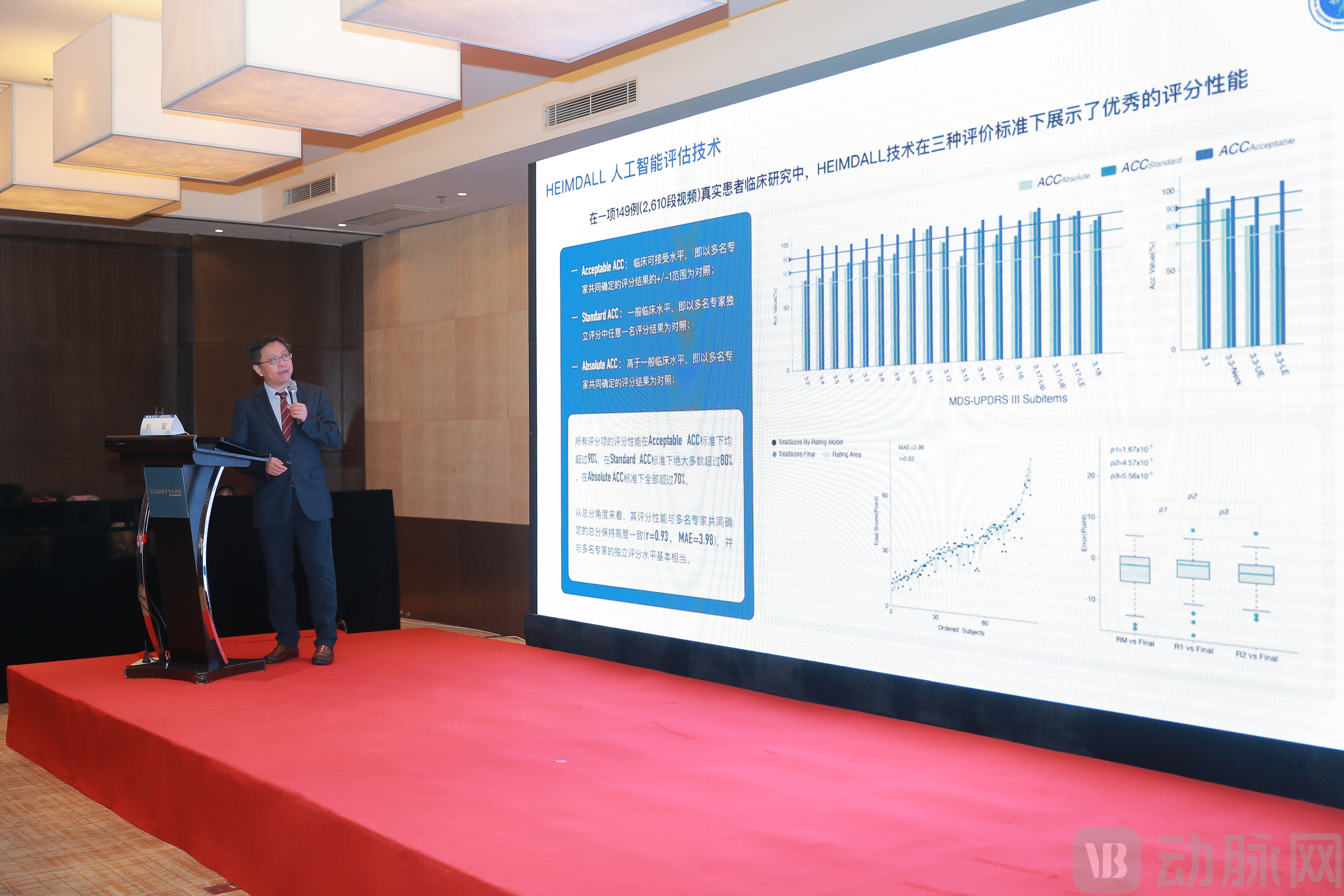
Professor Liu Jun
HEIMDALL Technology is a typical achievement of medical-engineering collaboration in specialized fields.
Ren Kang, CEO of Zhenluo Science, introduced that the Movement Disorder Society-Unified Parkinson’s Disease Rating Scale (MDS-UPDRS) has traditionally been used internationally to assess the severity of various motor symptoms, medication efficacy, and disease progression in patients with Parkinson’s disease. However, a major limitation of this scale is that it requires physicians to visually observe 33 different assessment items and then assign subjective scores based on their clinical experience. Due to the limited observational capacity of the human eye, subtle changes are difficult to detect, and different experts may vary in their judgments of symptom severity. Consequently, assessments often suffer from strong subjectivity, poor consistency, and significant variability.
Therefore, in recent years, research institutions worldwide have attempted to replace manual assessment with artificial intelligence scoring by leveraging technologies such as wearable devices and machine vision. However, survey data indicate that the most comprehensive studies cover only approximately 40% of the scale items, and the cumulative coverage across all studies does not exceed 80%.
Zhenluo Science’s “HEIMDALL” system is currently the world’s first and only technical framework capable of delivering complete intelligent scoring for the MDS-UPDRS scale using a single machine vision technology, thereby filling a significant international technological gap. According to Ren Kang, this technology primarily relies on cameras to capture images of human movements, employs core algorithms for 3D reconstruction and kinematic analysis, conducts feature engineering with clinical interpretability, and ultimately utilizes artificial intelligence models to automatically score different movements.
“Unlike traditional manual scale scoring, the HEIMDALL system can predict scores for associated movements based on the kinematic features of a single movement, thereby optimizing the traditional 33 scoring items into 18 assessment movements. By employing computer vision to replace human observation and leveraging machine learning and deep learning algorithms to substitute expert experience, the system significantly enhances accuracy, consistency, and stability.”
Professor Tan Yuyan from the Department of Neurology at Ruijin Hospital told VCBeat, “As one of the four cardinal symptoms of Parkinson’s disease, rigidity requires physicians to manually assess the stiffness of patients’ necks and limbs. Variations in experts’ subjective perceptions and experience make it difficult to ensure consistency and accuracy in evaluation results. The HEIMDALL technology indirectly assesses the severity of rigidity through other related movements, a approach that has no precedent globally.” Professor Tan Yuyan stated, “This holds positive significance for alleviating the clinical workload of physicians.”
Ren Kang stated that the team, in collaboration with Ruijin Hospital, has conducted clinical trials of the HEIMDALL technology on more than 150 patients, achieving an accuracy rate exceeding 90%. Including the HEIMDALL technology, the company has established a comprehensive spatio-temporal healthcare system for Parkinson’s disease. Its software and hardware products have empowered over 90% of China’s top-tier Parkinson’s disease centers, and it has partnered with 40% of global originator pharmaceutical companies.
Parkinson’s One-Stop Specialty Center Advances from 1.0 to 2.0
Professor Liu Jun introduced that, in addition to covering in-hospital scenarios, HEIMDALL technology can also leverage smartphones to facilitate regular symptom assessments for patients at home. This technology completely liberates clinicians from routine evaluations, allowing them to focus entirely on post-assessment diagnosis and treatment. This is of great significance for alleviating the strain on clinical resources in China and improving the efficiency of comprehensive Parkinson’s disease management.
As the first hospital in China to establish a specialized outpatient clinic for Parkinson’s disease, Ruijin Hospital took the lead in launching the Parkinson’s Disease One-Stop Diagnosis and Treatment Center 1.0 in 2020. This center provides integrated services encompassing registration, consultation, examination, and treatment. On one hand, it meets patients’ basic medical needs in a more convenient and patient-centered manner; on the other hand, by leveraging advanced diagnostic and therapeutic hardware featuring cutting-edge technologies, along with modernized office operations supported by a Parkinson’s disease data management system, it has fundamentally transformed the diagnosis and treatment model for patients with Parkinson’s disease.
“This year, we have once again taken the lead in advancing to the 2.0 model. Empowered by ‘Internet Plus Healthcare’ and artificial intelligence, online medical services have permeated every stage of care—pre-diagnosis, during diagnosis, and post-diagnosis—thereby meeting the lifelong health needs of Parkinson’s disease patients, significantly improving the efficiency of disease diagnosis, treatment, and management, as well as enhancing the experience for both patients and healthcare providers,” stated Professor Liu Jun.
According to reports, as a key initiative of the Parkinson’s Disease and Movement Disorders Professional Committee under the Neurology Branch of the Chinese Medical Doctor Association, Ruijin Hospital’s “One-Stop Specialized Center Model for Parkinson’s Disease” will be promoted nationwide. It will implement tiered management based on local conditions, establishing Advanced Centers, Standard Centers, and Primary Centers. Regardless of the tier, all Parkinson’s specialized centers will adhere to unified diagnostic and treatment guidelines, standardized management protocols, and provide equally specialized, comprehensive, precise, and one-stop medical services.
“‘One-Stop Specialized Disease Center’ 2.0 model integrates cutting-edge digital technology and artificial intelligence to achieve objective, standardized, digital, continuous, and personalized processes for assessment, diagnosis, and treatment. It establishes an online-to-offline full-course management system, providing a convenient healthcare model with standardized end-to-end care, making valuable explorations in the diagnosis and treatment of Parkinson’s disease,” said Professor Chen Shengdi.