

Roche Diagnostics-Dingjing Biotech Excellence Innovation Center Unveiled to Advance Personalized Oncology Ecosystem
Molecular diagnostics is one of the most promising and fastest-growing segments within the in vitro diagnostics (IVD) field. Particularly against the backdrop of the COVID-19 pandemic, molecular diagnostics has come under greater spotlight, sparking a surge in development. According to data from Health Circle, the compound annual growth rate (CAGR) of China’s molecular diagnostics market was 29% from 2016 to 2020, with the market size projected to reach RMB 33 billion by 2024.
Molecular diagnostics is entering a phase of diversified applications and maturity, with an increasing number of companies strategically positioning themselves in the industry and major developments occurring frequently. On July 24, 2022, another significant collaboration in the field of molecular diagnostics was finalized: the signing and unveiling ceremony for the Roche Diagnostics–Dingjing Biology Excellence Innovation Center, along with the Shaci Molecular Diagnostics Summit Forum, was held in Shapingba District, Chongqing.
At the 4th China International Import Expo in 2021, Roche Diagnostics and Dingjing Bio announced the establishment of a comprehensive strategic partnership. The newly unveiled Center of Excellence for Innovation stands as a prominent example of their collaboration in the field of precision medicine.Marking the establishment and official launch in Chongqing of the industry’s first fully automated NGS laboratory.
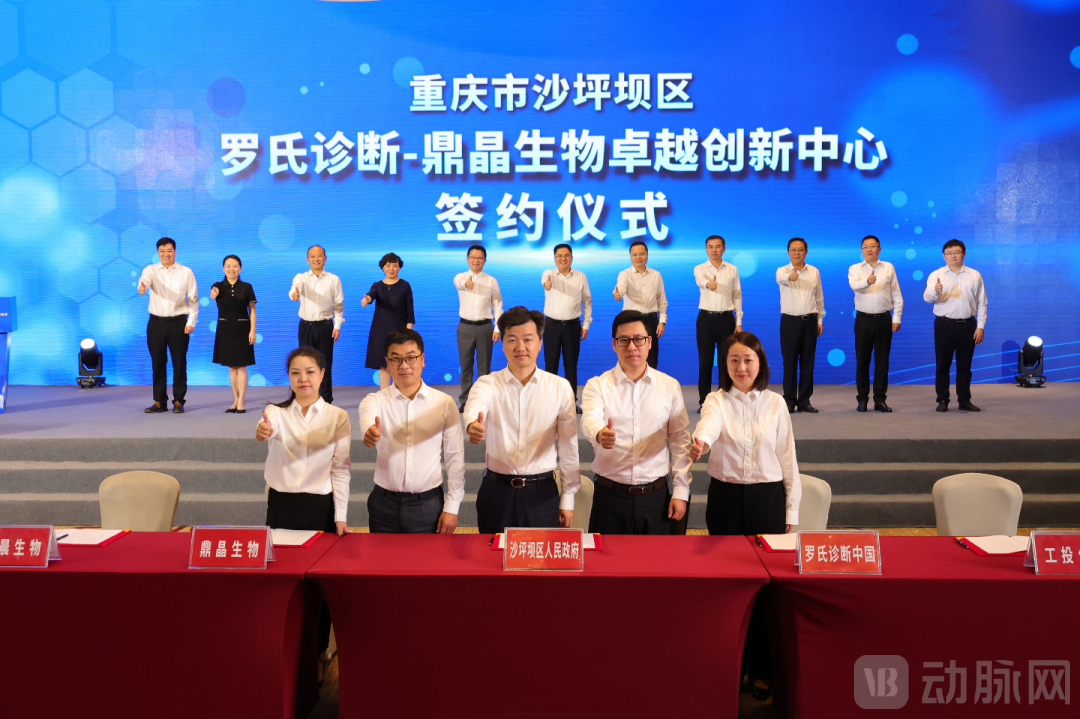
The Center of Excellence for Innovation is a crucial component of Roche Diagnostics’ effort to build an ecosystem for personalized cancer diagnosis and treatment. Yao Guoliang, General Manager of Roche Diagnostics China, stated, “Personalized applications in oncology are key to precision medicine and an indispensable part of achieving the ‘Healthy China 2030’ initiative. Adhering to the philosophy of ‘Rooted in China, Serving China,’ Roche Diagnostics is committed to collaborating with local partners to jointly advance the innovative development of precision medicine and create an ecosystem for personalized diagnosis and treatment. We believeThrough the Center of Excellence for Innovation, we are able to further advance the development of companion diagnostic products and the commercialization of laboratory automation, thereby accelerating the clinical translation of innovative products.”
Shen Weiqiang, Chairman of Dingjing Biotech, stated: “Dingjing Biotech has launched a series of products in the field of precision medicine and partnered with over 1,000 hospitals. The Excellence Innovation Center marks a strong start to our collaboration with Roche Diagnostics and will help Shapingba District restructure its biomedical industry and innovation chains, thereby fostering the development of industrial clusters.”
Tang Xiaoping, Secretary of the Shapingba District Committee of the Communist Party of China in Chongqing, stated, “Shapingba District is home to 16 universities, 335 municipal-level or higher research platforms, 2,153 technology-based enterprises, 32 hospitals at all levels, and over 600 various medical institutions, with annual patient visits exceeding 13 million. The market size for in vitro diagnostics exceeds RMB 5 billion. The Excellence Innovation Center will facilitate the establishment of the industry’s first fully automated next-generation sequencing (NGS) laboratory, further strengthening the biomedical industry chain in central and western China and driving the robust growth of the biomedical sector.”
It is understood that the Center of Excellence for Innovation, jointly established by Roche Diagnostics and Dingjing Biotechnology, isFully Automated NGS Laboratory, Shared Molecular Diagnostics Laboratory, Translational Medicine Exchange Platform, Biopharmaceutical Incubator, Clinical Demonstration and Training Center, Base for Localization of Innovative TechnologiesComposed of six major modules.
Among them,The fully automated NGS laboratory will become the industry’s first NGS laboratory built on a fully automated library preparation system.
NGS is a revolutionary technology in the field of molecular diagnostics, offering advantages such as high throughput, high sensitivity, and the ability to generate rich data. It has ushered in the golden age of gene sequencing and is widely used in scenarios including non-invasive prenatal testing, tumor companion diagnostics, early cancer screening, and infectious disease detection.
However, the current NGS workflow remains highly cumbersome, with operational difficulty and complexity far exceeding those of other clinical diagnostic techniques. In particular, the library preparation step alone involves hundreds of procedures, imposing extremely high demands on operators. Furthermore, issues such as prolonged turnaround time, risk of cross-contamination, and inadequate quality management urgently need to be addressed. These challenges collectively limit the large-scale clinical application of NGS.
The introduction of automation technology is expected to address the aforementioned limitations of NGS. NGS automation encompasses automated nucleic acid extraction, automated library preparation, and automated bioinformatics analysis. This approach significantly reduces reliance on manual labor, shortens turnaround time, provides more consistent quality assurance throughout the workflow, and accelerates the clinical implementation of NGS technology.
In November 2021, Roche Diagnostics launched the AVENIO Edge System, a fully automated NGS library preparation workstation. It is currently the only NGS library preparation workstation on the market that integrates library preparation, targeted probe capture, and library quality control into a single platform, enabling an end-to-end “sample-in, result-out” workflow. The system offers distinct advantages in enhancing testing quality, simplifying operational procedures, and improving management efficiency.
Leveraging the Center of Excellence, Roche Diagnostics and Dingjing Biotechnology collaborated to establish an NGS fully automated laboratory.Asia's First NGS Laboratory to Utilize a Fully Automated Library Preparation System, upgrading traditional NGS laboratory operations to an automated workflow, capable of integrating pre-cooling, amplification, and quantification modules. With its modular design, it allows flexible combination of experimental processes and uses pre-aliquoted reagents to simplify overall operations, significantly enhancing the accessibility of precision medicine research. This represents a milestone in the field of genomics research.
At the subsequent Shaci Molecular Diagnostics Summit, attendees discussed the topic of “Opportunities and Challenges in the Molecular Diagnostics Industry.”
Molecular Diagnostics: The Cornerstone of Precision MedicineAs innovative technologies and novel biomarkers continue to emerge, alongside deepening clinical understanding, China’s molecular diagnostics market is experiencing rapid growth. Its applications are becoming increasingly extensive in early disease screening, precision medication, prognostic assessment, and public health security.
However, as an emerging technology, molecular diagnostics faces multiple challenges. Xiang Debing, Director of the Oncology Center at Chongqing University Affiliated Jiangjin Hospital, stated, “China’s molecular diagnostics industry started relatively late, and the various solutions available are of uneven quality.”The industry urgently needs to improve standardization and normalization.Furthermore, as clinicians, weThere is still an urgent need for molecular diagnostic products that are simple, convenient, and cost-effective.”
When it comes to standardization, two major models in the molecular diagnostics industry must be mentioned: IVD products and LDT services. Successfully bringing an IVD product to market typically requires a 2–3 year cycle and an investment of approximately RMB 20 million, placing significant pressure on companies. This is particularly true for niche markets, where the return on investment for IVD products is disproportionate to the input, leading to insufficient incentives for corporate R&D.
In this context, LDTs have made it possible to rapidly introduce innovative technologies into clinical practice, thereby benefiting patients. In the United States, the LDT model is already quite mature, whereas in China it is still in its early stages, having long remained in a state of “imminent emergence yet struggling for survival.” Yuan Jianzhong, Vice President of Roche Diagnostics China, believes: “Policy is the decisive factor in determining the standardized development of the LDT model.“The latest version of the Regulations on the Supervision and Administration of Medical Devices, issued by the State Council in 2021, has accelerated the compliance of the LDT model; however, detailed implementing rules have not yet been promulgated. The key to driving progress lies in policy innovation first. It is expected that relevant policies for the LDT model will be implemented within the next one to two years, bringing LDT testing ‘into the light.’”
Addressing the impact of the COVID-19 pandemic on the molecular diagnostics industry, Pan Jiakui, Chairman of Decode (Shanghai) Biomedical Technology Co., Ltd., stated that the pandemic accelerated the public popularization of the concepts of “nucleic acid testing” and “molecular diagnostics,” facilitated capital accumulation within the molecular diagnostics sector, sped up companies’ international expansion efforts, and spurred a period of robust prosperity in the field of molecular diagnostics.
Li Zhengguo, Dean of the Life Sciences Research Institute at Chongqing University, stated, “In the post-pandemic era, we hope that molecular diagnostic technologies will continue to advance, focusing on the key attributes of timeliness, accuracy, efficiency, stability, cost-effectiveness, and high quality.”
Shen Weiqiang, Chairman of Dingjing Bio, stated: “The opportunities in the post-pandemic era lie in identifying gaps within the industrial chain and seizing them.”The first opportunity lies in automation, and the second in POCT."In the future, the molecular diagnostics market is expected to expand further, with anticipation for the emergence of more precise and convenient new technologies that can effectively address unmet clinical needs."