

Yeda Research and Development Company: The World's Original Tech Transfer 'Revolving Door' Driving Billions in Scientific Commercialization
1908, a young Jewish scholarChaim Weizmann, knocking on the door of a veteran figure in British politics, the leader of the Conservative PartyArthur Balfourdoor. He was about to undertake a formidable task—persuading Britain to support the establishment of a Jewish state.
In 1914, the then British Foreign SecretaryArthur Balfourissued the declaration that “His Majesty’s Government view with favour the establishment in Palestine of a national home for the Jewish people, and will use their best endeavours to facilitate the achievement of this object,” historically known as the 《The Balfour Declaration.
This declaration became a crucial bargaining chip for the establishment of a Jewish state. In 1948, Israel was formally established, and Chaim Weizmann, the skilled negotiator mentioned at the beginning of this story, became its first president.
In honor of this"Father of Israel", Israel's most influential scientific research institution—The Sieff Institute was officially renamed the Weizmann Institute in 1949.
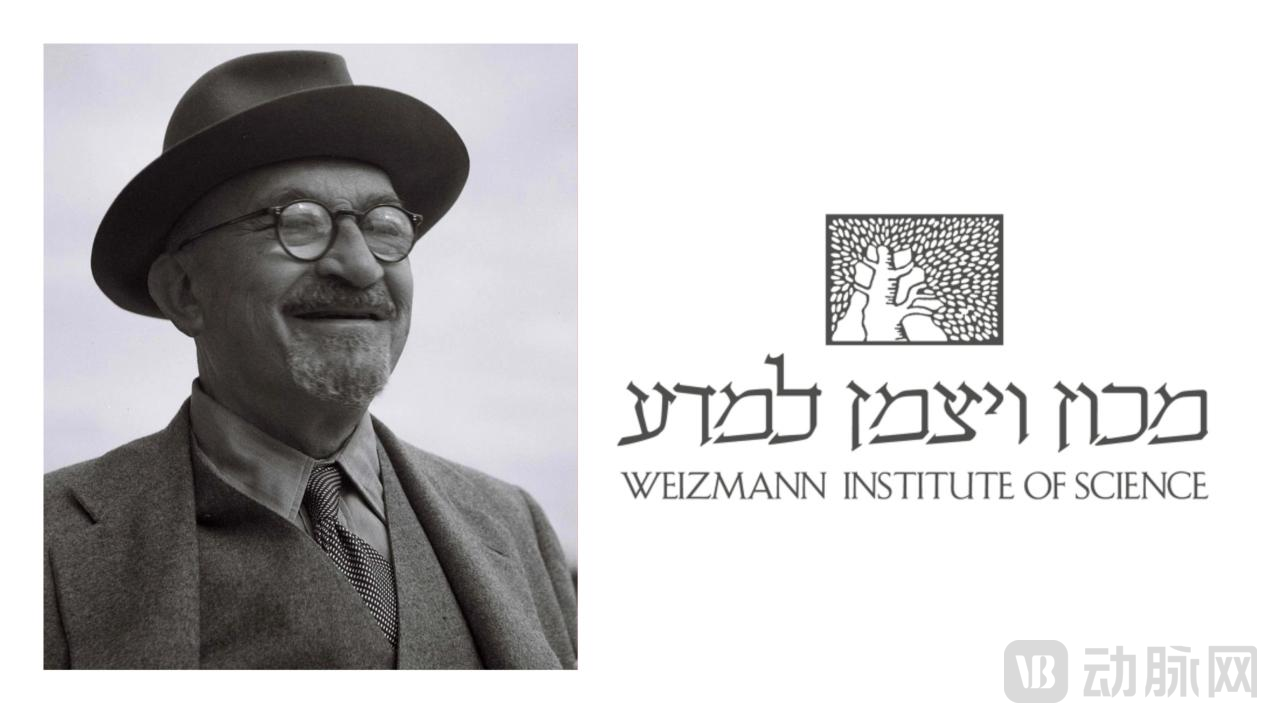
Figure: Chaim Weizmann and the Emblem of the Weizmann Institute
Perhaps stemming from a tradition, the Weizmann Institute established its own “negotiating voice” in 1959—Yeda Corporation: The World's First Technology Transfer Company. The company adheres to the philosophy of ““Let scientists focus on scientific research; we will handle everything else.”of the core philosophy, within just a few decades, annual revenueBillions of Dollars。
So, what unique achievements has Yeda Company made in facilitating the translation of scientific research outcomes?
Yeda: Let scientists sit at the lab bench, and let professional managers sit at the negotiation table.
Specialization Matters: Why Is Technology Transfer So Challenging? This is because the journey from a scientific research achievement to a market-ready product is long and arduous, encompassing many core stages, each with its own dominant factors and unique internal logic.
Whether a technology is valuable enough to reach the experimental stage depends on clinical needs; whether technological R&D can yield results relies heavily on researchers; and for scientific achievements to transition from the laboratory to the market, each step—such as value assessment, technology transfer, and patent licensing—involves specialized issues from another domain.
So, how should responsibilities be divided to ensure that professionals handle their respective areas of expertise? AsThe World's First Technology Transfer Company, the Weizmann Institute's Yeda Company was the first to provide an answer:Let scientists sit at the laboratory bench, and let professional managers sit at the negotiation table.
Following the establishment of Yeda Company, a clear division of functions was established between the Weizmann Institute and Yeda Company: the Weizmann Institute withdrew from technology transfer activities to focus exclusively on fundamental research, while Yeda Company took over the areas in which the Weizmann Institute lacked expertise.Deeply focus on the application development and technology transfer of research achievements.
Thanks to this clear “division of labor,” the collaboration between the Weizmann Institute and Yeda has become even closer, as each party knows exactly what its responsibilities are. Under this mechanism, staff at Yeda maintain long-term, close contact with researchers at the Weizmann Institute, ensuring that Yeda can promptly capture any new developments in their research outcomes.
Following dynamic capture, every research achievement with commercialization potential will be assigned to a dedicated evaluation team established by Yeda Company. For projects that pass the evaluation, Yeda will deeply engage in the entire commercialization process, including patent drafting, filing, grant, and subsequent operations, thereby handling aspects outside researchers’ expertise and maximizing the promotion of technology transfer.
Yeda’s Logic for Translating Scientific Research into Applications: From 0 to 1
In addition to the transformation philosophy of “each performing its own duties,” Yeda’s second distinctive hallmark is its research-to-commercialization mechanism that takes innovations from zero to one.
Generally, there are two common pathways for the commercialization of scientific and technological achievements: one is patent licensing or assignment led by corporate collaboration, and the other is entrepreneurship initiated by researchers themselves. Each approach has its own advantages as well as limitations.
Let’s begin with patent assignment. For researchers, assigning patents may seem like a relatively favorable option, as it offers a higher success rate and entails less pressure. However, due to the “strong binding” with corporate entities, researchers’ autonomy in subsequent technology transfer processes is reduced. Moreover, if the patented technology fails to be successfully commercialized, researchers seeking to reclaim the patent for further improvement will inevitably encounter commercial resistance.
However, venturing into entrepreneurship is even more challenging. For researchers, having long operated within a closed ecosystem centered on research institutions and universities, they often lack an accurate understanding of the market and face significant gaps in corresponding market resources. Furthermore, balancing their dual identities as researchers and entrepreneurs constitutes a core challenge that researchers must address throughout the entrepreneurial process.
So, how should one make the choice?
Leveraging its own strengths, Yeda made its choice in the early days of its establishment—Focus on the commercialization of achievements in niche fields, then generate revenue through patent licensing of flagship products to pave the way for other incubated projects.
Yeda excels at co-investing with other companies as a shareholder, or licensing exclusive or non-exclusive patents to other companies through technology transfer. Yeda’s Technology Transfer Office plays a supervisory role in this process, exercising comprehensive control over various issues that may arise during technology transfer, such as valuation, verification of the legal status of patents, and pledge of rights.
This approach enables rapid recoupment of incubation capital, allowing the affiliated Weizmann Institute to avoid being bogged down by commercialization operations—areas where scientists are often “less adept.” Instead, the institute can focus wholeheartedly on nurturing a single idea, scaling it up, and then exiting through a sale, using the substantial proceeds from the previous project to fund the incubation of the next one.
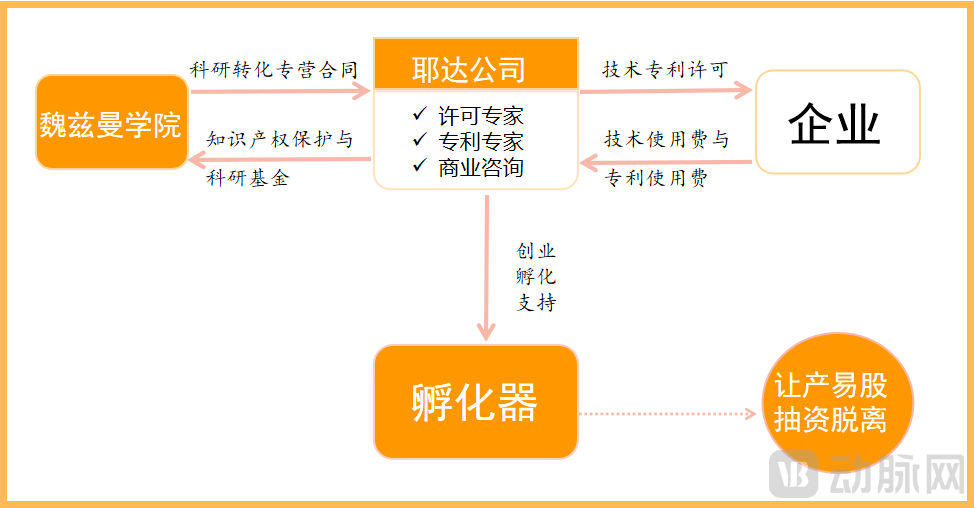
Figure: Yeda Company's Operational Mechanism
Today, Yeda holds the core patents for three of the world’s most profitable pharmaceutical companies’ key drugs: Teva’s multiple sclerosis medication Copaxone, Serono’s Rebif, and ImClone Systems’ anticancer drug Erbitux. Hundreds of millions in annual patent royalties flow into Yeda’s coffers, all of which will fund future research projects at the Weizmann Institute.
Under the direct influence of Yeda, other research institutes in Israel also seem to have found ways to commercialize their achievements. Currently,Israeli research institutions have formed distinct factions, each with its own unique characteristics—they are equipped with professional technology transfer companies dedicated to incubating achievements, and they primarily rely on patent licensing as the main method for commercializing their results.
Yeda’s Incentive Mechanism: Investing in Dreams, Winning Together with Dreamers
Yeda’s homepage describes itself as follows: Yeda is the arm of the Weizmann Institute.
Indeed, Yeda Company plays an indisputable supportive role in the incubation of scientific research projects at the Weizmann Institute, with Yeda Company being the most crucial element.Effective Scientific Research Incentive Mechanisms, Specifically Categorized into the Following Four Types:
The first type isDirect Investment, namely, directly funding Weizmann's scientific research through Yeda's internal funds to ensure the normal conduct of scientific research and to establish intellectual property protection from the outset;
The second type isGovernment Appropriations, thereby positioning Yeda Company as a bridge connecting researchers with the government, accurately conveying their respective needs and interests to each other, and guiding government funding to support researchers’ projects;
The third type isCo-investment, that is, Yeda Company collaborates with venture capital firms interested in scientific research projects to jointly invest in funds for the purpose of funding such projects;
The fourth type isEstablishment of a Reward Fund, meaning that Yeda Company selects cutting-edge research projects from laboratories and provides funding through awards at the earliest stages.
Among the four aforementioned incentive methods,Yeda and the research team will jointly share the proceeds from the commercialization of transferred achievements.It is worth noting that 40% of the revenue from technology transfer belongs to the individual researchers, rather than to the laboratory. This means that once a project begins commercialization, the benefits of a win-win partnership start to materialize—Yeda can generate profits, while scientific researchers also receive financial rewards.
Take Copaxone, a multiple sclerosis (MS) drug produced by the Israeli pharmaceutical company Teva and held as Yeda’s trump card, as an example. Basic research on Copaxone began in the 1960s, when scientists accidentally discovered this core technology while injecting disease pathogens into mice for research purposes. However, due to the highly innovative nature of the technology, most investors at the time adopted a wait-and-see approach, and no one was willing to purchase it. As a result, Copaxone remained dormant in the laboratory for nearly half a century.
However, Yeda took a unique approach by recognizing the potential value of this “new” technology, and thus acquired Copaxone in 2016—a product then considered a hot potato. Today, the patent for Copaxone alone generates $4 billion in annual revenue for Yeda, marking it as a masterstroke in Yeda’s investment portfolio.
Yeda’s funding incentive mechanism has sustained the innovative dreams of a cohort of world-class scientists. In turn, Yeda, by investing in and nurturing these aspirations, has reaped substantial rewards along the way. Now flush with cash, Yeda continues to scan the horizon for the next “rising star” in the science and technology innovation sector.
Israel, historically known as Canaan, is referred to in the Bible as the “Promised Land flowing with milk and honey.” Millennia ago, according to legend, the Jewish sage Moses parted the Red Sea, leading the suffering Jewish people out of Egypt to this land. Whether they were disappointed by the sight of endless yellow sand remains unknown to us today.
But looking at Israel today, which boasts world-class scientific and technological innovation commercialization institutions such as Yeda, its story tells us that,Turning the scalpel inward with a determined spirit for renewal, paving the way for innovation—a commitment that never goes unrewarded.