

Why Ultrasound and CT Manufacturers Are Rushing Into E-commerce: A Strategic Shift Toward B2B Digital Channels

GE Hangwei
Medical Device R&D and Manufacturer

Siemens Healthineers
Integrated Healthcare Service Provider

Neusoft
Comprehensive Solution Provider for Clinical Diagnosis and Treatment
The CMEF held two years ago took place at the onset of the rampant COVID-19 outbreak. Amidst the boom in internet healthcare infrastructure, pharmaceutical and medical device manufacturers also shifted their management and sales operations online.
JD.com and Alibaba Seize the Opportunity to Launch Collaborations in Pharmaceutical and Medical Device Distribution, While Device Manufacturers Such as Yuwell and Weigao Build Their Own Online Platforms to Explore New Channel Possibilities.
It is not only B2B medical consumables companies and B2C consumer healthcare enterprises that are seeking to capitalize on the e-commerce boom; major medical equipment manufacturers such as GE Healthcare and Neusoft are also attempting to join the fray. In particular, Neusoft’s memorable slogan from years past—“Take home a CT scanner for just 998,000 yuan”—was truly refreshing.
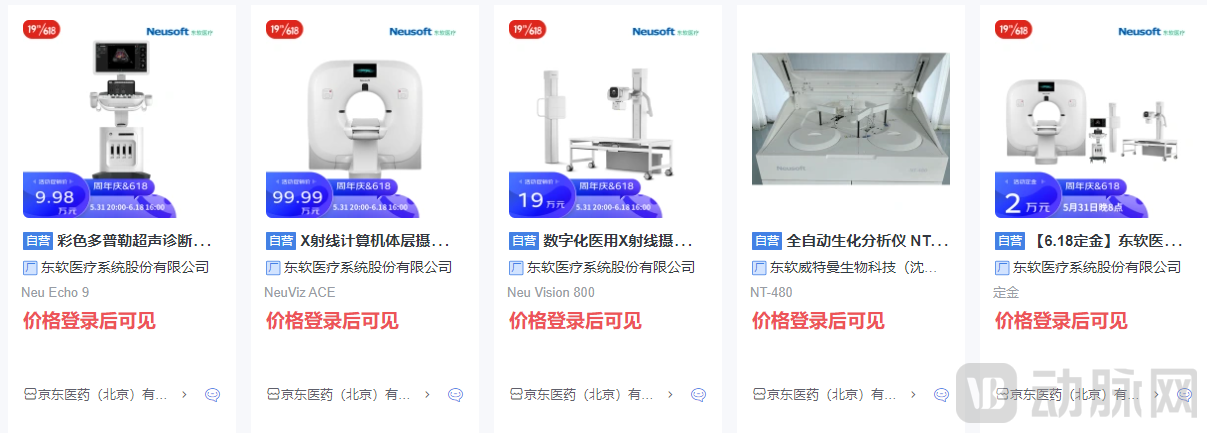 618 Is Not Just a Shopping Festival for Ordinary Consumers (Image Source: Jingxietong)
However, can producers who have long relied on “intermediaries” really deliver convincing data through new channels?
Selling medical devices through e-commerce channels is hardly a new phenomenon. Established e-commerce platforms have long been active in this space, while Meituan and Ele.me have entered the market via online-to-offline (O2O) models. Although latecomers such as Douyin, Kuaishou, and Xiaohongshu have not yet built direct transaction platforms, they are gradually exerting influence through short videos and image-text content, slowly constructing a content-driven e-commerce model.
Driven by the synergy of multiple modalities, the e-commerce channel for medical devices has long been well-established. Data from Menet indicates that as early as 2018, 70% of transactions in the pharmaceutical and medical device retail market were conducted through online platforms. Today, New Horizon Health’s Youyou Tube has further demonstrated this trend, achieving over one million yuan in sales within just three hours on e-commerce platforms.
Logically, expanding from home-use medical devices, consumables, and IVD products to large-scale medical equipment appears unproblematic. However, due to procurement model constraints, e-commerce channels are not viable for public hospitals, which constitute the primary revenue source; sales are limited to private medical institutions, making it difficult to directly boost equipment sales figures.
In practice, each enterprise invests significantly differently in e-commerce operations based on its own considerations, leading to correspondingly varied outcomes.
GE HealthCare was among the first medical device brands to establish a presence on JD.com and Tmall. Its “Jingxietong” storefront features products such as ultrasound systems, ECG machines, and anesthesia workstations, aiming to break away from the conventional “direct sales + distribution channel” model.
However, based on the actual operational status of the stores, GE Health has not disclosed sufficient equipment information online. The Jingxietong and Tmall flagship stores merely list simple products available for sale, without even providing brief introductions. To obtain detailed information about the equipment, procurement personnel still need to contact GE Health’s sales team by phone.
Siemens Healthineers’ online sales primarily focus on home medical devices such as hearing aids, but also include some localized products, such as mammography systems, biochemistry analyzers, and the teamplay Hospital Administration–Information Department solution. Additionally, it has introduced the imported ACUSON NX2 Elite ultrasound diagnostic system.
In contrast, domestic medical equipment manufacturers appear to be more receptive to e-commerce models. Companies such as Edan Instruments, Vinno, Dawei Medical, and Alltech Medical Systems have listed their self-operated ultrasound devices on various platforms, while a few enterprises have also begun experimenting with imaging equipment such as electronic colposcopes and digital radiography (DR) systems.
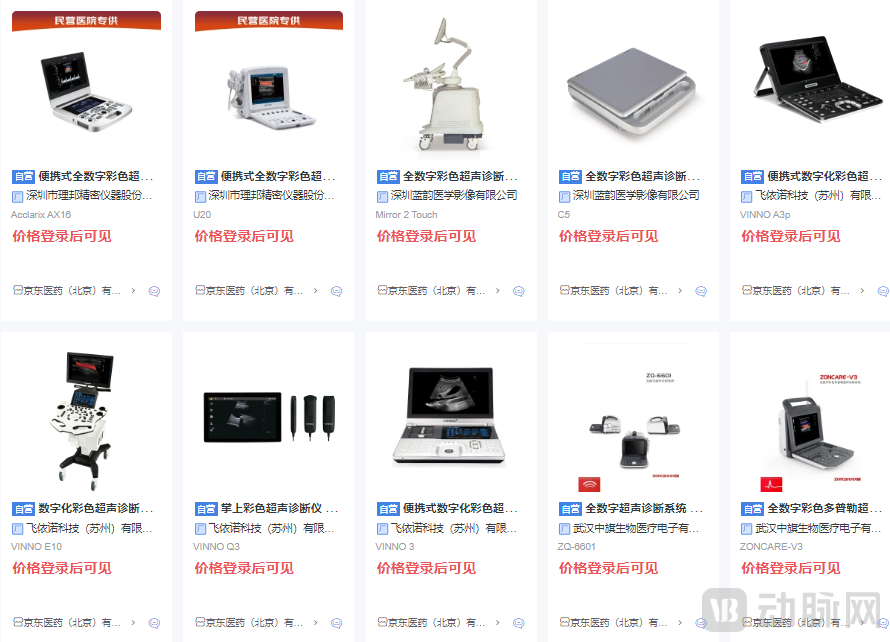
On the product display pages, ultrasound devices from various companies appear no different from ordinary consumer goods (Image source: Jingxietong)
Neusoft was the earliest entrant and the largest investor in this space. It not only established a presence on platforms such as JD.com and Sinopharm, conducting large-scale online promotions and offering substantial discounts, but also launched its own e-commerce platform, the Neusoft Medical Smart Selection Mall, enabling online purchases of equipment such as 16-slice CT scanners, flat-panel DR systems, and ultrasound devices. Out of its total nine product lines, Neusoft has listed three on the platform, truly embodying the essence of e-commerce.
Regarding Neusoft’s various strategic initiatives, CEO Wu Shaojie summarizes them as “breaking down barriers.”
The term “breaking barriers” here encompasses two key implications: first, dismantling the information asymmetry between imaging equipment manufacturers and purchasers to enhance transaction transparency; and second, penetrating new markets to generate new profit streams through novel channels.
“Domestic e-commerce is highly mature in the consumer sector, with nearly everyone having experience in online shopping. As we expand from C-end consumer markets to other channels, user acceptance tends to be relatively quick. However, for Neusoft Medical, the unique nature of the industry necessitates that we continue to structure our strategy around a B2B model focused on medical equipment.”
Similar to purchasing a car, today’s consumers are generally well-prepared before visiting 4S dealerships, often comparing products based on vehicle models, performance specifications, and consumer reviews. The same applies to medical imaging equipment. In Wu Shaojie’s view, the sales logic for large-scale medical imaging equipment is akin to that of selling cars. Rather than being opaque about their own products, manufacturers should provide purchasers with more comprehensive information to bridge the information gap between buyers and sellers, thereby enabling procurement professionals to acquire equipment that better meets the needs of healthcare institutions.
From this perspective, Neusoft’s core objective in exploring the e-commerce model is primarily brand promotion, with sales growth as a secondary goal. Wu Shaojie told VCBeat, “As Neusoft’s product portfolio becomes increasingly diverse, we need to recommend products that align with customers’ needs during our interactions to ensure cost-effectiveness. We also need to provide doctors with channels to independently verify information through innovative models. Furthermore, for regions where our direct sales force cannot reach, the internet enables doctors in those areas to proactively contact us. This serves as a form of supplementary sales support, effectively expanding our market coverage.”
Revisiting New Market Expansion. Although the state has repeatedly lowered the procurement thresholds for large-scale medical equipment in public healthcare institutions, it has never deviated from the fundamental approach of tendering and bidding. Therefore, Neusoft’s e-commerce initiatives hold greater brand value for the public hospital sector, with its true strategic focus lying in the burgeoning private healthcare market.
“Report on the Development of Private Hospitals in China (2021)” shows that since 2015, the number of private hospitals has been on an upward trend. In 2020, COVID-19 brought a wave of closures and mergers to this industry, but at the same time left behind higher-quality private hospitals with better management. Coupled with the promotion of group-based and chain operation models, the demand for medical equipment procurement and quality by private hospitals is increasing day by day.
Unlike public hospitals, private hospitals adopt more flexible procurement methods and are more price-sensitive regarding medical equipment. Therefore, by leveraging e-commerce models, imaging equipment manufacturers can streamline distribution channels, create room for price concessions, and provide financing services related to purchases, thereby alleviating the financial burden on small and medium-sized private medical institutions during acquisition.
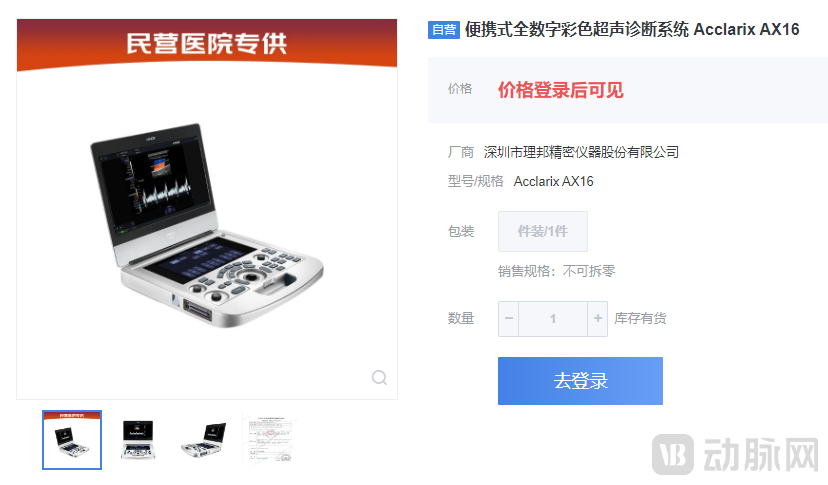
Edan Instruments also places significant emphasis on private hospitals, explicitly labeling “Exclusive Supply for Private Hospitals” on its e-commerce product pages (Image source: Jingxietong).
Neusoft has participated in every major shopping festival over the past two years, including the 618 Mid-Year Shopping Festival and Double 11. Significant discounts on Neusoft products are available across various platforms, including its own NeuBuy mall, JD.com’s Jingxietong platform, and Sinopharm’s B2B marketplace.
Data released by Neusoft Medical reveals that the company’s online communications have reached over 5 million people, with more than 2,000 customers establishing contact through digital channels, and its online sales performance has long surpassed RMB 100 million.
It is worth noting that e-commerce expansion focused on the private hospital market also has its limitations. Leading private hospitals have ample funding and investment capabilities, but they are few in number. For this category of hospitals, medical equipment manufacturers such as Neusoft typically assign professional sales teams to provide offline services, and these hospitals do not procure equipment through online channels. This is also why the equipment launched on platforms like JD.com and Tmall primarily consists of devices priced under one million yuan.
This does not affect the sales of imaging equipment companies in the private sector. Excluding more than a hundred top-tier hospitals, the remaining 20,000 private hospitals still represent a significant number. Wu Shaojie told VCBeat, “Their current needs are for ultrasound, CT, and DR systems. As overall medical standards continue to improve, the procurement of MRI and other equipment will gradually be put on the agenda. At that time, we will also adjust our pricing and sales strategies for MRI systems, striving to make these tools both accessible and affordable for more private hospitals.”
Wu Shaojie affirmed in the interviewThe value of new channels in the low-end imaging market and the growth of related revenue, as well as the new revenue generated by the e-commerce model in international markets.Given Neusoft’s promotional efforts and the current development trends of private hospitals, new channels still possess considerable potential for growth.
From an external perspective, the e-commerce initiatives undertaken by medical equipment manufacturers appear to be merely a tactic for expanding sales channels and capitalizing on trends. However, for the medical imaging sector, marketing innovation constitutes a critical component of their transformation strategy, aimed at addressing intensifying competition and potential crises.
Although large-scale medical equipment has not been subject to nationwide centralized procurement, Anhui Province initiated centralized procurement of large medical equipment several years ago.This category includes Class B large-scale medical equipment and medical devices with a unit price of RMB 2 million, with average price reductions for CT and MRI scanners exceeding 50%.
Another factor stems from the increasingly competitive landscape.High-end equipment demands substantial R&D investment and carries a high risk of failure; even after overcoming significant technical hurdles, market penetration is not guaranteed. Meanwhile, the mid-to-low-end segment is witnessing an intensifying price war as numerous domestic manufacturers enter the fray. Multinational corporations are accelerating their localization and domestic production efforts, while new domestic players are attempting to leapfrog competitors by capitalizing on the dual waves of import substitution and grassroots healthcare infrastructure development.。
Under the influence of a diverse range of factors, if private hospitals can develop under policy guidance, imaging equipment manufacturers will face a vast market with significant volume potential, thereby mitigating to some extent the policy risks associated with the public hospital market.
However, it is unwise to place full bets on the private hospital market, where demand trends remain uncertain. In line with pharmaceutical companies in recent years, medical imaging equipment manufacturers need a comprehensive, digitalization-centric transformation that spans from R&D and sales to business models, driven from the inside out.