

CX Genomics Files IPO Prospectus for World’s First Active Single-Cell Sorting System with >95% Accuracy
As the smallest functional units of the human body, cells have gene expression and functional specificity that are closely related to the pathogenic mechanisms of diseases. Traditional cell research—Bulk sequencing (Bulk RNA-seq)—conducts omics analysis on the entire cell population at the average level of a large number of cells, obtaining the average value of gene expression for each part of the cells, while losing the heterogeneity information of individual cells.
To obtain authentic cellular genetic information, transcriptome analysis must be conducted at the single-cell level.Single-cell technology enables the study of individual cells, decoding life at higher resolution and across spatiotemporal dimensions. It reveals cellular heterogeneity and functional dynamics within the microenvironment, with broad applications in new drug development, precision oncology diagnosis and treatment, reproductive genetics and health, immune system diseases, infectious diseases, and developmental biology research.
The single-cell detection experimental workflow primarily includes single-cell suspension preparation, cell sorting, cDNA synthesis and amplification, library construction and sequencing, and bioinformatics analysis.Currently, single-cell sequencing still faces challenges such as upstream equipment monopoly, difficulties in cell sorting, high consumable costs, and low precision of domestically produced equipment. These are trials that any technology undergoes during its early stages of development.
In 2017, the Human Cell Atlas project was officially launched, and Nature published a special issue dedicated to single-cell analysis, indicating that single-cell genomics testing would become a routine clinical test within the next decade. Therefore,How to sort and capture individual cells from heterogeneous tissues has become the most critical challenge in single-cell sequencing.
Currently, CX Genomics, a single-cell sequencing company specializing in cell sorting, won the third prize in the finals of the “Maker World 2019 Hangzhou Overseas High-Level Talent Innovation and Entrepreneurship Competition” in 2019 and received government funding amounting to tens of millions of yuan. The company has also completed the development of a single-cell sequencing prototype with a sorting accuracy of up to 95%.
Chunxun Bio (CX Genomics) was founded by a team of senior experts who returned to China after accumulating over a decade of research experience in fields such as microfluidics, molecular biology, and artificial intelligence in countries including Australia, Singapore, and the United States.
Dr. Zhao Sanqiang, Co-Founder and CEOHe received his bachelor’s degree from Northwestern Polytechnical University, conducted R&D for several years at a laboratory under the National High-Tech Research and Development Program (863 Program), then pursued advanced studies in Australia, earning his Ph.D. from Griffith University in 2009, and subsequently remained in Australia to work.Dr. Zhao and his team have long been dedicated to the research of innovative droplet sorting systemsRecognizing the immense application potential of this technology in the field of single-cell sequencing many years ago, Dr. Zhao resolutely decided to return to China to start a business, despite the fact that the domestic single-cell sequencing sector was not yet booming at the time. In 2019, Dr. Zhao formally resigned from his permanent position at a multinational corporation, returned to China full-time from Australia, and co-founded Hangzhou Chunxun Biotechnology (CX Genomics), serving as the company’s CEO.
Chunxun Biology (CX Genomics), leveraging cell sorting technology and driven by the collaborative efforts of a returnee team with backgrounds from three countries, has extended its capabilities to cover the entire experimental workflow for single-cell analysis—including single-cell suspension preparation, cDNA generation and amplification, library construction and sequencing, and bioinformatics analysis—and has developed a prototype cell sorter.
Leveraging the team’s expertise in cell sorting and staying true to the original vision of immune repertoire sequencing, PureSeq has embarked on the development of single-cell immune repertoire sequencing.
Single-Cell Immune Repertoire Sequencing, also known as Single-Cell V(D)J Sequencing, targets T and B lymphocytes. It employs microfluidic chips to generate single-cell systems, followed by PCR amplification of the full-length gene transcripts of T-cell and B-cell receptors (TCR/BCR), and finally performs high-throughput sequencing. By analyzing the diverse TCR/BCR sequences, the immune characteristics of the organism can be elucidated.
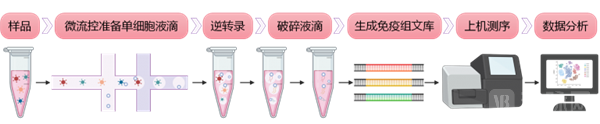
CX Genomics Single-Cell Immune Repertoire Sequencing Workflow
This technology is primarily applied in the fields of tumor immunotherapy, research on immune system diseases, transplantation and immune reconstitution, as well as antibody/vaccine development.
While establishing its immune repertoire sequencing platform, Chunxun also recognized the broader applications and greater market potential of transcriptome sequencing. Consequently, Chunxun launched its second product: single-cell transcriptome sequencing.
Chunxun’s CX Genomics single-cell transcriptome sequencing system utilizes a microfluidic platform to mix beads containing barcodes, unique molecular identifiers (UMIs), and poly(dT) sequences with cells and oil, forming tens of thousands of micrometer-scale water-in-oil droplets. Once the water-in-oil structure is established, cells are lysed within the droplets to release mRNA, which is then captured by the beads via poly(T) primers. Subsequently, the water-in-oil emulsion is broken to harvest the mRNA-captured beads for reverse transcription, generating cDNA tagged with barcode and UMI information, followed by the construction of standard sequencing libraries.
CX Genomics Single-Cell Sequencing System Employs Microfluidics and AI for Cell Sorting, isWorld's First Intelligent Active Single-Cell Sorting, also isThe Only Single-Cell System Achieving High-Throughput Physical Separation. Combined with Chunxun's self-developed microfluidic chips and its self-produced droplet-encapsulating oil-phase reagents,Its single-cell sorting accuracy has exceeded 95%.. In the interview, Dr. Zhao revealed that Chunxun is currently engaged in R&D to integrate its cell sorting prototype into an all-in-one system, while the supporting detection kits are also being refined.The all-in-one cell sorting system is expected to be unveiled to the public by mid-next year.。
Currently,PureXun’s single-cell transcriptome sequencing technology has demonstrated superior sorting accuracy and detection throughput compared to the international industry giant 10x Genomics., its single-cell immune repertoire sequencing platform is also nearing completion and will soon enter the testing phase.
Chunxun’s Self-Developed and Manufactured Droplet Generation Oil and Microfluidic Chips Are Now Available for Sale, while also undertaking external design, fabrication, and processing services for various functional PDMS microfluidic chips, with a minimum feature size of 30 micrometers.The performance of PureXun’s droplet generation oil is now on par with imported alternatives, yet it offers a more competitive price, giving it strong market competitiveness in China.
Upon completion of the integrated cell sorting system, it will be commercialized alongside compatible reagent kits, with single-cell detection services provided to customers purchasing these kits.Chunxun expects to generate over RMB 10 million in revenue next year after the all-in-one machine is launched.
Chunxun has completed an angel round of financing amounting to several million yuan and is currently preparing for a new round of funding.
Dr. Zhao noted that the early development of any new technology in China is challenging. Progressing from scientific research to market application, and from breaking import monopolies to achieving cost-effective domestic alternatives, requires concerted efforts from experts across various fields. Chunxun has achieved technological breakthroughs in cell sorting, but it still needs to collaborate closely with the entire industry chain for mutual advancement.Reduce costs and improve quality to expand the application of single-cell testing into early screening, diagnosis, and other scenarios, thereby unlocking greater potential for its technological advantages.。