

Heart-Forever Tech Unveils Painless Continuous Blood Pressure Monitor, Aiming to Be the CGM of Hypertension Management
Select a calibrated blood pressure monitor, adjust the cuff tightness, and position the lower edge of the cuff 2.5 cm above the antecubital fossa. Choose a chair and a table of appropriate height, place your elbow on the table so that the midpoint of the upper arm is level with the heart, activate the blood pressure monitor, remain still for one minute, and then begin the measurement.
This is the common form in which people measure blood pressure.
In fast-paced living environments, people pay insufficient attention to blood pressure management. Coupled with the cumbersome measurement process, this leads to the general population rarely or never measuring their blood pressure. The inadequate quality of blood pressure management further results in low rates of awareness, treatment, and control of hypertension, causing the overall prevalence of hypertension in China to remain high and continue to rise year by year. According to the Report on Cardiovascular Health and Diseases in China 2021 released by the National Center for Cardiovascular Diseases, the number of people with hypertension in China has reached 245 million.
At present, long-term continuous blood pressure monitoring will become an effective means to improve the awareness, treatment, and control rates of hypertension.
Through continuous blood pressure monitoring, patients can enhance the quality of their blood pressure management, conduct high-frequency qualitative and quantitative assessments of blood pressure fluctuations or the efficacy of antihypertensive therapy, and promptly communicate with their treating physicians to identify the causes of abnormal blood pressure readings. By implementing more effective lifestyle interventions and adopting more scientific and rational medication regimens, the quality of antihypertensive treatment can be significantly improved, thereby reducing long-term blood pressure variability.
Blood pressure data is a critical indicator that is directly or indirectly associated with cardiovascular and cerebrovascular diseases, as well as pathological changes in visceral organs. Continuous blood pressure monitoring over days, weeks, months, or even years can assist patients and individuals in a sub-health state in predicting, diagnosing, and assessing their physical condition. In cases of abnormal blood pressure readings, early warnings can be issued to prevent severe adverse events such as sudden cardiac death and cerebral hemorrhage.
For physicians, information obtained through long-term blood pressure monitoring—such as patient blood pressure variability, nocturnal blood pressure data, and extended blood pressure profiles—provides a novel perspective for studying the pathogenic factors of hypertension.
In the context of medication management, continuous blood pressure monitoring holds significant importance for drug selection, evaluation of therapeutic efficacy, and dosage control. Furthermore, during the research and development phase of related pharmaceuticals, continuous blood pressure monitoring can provide more scientific and quantitative reference data.
The significance and value of continuous blood pressure monitoring are self-evident. However, its product engineering design poses substantial challenges, requiring the integration of multidisciplinary fields such as medicine, fluid dynamics, and artificial intelligence, as well as technological breakthroughs in sensors and other areas. This has resulted in a scarcity of high-precision continuous blood pressure monitoring devices currently available on the market.
Recently, VCBeat learned that Xinyong (Beijing) Technology Co., Ltd. (hereinafter referred to as “Xinyong Tech”) is addressing this technical pain point.Based on a decade of research by its founder, Xinyong Technology has independently developed multi-channel pulse wave algorithms for continuous blood pressure monitoring and abnormal blood pressure early warning. This technology enables non-invasive, continuous, real-time, and accurate blood pressure measurement, further mitigating the risk of cerebral hemorrhage.
Through long-term exploration of various sensors, the company has independently developed multi-channel pulse wave sensors to address comfort issues during blood pressure monitoring. It is reported that Xinyong Technology has currently achieved finalized mass production of its sensors and has initiated the NMPA application process. With the establishment of collaborative relationships with hospitals and industry partners, its wearable devices are expected to be launched by the end of 2022.
Portable, unobtrusive blood pressure monitoring has long been regarded as the “holy grail” of medical measurement. Achieving this technological breakthrough faces at least three major challenges.
First, it is difficult to obtain monitoring data that includes blood pressure information.In medical terms, blood pressure generally refers to the pressure exerted by blood on the walls of the large arteries. However, these major vessels are typically located deep within the body, making it difficult to perform unobtrusive measurements on the body surface using portable sensors. Common metrics such as heart rate and blood oxygen saturation are mostly measured by traditional sensors that capture pulse waves from superficial capillaries, arterioles, venules, or small blood vessels. It is highly challenging to develop accurate blood pressure measurement models based on signals from such sensors. To achieve unobtrusive blood pressure monitoring, the primary challenge to address is the unobtrusive acquisition of physiological signals from the body surface.
Second, modeling is difficult due to the numerous factors influencing blood pressure.From the perspective of blood pressure etiology, contributing factors can be categorized into three aspects: cardiac, vascular, and hemodynamic. The heart serves as the primary driving force for blood flow; the elastic expansion and contraction of blood vessels regulate blood pressure and perfusion throughout the body; and changes in blood volume affect the overall load on the circulatory system. Blood pressure is susceptible not only to intrinsic physiological and psychological factors but also to external objective factors such as environment, temperature, and medication. To achieve precise blood pressure monitoring, it is essential to eliminate measurement confounders during model development. However, sensors themselves are highly sensitive to their surrounding environment, and environmental fluctuations can further alter signal acquisition characteristics. The superposition of these dual factors significantly increases the complexity and difficulty of model construction.
Third, it is difficult to resolve model consistency issues.Individual variability renders the information dimension of blood pressure more multifaceted, thereby increasing, to some extent, the complexity of signal processing or model development. Achieving model consistency is highly challenging.
The founding team of Xinyong Technology began researching portable, non-intrusive blood pressure monitoring technology in 2011, accumulating over a decade of experience. Recalling the process of overcoming the three major technical challenges, founder Li Yibin remarked, “Although we have dedicated many years to studying indirect blood pressure measurement and established some fundamental theories, it remains highly challenging to develop a model that demonstrates excellent consistency and delivers reliable, accurate results. In this regard, we can only say that we have achieved phased solutions to some of the key issues.”
Currently,Xinyong Technology, centered on the R&D of unobtrusive blood pressure monitors, has accumulated high-barrier technologies including algorithms for unobtrusive portable blood pressure measurement, as well as whole-system design and sensors.
Addressing the limitations of existing blood pressure monitor algorithms, which fail to achieve unobtrusive and portable measurement, offer poor interpretability of results, and require users to wear cuffs for accurate monitoring, Xinyong Technology has established a theoretical model framework. By leveraging its self-developed algorithm for continuous blood pressure monitoring based on multi-channel pulse waves, the company resolves the challenge of unobtrusive blood pressure monitoring, enabling non-invasive, continuous, real-time, and accurate measurement.
Meanwhile, the company has independently developed a silicon semiconductor-based pulse wave sensor, enabling stable signal acquisition and filling a technological gap in this field.
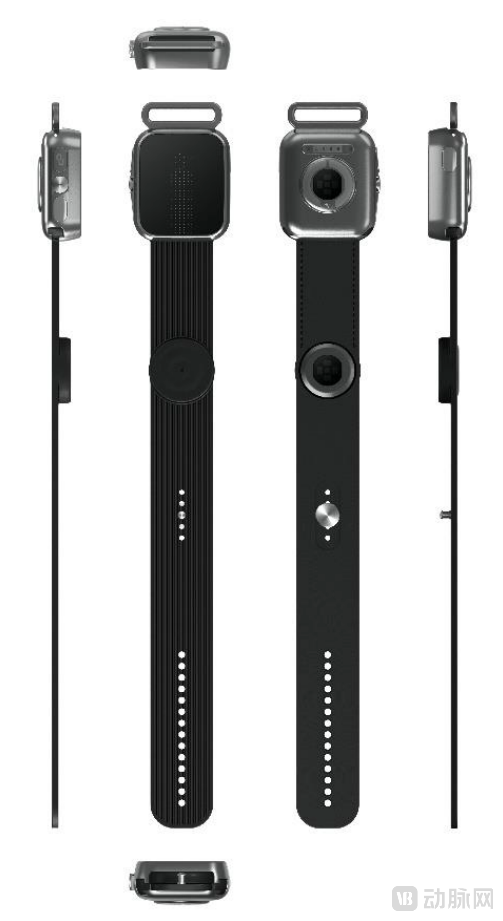
Xinyong Technology's Non-invasive Continuous Blood Pressure Monitor
Dr. Li Yibin himself holds a Ph.D. from the Department of Microelectronics at Tsinghua University. At the inception of Xinyong (Beijing) Technology Co., Ltd.,Li Yibin assembled a multidisciplinary team with expertise in hardware, software, and algorithms, and collaborated with leading experts across various medical fields to tackle the challenges of continuous blood pressure monitoring.Dr. Wei Yaoguang, its co-founder, has many years of extensive experience in software algorithm development.
The company initially focused on acquiring and analyzing sensor signals as a breakthrough point, laying the foundation for subsequent research on portable, non-intrusive blood pressure monitors. It then addressed data accuracy issues by examining signal attenuation and influencing factors from the perspectives of blood pressure formation mechanisms and human anatomy. Finally, leveraging fluid dynamics knowledge, it established a blood pressure monitoring algorithm model based on hemodynamic models of blood flow within vessels.
Throughout the process, the team conducted multiple experiments to establish both physical and AI models. They collected data from thousands of individuals, independently developed photoelectric and pressure sensors, and optimized product structural design and user experience. Based on extensive preliminary research involving over 75,000 sets of user data, the product’s accuracy has been verified to meet medical standards.
Today, by integrating hardware and software and focusing on continuous monitoring, the company offers a comprehensive risk early-warning product ecosystem that includes smart wearable devices, mobile apps, cloud platforms, and data-sharing capabilities. This system enables non-invasive, 24-hour intelligent and precise data acquisition, real-time data transmission, continuous monitoring with alerts, immediate extraction of monitoring results, real-time sharing, risk registration and assessment, intelligent data storage and management, and personalized health records. In 2021, the company secured tens of millions of RMB in financing from the renowned venture capital firm FreeS Fund.
Moving forward, the company will continue to advance the NMPA certification process and plans to collaborate with multiple top-tier hospitals.
In fact, the prevalence of cardiovascular and cerebrovascular diseases in China continues to rise. Nevertheless, very few companies have truly achieved breakthroughs in unobtrusive, portable, continuous blood pressure monitoring. As blood pressure monitoring becomes increasingly routine, and with the ongoing development and iterative advancement of this technology, its application scenarios will expand significantly. The products of Xinyong (Beijing) Technology Co., Ltd. are poised to capture a vast market opportunity.