

Edwards Lifesciences Launches Next-Generation HemoSphere® Patient Monitor with HPI Hypotension Prediction Index in China, Ushering in a New Era of Intelligent Hemodynamic Management
Today, Edwards Lifesciences (“Edwards”), a global leader in medical innovation for structural heart disease, critical care, and surgical monitoring, announced the HemoSphere, its next-generation hemodynamic monitoring platform featuring the HPI (Hypotension Prediction Index) software.®Patient monitors are officially launched in China.
The all-new HemoSphere patient monitor is Edwards’ first artificial intelligence (AI)-enabled patient monitoring product. Equipped with the Hypotension Prediction Index (HPI) software, which is developed based on AI technology, it can predict the likelihood of impending hypotension in patients, enabling clinicians to take timely therapeutic measures to reduce postoperative complications such as acute kidney injury and myocardial injury associated with hypotension, thereby improving patient outcomes. The launch of this monitor has brought about a revolutionary change in the fields of critical care and intraoperative monitoring in China.
Zhu Jinliang, Head of Critical Care and Vascular Surgery Business at Edwards China, stated, “The Yellow Emperor’s Inner Canon once pointed out that ‘the superior physician treats disease before it arises,’ which resonates profoundly with the emphasis in ‘Healthy China’ on strengthening prevention and nipping problems in the bud. The HemoSphere patient monitor launched by Edwards in China is precisely designed with prevention as its starting point, innovatively applying artificial intelligence to evolve routine vital signs monitoring into predicting the likelihood of hypotension. This ushers in a new era for hemodynamics, transitioning from monitoring to prediction, and serves as a prime example of Edwards’ commitment to driving digitalization and intelligence in the fields of critical care and hemodynamic monitoring.”
In recent years, with the continuous advancement of medical technology, surgical safety has been significantly improved. However, many patients still experience severe postoperative complications, which can even lead to death. Among these, intraoperative hypotension is a risk factor that affects the quality of patient recovery. It is strongly associated with postoperative complications such as acute kidney injury, myocardial injury, and stroke, as well as 30-day mortality. Therefore, reducing the occurrence of perioperative hypotensive events remains a significant challenge for anesthesiologists, requiring urgent attention.
Professor Yu Buwei, President of the Anesthesiology Branch of the Chinese Medical Doctor Association and President of the Anesthesiology Branch of the Shanghai Medical Doctor Association, stated: “As a fundamental physiological parameter, blood pressure is a key indicator closely monitored by every anesthesiologist in their daily practice. With the advancement of artificial intelligence, the future direction of intraoperative hypotension management should focus on prediction, prevention, and personalized care. Establishing the concept of personalized perioperative blood pressure management requires more extensive and large-scale clinical studies, as well as further advanced technologies. These new technologies can assist clinicians in better implementing personalized perioperative blood pressure management, thereby improving the quality of clinical care, promoting the development and growth of the entire perioperative medicine discipline, and truly realizing the patient-centered ‘therapeutic’ philosophy in anesthesiology to safeguard patients’ lives.”
The new-generation HemoSphere patient monitor from Edwards, equipped with the HPI (Hypotension Prediction Index) software, helps reduce the likelihood of perioperative hypotensive events. Developed using AI technology based on extensive historical data, the HPI software analyzes real-time arterial blood pressure waveforms to alert clinicians to potential hypotensive events (defined as mean arterial pressure <65 mmHg for at least one minute) within the next 20 minutes for non-surgical adult patients and within the next 15 minutes for surgical patients. It also provides hemodynamic parameters related to preload, afterload, and myocardial contractility, enabling physicians to identify precipitating factors and intervene before hypotension occurs. Timely preventive and therapeutic measures can thereby reduce the risk of postoperative complications such as acute kidney injury and myocardial injury associated with hypotension, ultimately improving patient outcomes.
In addition to being equipped with HPI software, the new generation HemoSphere patient monitor is also compatible with various systems, enabling integration with Acumen IQ®Cardiac Output and Pressure Monitoring Sensor, FloTrac®Cardiac Output and Pressure Monitoring Sensors and Swan-Ganz Catheters®Seamless compatibility with pulmonary artery catheters to meet diverse clinical needs. Furthermore, it offers a variety of modular, multi-parameter hemodynamic monitoring solutions, enabling clinicians to navigate intuitively via a high-definition touchscreen for intelligent decision support and personalized patient care.
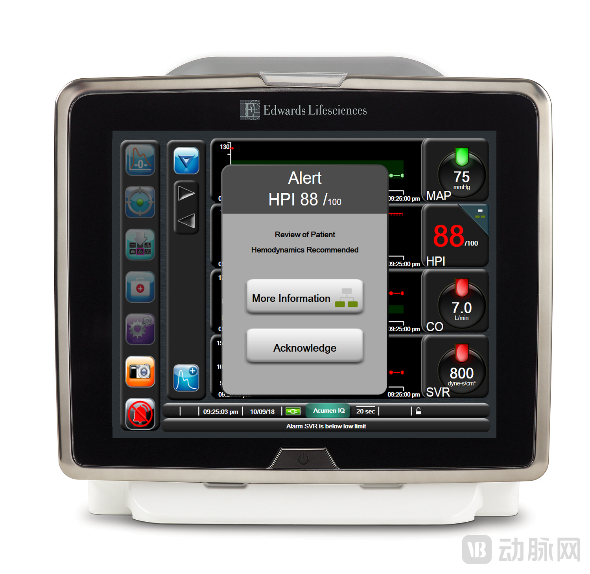
HemoSphere Patient Monitor: A New-Generation Hemodynamic Monitoring Platform Equipped with HPI (Hypotension Prediction Index) Software
With over 50 years of expertise in critical care and surgical monitoring, Edwards Lifesciences remains committed to proactively empowering clinicians with clinical solutions. Through sustained and robust investment in innovation and a strong R&D pipeline, the company strives to benefit more patients. Critical care and surgical monitoring constitute a cornerstone of Edwards’ development. Since the launch of the Swan-Ganz pulmonary artery catheter in China in 2001, Edwards has continuously upgraded hemodynamic monitoring technologies—progressing from invasive to minimally invasive and then to non-invasive approaches—introducing innovative products such as the FloTrac cardiac output and pressure monitoring sensor, the Finger Cuff® non-invasive blood pressure sensor, and the EV1000®A hemodynamic monitor to Chinese patients. To date, 11 of Edwards’ innovative critical care and surgical monitoring products have been approved in China, over 12,000 clinicians have received relevant training, and more than 1.3 million patients have benefited.
Ye Tiancheng, General Manager of Edwards Lifesciences for Greater China, stated: “China is a major strategic market for Edwards globally. Following the balloon-expandable transcatheter aortic valve system SAPIEN®3 and the New-Generation Surgical Aortic Valve INSPIRIS RESILIA®Since successfully entering the Chinese market, Edwards has introduced globally leading innovative technologies to Chinese healthcare professionals and patients for three consecutive years. The launch of the next-generation HemoSphere patient monitor further enriches Edwards’ product portfolio in China, underscoring the company’s determination and confidence in deepening its commitment to the Chinese market. Moving forward, we will continue to uphold our commitment in China—“Wholehearted Care, Starting from the Heart”—by accelerating the introduction of more breakthrough innovative products, empowering physicians to enhance diagnostic and therapeutic capabilities, benefiting more Chinese patients, and contributing to the early realization of the “Healthy China 2030” initiative.
About Edwards Lifesciences
Edwards Lifesciences is a global leader in medical innovation for structural heart disease, critical care, and surgical monitoring. With patients at the center of everything we do, we collaborate with leading clinicians and researchers worldwide to address unmet medical needs, improve patient outcomes, and enhance quality of life. For more information, visit Edwards.com or follow the official WeChat account of Edwards Lifesciences.