

Rise of the 'Male Beauty Economy': A New Growth Engine for the Aesthetic Medicine Industry
The New Frontier in the Medical Aesthetics Industry Is Being Propelled to the Forefront by Men.
“In the past two years, we have observed a growing number of men beginning to try medical aesthetic procedures. Among them, an increasing proportion are undergoing skin rejuvenation, injectable treatments, and rhinoplasty. This demographic is predominantly composed of individuals born in the 1990s,” the founder of a leading medical aesthetics chain told VCBeat, noting that male-oriented medical aesthetic services have become a key strategic focus for the company since 2020.
Data offers a glimpse into the market’s fervor. According to SoYoung Data Research Institute, approximately 2.3 million men engaged in medical aesthetic consumption in 2021. Moreover, female consumers saw a year-on-year increase of 10.78%,Male aesthetic medicine consumers saw a year-on-year increase of over 65%, with the growth rate reaching six times that of female consumers.
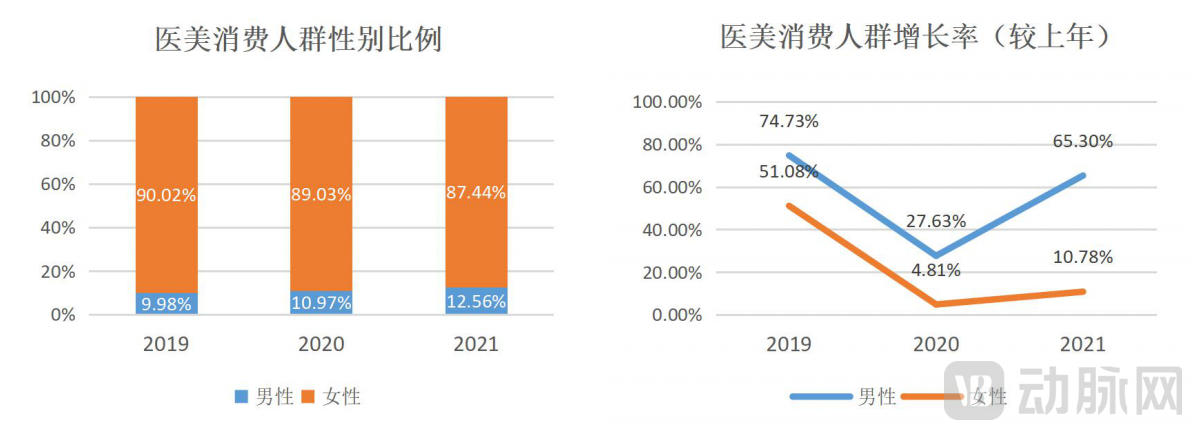 (Image source: SoYoung Data Yanjiuyuan)
In addition to the overall growth in the number of users, male clients also exhibit a higher average transaction value for medical aesthetic procedures. Data from iiMedia Research shows thatThe average transaction value per male aesthetic client is 2.75 times that of female clients, indicating higher profit margins for medical aesthetic procedures among men.
With rapidly rising market demand on one side and healthy profit margins on the other, male aesthetic medicine undoubtedly holds strong market potential, making it a new niche segment that many medical aesthetics institutions are competing to enter.
Can Male Aesthetic Medicine Become a New Growth Engine for the Aesthetic Industry? What Are the Opportunities and Challenges? VCBeat Explores These Questions Through Industry Interviews and Analysis.
As an increasing number of men become a key customer base for medical aesthetic clinics, “male medical aesthetics” is on the rise: according to the Global Medical Aesthetics Consumer Trends Report,37% of Chinese men are potential consumers of medical aesthetics, indicating strong demand.
“In the past, men were rarely seen in the medical aesthetics market, as most people considered it a business exclusively for women. However, with social development, more men are beginning to acknowledge their intrinsic needs, seeking to enhance their appearance through medical aesthetic procedures to boost self-confidence, thereby fostering favorable impressions and improving success rates in romance, social interactions, and the workplace,” said Wang Tao, director of a plastic surgery hospital in Chengdu.
Currently, the exploration of male aesthetic medicine demand primarily stems from three aspects:
· One category involves undergoing improvement treatments together, either at the recommendation of the healthcare provider or their partner, while accompanying their spouse or family members for medical procedures;
· The second category comprises men born in the 1990s and 2000s who have gradually come of age; a significant proportion of them place emphasis on their personal image.
· Category 3 consists of middle-class males, who possess the financial capacity for high consumption and primarily seek medical aesthetic treatments to address anti-aging needs.
“Unlike traditional aesthetic medicine demands among women, male aesthetic medicine involves a wide range of unique aesthetic preferences and concerns."Dean Wang Tao stated that, for instance, societal awareness and acceptance of male cosmetic surgery remain at a low level; consequently, male aesthetic patients often prefer minimally invasive procedures with recovery periods ideally limited to two or three days."Male aesthetic seekers prefer gradual changes in their appearance.”
In contrast to female aesthetic seekers, whose primary demands across all age groups are anti-aging and beautification,Male aesthetic patients’ demands exhibit distinct age-stratified characteristics, for instance, younger men tend to favor a more masculine appearance, thus showing a preference for aesthetic procedures such as nasal bridge augmentation and chin lengthening; older men seek to look younger, making them more inclined toward treatments like lower blepharoplasty (eye bag removal) and hair transplantation. In contrast, female aesthetic seekers across all age groups consistently favor procedures such as double eyelid surgery, mandibular contouring for facial slimming, and hyaluronic acid injections.
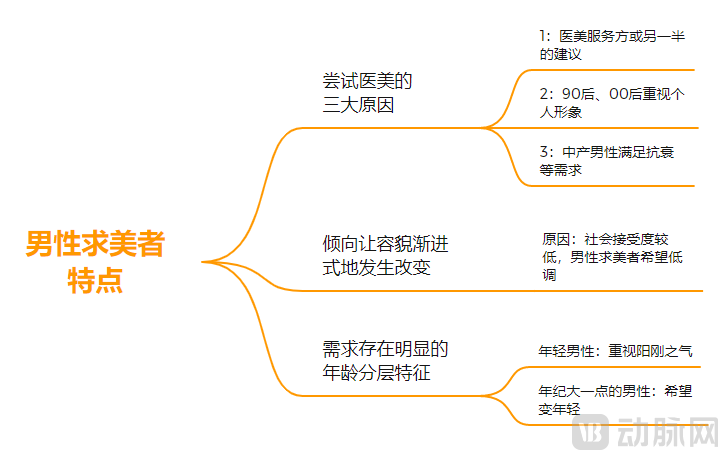 (Characteristics of Male Aesthetic Seekers; Graphic by VCBeat)
“Male aesthetic medicine is emerging as a new trend pursued by the market. Our observations indicate that some chain aesthetic clinics have begun to strategically position their male aesthetic services as a distinct business line, and specialized clinics catering exclusively to men are also appearing in the market.“Li Ping, a seasoned investor focusing on consumer healthcare, stated, ‘This will represent a significant market opportunity.’”
It is important to note that China’s medical aesthetics market remains in a phase of rapid growth. According to the Report on the Analysis of Current Market Status and Investment Prospects of China’s Medical Aesthetics Industry (2019–2025), the penetration rate of China’s medical aesthetics market stands at only around 2%, compared to approximately 10% in mature markets such as the United States and Brazil, indicating a fivefold potential for future expansion. Within this context, the rise of male medical aesthetics will serve as one of the key drivers propelling the rapid development of the industry.
How can the industry seize opportunities when the wind rises?
Male Aesthetic Medicine Has Gradually Become the Industry’s “Hot Commodity.”
From the demand side,Men show a greater preference for aesthetic medical procedures such as hair transplantation, eyebrow tattooing, lower blepharoplasty, and ocular contouring. In addition, emerging demands in areas like skin management and breast augmentation are gaining momentum.
“In the field of men’s medical aesthetics, two major characteristics are currently evident. First, there is the single, dominant track represented by hair transplantation, which addresses a rigid demand and boasts a substantial market capacity. Second, there are combined service offerings, such as eyebrow tattooing and eye bag removal, which are primarily integrated into the overall business layout of medical aesthetic institutions. Currently, some of these services are being spun off as standalone operations and have the potential to emerge as new dominant tracks. The combined market size for these segments has already reached hundreds of billions of yuan,” said Li Ping, a senior investor. She noted that each medical aesthetic enterprise is making strategic arrangements tailored to its own endowments.
First, let us examine the hair transplantation sector, which constitutes a single major track.As a key subsector of male medical aesthetics, hair loss has become a “top priority” for many young people today. According to data from the National Health Commission, the number of men experiencing hair loss in China has reached 163 million.
Behind the vast population lies enormous demand, which has fueled the rapid development of the hair transplantation industry. According to Frost & Sullivan, China’s hair transplantation medical services market is projected to grow from RMB 13.4 billion in 2020 to RMB 37.8 billion in 2025, representing a compound annual growth rate (CAGR) of 23%.
From the perspective of the competitive landscape, there are currently four mainstream categories of players in the hair transplantation sector.
· First, hair transplant departments in public hospitals such as Shanghai Changzheng Hospital and Southwest Hospital;
· Second, the hair transplantation departments of private medical aesthetic service institutions represented by Yimeier and Xiduo;
· Third, private non-chain hair transplant institutions represented by Hengbo and others;
· Fourth, national private chain hair transplant institutions represented by Yonghe Medical, Biliansheng, Damai Hair Transplant, Xinsheng Hair Transplant, and Boshiyuan.
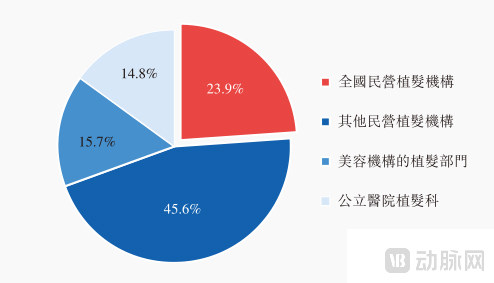
(Source: Yonghe Medical’s prospectus)
According to the prospectus previously submitted by Yonghe Medical, non-chain specialized hair transplant institutions scattered across various regions account for approximately 45.6% of the market share due to their large number. Ranking second are large chain hair transplant institutions, including Yonghe Medical, Biliansheng, Damai Hair Transplant, and Xinsheng Hair Transplant, which collectively hold approximately 23.9% of China’s hair transplant market share. The hair transplant departments of comprehensive medical aesthetic institutions account for approximately 15.7% of the market share, while those in public hospitals hold the remaining approximately 14.8%.
Amid the industry’s rapid development, the hair transplantation sector has also seen the emergence of publicly listed and pre-IPO companies: Yonghe Medical went public last year and currently boasts a market capitalization exceeding HK$4 billion, while Daimai Hair Transplantation filed its prospectus this June.
Next, we examine the male aesthetic medicine business primarily housed within comprehensive medical aesthetic service institutions.Among these, skin-improvement procedures such as under-eye bag removal, pigmentation spot reduction, and wrinkle reduction are currently favored by male aesthetic seekers.
“Middle-class men are the primary demographic seeking skin improvement treatments, and they tend to favor well-known medical aesthetics chains,” said Dr. Wang Tao. Microneedling radiofrequency, PicoSure laser, and intense pulsed light (IPL) skin rejuvenation are among the skin improvement procedures that male aesthetic seekers repeatedly try.
Taking microneedle radiofrequency (RF) as an example, this innovative fractional microneedle RF therapy creates micro-channels in the epidermis using microneedles, then delivers RF (radiofrequency) energy directly to the dermis. The emitted thermal energy stimulates collagen production and promotes the reorganization of elastic fibers, thereby improving depressed and damaged skin conditions such as wrinkles, enlarged pores, skin laxity, acne scars, and other types of scarring.
“These seemingly fragmented demands have gradually given rise to specialized skin management institutions,” stated Dr. Wang Tao. “Currently, these institutions primarily cater to women, but in the future, we may see a significant emergence of skin management centers predominantly targeting men.”
Similar to skin management, male breast surgery is also becoming another niche trend in men's aesthetic medicine demand.In China, a significant number of men suffer from gynecomastia, a condition primarily characterized by the proliferation of breast tissue due to an imbalance in systemic or local estrogen and androgen levels. As this condition manifests as breast enlargement, many patients seek plastic surgery to reduce breast size.
To address this demand, medical aesthetic service providers focusing on male breast surgery, such as the Yongchun Male Plastic Surgeons Group, have already emerged in the market.
Moreover, body contouring and other aesthetic procedures are also highly sought after by male patients.For a significant proportion of men, body contouring has become a trend following fitness and muscle building. This shift reflects a change in aesthetic goals: whereas the previous focus was solely on slimness, the current ideal emphasizes both leanness and well-defined physique. Achieving such results through fitness alone often demands considerable diligence and self-discipline; consequently, many men are opting for medical aesthetic procedures to “sculpt” their bodies.
From an industry perspective, the body contouring market primarily comprises three major approaches: invasive medical aesthetic contouring, non-invasive medical aesthetic contouring, and lifestyle beauty contouring.
Specifically, invasive medical aesthetic procedures, such as liposuction, offer rapid results but often carry risks including skin ecchymosis, nerve numbness, skin laxity, and subcutaneous hemorrhage. Non-invasive medical aesthetic body contouring primarily utilizes photoelectric technologies—such as ultrasound, radiofrequency, and cryolipolysis—to achieve fat reduction through external application; while these methods also yield relatively quick results, their efficacy largely depends on the quality of the equipment used. In contrast, lifestyle beauty treatments focus on daily conditioning and produce slower results.
“We have found that some male aesthetic patients are increasingly seeking ‘precision sculpting’ of specific areas, particularly the waist, abdomen, and thighs,” stated Dr. Wang Tao, Director of the Hospital.
Certainly, as the population of male aesthetic seekers continues to rise, the interviewees also unanimously agree that,In addition to offering more aesthetic medicine treatments tailored to male clients, avoiding cookie-cutter standardized aesthetics and excessive procedures is a critical factor in determining the viability of the business model.
Against the backdrop of rapid growth in male medical aesthetics, how can aesthetic medicine service providers seize this emerging opportunity?
“Objectively speaking, the demand for aesthetic medical services among men is fundamentally no different from that among women; the distinction lies only in treatment approaches and service delivery. Therefore, from a business logic perspective, the greater emphasis should be on”To address male-specific needs, demand conversion is achieved through strategic project and marketing packaging, while ensuring safety.“said senior investor Li Ping.”
For instance, skin management packages can be tailored to the profiles of middle-class men, with service workflows redesigned to provide male aesthetic seekers a private and premium experience. Compared to standalone medical aesthetic procedures, such packages drive higher average transaction values and repurchase rates, enhance user stickiness, and cater to the convenience-seeking needs of high-net-worth male clients.
“At this juncture, it is particularly crucial to conduct user education and attract traffic by addressing the needs of male aesthetic seekers, which tests the marketing capabilities of medical aesthetics service providers.” Li Ping believes that, in addition to routine advertising, medical aesthetics service providers should also place greater emphasis on emerging media platforms such as Weibo, Xiaohongshu (Little Red Book), Kuaishou, and Douyin. By leveraging content-driven recommendations and short videos, they can strengthen users’ emotional perception, thereby fostering trust in relevant aesthetic procedures and institutions.
Of course, for industry participants, the most important thing remains to prioritize medical quality.“No matter whether it is male aesthetic seekers, or the rapidly growing post-90s and post-00s generations, medical service institutions must always prioritize service quality and advocate for healthy beauty,” stated Director Wang Tao. “Only by strictly maintaining medical quality can we attract more aesthetic seekers.”
One background that must be mentioned is the current chaos in the medical aesthetics industry, with numerous illegal “black market” medical aesthetic institutions. According to the White Paper on Insights into China’s Medical Aesthetics Industry (2020), an average of approximately 100,000 people suffer injuries or disabilities each year due to such illegal practices.
For instance, in July 2021, the death of internet celebrity Xiao Ran due to improper procedures at a medical aesthetics clinic, which led to a fatal post-liposuction infection, sparked widespread concern across society and within the industry. “Pursuing beauty at the cost of life” briefly became a popular summary among netizens expressing their dissatisfaction with the chaotic practices plaguing the medical aesthetics sector.
Furthermore, the medical aesthetics market is rife with counterfeit and unapproved products, severely infringing upon the rights and interests of consumers seeking aesthetic treatments. Taking minimally invasive aesthetic procedures as an example, data from the Chinese Association of Plastics and Aesthetics indicates that 70% of hyaluronic acid and botulinum toxin products sold in the domestic market are counterfeit or unapproved imports.
“Fake hyaluronic acid is not absorbed by the skin; its prolonged presence in the body can even cause tissue changes and lead to an uneven facial contour. More dangerously, some unscrupulous institutions use polyacrylamide hydrogel (PAAG)—a gel listed by the World Health Organization as a suspected carcinogen—to pass off as hyaluronic acid. This implants a ‘ticking time bomb’ in aesthetic patients, as the substance may decompose at any time and release highly toxic compounds, posing a life-threatening risk,” a medical aesthetics doctor who requested anonymity previously told VCBeat.
In response to this,At the national level, multiple regulatory policies have been issued to guide the healthy development of the medical aesthetics industry.For instance, in March this year, the National Medical Products Administration issued an announcement on adjusting certain contents of the “Medical Device Classification Catalog,” bringing products such as “skin boosters” under Class III medical device management and further clarifying product ingredients, indications, and other specifications.
An increasingly standardized market will inevitably sustain the high-speed growth of the medical aesthetics industry over the medium to long term. Last month, Shenzhen took the lead by issuing the Several Measures for Promoting the High-Quality Development of the Big Health Industry Cluster in Shenzhen, which explicitly encourages the development of the medical aesthetics industry and provides specific support across multiple segments of the sector. This move is expected to serve as a model and reference for other cities in fostering the growth of the medical aesthetics industry.
Amid this trend, the explosive growth of the male medical aesthetics market has undoubtedly brought new incremental demand and is bound to propel the industry into a new era of “beauty.”