

OrbusNeich: A Chinese Pioneer in Global Vascular Intervention Devices Defies the Odds with IPO Bid

OrbusNeich
Cardiac Interventional Treatment Product R&D and Production Manufacturer
China's high-value consumables industry for vascular intervention has developed for over two decades, with balloons—a key product category—remaining a persistent challenge to overcome.
In the PCI (percutaneous coronary intervention) balloon market, over 70% of the market is still dominated by imported companies such as Abbott, Boston Scientific, and Medtronic, presenting an inversion compared to the 80% domestic production rate of coronary stents.
In a market dominated by importers, few domestic brands can compete. OrbusNeich, headquartered in Hong Kong with manufacturing facilities in Shenzhen, sells its products to more than 70 countries and regions worldwide, making it one of the few companies capable of competing with imported brands. It is the only company headquartered in China that ranks second in market share in Japan, where PCI technology is highly advanced, and also holds leading positions in overseas markets such as the United States and Europe.
In the development history of China's vascular intervention industry, OrbusNeich is an indispensable enterprise, regarded as the origin of China's balloon catheter industry.
Recently, OrbusNeich submitted its IPO application to the Hong Kong Stock Exchange. OrbusNeich operates across multiple segments of the vascular intervention industry, including coronary intervention, peripheral intervention, structural heart disease, and neurointervention. According to the prospectus, despite the impact of volume-based procurement on domestic peers, the company’s performance continued to grow, with revenue reaching USD 116 million in 2021, a year-on-year increase of approximately 30%.
OrbusNeich’s long-standing implementation of a global strategy may be the key to its current prominence.
Two decades ago, when China’s vascular intervention industry was still in its infancy, OrbusNeich chose to expand into overseas markets. This strategic move has fortified the company with greater resilience against risks as it faces the challenges of volume-based procurement today, while also enhancing its cost control and R&D capabilities amidst industry consolidation.
How Did OrbusNeich Succeed in Its Global Expansion? How Will It Strategize for the Next Decade? VCBeat (WeChat ID: vcbeat) Interviewed OrbusNeich.
OrbusNeich was founded by Mr. Qian Xuexiong in 2000, a pivotal year for the development of China’s vascular intervention industry. On one hand, percutaneous coronary intervention (PCI) began to gain widespread adoption in China, with surgical volumes experiencing rapid growth. Data from the National Registry of Coronary Heart Disease Interventions showed that the number of procedures performed annually increased by 40% compared to the previous year between 1999 and 2001. On the other hand, domestic companies began to emerge amidst this wave of development.
Before embarking on his entrepreneurial journey, Mr. Qian Xuexiong had already cultivated deep expertise in the Asia-Pacific cardiovascular market for many years, having assisted Cordis in expanding its pacemaker business across the region. This experience enabled him to perceive the approaching inflection point with greater acuity than his peers.
Mr. Qian Xuexiong’s career, spanning two centuries, has witnessed the rise of the Asia-Pacific cardiovascular market while capitalizing on two key opportunities driving the global cardiovascular market’s rapid growth.
The first opportunity lay in participating in the pioneering phase of international giants’ expansion into the Asia-Pacific market, thereby accumulating substantial industry resources during a period of market void.
In the 1950s, Mr. Qian Xuexiong moved from Shanghai to Hong Kong, where his work at a pharmaceutical factory sparked his lifelong connection with the healthcare industry. Following the merger of pharmaceutical companies, Mr. Qian began assisting Cordis, a global leader in cardiovascular medical device manufacturing, in developing the Asian market in the 1970s. At that time, Cordis was one of only two companies worldwide with mastery over pacemaker technology. However, no hospitals in Asia were yet implanting pacemakers in patients. After Cordis divested its pacemaker business in 1985, it focused on expanding its cardiac catheterization operations.
While helping to distribute Cordis products, Mr. Qian Xuexiong established strong relationships with physicians in the Asia-Pacific region, particularly those in Japan. Japanese PCI specialists are capable of managing complex lesions and hold authoritative influence within the industry; therefore, their endorsement of products carries significant weight among physicians in other markets, such as Southeast Asia, Europe, the United States, and China. OrbusNeich’s early success in the Japanese market greatly contributed to the subsequent establishment of brand awareness and the development of its R&D capabilities.
The second opportunity was that OrbusNeich seized the rapid growth in global PCI procedure volumes, securing a foothold in the global vascular intervention market.
In 1996, with Johnson & Johnson’s acquisition of Cordis, Mr. Qian’s Asia-Pacific distribution business came to an end. Although he was already over sixty years old, his passion for cardiac medical technology remained undiminished. In 2000, Mr. Qian founded OrbusNeich, launching its cardiovascular interventional business.
Mr. Qian was one of the pioneers who introduced percutaneous coronary intervention (PCI) to China, bringing innovative interventional therapies to combat cardiovascular disease, the leading cause of death. He assisted in training mainland Chinese physicians to perform cardiac catheterization procedures. He recalls that initially, only a few dozen cardiac catheterizations were performed annually in China; by the second year, the number had risen to several hundred. By 2009, China had performed 200,000 cardiac catheterization procedures, surpassing Japan.
Mr. Qian Xuexiong, like the rest of the Qian family, was deeply patriotic. While his cousin, Mr. Qian Xuesen, dedicated himself to China’s aerospace industry, Mr. Qian Xuexiong focused on building an international medical product brand owned by Chinese people. Mr. Qian began independent research and development of coronary stents in 1999. In 2001, he established a world-class manufacturing facility in Futian District, Shenzhen, becoming one of the first entrepreneurs to support the Futian Bonded Zone.
In September 2001, OrbusNeich’s first balloon catheter received approval from Japan’s PMDA. In 2005, OrbusNeich acquired Orbus Medical, gaining its R&D center in the United States and manufacturing facility in the Netherlands, while also expanding its sales network in Europe.
Subsequently, OrbusNeich has established brand recognition in the Asia-Pacific and European markets through its diversified and innovative product portfolio.
In 2007, OrbusNeich’s first-generation Sapphire received CE certification, marking the beginning of the OrbusNeich Sapphire balloon catheter product series, which has gained widespread recognition in the global coronary intervention market. In 2008, its ScoreFlex scoring balloon received CE certification. In 2013, OrbusNeich Medical launched the COMBO dual-therapy stent, featuring its proprietary antibody-coating technology; it is the world’s first and only stent that promotes vascular self-healing.
After more than a decade of steady and solid growth, Qian Yongxun assumed the role of Chief Executive Officer in 2016, recharting the company’s strategic development roadmap. OrbusNeich has since entered a phase of rapid expansion, launching into the U.S. market while broadening its product portfolio from coronary interventional devices to peripheral PTA balloons. This year, the company has further extended its reach into the fields of neurointervention and structural heart disease.
In addition to the Qian family’s two-generation commitment, a professional and international management team has also provided strong impetus for OrbusNeich to rank among the industry leaders.
In terms of specialization, Ms. Liu Guizhen, a Director at OrbusNeich, holds a law degree from the University of Hong Kong and a Master’s degree in International Economic Law from the University of Warwick in the UK. Prior to joining OrbusNeich Medical, she served as a Managing Director at the international investment bank Morgan Stanley, bringing over 20 years of experience in law, business operations, and management. Robert Cottone, the Technical Director from the United States, previously worked at Cordis Corporation and founded Orbus Medical Technology; he possesses extensive expertise in the source innovation, design, and optimization of stents and balloons. Regarding internationalization, its Commercial Director is from Europe, and various offices are managed by local executives well-versed in regional affairs.
After two generations of pioneering efforts, OrbusNeich ranked second in the Japanese market and fourth in the European market in terms of PCI balloon sales volume in 2021, while ranking sixth in both the Chinese mainland and U.S. markets. It is also the highest-ranking Chinese manufacturer in overseas markets. In terms of PTA balloon sales volume, OrbusNeich ranked third in the Japanese market and fourth in the U.S. market.
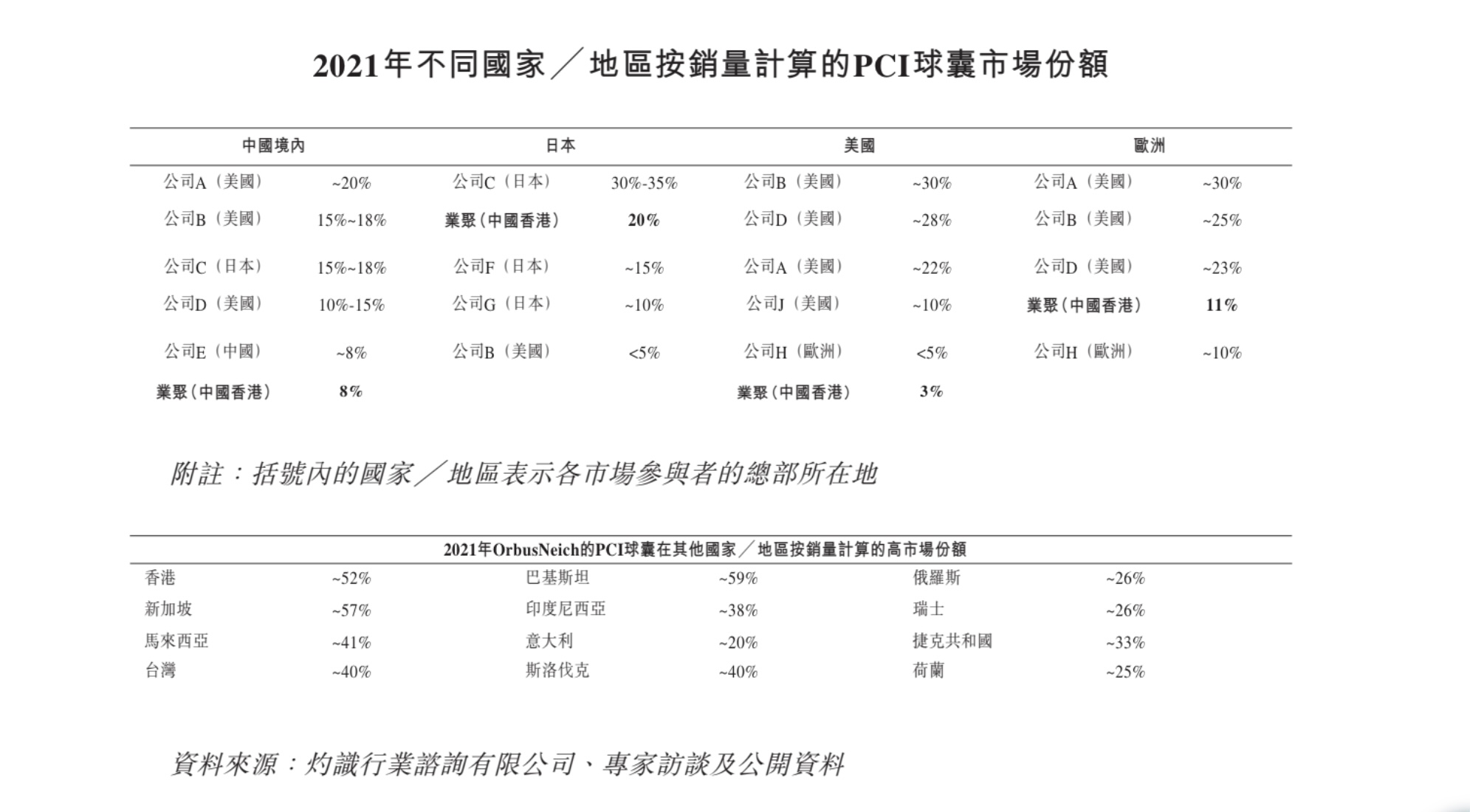
OrbusNeich has become a household name among cardiologists, thanks to its superior product performance, safety, and quality. The company’s growth demonstrates that the Chinese market offers not only abundant resources and a demographic dividend, but also the capability to export brands in the high-barrier medical manufacturing sector.
As is well known, Chinese manufacturers of high-value medical consumables have long struggled to break into overseas markets. These markets are characterized by high entry barriers, intense competition, and stringent localization requirements.
Especially for interventional vascular physicians, considerations of product safety, quality, and functionality are paramount when selecting medical devices. Consequently, physicians worldwide tend to favor established brands such as Boston Scientific and Medtronic. This preference raises the barrier to entry, making it difficult for new brands to gain visibility among clinicians.
Although domestically produced balloons are nearly indistinguishable from imported ones in treating common lesions, there remains a significant gap between domestic manufacturers and leading enterprises in terms of performance in complex lesion treatment, product diversity, and production scale. Consequently, the market share of domestically produced balloons has remained low, and the low-price strategy adopted by domestic manufacturers cannot be replicated overseas.
With the domestic vascular intervention market impacted by centralized procurement, the importance of overseas markets has become even more pronounced, making international expansion the sole strategy for mitigating risks and driving growth. What experiences has OrbusNeich gained in expanding into overseas markets? What insights can it offer to China’s medical device industry?
The story and experience of exploring overseas markets for two decades may be difficult to summarize simply. As times change, the overseas market evolves rapidly, requiring strategies to be adjusted flexibly and continuously. However, the senior management team of OrbusNeich frankly stated that the company has consistently continued to invest in three key capabilities.
OrbusNeich stated, “The success of a medical device company is primarily based on its capabilities in R&D, operations, and commercialization.”In terms of R&D capabilities, our 20 years of industry experience have validated our strengths, leading to the development of multiple innovative and physician-preferred products. These include the market’s first 1.75mm scoring balloon, which was also the first of its kind approved in Japan; the Sapphire II Pro CTO balloon, which had the smallest profile on the market at launch; and the market-exclusive dual-therapy stent.
From an operational perspective, numerous challenges may arise between R&D and mass production; however, our products have achieved large-scale manufacturing while maintaining high quality standards.In late 2020, the U.S. FDA conducted an unannounced inspection of our manufacturing facility and issued a zero-deficiency observation, underscoring our operational excellence.
The third aspect is the development of commercialization capabilities. In terms of commercialization, OrbusNeich sold more than 860,000 PCI balloons worldwide in 2021. This achievement is attributed to our comprehensive sales network and the strategy of combining direct sales with distribution.
In terms of commercialization strategy for the global market, OrbusNeich’s approach is to divide the global market into two major categories.
OrbusNeich’s executive team stated, “In terms of our global market strategy, we categorize markets into two main types. The first is mature markets, where we already have high hospital coverage in regions such as Japan, Europe, and the Asia-Pacific. The second is high-growth markets, where there is significant room for expansion in our hospital coverage.”
For mature markets, OrbusNeich has a high hospital coverage rate, making it relatively difficult to achieve revenue growth by expanding the market with the same products. Therefore, OrbusNeich's strategy is to promote the launch of new products in mature markets.For example, in the Japanese market, where OrbusNeich holds a competitive advantage, the company launched new guide extension catheters last year to complement its existing balloon and stent product lines. These new products are designed to work synergistically with the established portfolio. Meanwhile, OrbusNeich is also committed to product iteration and upgrading, introducing higher-performance devices to maintain its existing market share.
For the rapidly growing market, OrbusNeich needs to increase its hospital coverage. The company’s focus is on expanding its hospital reach and leveraging its exclusive products to break through the encirclement of industry giants.
“To expand coverage in newer markets, the first step is to introduce the company’s proprietary products. Because the quality and performance of medical devices are directly linked to surgical success and patient outcomes, when presented with two products of equivalent performance, physicians will invariably choose the brand they are accustomed to using. Therefore, product uniqueness is critical when entering new markets.”
Taking the U.S. market as an example, OrbusNeich entered the local market in 2017 and launched the Sapphire II Pro, the first 1.00 mm chronic total occlusion (CTO) balloon approved by the U.S. FDA, in the United States in 2018. At the time, it was the smallest-diameter CTO balloon on the market, a strategy that rapidly opened up the local market.
OrbusNeich’s experience in globalization may teach us a lesson: as the overseas market is the birthplace of the global high-value consumables industry for vascular intervention, domestic companies ultimately need to rely on their core competencies to break into these markets.
Currently, discussions on the domestic vascular intervention market almost invariably revolve around volume-based procurement (VBP). With the advent of VBP, conventional balloon categories suffering from serious product homogenization face the risks of price reductions and compressed market space. In the 2020 volume-based procurement of coronary balloons implemented across seven provinces and regions, balloon prices dropped from RMB 3,413 to RMB 265.
How Will OrbusNeich Respond to Changes in China’s Centralized Procurement Market?
On the one hand, OrbusNeich believes that centralized procurement presents both challenges and opportunities.Based on its performance in winning bids, OrbusNeich has demonstrated strong results in the centralized procurement of balloons. In the 2020 centralized procurement results for coronary balloon dilation catheters across seven provinces, multiple pre-dilation and post-dilation products from OrbusNeich were successfully awarded contracts.
According to OrbusNeich’s prospectus, the proportion of its revenue from the Chinese market rose from 8.6% in 2019 to 14.7% in 2021, with revenue doubling during this period. OrbusNeich increased its market share in China by capitalizing on opportunities presented by centralized volume-based procurement. In terms of gross profit margin, OrbusNeich remained unaffected, recording gross margins of 67.9%, 65.6%, and 69.7% in 2019, 2020, and 2021, respectively.
An executive from OrbusNeich stated, “The volume-based procurement (VBP) policy has provided us with a significant opportunity to transition our China market strategy from the previous exclusive distribution model to establishing a direct sales team. This is also one of the reasons why our gross margin has not been significantly impacted. In fact, we believe that VBP undoubtedly presents substantial opportunities for the company. Currently, the top four brands in the domestic PCI balloon market are all overseas companies, accounting for approximately 70% of the entire Chinese balloon market. The localization of medical devices is a major trend, so there is still considerable room for growth in the market share of domestically produced products. We have established a strong reputation in major overseas markets, including Japan, Europe, the Asia-Pacific region, and the United States. Our products are manufactured in China but deliver quality comparable to imported goods. Therefore, we are well-positioned to capitalize on the process of import substitution.”
On the other hand, OrbusNeich’s global footprint gives it a natural advantage in mitigating the risks associated with centralized volume-based procurement.
An executive from OrbusNeich stated, “Unlike many domestic peers, OrbusNeich sells its products to more than 70 countries worldwide, with approximately 85% of its revenue derived from overseas markets. The R&D costs for our products are amortized across this extensive market base, thereby providing greater flexibility to adopt a strategy of trading price for volume under the centralized procurement framework, so as to expand the hospital coverage and market share of the Group’s products in China. On the other hand, although certain products have been included in the scope of centralized procurement, the Group will continue to develop high-performance, high-quality products that fall outside the centralized procurement scheme, thereby enhancing profitability.”
Undoubtedly, centralized procurement has also accelerated the pace of innovation in China’s balloon catheter industry, which aligns perfectly with OrbusNeich’s strategic layout.
OrbusNeich’s product innovation primarily proceeds along two directions.
On one hand, we are enriching our existing portfolio of coronary and peripheral interventional products, while actively upgrading and iterating our current product lines.OrbusNeich has taken note of the growing advocacy for an “intervention without implantation” approach in the fields of coronary and peripheral interventions in recent years, and has been refining its coronary intervention product portfolio along this direction, with active strategic positioning in this area. Regarding drug-eluting balloon (DEB) products, while most DEBs currently available on the market are paclitaxel-coated, OrbusNeich is developing a sirolimus-eluting DEB. This not only offers a safer drug choice but also enhances drug release efficacy.
OrbusNeich also recognizes that, beyond the devices used for lesion treatment, the core competitiveness of balloon products heavily relies on lesion preparation devices. Achieving a smooth lesion surface is crucial to maximizing the efficacy of drug-eluting stents or balloons. OrbusNeich’s Scoreflex NC scoring balloon is the scoring balloon with the smallest outer diameter globally. Following FDA approval late last year, it was launched in the United States earlier this year and has received highly positive market feedback. Furthermore, building on the Scoreflex NC platform, the company has developed the Scoreflex Trio, a triple-wire scoring non-slip balloon. This product was launched in Japan last October, becoming one of only two non-slip balloon products available in the Japanese market.
OrbusNeich’s management believes that the core rationale behind advocating “intervention without implantation” is to reduce the need for long-term dual antiplatelet therapy. With its stent products, OrbusNeich’s currently marketed Combo Plus dual-therapy stent can address the issue of patients requiring prolonged use of two antiplatelet agents. This stent utilizes OrbusNeich’s proprietary antibody-coating technology and is the world’s first and only drug-and-antibody dual-coated stent that promotes vascular self-healing. Even patients with acute coronary syndrome (ACS) can opt for a short-term 3-month dual antiplatelet therapy (DAPT) regimen.
OrbusNeich is also actively expanding its business scope. In addition to its existing cardiovascular and peripheral products, the company is currently developing neurovascular products and has established a joint venture with European partners to focus on structural heart disease valve products.
OrbusNeich’s choice of expansion areas is not a trend-chasing investment, but rather built upon the strengths of its existing business.
The principles underlying products in the neurointerventional field are similar to those in coronary and peripheral interventions. Moreover, the physicians performing structural heart disease procedures are the same group as those conducting coronary interventions. With both markets experiencing rapid growth, OrbusNeich has gained the confidence and momentum to expand its business.
In the field of structural heart disease, OrbusNeich has commercialized TricValve, a product designed for severe tricuspid regurgitation, which received FDA Breakthrough Device designation in late 2020. While current heart valve products on the market are all "wet valves," TricValve is a "dry valve," significantly simplifying surgical procedures and aligning with the company’s development philosophy of "simplifying complexity." Currently, there are very few products available for the tricuspid valve; besides TricValve, only Abbott and Edwards Lifesciences have corresponding commercialized products. As OrbusNeich’s flagship product in the structural heart sector, TricValve not only enhances brand visibility but also provides safer treatment options for patients and physicians.
In the field of neurointervention, leveraging OrbusNeich’s years of experience and technological platform in cardiovascular care, the company has developed a robust portfolio of related products. Among its current pipeline, the neuro balloon catheter has already been submitted to the National Medical Products Administration (NMPA) for approval. Other pipeline products include neuro aspiration catheters, thrombectomy devices, and more.
Overall, OrbusNeich possesses a rare capability for overseas market expansion in the vascular intervention sector. Globalization demands first-class products, management platforms and talent, as well as top-tier R&D capabilities. As China’s vascular intervention industry enters a new era, global competitiveness is becoming increasingly critical. Leveraging its listing on the Hong Kong Stock Exchange, OrbusNeich will accelerate its development and embark on a new journey.
[1] An analysis of the data from the third national registry of percutaneous coronary intervention (PCI) cases conducted in China from 1999 to 2001, chaired by Gao Runlin, showed [19] that the annual number of procedures increased by approximately 40% compared with the previous year.