

A new round of Sino-European medical device disputes has begun
On June 20, 2025, the European Union, citing dissatisfaction with "localization requirements" in China's provincial-level bidding processes, imposed restrictions on Chinese medical device companies under the International Procurement Instrument (IPI), prohibiting Chinese enterprises from participating in public procurement projects for medical devices valued over 5 million euros (approximately 40 million RMB) across the 27 EU member states.
Half a month later, China issued the "Notice of the Ministry of Finance on Adopting Relevant Measures for Medical Devices Imported from the European Union in Government Procurement Activities" (hereinafter referred to as the "Notice") in response, requiring that when purchasers procure imported medical devices with a budget amount exceeding 45 million RMB, EU enterprises (excluding European-funded enterprises in China) should be excluded from participation. Moreover, when non-EU enterprises participate in procurement, the proportion of medical devices they supply that are imported from the EU must not exceed 50% of the total contract value of the project.
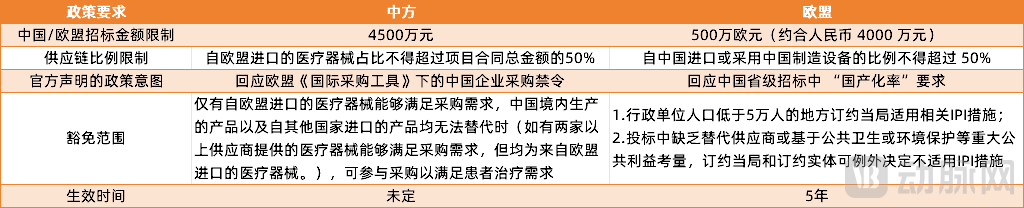 Comparison of Medical Device Restriction Policies between China and Europe
Previously, policymakers rarely interfered in cross-border trade of medical equipment by using bidding amounts as a limiting factor. In this round of policy maneuvering, both sides have set a threshold far higher than the usual procurement scale, aiming to directly restrict centralized procurement and, at the same time, control the import of high-end medical devices.
Under conflict, who suffers and who benefits?
Analyzing the impact of China's countermeasures on imported equipment can refer to the policy response released by the Ministry of Finance on July 10 titled "Notice of the Ministry of Finance on Adopting Relevant Measures for Medical Devices Imported from the EU in Government Procurement Activities." This document clarifies the RMB 45 million threshold mentioned in the Notice:
"If the budget amount for a government procurement project of medical devices reaches or exceeds 45 million RMB, the measures specified in the 'Notice' shall be implemented regardless of whether the procurement involves a single unit (set) of a single-type product, bulk procurement of a single-type product, or procurement of different types of products."
Before 2025, the number of government procurement projects with budgets exceeding 45 million yuan was limited, typically concentrated on the purchase of cutting-edge medical equipment such as 7T MRI, ultra-high-end PET/CT, ultra-high-end PET/MR, and proton therapy systems.
However, after entering the era of centralized equipment procurement, the number of projects such as "replacing old with new" initiatives by regional health commissions and centralized procurement of high-end and premium equipment has significantly increased. Due to the large procurement volume, both high-, mid-, and low-end equipment may potentially exceed the procurement budget cap of 45 million yuan.
Taking "Zhejiang Provincial Government Procurement Center's Tender for Ultra-High-End CT Procurement Project (I) of Zhejiang Provincial Health Commission" as an example, this project plans to purchase 12 sets of 256-slice ultra-high-end CT equipment. Although the final成交price for each CT is within 20 million, the total project budget reaches as high as 260 million.
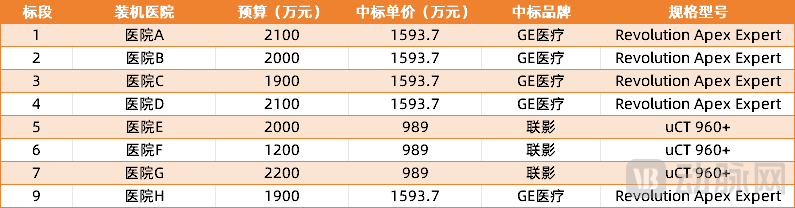
Regarding the winning bid for the Zhejiang Provincial Health Commission's ultra-high-end CT procurement project (I) by Zhejiang Government Procurement Center, although GE Healthcare is not an EU company, it has been affected by relevant policies this year, and its winning product, Revolution Apex Expert, has already been localized in China.
The "trade-in" program for county-level medical consortia involves mid-to-low-end medical equipment, with equally substantial procurement budgets. Taking the trade-in program for county-level medical consortia in Xinjiang as an example, the total budget for this project is 600 million yuan, with approximately 300 million yuan allocated per procurement batch. Among this, the package for general ultrasound equipment was ultimately awarded at 39.198 million yuan for 94 ultrasound machines, suggesting that its budget exceeded 45 million yuan.
However, judging from past bidding data, the impact of the "Notice" on centralized procurement has been relatively limited. Over the years, the rise of domestic equipment and relevant policies requiring a certain "localization ratio" in provincial tenders have led to a steady decline in the number of imported devices held by distributors.
Meanwhile, companies such as Siemens and Philips have already achieved a certain level of localization for their high-, mid-, and low-end products, making it difficult to trigger the restriction that "the value of medical devices imported from the EU must not exceed 50% of the total project contract amount."
In the long term, the variety of centralized procurement of equipment will gradually increase, potentially restricting sales of related imported products in the future and forcing distributors to further reduce the bidding proportion of imported devices.
Regarding ultra-high-end products priced above 45 million, the "Notice" directly affects such products, but due to the existence of exemption policies, the impact pathways differ.
Taking Siemens Healthineers as an example, the unit prices of its flagship products, the photon-counting CT NAEOTOM Alpha and the 7T MRI MAGNETOM Terra series, are both over 45 million yuan. Among them, the MAGNETOM Terra.X received NMPA (National Medical Products Administration) approval in September last year, with registration number Guoxiezhun 20243061675, becoming the first fully domestically produced 7T clinical MRI system in China, and therefore will not be affected by the current policy.
The situation faced by the photon-counting CT NAEOTOM Alpha is more complicated than that of the previous-generation product MAGNETOM Terra, involving policy exemptions.
The following is the policy Q&A from the "Notice" issued by the Ministry of Finance:
"The provision in the 'Notice' stating that 'the aforementioned measures do not apply to procurement projects where medical devices imported solely from the EU can meet procurement needs' is not limited to single-source procurement situations; for example, it also applies when two or more suppliers provide medical devices that meet the procurement requirements, but all such devices are imported from the EU."
If only medical devices imported from the EU can meet the procurement requirements, and products manufactured within China or imported from other countries are unable to serve as substitutes, the procurement project may proceed with purchasing medical devices imported from the EU to meet patient treatment needs. However, the procuring entity shall organize specialists to conduct an evaluation demonstrating that only EU-imported medical devices can be procured, and shall submit the relevant documentation together when applying for the purchase of imported products.
Although MAGNETOM Terra, bearing the "National Medical Device Import Registration," currently faces no competitors from domestic manufacturers in the market, it has been rendered ineligible for sales in China due to the availability of substitute products such as MAGNETOM Terra.X (and potentially GE Healthcare's imported SIGNA 7.0T MRI if approved).
Photon-counting CT NAEOTOM Alpha shares the same "National Medical Device Import Registration" status; however, since no other photon-counting CT systems have been approved in China, this device falls within the exemption clause, allowing domestic institutions to procure it normally.
The only issue is that Canon Medical's photon-counting CT TSX-501R has already received FDA 510(k) clearance in the United States this month. If the CT TSX-501R subsequently gains NMPA approval, regardless of whether it is domestically produced or imported, it will break Siemens' NAEOTOM Alpha's exempt status due to its previously irreplaceable position.
Even so, Siemens can still avoid sanctions by slightly lowering prices. According to bidding data, in 2025 the unit price of photon-counting CTs in China was mostly below 50 million yuan, with Ningxia Medical University General Hospital and the Second Affiliated Hospital of Dalian Medical University purchasing at 43.99 million and 41.98 million yuan respectively, already within the red line of 45 million yuan. Therefore, photon-counting CTs remain in a safe position and are unlikely to face sales restrictions due to policy.
Compared to China's policies, the impact of the EU's current restrictive measures will be greater in the short term. According to a report by the Global Times: in 2023, the EU medical technology market was valued at approximately 150 billion euros, with government procurement accounting for 70%. Contracts worth over 5 million euros accounted for 4% of the number of tenders, but represented about 60% in value terms.
In the field of medical imaging equipment, companies such as Mindray Medical, United Imaging Healthcare, and Neusoft Medical have extensive overseas expansion. Taking United Imaging Healthcare as an example, by the end of the first quarter of 2025, the company had obtained CE certification for 49 products, including high-end and ultra-high-end devices such as the uMR Jupiter 5.0T MRI, uMR Max 3.0T MRI, uMI Panorama series PET/CT, and uAngio AVIVA (DSA), making it relatively easy to reach the procurement threshold of 5 million euros.
Mindray Medical also has a relatively mature commercial presence in the European market. Taking its footprint in primary healthcare across Europe as an example, products such as the TE Air wireless handheld ultrasound and the TEX20 ultrasound system have consistently ranked high in sales, although policy barriers could potentially hinder further commercialization.
Other markets, such as IVD equipment, dialysis equipment, cardiovascular intervention, and high-value cardiac consumables, are also facing dual challenges in both product development and supply chain. For instance, dialysis equipment companies represented by Weigao Shares and Jianfan Bio had exports to Europe amounting to 720 million USD in 2024, primarily supplying public dialysis centers in countries such as Spain and Italy, but may have to forgo some orders with high procurement budgets.
Overall, the reasons why EU policies have a greater short-term impact than domestic policies can mainly be attributed to two points. On one hand, the EU's medical industry development is more advanced than that of China, resulting in larger procurement volumes and thus greater economic impact from sanctions; on the other hand, domestic enterprises are generally relatively young—while their products can match those of EU companies, they have not yet had sufficient time or resources to establish localization strategies, making them more vulnerable to policy shocks.
However, companies like Siemens and Philips can mitigate the impact of China's countermeasures through localization strategies in China, and domestic enterprises can also bypass IPI restrictions via localized production and supply chain arrangements. Yet, as the risks of deglobalization have sharply increased in recent years, these companies need to accelerate their localization efforts and enhance their resilience.
Moreover, the IPI only restricts public procurement exceeding 5 million euros; the markets for small and medium-sized hospitals, private institutions, and home medical use remain open. During the period when the EU reconsiders the IPI, domestic enterprises can also focus on capturing this segment of the market.
There are no real winners in trade conflicts, so resolving disputes through diplomacy remains the best solution. After all, the localization of Siemens Healthineers and Philips Healthcare in the Chinese market has significantly driven technological advancement in medical equipment, progress in medical talent, and improvements in the supply chain, while high-value products from United Imaging Healthcare and Mindray Medical have brought more affordable, accessible, and widely available medical services to patients in Europe.
Medical technology should inherently be a collaborative achievement transcending national borders; only by removing barriers and working together can we accelerate the advancement of healthcare as a whole.