

ByteDance and Amazon Accelerate Offline Healthcare Expansion Through Strategic Acquisitions

One Medical
Digital Basic Medical Service Provider
Internet giants are accelerating their expansion into offline medical services.
Following Amazon’s late-July announcement of its $3.9 billion acquisition of One Medical, which operates 188 offline clinics, ByteDance has recently completed a full acquisition of the premium women’s and children’s hospital Amcare, sending shockwaves through the industry.
In fact, it is hardly new for internet giants to venture into medical services: companies including Tencent, JD.com, and Kuaishou have all attempted to operate offline clinics. As early as 2020, ByteDance established Songguo Clinic in Beijing, which is now known as Xiaohe Clinic.
Moreover, ByteDance led the Series C funding round for the internet healthcare platform “Haoxinqing” in 2021, and its subsidiary Xiaohe Health acquired a stake in Hongda Airui Medical Technology. These companies all possess “offline DNA”: Haoxinqing operates physical offline psychological clinics, while Hongda Airui Medical Technology owns brick-and-mortar medical institutions such as Beijing Meizhong Airui Cancer Hospital.
ByteDance’s recent increased investment and full acquisition of Amcare indicate a deeper foray into the healthcare services sector:If ByteDance’s previous moves were purely financial investments, this full acquisition signifies the integration of Amcare into its ecosystem, becoming a key component in connecting its online and offline medical service workflows.
From Financial Investment to Full Acquisition of High-End Women’s and Children’s Hospitals: How Is ByteDance Strategizing? How Far Have the Healthcare Service Ecosystems Built by Internet Giants Like ByteDance and Amazon Progressed? What Are the Potential Future Evolutionary Trends? VCBeat Has Conducted a Review and Analysis.
Since mid-2021, ByteDance has extended its reach from online healthcare to asset-heavy offline medical services, making frequent moves in this sector.: This includes investments in Amcare, Haixinqing, and Hongda Airui Medical Technology, as well as Dazheng Medical, which was reported to be a target for investment but ultimately did not proceed due to an exclusivity agreement tied to Tencent Investment.
“ByteDance has been actively seeking high-quality targets with offline physical medical service institutions, including vertical sectors such as health checkups, pediatrics, traditional Chinese medicine (TCM), community health services, and family doctors,” said an industry insider close to ByteDance. “ByteDance is interested in learning about and engaging with leading companies in niche sectors, provided they possess strong operational and management capabilities.”
However, unlike its moves in other sectors, ByteDance has been relatively more cautious in the healthcare segment. This is because private hospitals and clinics face numerous challenges, making quality control and operational management critically important.
Taking the recent full acquisition of Amcare as an example, the institution’s official website indicates that it currently operates seven women’s and children’s hospitals, two comprehensive outpatient centers, and five postpartum care centers, with coverage extending across the Beijing-Tianjin-Hebei, Yangtze River Delta, and Pearl River Delta regions. Its gynecological medical team is primarily composed of professionals from Grade A tertiary hospitals and secondary specialized hospitals, and it obtained the license for in vitro fertilization (IVF) services when it acquired Beijing Baodao Obstetrics and Gynecology Hospital in 2020.
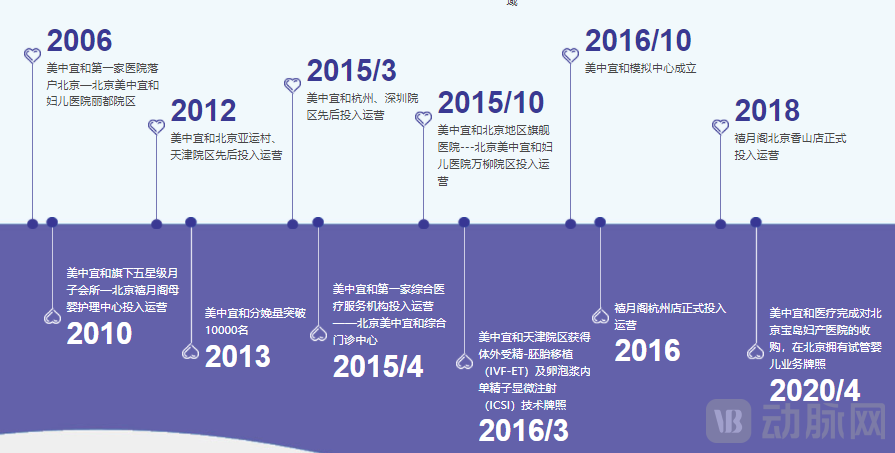
(The Development Timeline of Amcare. Image source: Official corporate website)
Additionally, according to previous disclosures by relevant executives at Beijing Amcare Women’s & Children’s Hospital, the institution has served over 500,000 high-net-worth families and delivered more than 70,000 newborns. A significant portion of its revenue is derived from obstetrics, with an average transaction value per customer of approximately RMB 70,000, positioning it at the higher end of the market price spectrum.
Prior to its acquisition by ByteDance, Amcare had long been a favorite among investors: Legend Capital, CICC Jia Cheng, and Aerospace Investment invested in the company as early as 2011; Warburg Pincus, Everbright Capital, and China Renaissance participated in its RMB 100 million Series A financing round in 2013. Since then, Amcare has also attracted investments from prominent institutions such as Hillhouse Capital, Sino-Ocean Capital, Guoke Investment, WuXi AppTec, and Shuimu Investment Group.
“The integration of online and offline services has always been a key trend in internet healthcare.“, many leading enterprises are making attempts, but there are no particularly successful cases so far. Therefore, as the most prominent internet giant at present, ByteDance’s attempt holds significant symbolic meaning,” Li Ping, co-founder of an internet healthcare company, told VCBeat. “Women’s and children’s health, mental health, and medical aesthetics are the sectors most aligned with ByteDance’s robust “content ecosystem” (including Douyin, Toutiao, Huoshan Short Video, etc.).”
At its core, scenarios such as women’s and children’s health, mental health, and medical aesthetics are more effective at driving online patient acquisition compared to other medical fields.
It is worth emphasizing that,ByteDance has long been piloting the integration of online and offline operations from within.As shown on the “Xiaohe Health” app, Beijing Xiaohe Outpatient Clinic has been prominently featured on the homepage, with departments such as Stomatology, Ophthalmology, Traditional Chinese Medicine, Dermatology, Gynecology, and Medical Aesthetics now available. Operating hours are from 9:00 AM to 6:00 PM, Monday through Sunday. The app currently displays 466 patient reviews.
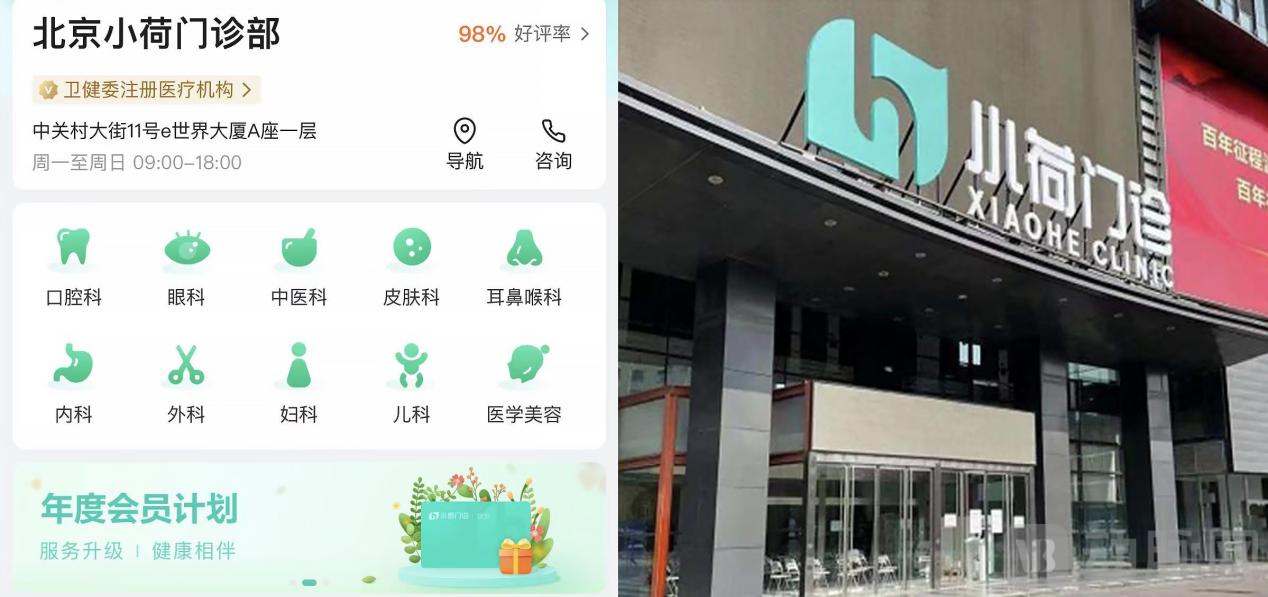
(The offline physical locations and online pages of Beijing Xiaohe Clinic)
In its business initiatives, Beijing Xiaohe Outpatient Clinic launched an annual membership plan online, with a yearly fee of RMB 599. The package includes services such as “ultrasonic dental cleaning,” “traditional Chinese medicine (TCM) conditioning,” “skin analysis,” and “eye health assessment,” along with discounts on selected items—common operational strategies employed by internet platforms.
In addition to accelerating the digital transformation of offline service providers, the operations of “Xiaohe Health” are also advancing rapidly.Currently, the “Xiaohe Health” app is gaining rapid momentum. According to monitoring data from Qimai Data, “Xiaohe Health” has maintained a high level of downloads among internet healthcare platforms on the iPhone platform over the past year, with a peak single-day download count of 9,228. The average daily downloads over the past month stood at 3,810, bringing the cumulative total to 1.86 million downloads to date.
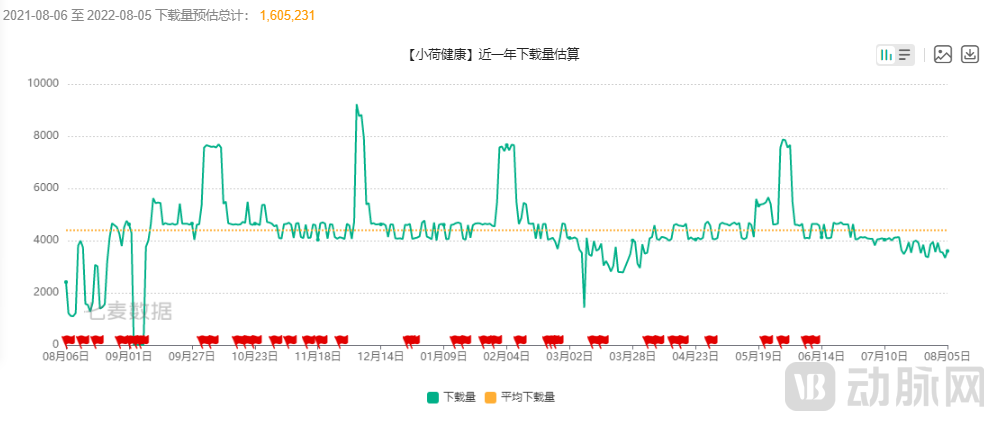
(Image source: Qimai Data)
Although there is still a gap compared to the top-tier players in China—for instance, the download volume of a leading internet healthcare app is approximately twice that of “Xiaohe Health”—this gap stood at around threefold during the same period last year. In other words, the “Xiaohe Health” app is gradually narrowing the disparity as it catches up with the leading apps.
In its exploration of monetization models, “Xiaohe Health” has established two major business segments: “Disease Database” and “Medical Services.”
The “Disease Database” features “real-world experiences” with various disease treatments uploaded by users, operating under a patient community model. Related disease cases are contributed by users, while general medical knowledge is provided by “Xiaohe Medical Encyclopedia.” “Xiaohe Medical Encyclopedia” was upgraded from “Baike Mingyi,” which ByteDance acquired in full for RMB 500 million in 2020.
“Medical Services” comprises six segments: “All Hospitals,” “Online Pharmacy Mall,” “Home Medicine Delivery,” “Pediatric Vaccinations,” “Premium Medical Aesthetics,” and “Free Medication & Clinical Trial Recruitment.” Based on historical experience, “Medical Services” should be the key to ByteDance’s ability to establish a viable short-to-medium-term profitability model in the healthcare sector. Online consultations can bridge doctor-patient resources and capture patient needs, enabling the platform to generate revenue through related products and services. Pharmaceuticals have consistently been the highest value-added products within current medical service scenarios.
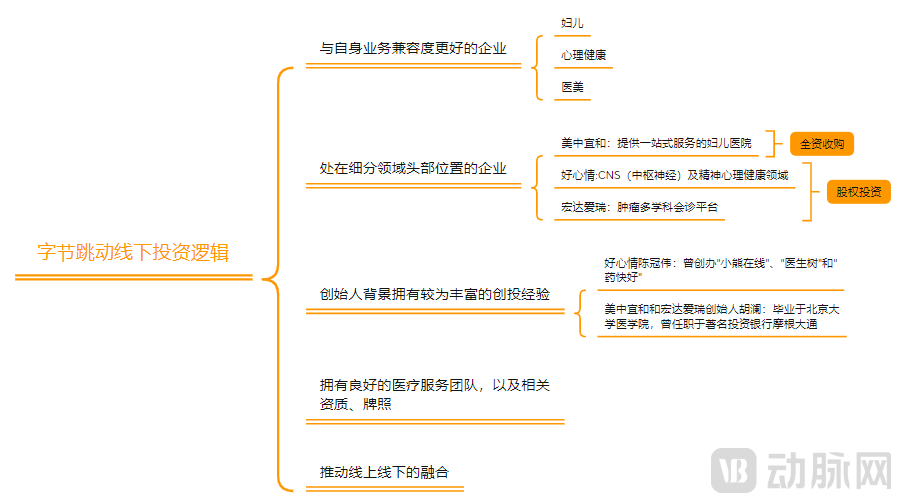
(ByteDance’s Offline Investment Logic; Graphic by VCBeat)
“The all-cash acquisition of Amcare represents a major move in the industry, demonstrating ByteDance’s determination to enter the healthcare services sector,” said Li Ping.Following a small-scale internal pilot, the inclusion of Amcare may become a key attempt by ByteDance to integrate its online and offline medical services. If this integration proves successful, ByteDance may accelerate its expansion across various specialized segments of the healthcare sector.”
In summary, ByteDance is continuously expanding its offline healthcare service footprint by acquiring leading companies in various niche sectors. Meanwhile, it is accelerating the operation and promotion of its “Xiaohe Health” app online, establishing a preliminary business model. Finally, ByteDance is deeply integrating these two fronts to drive the convergence of online and offline services.
Two weeks before the news broke that ByteDance had fully acquired Amcare, global internet giant Amazon similarly announced its acquisition of One Medical, a leading U.S. community healthcare provider, for as much as $3.9 billion (approximately RMB 26.3 billion).
This is Amazon’s largest healthcare acquisition since it entered the medical field in 2000.
VCBeat previously conducted a case study on One Medical, a membership-based community healthcare service platform that operates both offline clinics and an online digital platform. By adopting a strategy of extensive outreach and broad coverage, One Medical locates its clinics in high-traffic areas such as shopping malls, office buildings, and residential communities, thereby positioning them as close as possible to members’ locations to reduce their travel costs. Currently, One Medical serves over 760,000 members through 188 offline clinics, primarily providing employee health benefits to enterprises.

(One Medical clinic; image source: official corporate website)
Earlier this year, Amazon launched its telehealth service platform, Amazon Care, which supports both online and offline care models. The platform offers services including remote medical consultations, online doctor appointments, in-home nursing visits, and medication delivery.
According to Citibank analysts, the integration of virtual and in-person care is central to the strategic focus of the One Medical and Amazon Care segments.This means that Amazon is also leveraging this acquisition to drive the integration of offline medical services with its own online technologies.
As can be seen, similar to ByteDance, Amazon has not opted to build its own medical service institutions but has instead pursued an acquisition-driven strategy.
“For a long time, domestic internet healthcare companies have sought to penetrate deeply into the medical services sector. In recent years, many such enterprises established offline clinics, opening multiple locations within a single city, while others launched traditional Chinese medicine (TCM) clinics or general practice centers. However, the executives leading these initiatives were top talents from the internet industry rather than the healthcare sector. Given the significant barriers between industries, the actual outcomes were less than satisfactory,” Yang Yang, a senior investor, told VCBeat. “One Medical has been in operation for 15 years, and its internal operations are relatively mature. For Amazon, acquiring One Medical means it does not need to start from scratch; instead, the focus should be on how to further enhance One Medical’s existing strengths.”
In other words, compared with exploring a self-built model, identifying and investing in mature healthcare service providers will save internet companies significant learning costs and facilitate the rapid deployment of integrated online and offline medical services.
However, despite the aforementioned advantages, cross-enterprise integration is by no means an easy task.
Prior to the acquisition, Amazon and One Medical operated independently, with distinct and non-overlapping markets, teams, corporate cultures, and strategic directions. Post-acquisition, the two companies must undertake a comprehensive and protracted process of alignment and integration across all organizational levels. This complex and enduring endeavor is testing Amazon’s capability in business integration.
Internet giants are increasingly betting on offline medical services. In the view of veteran investor Yang Yang,Beyond the strategic considerations of tech giants’ continued deepening involvement in healthcare, the core issue lies in the inseparable and complementary relationship between online and offline services.
· First, in real-world healthcare settings, the trust and sense of security established through face-to-face interactions remain difficult for online services to replace;
·Second, compared with offline medical services, users primarily engage in online follow-up consultations for common and chronic diseases, while diagnostic tests, examinations, and surgical procedures cannot be conducted online;
· Third, the online channel exhibits a stronger aggregation effect, which drives cost reduction and efficiency gains in offline services, while feedback and data from offline operations further enhance the online platform.
Therefore, the integration of online and offline services requires not only data interoperability but also continuity in service workflows, as well as strengthened collaboration between online platforms and offline hospitals to promote mutual synergy.
It is also worth noting that the vast majority of offline institutions operate with heavy assets, and chain expansion entails a multiplicative increase in costs. Therefore,The expansion of the offline service network must be premised on cost controllability.
Of course, the challenges facing the internet healthcare industry remain prominent, particularly in constructing a closed-loop business model. Existing internet healthcare companies are still in an exploratory phase: after more than a decade of development, there appears to be no clearly defined commercial path beyond “selling medications.”
For instance, mainstream internet healthcare models such as online appointment scheduling and virtual consultations struggle to cover costs due to low average transaction values and significant demand fluctuations, resulting in limited long-term growth potential. Conversely, establishing offline hospitals or clinics as a foundation for internet-based services transforms the business into a capital-intensive endeavor. Finally, relying exclusively on public hospitals to operate internet hospitals leaves platforms vulnerable to the eventual scenario where these public institutions establish their own independent digital channels.
But regardless,Companies such as ByteDance and Amazon have built online internet healthcare platforms and subsequently acquired offline medical service providers, thereby establishing strategic potential for expansion.. And this may well propel ByteDance and Amazon to become key game-changers in the healthcare sector.
It is important to note that, due to the unique characteristics of the healthcare industry, all participants must maintain sufficient patience and humility, avoiding any rush to achieve quick results.
From this perspective, internet giants still need to forge ahead.
(At the interviewees’ request, Li Ping and Yang Yang are pseudonyms.)