

Jinxi Medical Targets High-Potential Medical Imaging Sector with Mobile CT and Teleconsultation Systems
Leveraging its advantages in high-resolution imaging, vessel enhancement, multiplanar reconstruction, and three-dimensional reconstruction, CT plays a pivotal role in clinical diagnosis, intraoperative procedures, and postoperative assessment. It is regarded as a highly effective tool for achieving early diagnosis and facilitating timely treatment.
Although the technical value of CT continues to be clinically validated, since Hounsfield invented CT in 1969, this technology has been continuously iterating in response to evolving clinical needs. Mobile CT represents a significant niche direction in the current iterative development of CT technology.
Not only have domestic and international manufacturers entered the market, launching related products to meet clinical needs for rapid bedside diagnosis in the Neurological Intensive Care Unit (NICU), preoperative localization, intraoperative monitoring, and pre-hospital diagnosis by stroke emergency ambulances. Moreover, this technology has been extensively applied in COVID-19 screening, owing to its features such as non-contact scanning, compact size, ease of operation, broad mobile coverage, and high scanning throughput.
Tianjin Jinxi Medical Equipment Co., Ltd. (hereinafter referred to as “Jinxi Medical”) specializes in the research and development of high-end medical imaging equipment. In 2020, the company’s independently developed Jinxi Mobile CT (mobile head cone-beam CT) obtained a Class III Medical Device Registration Certificate issued by the National Medical Products Administration (NMPA), as well as a Class III Medical Device Production License issued by the Tianjin Medical Products Administration, officially entering the stage of industrialized production.
This product utilizes flat-panel detector technology to perform CT scanning of soft tissues in the patient's head. It overcomes the limitations of traditional spiral CT systems, which are not suitable for mobile applications, and employs cone-beam reconstruction techniques to achieve high-resolution imaging of both brain parenchyma and bone windows in cone-beam CT of the head. Furthermore, by leveraging CT artifact removal algorithms, noise reduction and image enhancement technologies, and high-speed parallel image reconstruction technology (with independent intellectual property rights), it provides equipment support for rapid diagnosis of head emergencies and bedside diagnosis of critically ill patients with head conditions.
Stroke is a major disease that poses a serious threat to the health of China’s population and hinders socioeconomic development, while also generating high demand for mobile CT services. According to the 2019 Global Burden of Disease Study, there were 3.94 million new stroke cases in China in 2019, including 2.87 million cases of ischemic stroke, 850,000 cases of intracerebral hemorrhage, and 220,000 cases of subarachnoid hemorrhage.
The application of cerebrovascular imaging techniques, such as computed tomography angiography (CTA) and digital subtraction angiography (DSA), for early screening, diagnosis, and treatment is a crucial measure to effectively reduce the incidence and mortality rates of stroke. However,For patients with acute ischemic stroke or those who have undergone cranial surgery, among others, who have a high demand for timely CT scan diagnosis, there are numerous pain points in the processes of rapid screening, diagnosis and treatment, as well as postoperative management.
On one hand, during the process, patients may face significant risks to their treatment due to the long and bumpy journey to the hospital, which can easily cause them to miss the "golden hour" for stroke treatment or suffer secondary injuries; the long distance for stretcher transport may make it difficult to meet the needs for using equipment such as ventilators and monitors along the way; and delays in emergency response to changes in the patient's condition can pose great risks to their care.
On the other hand, conventional CT scanners are typically immobile due to their large size and weight. Their high power consumption, high radiation dose, and long scan times further limit their mobility, rendering them unsuitable for bedside use. To meet the requirements of bedside imaging, it is necessary not only to overcome spatial constraints but also to equip conventional CT systems with specialized software to ensure clear image acquisition—a task of considerable difficulty.
Mobile CT is an effective solution to these problems and a dark horse in the specialized CT segment.
Jinxi Medical has independently developed the Jinxi Mobile CT, leveraging its proprietary technologies including a CT artifact removal algorithm with independent intellectual property rights, noise reduction and image enhancement, high-speed parallel image reconstruction, and cone-beam reconstruction.To rapidly acquire cerebral imaging data, thereby gaining critical time for patient treatment.
It is reported that the product features low radiation dose, an integrated X-ray protection system, compact size, lightweight design, self-contained mobility, no requirement for a dedicated CT table, dual power supply options (220V AC mains or battery), short scan time, and DR functionality.
Addressing the most contentious issue of high radiation doses associated with mobile CT scanners, the company has independently developed an X-ray protection system that effectively shields operators and surrounding personnel from radiation. According to the test report issued by the Institute of Radiation Medicine, Chinese Academy of Medical Sciences, the radiation dose in the safe zone (the area outside the red frame) of the Jinxi mobile CT is less than 2.5 μSv/h, complying with the Basic Standards for Protection against Ionizing Radiation and for the Safety of Radiation Sources (GB 18871-2002).
Therefore, this product is suitable for scenarios such as point-of-care rapid diagnosis, preoperative localization, and postoperative follow-up. It can also be equipped on ambulances for pre-hospital stroke diagnosis, and is widely used in trauma emergency care, disaster relief, and battlefield medicine to enable on-site or mobile diagnosis and treatment. This effectively fills the clinical gaps that traditional CT scanners fail to address.
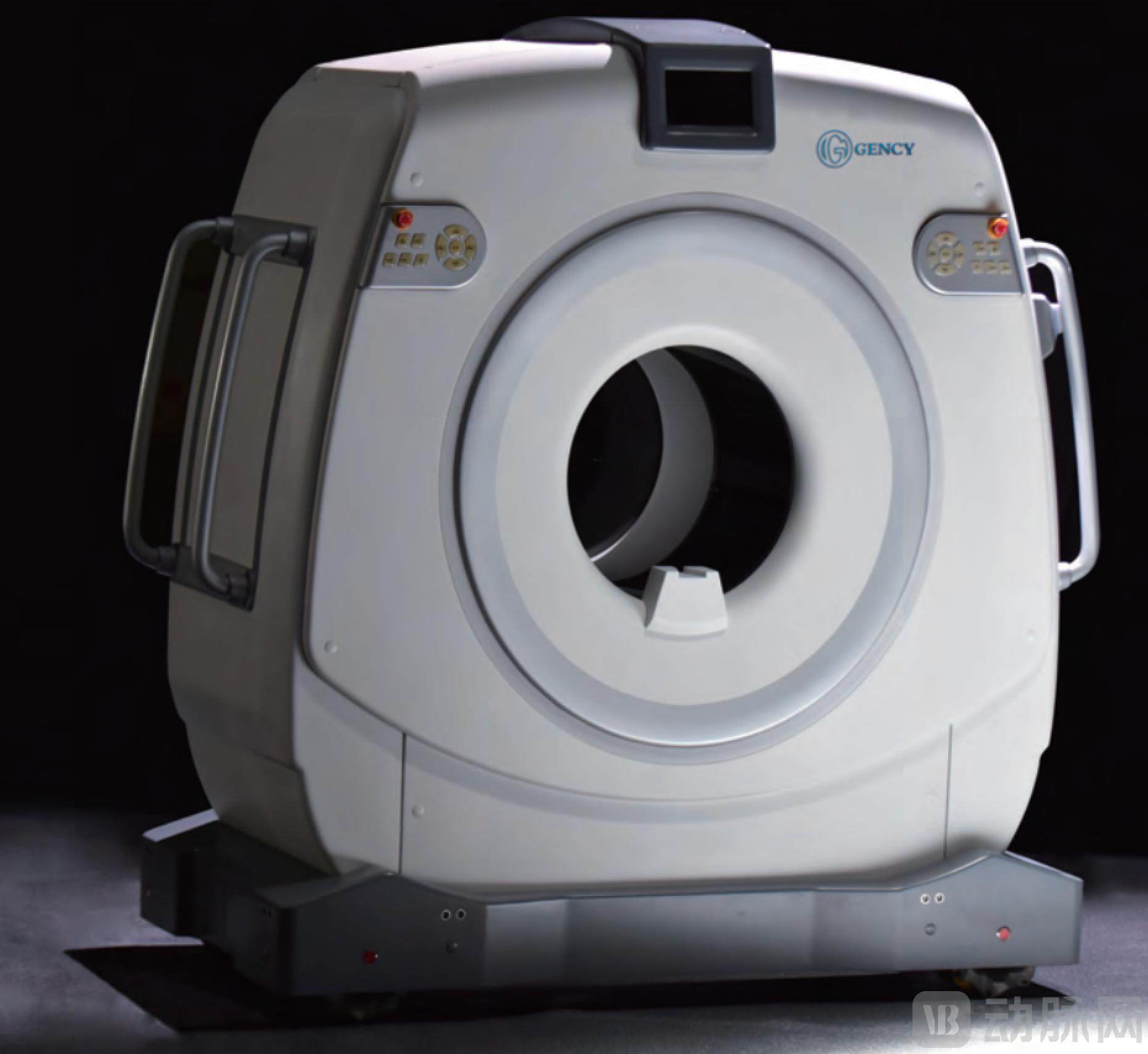
Jinxi Medical Mobile CT
Mobile CT Stroke Ambulance is a significant expanded application based on mobile CT technology.
The mobile CT stroke ambulance primarily consists of specialized vehicles, mobile CT scanners, blood glucose and coagulation testing instruments, cardiopulmonary resuscitation (CPR) emergency equipment, vital signs monitoring devices, and a medical information communication platform.
According to public information, the world’s first “mobile stroke unit,” which was built and put into operation in Germany in 2011, reduced the average treatment time (from the hospital’s receipt of the emergency call to the patient receiving treatment) by approximately 20 minutes compared with traditional approaches.
Jinxi Medical, with its Jinxi Mobile CT as the core technology, conducts comprehensive research on mobile CT-equipped stroke ambulances. The company aims to optimize the stroke treatment workflow by maximizing the satisfaction of the needs of both stroke care physicians and patients.
In terms of appearance design,The enterprise adopts an integrated emergency light design with a distinctive ambulance-specific styling. Meanwhile, eco-friendly and durable materials are selected for the interior of the medical cabin to meet the requirements for daily disinfection and cleaning.
Guided by this philosophy, Tianjin Jinxi Medical Equipment Co., Ltd. has developed a large medical cabin to meet the spatial requirements for the installation and operation of medical equipment, as well as for patient resuscitation and treatment. The company also offers high-performance HVAC (Heating, Ventilation, and Air Conditioning) solutions for medical cabins, ensuring that the climate control systems for the driver’s cab and the medical cabin operate independently.
The medical cabin is equipped with a negative-pressure purification system and a dedicated stretcher platform for CT scanning, meeting the requirements for stretcher loading/unloading and patient positioning during CT examinations.
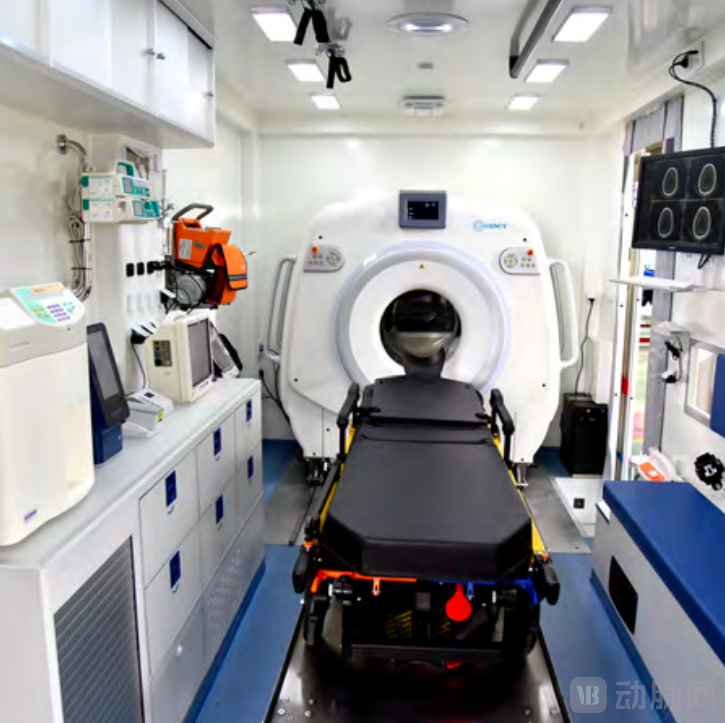
Interior of the Medical Cabin of the Jinxi Mobile CT Stroke Ambulance
In radiation protection,The company has not only designed high-density lead plates around all six sides of the cabin to provide fully enclosed X-ray protection, but also independently developed the Jinxi Mobile CT Protection System to ensure radiation safety for personnel surrounding the vehicle.
On the power supply system,The enterprise adopts a multi-source power supply solution (battery, photovoltaic power generation, vehicle-mounted generator, and mains electricity), as well as a 48V/12V dual DC power system, to meet the power requirements of medical equipment under various conditions.
Nowadays, with the development of technologies such as 5G and informatization, remote consultation systems have been realized, and mobile CT stroke ambulance technology has further advanced, enabling patients to be admitted to the hospital and receive medical treatment as soon as they board the ambulance.
The Jinxi Mobile CT Stroke Ambulance utilizes 5G communication and incorporates signal enhancement technology. It captures patient information by identifying patient identification documents and automatically collects audio-visual data. Furthermore, by integrating in-vehicle hardware and interfacing with hospital systems such as the Hospital Information System (HIS), Laboratory Information System (LIS), and other institutional platforms, it aggregates CT imaging data and rapid testing/monitoring device data. This enables seamless connectivity between the onboard system and hospital systems, ensuring real-time data synchronization.
Upon entering the mobile CT stroke ambulance, patients can complete admission procedures and undergo examinations.
Leveraging the 5G-enabled smart healthcare system and teleconsultation platform, physicians can transmit real-time data from mobile CT stroke ambulances—including 4K high-definition video, CT imaging, electronic medical records, and readings from electrocardiographs, ventilators, and patient monitors—to the consultation site. This enables specialists to provide rapid remote guidance for the emergency management of acute stroke, including intravenous thrombolysis and mechanical thrombectomy.
Building on this suite of facilities, a complete and rapid “treatment chain” can be established, enabling patients to complete registration, hospital admission, remote specialist consultations, and thrombolytic therapy while still in the ambulance.This approach further transforms the traditional stroke treatment workflow, shortening the time from symptom onset to hospital admission, diagnosis, and treatment. By moving CT imaging and blood testing from in-hospital settings to pre-hospital environments (at the scene of stroke onset), it provides rapid, stable, and precise technical support for advancing the thrombolysis window in acute ischemic stroke. Meanwhile, it offers medical support to primary healthcare institutions lacking diagnostic and therapeutic experience, thereby enhancing their emergency care capabilities.
In addition, mobile CT stroke ambulances can also be applied to emergency medical services such as trauma care, disaster relief, and battlefield medicine, as well as for medical support at large-scale events and sports competitions.
“Patient-centered, leveraging Internet-plus information technology to provide integrated, seamless, efficient, and orderly standardized pre-hospital and in-hospital emergency diagnosis and treatment services for stroke, while exploring the establishment of a regional heart and brain care network model that combines tiered treatment with regional collaboration. This is the ultimate goal of Jinxi Medical.”Zhang Li, founder of Jinxi Medical, told VCBeat.
To achieve this goal, Tianjin Jinxi Medical Equipment Co., Ltd. has built a stroke prevention and treatment network based on the construction of the 120 emergency medical services (EMS) stroke first-aid map module. By scientifically coordinating and rationally allocating resources, the company aims to shorten the time for patients to receive treatment, reduce disability rates, and improve survival rates. This approach enables multi-party participation and collaborative care involving patients and their families, 120 EMS centers, hospital emergency departments, and stroke centers.
Simultaneously, process management is implemented for all personnel and equipment involved in treatment. This includes management of patient care workflows, clinical staff operational and rescue procedures, and telemedicine and command personnel operational protocols. By defining behavioral boundaries, the system achieves seamless recording with full-process traceability, ensuring that information is queryable and auditable. This safeguards the safety and quality of medical services while providing enhanced support for evidence-based medicine. Ultimately, it presents a scientifically standardized emergency response workflow for stroke, effectively improving the efficiency of stroke treatment.
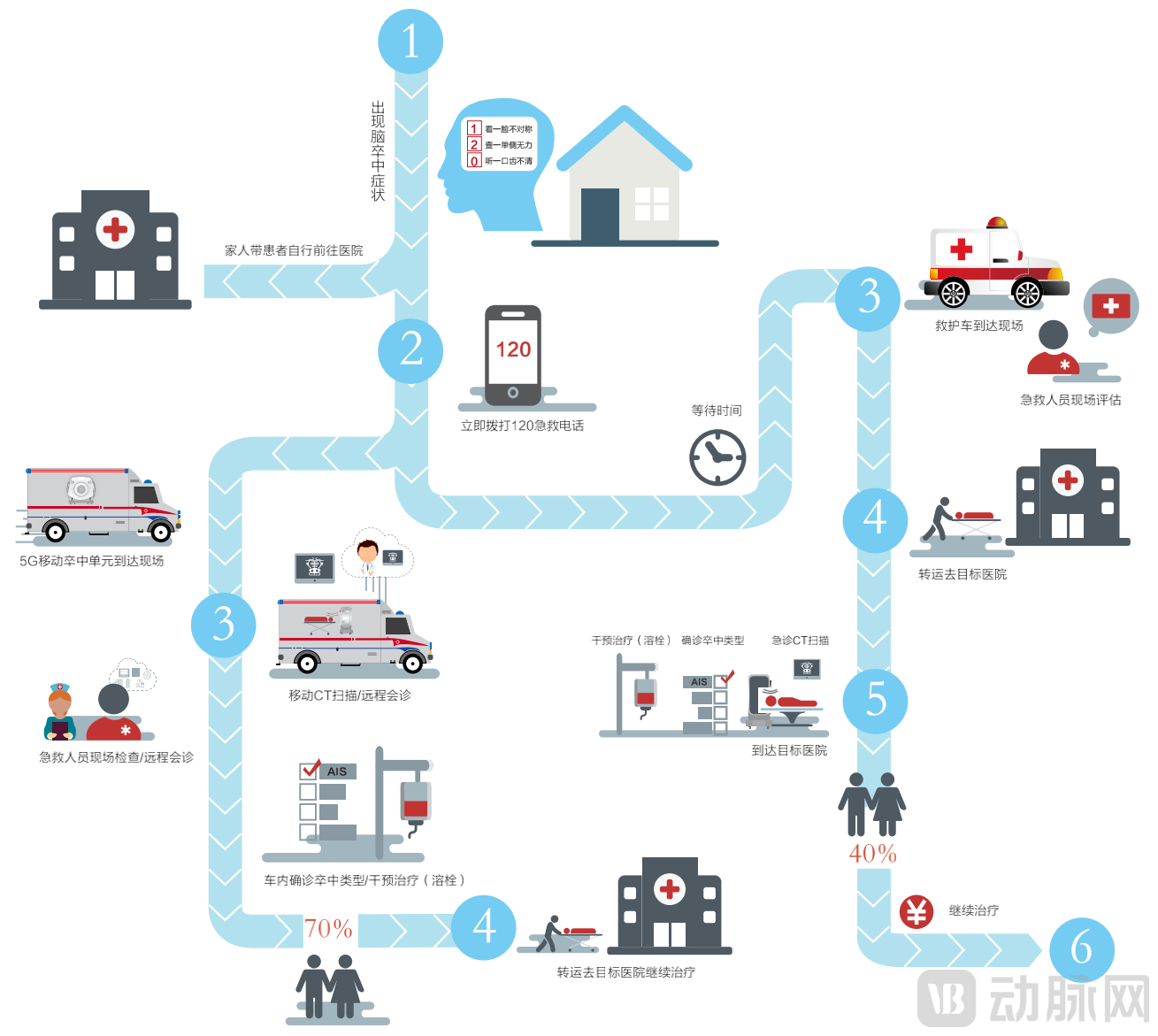
Treatment System
In the future, with the continuous advancement of technology and the improvement of medical and emergency care systems, the proportion of patients receiving timely treatment will further increase, and the application of mobile CT scanners and mobile CT stroke ambulances will undoubtedly become more widespread.