

Post-Pandemic Fundraising Strategies for Internet Healthcare Startups
In 2022, the IPO of Zhiyun Health and WeDoctor’s financing round of over RMB 1 billion created one of the few highlights in the internet healthcare sector.
As the industry has matured, leading companies have emerged—either racing toward IPOs or having achieved a degree of financial self-sufficiency—with capital increasingly concentrating in these top-tier players. Overall, the sector’s momentum no longer matches the peak levels seen during the pandemic years.
VCBeat has learned that some small and medium-sized enterprises (SMEs) are continuing their innovation efforts and seeking financing to support further business growth. However, discussions and skepticism regarding the business models of internet healthcare remain prevalent within the industry. Can internet healthcare companies still secure funding? In particular, what capabilities make emerging SMEs more attractive to investors? VCBeat conducted an analysis based on interviews with multiple investment firms and enterprises.
According to data from the National Health Commission, as of June 2022, a total of 1,700 internet hospitals had been established across China; while the growth rate has slowed, the number continues to rise.
Additionally, data from Qichacha shows that over the past year, more than 400 companies with “Internet Hospital” in their names have been registered and established. Although registering a company as an Internet Hospital does not equate to obtaining official approval for operating an Internet Hospital, it at least indicates that these companies have either successfully secured approval for their Internet Hospitals or are actively preparing for such endeavors.
Meanwhile, cities such as Yinchuan, Chengdu, Qingdao, Guangzhou, and Tianjin have successively established a number of internet healthcare industrial parks, offering services including platform development and operational support.
The establishment and expansion of new companies, businesses, and models inevitably involve external financing. VCBeat has learned that multiple internet healthcare companies are currently in the process of raising funds.
These companies are focusing on more specialized niches, no longer building large, all-encompassing platforms.
Founded in 2021, Hanyi has focused on the rare disease sector by establishing a private-domain operational platform that connects physicians, patients, and pharmaceutical companies. This platform empowers specialist physicians to build their own online rare disease departments, delivering comprehensive solutions spanning physician education, academic exchange, academic promotion, and patient management.
Hu Yifan, founder of HanYi, formerly served as Vice President of Qilekang Shiliu Yunyi Internet Hospital. Drawing on his extensive experience in the internet healthcare sector, Hu believes that the physician community operation model is well-suited to address the pain points and critical needs associated with rare diseases. “Similar to many other conditions, rare diseases urgently require efficient and effective post-diagnosis management. However, rare diseases are particularly unique: many patients remain undiagnosed, and achieving a definitive diagnosis is both difficult and time-consuming. Our platform is designed not only to assist physicians in patient management but also to enhance clinicians’ ability to recognize rare diseases, thereby enabling more efficient and precise identification of affected patients.”
Currently, HanYi is in the early stages of operation and requires financing to further advance product R&D and physician network expansion.
Shanyuhai Doctor positions itself in primary care, achieving differentiation amid a landscape where many platforms focus exclusively on large hospitals. By deploying SaaS systems free of charge in primary healthcare institutions, Shanyuhai Doctor attracts physicians to join its platform and provides them with online patient management tools, enabling functionalities such as remote consultations and referrals. On its platform, 70% of the enrolled physicians come from primary care settings.
In the new round of financing plans, Shan Yu Hai Doctor plans to raise 10 million yuan for the SaaS system to penetrate the grassroots market.
Some companies are also working to validate their commercialization capabilities and diversify their revenue streams, with the aim of securing financing more smoothly.
Zhenru.com is an internet-based breast health platform that provides patients with integrated online and offline services, including breast healthcare, health education, disease diagnosis and treatment, and rehabilitation guidance.
Previously, Zhenru Network secured RMB 5 million in angel-round investment from Sunny Optical, a publicly listed manufacturer of optical products. “We are currently raising our pre-A round, targeting RMB 20 million,” said Yang Yin, founder and chairman of Zhenru Network. The company plans to sign cooperation agreements with 20 tertiary hospitals and 80 tertiary hospitals across China in 2024, register 5,000 physicians, and reach 2 million registered users. The proceeds from this financing round will be primarily used for business expansion, including R&D investment in the technology platform and marketing expenses.
Yang Yin mentioned that the company originally planned to focus on building service capabilities first, without prioritizing revenue generation; however, to facilitate smoother fundraising, the company is now exploring various commercialization avenues, including breast disease management service packages, patient escort services, corporate employee health management services, and a health products marketplace.
Feizhen.com, which brings together experts in thoracic surgery, radiology, pulmonology, and oncology from numerous authoritative Grade A tertiary hospitals across China, is currently raising its Pre-A+ round of financing.
“Diagnosis of pulmonary diseases largely relies on imaging data, making internet platforms particularly well-suited to facilitate early screening, diagnosis, and treatment of these conditions. Therefore, we have built a smart internet healthcare platform anchored by a data center to disseminate popular science health knowledge and connect patients with high-quality medical resources,” said Miao Peisheng, co-founder of Feizhen Wang (Lung Diagnosis Network). Regarding early screening, Feizhen Wang provides medical science education and leverages artificial intelligence to assist physicians in diagnosis. Once patients are identified, the platform utilizes its network of high-quality doctors to deliver timely, integrated online-to-offline one-stop services. In the post-diagnosis phase, it offers postoperative health management services. As a next step, building upon its internet hospital framework, Feizhen Wang plans to establish a specialized hospital for pulmonary nodules to achieve deep integration of online and offline services.
Through online consultations, disease management service packages, early screening, insurance, patient navigation, and testing, Feizhen Wang generated nearly RMB 10 million in medical service revenue in 2021 from both online and offline sources.
For technology-driven enterprises, creating benchmark case studies has become a critical priority. Building on its foundation of serving 2,000 medical institutions, the internet diagnosis and treatment SaaS platform Wangyi Alliance has prioritized the development and operation of the Jingzhou Central Hospital Internet Hospital and the Bijie City Regional Internet Diagnosis and Treatment Platform, fully integrating online and offline service workflows for local healthcare providers. Currently, Wangyi Alliance is raising RMB 50 million in Series A funding, which is planned to be used for technological research and development as well as market expansion.
In addition, companies such as Lianou Health and Fangcun Doctor, which have a certain service volume or focus on digital therapeutics, are also undergoing fundraising.
Overall, compared with the early-stage financing needs of the industry, current enterprises exhibit both continuity and significant differences. The continuity is reflected in the ongoing use of internet hospitals as infrastructure, with subsequent business activities centered on connecting doctors and patients. Current enterprises have absorbed lessons from the industry’s previous explorations, such as disease management service packages, family doctor products, and B2B2C models, all of which represent direct avenues for monetization.
The difference lies in the fact that enterprises now have a clearer understanding of the importance of acquiring precise traffic. By focusing on specific specialties or diseases, they are providing more in-depth services to doctors, hospitals, and patients. Meanwhile, in response to the digital transformation needs of pharmaceutical companies in recent years, they are integrating pharmaceutical digital marketing with internet healthcare to explore new business models.
The industry has undergone iteration. It is evident that internet healthcare, as a focus for investment institutions, will no longer be limited to the online consultation models of the past, which primarily aimed at convenience and efficiency. After communicating with multiple investors, VCBeat has summarized the key areas currently drawing the most attention from investors.
Is it an internet tool or internet thinking?
The original intention behind the penetration of the internet into the healthcare sector was to leverage its efficiency and transparency to address issues such as low operational efficiency and information asymmetry. In recent years, various internet-based tools have emerged to assist patients in seeking medical care and help physicians manage patient care. From the perspective of accessibility, digital health has delivered substantial value.
Jiang Xiaodong, Managing Partner at Changling Capital, stated that healthcare services with internet attributes are not merely delivered through internet tools. “The core mindset of the internet is customer-centricity; when applied to healthcare services, it translates into a pursuit of patient-centric care.”
How to Achieve Patient-Centered Care? In Jiang Xiaodong’s view, it is necessary to reconstruct the processes and formats of healthcare services from the perspective of the outcomes and efficiency experienced by patients. This involves the integration of online and offline services. “Few diseases can be effectively managed through purely online means; the Online-Merge-Offline (OMO) model is applicable to a wide range of healthcare services. However, due to varying disease characteristics, the proportion of online and offline services required for management and treatment differs accordingly.”
It is evident that internet tools serve merely as a vehicle for internet-based medical services, but do not constitute the entirety of such services.
“The traditional healthcare service system, which is centered around hospitals and doctors, urgently needs to change. In the future, most medical services will evolve into an OMO (Online-Merge-Offline) model,” mentioned Jiang Xiaodong. From this perspective, the industry is still in its early stages, with abundant opportunities remaining.
As the Bonus Fades, Where Will Traffic Come From?
Currently, early-established internet healthcare companies such as WeDoctor and Haodf Online have formed relatively stable traffic flows thanks to years of accumulation; meanwhile, players like Ping An Health, JD Health, and AliHealth can access large-scale traffic from their parent companies’ ecosystem.
Since 2020, internet healthcare has experienced a surge in overall traffic. However, due to the vigorous development and promotion of public internet hospitals, a significant portion of this traffic has concentrated within the public healthcare system, particularly in internet hospitals affiliated with large Grade A tertiary (San Jia) hospitals.
According to Wang Jinsong, an investor at Yuanjing Capital, current internet healthcare projects can be broadly categorized into service platform-based and software technology-based models. As the era of traffic dividends wanes, service platform companies face increasing challenges in user acquisition. Only by leveraging the inelastic demands of hospitals or patients can they retain users on their platforms and generate subsequent revenue streams such as user payments. Meanwhile, for the patient side, the integration of corresponding hardware, such as smart wearable devices, enables continuous data collection and service delivery, thereby fostering stronger user stickiness. “We place greater emphasis on the entry point for startups—specifically, whether there are pressing, inelastic needs that urgently require solutions.”
Guo Liang (a pseudonym), an investor at a well-known institution focusing on digital health, stated that whether a company has strong traffic sources is indeed a key dimension to consider; typically, companies incubated by large conglomerates or backed by industry associations tend to have an advantage in terms of traffic.
How to Support the Public Healthcare System?
As previously mentioned, large-scale traffic is converging toward public internet healthcare platforms. Currently, many public hospitals have digitized their medical services, integrating them with offline diagnostic tests, examinations, surgeries, and inpatient care, thereby significantly improving patient experience. In particular, in recent years, as public hospitals faced numerous challenges due to the pandemic, internet healthcare services helped maintain the connection between hospitals and patients, mitigating patient attrition to some extent.
“Determined by the structure of China’s healthcare service system, Guo Liang believes that regardless of the stage of development, the industry cannot detach itself from the public healthcare system; this is one of the core logics underlying the development of internet healthcare.”
According to VCBeat, public healthcare institutions face two realities when it comes to internet-based medical services: First, although they have established internet hospital platforms and are eager to operate them effectively, they have yet to identify a viable breakthrough. Second, in response to various measures under the reform of medical insurance payment methods, there is an urgent need to explore ways to reduce costs while ensuring effective treatment and advancing medical technical capabilities, thereby achieving improved financial performance.
“Current disease management programs conducted in collaboration with hospitals are one of the solutions to address practical issues within the public healthcare system. Even the currently popular digital health initiatives are, in essence, a form of disease management,” said Guo Liang. He believes that this model, which enhances hospital department development and assists physicians in patient management through online platforms, represents a promising direction for the future.
How to Grasp Different Types of Business Models?
It has become a consensus that internet healthcare is an industry characterized by long cycles. However, business models vary across enterprises, resulting in diverse revenue models. Furthermore, the assessment of cycle duration differs depending on the specific business segment.
“Software technology companies primarily serve hospitals as their clients. As powerful buyers, hospitals comprise multiple departments with varying needs,” noted Wang Jinsong, an investor at Yuanjing Capital. “For such projects, we place greater emphasis on customer acquisition and project longevity, particularly the potential for recurring revenue. Additionally, we evaluate early-stage execution and sales efficiency; high-quality projects typically demonstrate strong efficiency in their early phases, generating greater momentum for market expansion.”
Non-technical service business models are diverse, yet they share a commonality: connecting key stakeholders such as healthcare providers, patients, pharmaceutical companies, and insurers, with payment made by the pivotal participants among them.
Guo Liang believes that models such as disease management and the integration of pharmaceuticals, healthcare, and insurance involve the core of medical services and require professional refinement. These initiatives inevitably entail high product costs and slow growth rates, necessitating a more rational perspective. “The theoretical business model of a project must be viable, addressing the demands and pain points of all key stakeholders within the business ecosystem, while the team must also possess strong commercialization capabilities.”
During VCBeat’s industry research, some institutions that had previously invested in leading internet healthcare companies indicated that they are now less engaged in monitoring and investing in such projects.
However, investors who continue to closely monitor this sector largely agree that while discussions on business models and skepticism toward profitability models are inevitable during the industry’s development, the underlying logic of its value proposition remains intact. This includes persistent imbalances in the supply of medical resources, the rapid growth of health insurance expenditures, and demographic shifts. Compared with other industries, digitalization centered around the patient care journey remains superficial; thus, significant opportunities still exist, with a scarcity of truly breakthrough solutions.
More insights can be gained from companies that have secured financing.
Over the past year, there have been 19 financing rounds in the primary market for internet healthcare, with a total funding amount of RMB 2.27 billion. In addition to WeDoctor securing a substantial round exceeding RMB 1 billion, most other small- and medium-sized financing deals ranged from tens of millions to over one hundred million yuan. As a leading comprehensive platform, WeDoctor’s funding size is correlated with its business scale and revenue, reflecting its unique position. Small- and medium-sized financings are concentrated in specialized medical fields and specific service segments, better representing the current general landscape of the industry.
So, what characteristics do companies possess behind these small and medium-sized financing rounds?
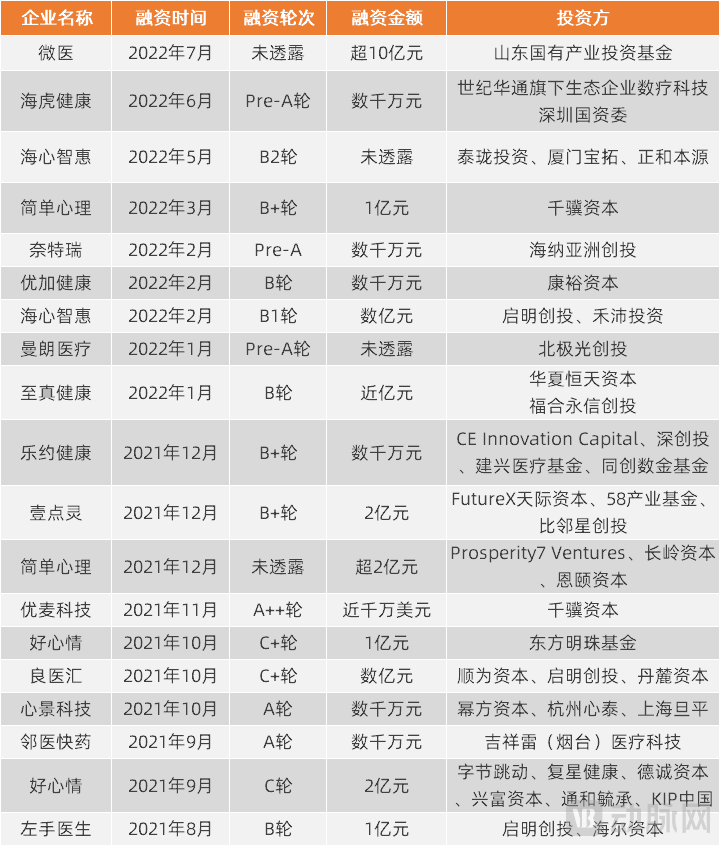
Internet Healthcare Financing Trends Since 2022, Source: Public Reports, Chart by VCBeat
First, they were fully prepared when the opportunity arose, particularly among several companies in the mental health and psychology sector.
Following a surge in mental health issues in the post-pandemic era, psychological well-being has garnered nationwide attention. Previously, companies such as Haixinqing, Jiandan Xinli, and Yidianling had established online service platforms to address supply-side shortages in disease diagnosis, treatment, and psychological counseling. Guided by patient demand, these platforms have since extended their services to offline settings.
Currently, mental health has become the hottest niche sector in internet-based healthcare. Benefiting from early exploration of service and business models, as well as continuous iterations based on market demands, these companies have naturally become favored by investors. Notably, Haixinqing and Jiandan Xinli each secured funding twice within a single year.
Second, evolving services into products, with digital therapeutics being the most prominent example.
Internet-based medical services have long evolved beyond simple online consultations and prescription issuance. End-to-end services spanning from diagnosis to medication delivery have become the norm, with some offerings further developing into comprehensive service packages that integrate various resources required by patients. Currently, digital therapeutics have also emerged as a key direction for the evolution of internet healthcare products.
Haixin Zhihui, Youmai Technology, Xinjing Technology, and others are all exploring the standardization of specific disease management into digital therapeutic products.
Digital therapeutics products require approval for a medical device registration certificate, signifying authoritative recognition of their safety and efficacy. Compared to pure business model innovations whose effects are difficult to demonstrate directly, this regulatory endorsement offers tangible, verifiable proof of value, thereby becoming one of the key benchmarks for assessing a company’s strength.
Third, technology companies closely monitor market demand and promptly iterate their solutions.
Among the companies listed, Haihu Health and Naiterui are technology service-oriented enterprises. In the past two years, in addition to physical hospitals and internet healthcare companies, other enterprises along the medical health industry chain have also had demands for deploying online medical services. Therefore, internet healthcare parks established by technology companies have emerged to meet such needs more efficiently.
The services and product offerings of the aforementioned types of enterprises vary, yet they share a common characteristic: while consolidating their professional service capabilities or technical expertise, they adapt their strategies in response to market dynamics.
Overall, new industry players have emerged continuously, and fresh capital continues to flow in. Whether a company can secure financing ultimately depends on its individual merits. As many investors have noted, the digital transformation of traditional healthcare services remains a long and arduous journey, and there is still ample room for internet-based healthcare to make an impact.