

BioInnovate Launches Hong Kong IPO as the 'First Model Mouse Stock' in the Market

Biocytogen
Antibody Drug Developer
One Year After Pivoting to the Hong Kong Stock Market, Biocytogen Officially Launches Its IPO
Thus, the goal proposed by Shen Yuelei, founder of Biocytogen, to build an open drug development platform based on model animals and ultimately become a global source of novel drugs is being realized step by step. Established in Beijing in 2009, Biocytogen is well known to most pharmaceutical professionals in China. From model mice to antibody candidate molecules and early-stage pipelines, Biocytogen has evolved alongside the growth of China’s innovative drug ecosystem, serving as a key supporting force throughout this journey.
Currently, as a clinical-stage biotechnology and preclinical research services company, Biocytogen has established R&D and manufacturing centers in Beijing, Haimen (Jiangsu Province), and Boston, USA. It has forged long-term partnerships with nine of the top ten global pharmaceutical companies and is a leading domestic provider of gene editing services, model animals, and pharmacological and efficacy evaluation services. With the establishment of a series of fully human antibody platforms and leveraging its “Thousand Mice, Ten Thousand Antibodies” initiative, Biocytogen has begun to exert strong momentum in the innovative antibody market. Through in-house development and collaborations, the company has advanced dozens of novel antibody drugs into preclinical studies and clinical trials. In 2021, the company’s total annual revenue reached RMB 350 million, representing an increase of nearly 40% compared to 2020. Notably, revenue from antibody development surged by 115.6% from 2020 to 2021, serving as the primary growth driver.
In fact, prior to its IPO, Biocytogen was already a star project in the primary market, having completed multiple rounds of financing totaling over RMB 2 billion. This attracted professional investment institutions such as SDIC Innovation Investment, CMB International, China Life Healthcare Fund, and Qingchi Capital, which provided support across multiple rounds. Dr. Li Bin, Founder of Qingchi Capital, stated, “We have been following Biocytogen for a long time. As a pioneer in the gene-edited model animal industry, it has accelerated the global new drug development process. The ‘Thousand Mice, Ten Thousand Antibodies’ initiative launched in 2020 reminded us of the successful path taken by Regeneron, a global leader in biotechnology R&D. We hope to continue supporting the company’s medium- to long-term strategy and help it build Biocytogen’s unique engine for antibody-based new drug development.”
For Biocytogen, the most fundamental driver of innovation is gene editing.
In 2009, the application of gene editing technology in biological research gradually gained momentum. The newly established Biocytogen team actively engaged in this profound transformation of biotechnology. Each year, Biocytogen provides professional gene editing services to hundreds of clients, steadily building brand recognition among researchers.
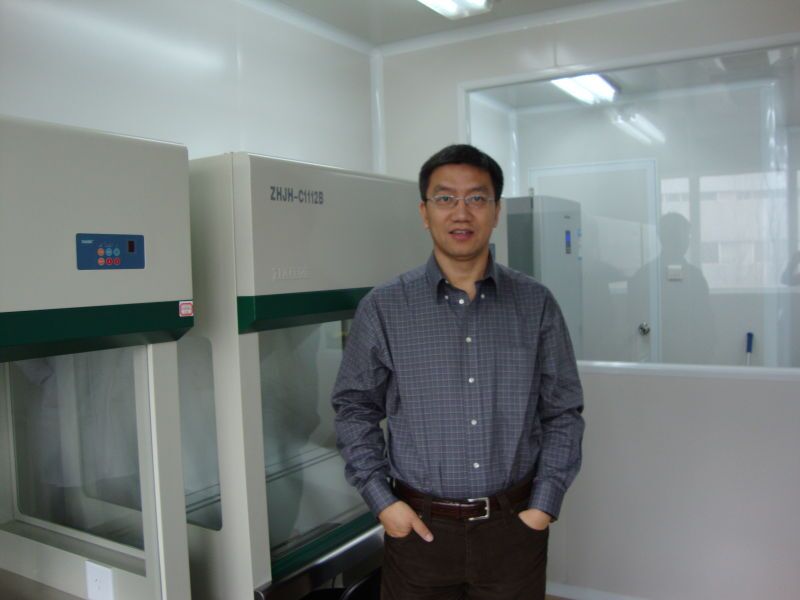
Dr. Shen Yuelei during the early establishment of Biocytogen
Yuelei Shen, the founder of Biocytogen, holds a Ph.D. in immunology and conducted his postdoctoral research on immunological issues using model organisms. He recognized that gene-editing technologies determine the sophistication of model organism development. Consequently, while delivering gene-editing services to clients, Dr. Shen led Biocytogen in advancing its own gene-editing capabilities, independently developing three major gene-editing technology platforms—namely, ESC/HR, EGE, and SUPCE technologies—which later underpinned the company’s gene-editing business.
After more than a decade of intensive development, Biocytogen has developed over 2,500 genetically engineered mouse and cell models, and pioneered the reverse export of model organisms to European and American markets. In 2021, Biocytogen’s sales of model organisms increased by 63% year-on-year, with a gross profit margin of 75%.
It is worth noting that in China, the average unit price of model mice offered by most peer companies is generally below RMB 300, whereas Biocytogen’s average unit price approaches RMB 1,000, clearly demonstrating the high technological value embedded in its developed model mice.
In 2015, Biocytogen established a pharmacological and efficacy evaluation platform based on model animals, further expanding its business scope into preclinical CRO services. In 2021, Biocytogen’s revenue from preclinical pharmacological and efficacy services exceeded RMB 100 million, ranking second in terms of revenue contribution among its four major business segments.
“Set your sights on the Himalayas, but the journey must begin with the first step.” Shen Yuelei once described his entrepreneurial mindset in this way. Unwilling to be confined to the provision of model animals and pharmacological efficacy services, Biocytogen has pressed forward relentlessly, advancing into the development of fully human antibody drugs. Among the three major gene-editing technologies, the most critical is SUPCE, an ultra-large fragment gene-editing technology that constitutes Biocytogen’s exclusive technological barrier and laid the essential foundation for the subsequent establishment of its fully human antibody mouse platform, RenMice. The naming of RenMice is also distinctive, incorporating the Pinyin “Ren” for the Chinese character “人” (human), imbuing it with a distinct Oriental flair!
Fully human antibody mouse technology involves introducing human immunoglobulin variable region gene sequences into the mouse genome, enabling the mouse immune system to naturally produce a diverse repertoire of fully human antibodies. Compared with chimeric antibodies, fully human antibodies are more challenging to develop; however, they exhibit no immunogenicity upon administration in humans and possess high affinity and strong stability. In other words, fully human antibodies are more suitable for drug development. In this sense, the emergence of fully human antibody mice represents a significant milestone in the advancement of antibody therapeutics. Opdivo (a PD-1 monoclonal antibody), an early fully human antibody product, has achieved peak annual sales of USD 7.2 billion since its initial approval in December 2014. Nevertheless, developing such platforms is extremely difficult. Prior to the advent of the RenMice platform, only two global in situ replacement platforms for fully human antibody mice existed: Regeneron’s VelocImmune and Kymab’s Kymouse, neither of which was licensed to third parties.
Since 2014, leveraging its proprietary SUPCE technology for ultra-large fragment chromosomal editing, Biocytogen has independently developed the RenMice fully human antibody mouse platform over a period of nearly six years. The RenMice platform employs a one-step in situ replacement strategy, making it one of the most comprehensive fully human antibody mouse models worldwide in terms of variable region gene replacement. Based on the RenMice platform’s capability to generate various druggable antibody formats—including high-affinity and high-specificity monoclonal antibodies, bispecific antibodies, bispecific antibody-drug conjugates (ADCs), TCR-like antibodies, and GPCR antibodies—Biocytogen has entered into licensing collaborations with 14 renowned multinational pharmaceutical companies and leading drug developers, including BeiGene, Innovent Biologics, and Xencor (USA).
For now, Biocytogen is better known for its “Thousand Mice, Ten Thousand Antibodies” program.
As envisioned by Biocytogen, the company leverages its fully human antibody RenMice® platform to generate a more diverse and abundant repertoire of antibodies through gene knockout strategies, thereby expanding the possibilities for drug screening. Furthermore, by utilizing its extensive portfolio of humanized target animal models and disease models, large-scale in vivo efficacy screening becomes feasible. The implementation of the “Thousand Mice, Ten Thousand Antibodies” initiative will undoubtedly further enhance the clinical translation success rate of antibody molecules.
The essence of the “Thousand Mice, Ten Thousand Antibodies” initiative is to first identify functional antibodies targeting specific antigens, then conduct large-scale screening in mouse models to select candidates with superior efficacy and safety profiles, and ultimately develop them into therapeutic drugs.
Traditional preclinical research on antibody drugs typically involves multiple stages, including target-by-target investigation, in vitro assay development, target validation, antibody humanization, lead screening, and optimization studies, resulting in a development cycle of nearly six years. In contrast, the “Thousand Mice, Ten Thousand Antibodies” program adopts a reverse-engineering approach, starting with the end goal in mind. It utilizes a high-throughput single B-cell discovery system to obtain high-affinity antibodies, followed by large-scale, evidence-based in vivo efficacy evaluation to identify preclinical candidate (PCC) drugs, thereby shortening the preclinical R&D timeline to 12–18 months. This drug development pathway bypasses early-stage in vitro validation, enabling faster identification of antibody candidates worthy of further development. Moreover, drug screening based on this strategy enhances the likelihood of successfully advancing investigational drugs into clinical trials.
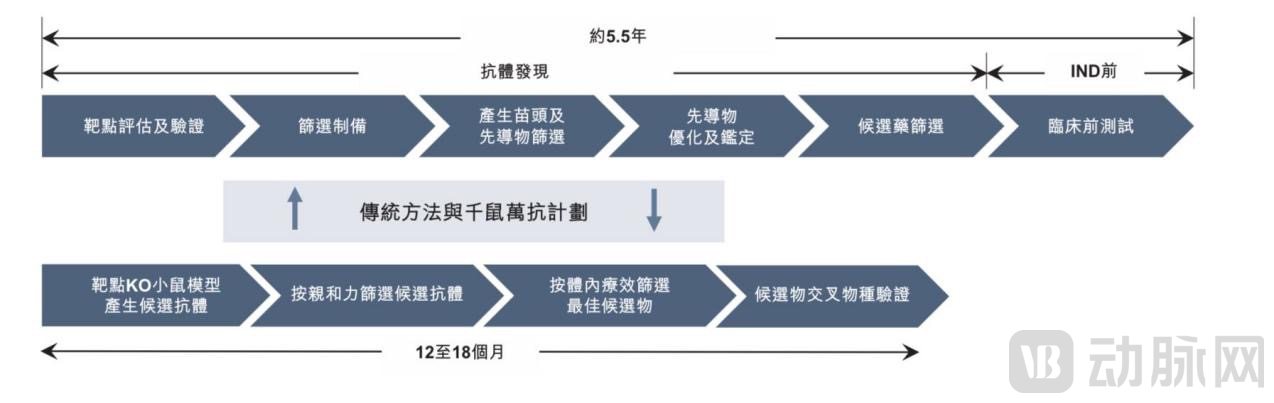
Logic of the “Thousand Mice, Ten Thousand Antibodies” Program Image source: Prospectus
The underlying context is that, regardless of the new drug development strategy employed, a critical early step—once the target’s pathway and mechanism of action have been elucidated—is to identify antibodies that can both modulate target function and possess favorable developability. However, a substantial portion of new drug development efforts stalls precisely at this stage. This is because the target itself is a protein, and traditional drug discovery approaches start with the target protein; yet current scientific understanding remains insufficient regarding the functional roles of such proteins and their intrinsic mechanisms of interaction with specific diseases. Consequently, new drug development resembles blind men feeling an elephant, making it inherently difficult to identify suitable antibodies for target modulation.
Currently, there are over 1,000 known potential targets for antibody drugs. However, since the launch of muromonab, the first monoclonal antibody drug, in 1986, only about 144 antibody drugs targeting 60 distinct therapeutic targets have been approved by the FDA and EMA worldwide. The majority of potential targets have not even entered clinical trials. With the advancement of its “Thousand Mice, Ten Thousand Antibodies” initiative, Biocytogen is building a rich portfolio of antibody molecules targeting more than 1,000 potentially druggable targets, thereby providing a continuous supply of resources for new drug development. This remarkable feat bears some resemblance to Cangjie’s creation of Chinese characters thousands of years ago.
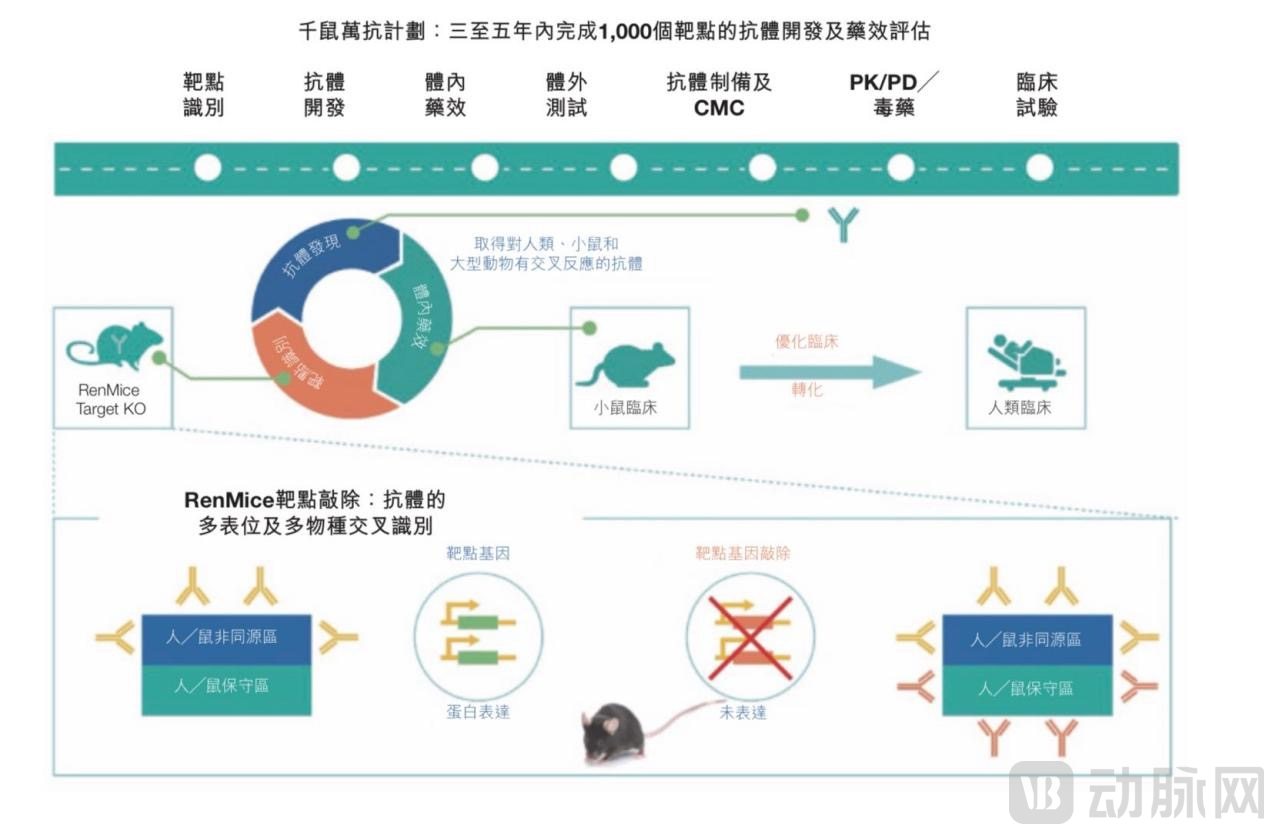
Interpretation of the “Thousand Mice, Ten Thousand Antibodies” Program Workflow Image Source: Prospectus
However, although the drug development process described in the “Thousand Mice, Ten Thousand Antibodies” project is easy to understand and can greatly simplify the R&D of novel antibody drugs, it is extremely difficult to implement the plan in practice, so few have attempted this approach. Nevertheless, after years of accumulation, Biocytogen has established a robust, end-to-end new drug R&D platform covering fully human antibody discovery, model animals, and pharmacology and efficacy evaluation, with gene editing as its foundational technology.
The first step is antibody preparation. Biocytogen needs to individually knock out more than 1,000 potential non-lethal antibody drug targets in its fully human RenMice platform. For each knockout RenMice strain, 400–600 antibodies recognizing different epitopes can be generated against a given target, including antibodies that identify conserved epitopes from mice to humans through multi-species cross-immunization. To date, the “Thousand Mice, Ten Thousand Antibodies” initiative has leveraged Biocytogen’s patented SUPCE and other gene-editing technologies, along with its robust fully human RenMice platform, underpinned by over a decade of technical expertise accumulated by Biocytogen.
Financial data from the prospectus reveals that Biocytogen has, to a certain extent, internalized its gene-editing capabilities to accelerate the “Thousand Mice, Ten Thousand Antibodies” initiative and focus on antibody drug discovery. Between 2020 and 2021, revenue from this traditional strength—gene editing—declined from RMB 68.9 million to RMB 51.1 million, dropping to the lowest share among Biocytogen’s four major business segments. This underscores the substantial demand for gene editing driven by the advancement of the “Thousand Mice, Ten Thousand Antibodies” initiative and highlights Biocytogen’s strategic shift from biological services toward new drug development.
Next is antibody screening, which requires a diverse panel of disease mouse models to identify approximately 200 candidate antibodies for evaluating efficacy, safety, pharmacology, and pharmacodynamics. Subsequently, one or two of these antibodies are validated in large animal models with spontaneous diseases before advancing to human clinical trials. In this phase, Biocytogen’s capability in supplying model animals played a pivotal role.
At this stage, Biocytogen’s “Thousand Mice, Ten Thousand Antibodies” program has been repeatedly validated through its internal drug pipeline and external licensing projects. For instance, the company’s independently developed anti-CD40 antibody, selected based on in vivo efficacy study data, has demonstrated favorable safety and efficacy profiles in humans according to preliminary clinical trial results. According to the prospectus, Biocytogen has signed 24 co-development agreements with leading biotech and biopharma companies, including Merck KGaA (Germany), RemeGen, TianGuangShi Biologics, China Resources Biopharmaceutical, Shanghai Institute of Biological Products, North China Pharmaceutical Group, Baichuan Bio, AID Therapeutics, and Japan’s LiberoThera.
These collaborative development partnerships have generated substantial short-term revenue for Biocytogen, along with anticipated long-term economic returns. More importantly, bolstered by the recognition of high-quality global partners, Biocytogen is able to leverage leading clinical and commercial resources worldwide to advance more potential antibody drug candidates to markets around the globe.
According to public information, the “Thousand Mice, Ten Thousand Antibodies” project has completed the knockout of more than 980 targets. Among these, over 300 targets have entered the antibody screening phase, and more than 240 targets have yielded hit molecules. The project has achieved 24 antibody drug development and licensing deals. Biocytogen estimates that it will be able to complete antibody molecule screening for 200–300 potential targets annually in the future.
The “Thousand Mice, Ten Thousand Antibodies” initiative is attempting to reshape the new drug development process and is also transforming Biocytogen, enabling this company, which still faces substantial R&D expenditures for new drugs, to potentially turn a profit within a shorter timeframe.
First, there was a significant increase in revenue levels. According to the prospectus, between 2020 and 2021, Biocytogen's total revenue grew from RMB 253 million to RMB 354 million, representing a substantial year-on-year increase of 39.8% despite adverse market conditions, driven by revenue growth in antibody development, preclinical pharmacology and efficacy evaluation services, and sales of model animals.
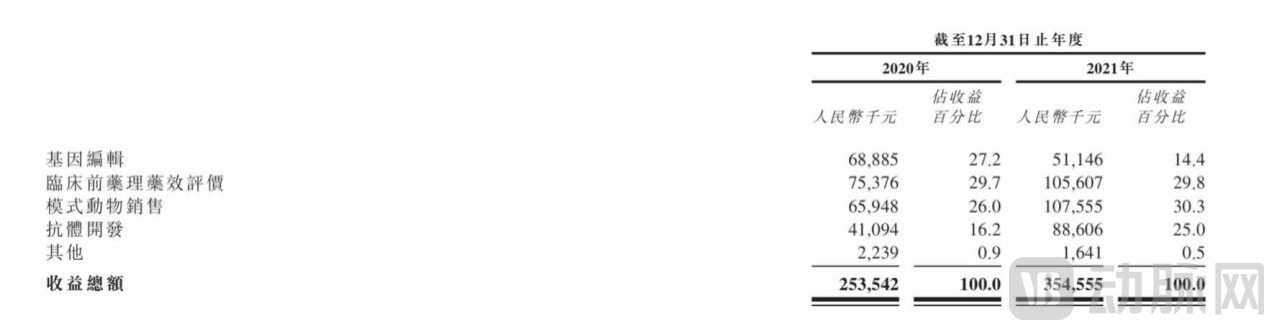
2021–2021 Revenue Level and Composition Source: Prospectus
Among these, the antibody development business delivered outstanding performance. Driven by continuous business expansion, the company secured multiple upfront payments and achieved several milestones in its antibody development projects. In 2021, Biocytogen’s antibody-related revenue grew by 115%, rising from RMB 41.1 million to RMB 88.6 million, making it the fastest-growing segment among its four major business lines. Its share of total revenue also increased from 16.2% to 25%.
In terms of traditional businesses, in addition to the gradual internalization of gene editing operations as previously mentioned, both preclinical pharmacology and efficacy evaluation services and model animal sales have demonstrated strong growth momentum. Specifically, revenue from preclinical pharmacology and efficacy evaluation services increased by 40.1%, from RMB 75.4 million to RMB 105 million. Revenue from model animal sales surged from RMB 65.9 million to RMB 107 million, surpassing that of preclinical pharmacology and efficacy evaluation to become Biocytogen’s primary cash flow driver. This growth was driven by a substantial increase in the number of model animals sold, which rose from 69,000 to 109,000 units. These figures indicate that Biocytogen’s market competitiveness in the model animal business continues to strengthen.
Next is the improvement in gross profit margins. Between 2020 and 2021, Biocytogen’s gross margin for its core business increased from 65.9% to 69.8%. Entering 2022, Biocytogen continued to maintain a strong momentum of high-speed growth. From January to April 2022, the company’s revenue grew by 67% compared to the same period in 2021, with the gross margin for its core business reaching 70%. According to data from Tonghuashun, Biocytogen’s high gross margin of nearly 70% significantly outperforms its industry peers. Among the A-share and Hong Kong-listed biopharmaceutical companies that disclosed their 2021 annual reports, a total of 44 companies reported annual revenues exceeding RMB 10 billion, with an average annual gross sales margin of 37.39%.
Finally, the continuous expansion of overseas business. As mentioned earlier, Biocytogen is the first company in China to export model animals to overseas markets. According to its prospectus, leveraging its gene-editing technology platform, Biocytogen has expanded its global customer base through the sale of model animals and preclinical CRO services. It has completed over 500 drug evaluation projects for more than 200 partners worldwide and established partnerships with nine of the top 10 global pharmaceutical companies, with overseas revenue accounting for as high as 36%. From January to April 2022, Biocytogen’s overseas business grew rapidly, with overseas revenue contributing over 45% of total revenue, continuously injecting vitality into the company’s development.
In summary, this IPO marks a significant milestone in Biocytogen’s growth and will inject strong momentum into its future development. Furthermore, Biocytogen’s listing is a major event that enriches and optimizes the competitive landscape of China’s innovative drug industry.