

Commercialization of AI-Powered Rehabilitation Robots: Navigating Legal Regulations and Compliance
Editor’s Note: This article is contributed by the Healthcare Team at AnJie Law Firm, authored by Cai Hang and Zhang Yin. Republished with permission from VCBeat.
(I) Preface: Continuous Innovation in the Field of AI Medical Devices
As the winds of change sweep through the medical community, innovation in AI-driven healthcare technology continues unabated. As a core force behind the new wave of industrial transformation, artificial intelligence is deeply integrating with the healthcare sector, continuously fostering new business models and creating novel applications. Among the myriad of emerging AI healthcare innovations, the leading segment that has achieved early deployment and commercialization is undoubtedly “AI + Medical Imaging.” AI-assisted diagnostic products for medical imaging have repeatedly demonstrated their efficacy in practice and are now widely entering a phase of substantial returns, according to public reports.[1], Currently, the National Medical Products Administration (NMPA) has issued more than 20 Class III medical device certificates for AI-based products, and leading players in AI medical imaging are actively pursuing domestic or overseas listings.
Beyond AI medical imaging, the field of “AI + medical robotics” is also seeing a surge of high-quality innovative enterprises and products. AI-powered medical robotic products, together with AI-assisted diagnostic software, belong to the same category of intelligent medical devices, akin to twins on stage, and are now entering a golden period of rapid growth and heightened attention. According to data released by the China Center for Information Industry Development (CCID)[2]In China's medical robot market, rehabilitation robots, assistive robots, surgical robots, and medical service robots account for 47%, 23%, 17%, and 13% of the market share, respectively.
To enhance public understanding of intelligent medical devices, this series will focus on rehabilitation robots and surgical robots, providing an in-depth analysis of the legal risks and issues encountered during the commercialization of AI-powered medical robots. As the first installment, this article introduces AI rehabilitation robots.
(II) Overview of the AI Rehabilitation Robotics Industry
Rehabilitation medicine focuses on patients and individuals with disabilities, aiming to help them maximize the recovery of various physical functions and improve their quality of life. Since 2008, rehabilitation medicine in China has gained attention from the government and policy levels, gradually forming a three-tier rehabilitation system comprising community rehabilitation centers (or home-based rehabilitation), specialized rehabilitation hospitals (or health and wellness institutions), and tertiary general hospitals. By 2016, 29 rehabilitation medical services had been included in the scope of medical insurance coverage.[3]. With the intensifying aging of China’s population, the rehabilitation medical services industry has maintained robust growth driven by policy support and is projected to surpass RMB 200 billion in 2024.[4]。
AI rehabilitation robots are novel devices designed to assist patients with rehabilitation training and therapy. They can effectively replace human caregivers during training and treatment sessions by simulating real-life scenarios, enabling users to engage in limb movement exercises, prevent joint and muscle atrophy, enhance muscle strength, and train the nervous system through a human-machine interaction interface, thereby achieving more proactive and efficient recovery outcomes. The primary technical challenges of AI rehabilitation robots lie in developing human-machine interaction control strategies and ensuring real-time, accurate interaction and control. Specifically, these systems must rapidly process collected user signals and external environmental data into motion commands, allowing the robot to provide appropriate feedback—such as moving forward, turning, stopping, or applying suitable force levels. Additionally, AI rehabilitation robots collect and analyze user data to monitor and manage health status or assist users in performing activities of daily living (e.g., walking or grasping). The core components of an AI rehabilitation robot are illustrated below:
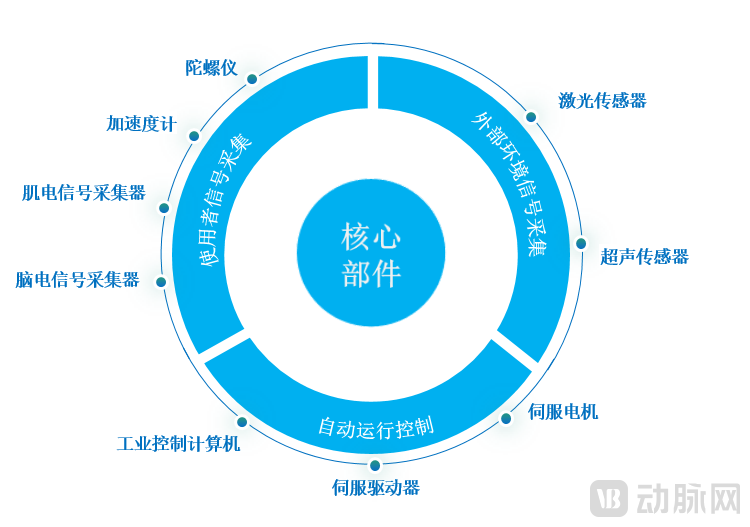
Core Components of AI Rehabilitation Robots[5]
As AI rehabilitation robots have not yet entered the stage of large-scale, standardized mass production, R&D enterprises typically assume responsibility for manufacturing the robots themselves. On the sales side, buyers are primarily B-end institutional clients within the three-tier rehabilitation system, and the sales model generally combines direct and indirect sales.
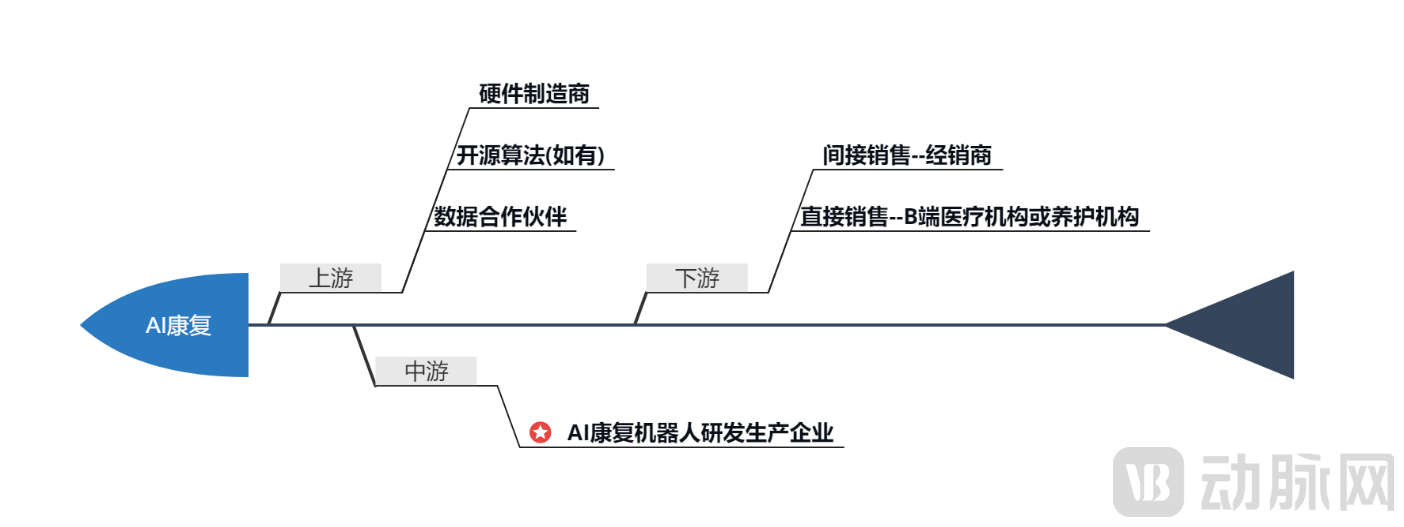
Schematic Diagram of the Upstream and Downstream of the AI Rehabilitation Robot Industry
The commercial application of AI-powered rehabilitation robots originated in the United States. Around 2010, Chinese enterprises and research institutions began entering this industry by combining the introduction of advanced foreign technologies with independent research and development. After a decade of refinement and perseverance, domestically developed AI rehabilitation robots have gradually embarked on commercialization, surpassing foreign products in overall cost-effectiveness. Chinese AI rehabilitation robots are increasingly dominating the mainstream market and becoming the primary choice for domestic patients. Looking ahead, artificial intelligence technologies related to human-machine integration and human-machine augmentation will represent the next developmental trend in the AI rehabilitation robotics sector.
(3) Major Legal Issues in the Commercialization of AI Rehabilitation Robots
3.1 Product Registration and Algorithm Update Regulation for AI Rehabilitation Robots
AI rehabilitation robots are wearable medical devices. In accordance with the relevant provisions of the Regulations on the Supervision and Administration of Medical Devices, the Measures for the Registration and Filing of Medical Devices, and the Catalogue of Medical Device Classification, rehabilitation robots should be classified as Class II medical devices based on their dual attributes as “joint training equipment” and “physiological signal processing software.” They are subject to review by the drug regulatory departments of provinces, autonomous regions, and municipalities directly under the Central Government, and a Medical Device Registration Certificate is issued upon approval. According to searches conducted through public channels of the National Medical Products Administration (NMPA), major developers of AI rehabilitation robots have obtained Class II medical device registration approvals in provinces and municipalities including Hunan, Guangdong, Jiangsu, Shanghai, and Zhejiang. The marketization and commercialization of AI rehabilitation robot products have thus completed substantial preparatory work for licensed market entry.
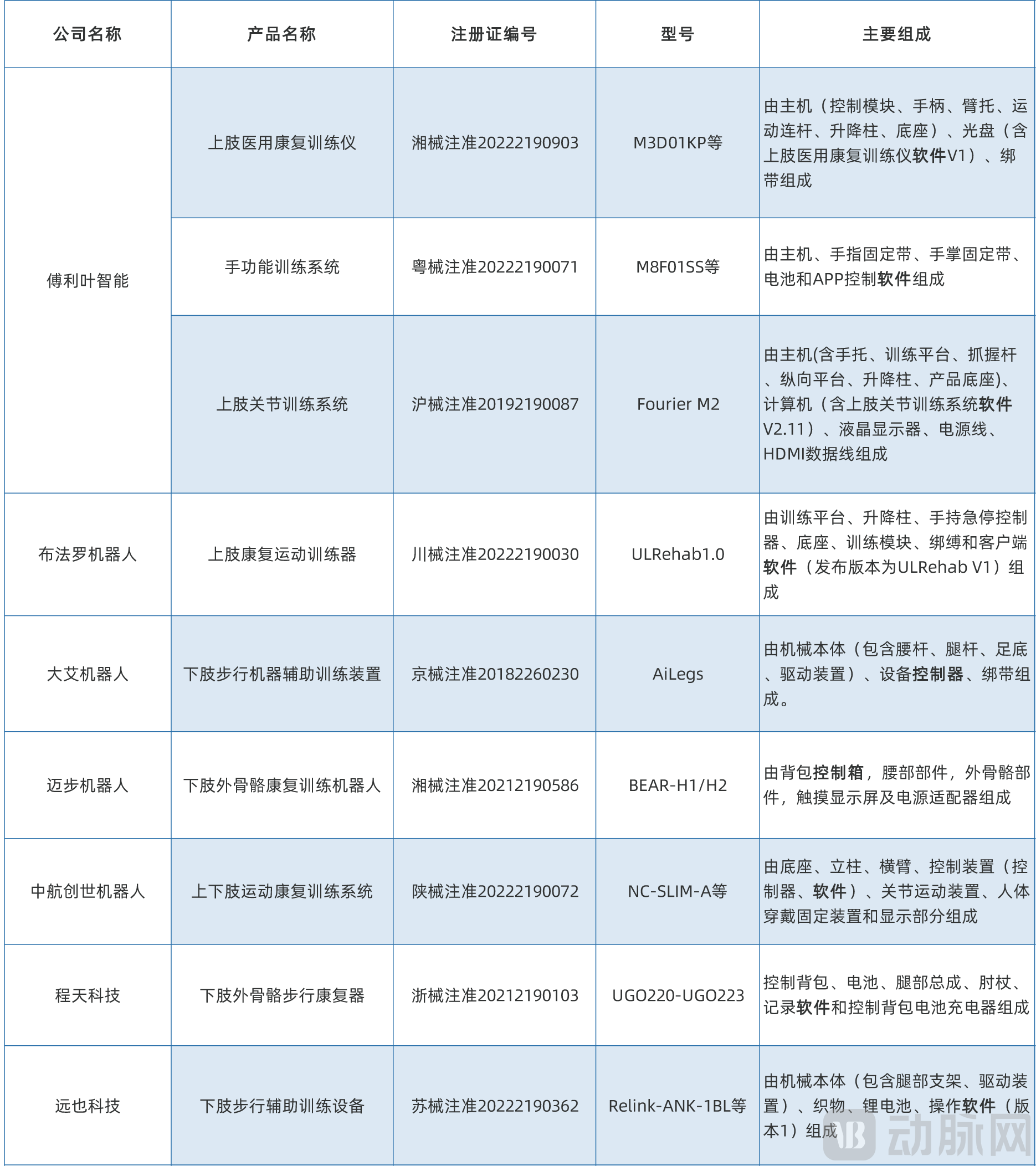
Key Regulatory Approvals for AI Rehabilitation Robots, Compiled from Public NMPA Queries
As can be readily observed from the figure above, most medical device manufacturers list software separately as a primary component, while a minority describe core control components as controllers or control boxes. Regardless of the listing method, AI rehabilitation robots necessarily incorporate artificial intelligence algorithm technologies to achieve human-computer interaction functionality. In recent years, the Center for Medical Device Evaluation (CMDE) of the National Medical Products Administration has progressively refined its regulatory review guidelines for AI-based medical devices, striving to establish quality control throughout the entire product lifecycle. These guidelines set forth review standards across five key stages: requirements analysis, data collection, algorithm design, software verification and validation, and change control.[6]Notably, after obtaining the medical device registration certificate, if the artificial intelligence algorithm used in the device is updated, the registrant must apply to the original registration authority for a change in registration, based on the rules shown in the figure below, with the core criterion being whether the algorithm update affects the device’s effectiveness or safety.
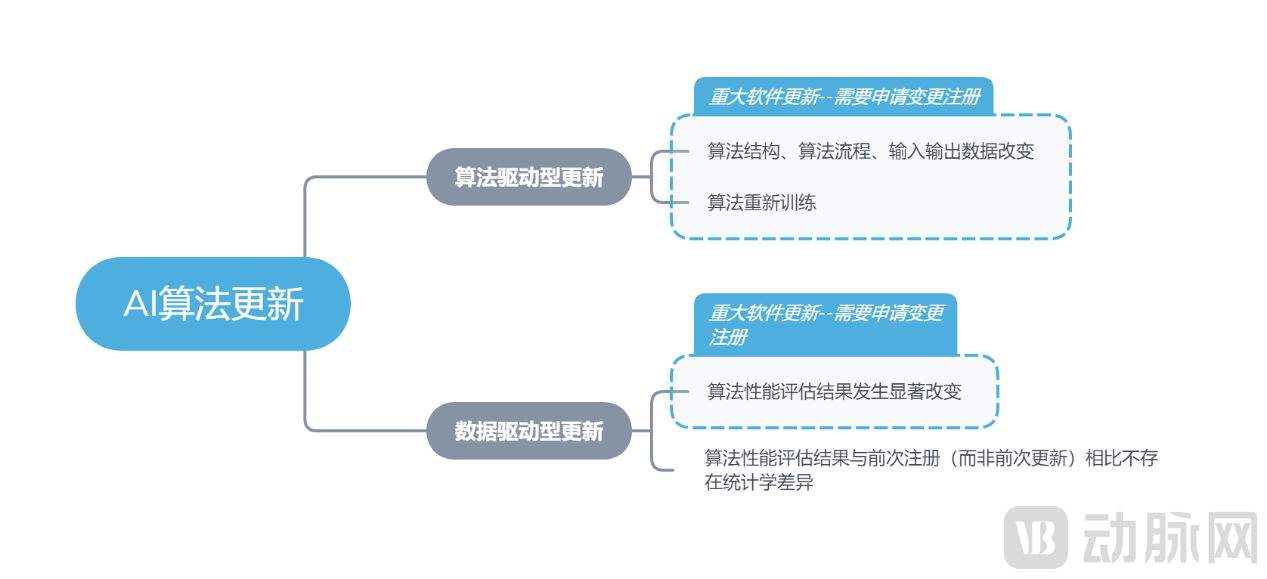
Relationship Diagram between AI Algorithm Updates and Applications for Registration Changes
3.2 Enterprises should pay attention to the acquisition, usage methods, and compliance of AI training data
Since AI algorithms or models require large amounts of relevant data for training, it is crucial to ensure that the training data used in the research and development of AI-based medical devices, as well as the methods for acquiring and using such data, comply with China’s regulations on cybersecurity, data security, and personal information protection.
(1) Regarding data collection, training data is typically obtained either directly by the enterprise (e.g., employee data) or indirectly through third-party clinical research partners (e.g., medical institutions, health examination centers). Prior to collecting and subsequently using such data, consent and authorization from the respective individuals must be obtained. If clinical trials are involved, data collection requires approval from an ethics committee. When data is collected indirectly through third parties, the cooperation agreement between the enterprise and the third party shall explicitly stipulate that: (i) the third party shall obtain valid individual consent in accordance with applicable laws for the collection, use, sharing, and storage of corresponding data, and it is recommended that the third party agree with such individuals on a sufficient authorization period; (ii) after collection, the third party is obligated to de-identify such data, with clear specifications on the type (static or dynamic), rules, extent, and methods of de-identification, and it is recommended that the de-identification process be conducted within the third party’s premises or databases; and (iii) the data delivered and shared by the third party with the enterprise shall consist of de-identified raw databases compliant with the aforementioned two requirements.
(2) With regard to data storage and data usage, enterprises shall fulfill their responsibilities for cybersecurity and data protection through measures such as data encryption, data isolation, access management, usage restrictions (e.g., prohibition on large-scale copying), and lifecycle management. Enterprises shall also formulate and improve various internal data protection standards, including but not limited to the “Data Classification Management System” and the “Cybersecurity and Information Security Emergency Management System.”
(3) Following the commercial rollout of AI-powered rehabilitation robots, patient- and healthcare institution-related data collected by the devices shall be classified as health and medical data. It is recommended that such data be stored on servers within healthcare institutions and not transmitted externally. In cases where remote computational resources, such as cloud computing, are required, only explicitly authorized and de-identified data shall be transmitted or shared, in accordance with the cooperation agreements among the enterprise, patients, and healthcare institutions.
3.3 Major Risks of the Indirect Sales Model for Rehabilitation Medical Devices
Given that the end customers of the rehabilitation medical device industry encompass a wide range of professional institutions—including medical facilities at all levels (such as rehabilitation departments in general hospitals, rehabilitation hospitals, rehabilitation medical centers, and rehabilitation outpatient clinics), organizations under the China Disabled Persons’ Federation (such as disability rehabilitation institutions), and entities within the civil affairs system (such as welfare homes and elderly care institutions)—and considering the fragmented and numerous nature of B2B clients in the rehabilitation sector, the industry typically exhibits a high proportion of indirect sales revenue, whereby companies sell their products through distributors. While the indirect sales model offers advantages such as expanded marketing channels and reduced sales costs, it also introduces the following legal risks:
(1) Distributors may lack the necessary qualifications. Enterprises should ensure that distributors possess the relevant qualifications for operating medical devices. For Class II medical devices, distributors shall file a record with the municipal-level department responsible for drug supervision and administration in the city divided into districts where they are located.[7]. Enterprises should also regularly verify whether the relevant business licenses or filings of distributors remain valid. In addition to qualifications, factors such as distributors’ business performance, payment compliance, and reputation for integrity should be incorporated into the criteria for distributor admission management.
(2) Prevention of Commercial Bribery by Distributors. Enterprises should strive to prevent distributors and their sales personnel from engaging in commercial bribery or obtaining improper commercial benefits during the product sales process. Specifically, enterprises should sign an “Anti-Commercial Bribery Commitment Letter” with distributors and establish relevant internal regulations for preventing commercial bribery, such as the “Distributor Management Process,” “Distributor Code of Conduct,” and “Sales Contract and Order Management Procedure.” These anti-commercial bribery standards should be thoroughly communicated through distributor training and other means. To avoid conflicts of interest and improper transfer of benefits, distributors and their sales personnel shall not hold positions or equity interests in the enterprise or in end-user medical device procurement entities. Normal corporate rebates provided to distributors should be applied as credits against subsequent purchase payments and must not be transferred to any third-party or personal accounts.
(IV) Conclusion
As a novel entity in the rehabilitation sector, AI-powered rehabilitation robots can better assist patients in completing active rehabilitation training, thereby helping them seize the critical window for therapeutic intervention, and are poised to secure a significant share of the rehabilitation equipment market. Although current AI rehabilitation robots remain expensive and have shortcomings in wearability comfort and battery life that require improvement, their future commercialization and scalability prospects are promising. This is driven by the vast market underpinned by China’s high population density and aging demographics, combined with a robust supply chain ecosystem. Concurrently, comprehensive compliance measures should be implemented to ensure regulated operations.
Author of this article:
AnJie Law Firm's Healthcare Team
Contact QR Code

Introduction to Attorney Cai Hang: For over a decade, he has specialized in investment and financing services in the fields of healthcare, TMT (Technology, Media, and Telecommunications), and artificial intelligence, wielding significant influence in China’s venture capital legal services sector. *China Business Law Journal* named him one of the “100 Elite Chinese Lawyers,” recognizing him as one of the country’s most outstanding commercial lawyers. He has also been repeatedly recommended by leading legal ranking agencies such as Legal 500 and Legalband in the areas of TMT and venture capital. In addition to venture capital practice, he is highly proficient in mergers and acquisitions and capital markets. Mr. Cai is the Managing Partner of AnJie Law Firm’s Shanghai office. Email: caihong@anjielaw.com

Introduction to Attorney Zhang Yin: She has represented renowned domestic and international funds in completing a substantial volume of investment and M&A transactions, while also providing legal services for corporate clients’ financing and investment activities. The industries covered primarily include healthcare, biopharmaceuticals, artificial intelligence, entertainment and media, and tourism. Legalband named her one of the “Top 30 Rising Stars in China’s Legal Industry 2021.” In the field of big health compliance, Attorney Zhang has assisted medical enterprises in deeply engaging in internet hospital compliance matters and has represented clients in the acquisition of multiple medical institutions and internet healthcare companies. Email: zhangyin@anjielaw.com
*References
[1] Zero One Finance · Zero One Think Tank: “Overview of AI Medical Imaging Enterprises in China,” published in June 2022
[2] Industrial Internet Innovation Center (Shanghai) Co., Ltd. et al.: “Blue Book on the Development of the AI Healthcare Industry 2020,” released in September 2020
[3] See the “Notice on Including Additional Medical Rehabilitation Items in the Scope of Basic Medical Insurance Coverage” (MOHRSS Document No. 23 [2016]) for details.
[4] iResearch: “2022 Research Report on China’s Rehabilitation Medical Industry,” released in June 2022
[5] Due to space constraints, the analysis of medical devices that utilize brain-computer interface technology and acquire electroencephalogram (EEG) signals will be presented in the second article of this series.
[6] See “Guiding Principles for the Registration Review of Artificial Intelligence Medical Devices” (CMDE Notice No. 8, 2022) for details.
[7] See Article 21 of the Measures for the Supervision and Administration of Medical Device Operation for details.