

Johnson & Johnson MedTech Deepens Strategic Collaboration with Changmugu to Accelerate Digital Transformation in Orthopedic Surgery

Longwood Valley
Developer of Orthopedic Artificial Intelligence and Surgical Robot Solutions
Digitalization has become the largest growth driver in orthopedics and is regarded as the third major technological wave in the field, following microsurgery and minimally invasive surgery.
Under the traditional surgical model, challenges persist in preoperative planning, prosthesis inventory management, surgical complexity and duration, as well as postoperative patient rehabilitation. These issues have long plagued orthopedic surgeons and patients alike. The digitalization of orthopedics offers a breakthrough to address these challenges; cutting-edge digital solutions—such as preoperative surgical planning, intraoperative navigation, and surgical robots—can effectively enhance surgical precision.
Amid the digital wave in orthopedics, international orthopedic giants such as Johnson & Johnson MedTech are continuously increasing their investments in digitalization.
On August 11, 2022, Johnson & Johnson MedTech and Longwood Valley deepened their strategic partnership. In the future, both parties will jointly explore areas including digital innovation, product development, market promotion, and brand communication.Promoting the coverage of intelligent, precision clinical solutions across the entire care journey in orthopedics and surgery, jointly building a patient-centered digital surgical ecosystem.
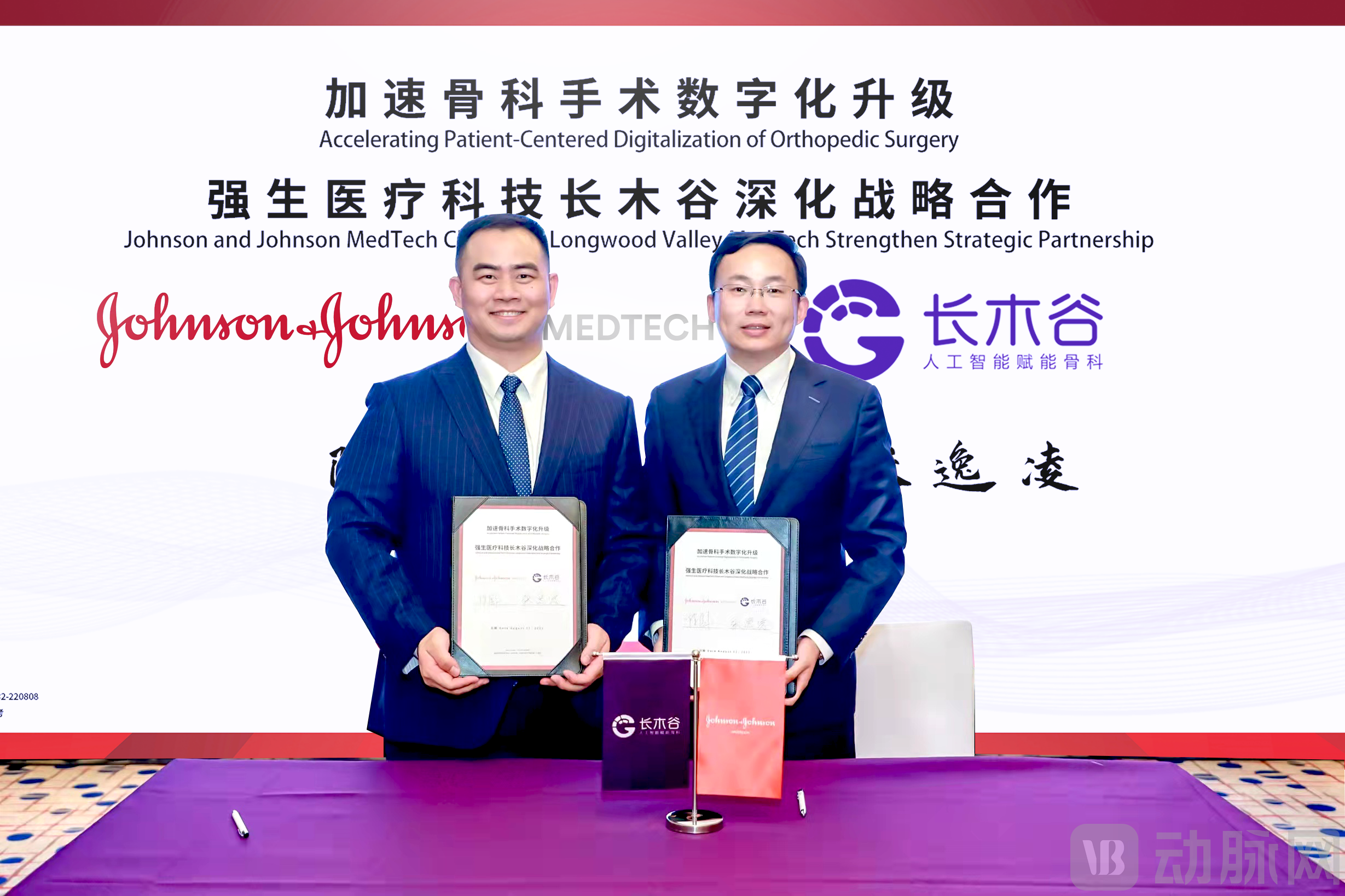
Johnson & Johnson MedTech Deepens Strategic Partnership with Longwood Valley
Longwood Valley specializes in the research, development, and manufacturing of comprehensive digital solutions for orthopedic surgery, offering end-to-end digital services that include AI-assisted diagnosis, personalized surgical planning, surgical robots, and postoperative assessment. Notably, this is not the first collaboration between Johnson & Johnson MedTech and Longwood Valley. The establishment of this strategic partnership also constitutes a significant component of Johnson & Johnson MedTech’s digital transformation, further deepening the strategic cooperation between the two parties.It marks a significant milestone in Johnson & Johnson MedTech’s joint efforts with local enterprises to drive digital innovation in the Chinese market.This deepened strategic cooperation encompasses the AIJOINT AI-powered digital surgical system for joint replacement, as well as joint research and development and commercial promotion of future orthopedic digital products.

Johnson & Johnson MedTech Deepens Strategic Partnership with Longwood Valley
Urgent Demand for Digitalization in Orthopedics and Accelerated Transformation by Industry Giants Drive Deepening Collaboration Between Johnson & Johnson MedTech and Longwood Valley, spanning the entire care continuum from hip and knee joints to orthopedic and major surgical procedures.
From an external perspective, orthopedics is currently in a window of opportunity for digital transformation.Against the backdrop of population aging, China’s orthopedic market is experiencing rapid growth. The number of patients with joint diseases in China exceeds 200 million, and those with spinal disorders also surpass 200 million. In 2020, orthopedic hospitals in China recorded 16.02 million patient visits. The market size of China’s orthopedic industry has reached the hundred-billion-yuan level.
Orthopedic surgeries are highly complex and demand significant postoperative functional recovery. The rapid growth in the number of orthopedic patients has increasingly exacerbated the mismatch between substantial patient demand and the scarcity of high-quality medical resources, leading to a surge in the demand for digital solutions in orthopedics.
Taking joint replacement surgery as an example, orthopedic implants come in a wide variety of models, requiring surgeons to maintain substantial preoperative inventory. Traditional joint replacement procedures rely heavily on surgical experience, involving repeated measurements and comparisons of patient X-rays on two-dimensional templates to determine the implant series, model, and placement position, with intraoperative fluoroscopy also required. By leveraging the AIJOINT artificial intelligence solution for joint replacement surgery, surgeons can customize implants based on patients’ 3D reconstruction models. This technology assists in determining the implant model, size, placement angle, depth, and configuration, thereby reducing operative time, intraoperative blood loss, and the frequency of fluoroscopy, while lowering the incidence of postoperative complications. Consequently, it transforms orthopedic surgery from an experience-based and conceptual approach to one that is precise, standardized, personalized, minimally invasive, and intelligent.
From an internal perspective, digitalization has become a new strategic focus for orthopedic companies.Traditional orthopedic companies, historically dominated by hardware such as screws and implants, are accelerating their digital and intelligent transformation by integrating orthopedic consumables and implants with digital technologies to create greater medical value. In March 2022, Johnson & Johnson’s Medical Devices business was officially renamed “Johnson & Johnson MedTech,” signaling its commitment to embracing innovation and advancing its digitalization efforts.
Longwood Valley has deeply cultivated technological innovations in digitalization, artificial intelligence, and surgical robotics, providing comprehensive end-to-end digital solutions for orthopedic surgeries. With significant advantages in its accumulation of digital products and AI technologies, its core need lies in broader channels for commercial implementation.
In the field of orthopedics, Johnson & Johnson MedTech and Longwood Valley are advancing hand in hand.Johnson & Johnson MedTech not only boasts globally leading products and solutions in the orthopedics market, but also has a long history of market cultivation and an excellent marketing team, providing robust commercialization channels. Longwood Valley is a key component of Johnson & Johnson MedTech’s local digital innovation ecosystem in China.
By leveraging the complementarity between product innovation and commercialization, the partnership can significantly enhance the efficiency and precision of orthopedic surgeries, address critical clinical needs, and accelerate the implementation of digital solutions in orthopedics. Through comprehensive and extensive collaboration, this initiative will promote the broader adoption of digital orthopedics in clinical practice.
The partnership between Johnson & Johnson MedTech and Longwood Valley dates back to 2019.
In November 2019, Johnson & Johnson MedTech and Longwood Valley officially signed a strategic cooperation agreement to collaborate on the AIHIP artificial intelligence hip replacement solution. This partnership integrates AIHIP with Johnson & Johnson MedTech’s total hip arthroplasty system, leveraging preoperative patient CT scans to rapidly reconstruct 3D models, match implant size and type, and optimize acetabular cup placement angle, depth, and coverage, as well as femoral stem insertion depth and intramedullary fit, thereby promoting precision and standardization in hip replacement surgery.
In 2021, Johnson & Johnson MedTech once again partnered with Longwood Valley, expanding the scope of their collaboration to commercialize the AIJOINT artificial intelligence-driven digital end-to-end solution for joint replacement. To date, the solution has been implemented in more than 600 hospitals, serving over 20,000 patients.
AIJOINT Artificial Intelligence Joint Replacement Digital End-to-End Solution includes the AIHIP Artificial Intelligence Hip Replacement Solution, the AIKNEE Artificial Intelligence Knee Replacement Solution, the AIUNI Artificial Intelligence Unicompartmental Replacement Solution, and the AIREVISION Artificial Intelligence Joint Revision Solution, enabling rapid 3D reconstruction, intelligent image segmentation, intelligent prosthesis matching, accurate positioning, and precise osteotomy.
AI-assisted joint arthroplasty utilizes preoperative CT data and the G-NET neural network to perform intelligent bone segmentation, enabling 3D reconstruction and precise identification of anatomical landmarks with an average recognition error of less than one pixel. Based on bone anatomy and corresponding anatomical parameters, the system automatically calculates and intelligently matches the optimal prosthesis model and placement position, achieving an accuracy rate exceeding 96.7%.
The AIJOINT system can transform the surgical expertise of leading joint surgeons into standardized algorithms for deep learning and training, providing orthopedic joint surgeons with an intelligent, comprehensive digital solution that covers the entire surgical workflow, including preoperative planning, intraoperative navigation, and postoperative assessment.
Beyond the shared vision and goal of accelerating patient-centric digital upgrades in orthopedic surgery, factors such as product portfolio, team expertise, and technological capabilities are also key considerations for deepening the partnership between the two parties.
In terms of product portfolio, Longwood Valley provides a comprehensive digital orthopedic surgery solution encompassing AI-assisted diagnosis, personalized surgical planning, and postoperative assessment.The product portfolio strategy aligns with the logical framework of clinicians’ diagnostic and therapeutic workflows. Products are introduced in a phased manner, following the perioperative continuum—preoperative, intraoperative, and postoperative—from disease detection and diagnosis to surgical planning and finally to surgical navigation.
In terms of team expertise, the core team at Longwood Valley hails from top-tier universities such as Harvard University, Stanford University, Tsinghua University, Peking University, and Beihang University. The digitalization of orthopedics requires close collaboration between physicians and engineers. Adhering firmly to the principle of “medical-engineering integration,” the company’s core engineering team, primarily recruited from Tsinghua University, brings extensive experience in surgical navigation, artificial intelligence, and medical image processing. The hardware team, composed of professionals from Beihang University and leading Chinese medical device manufacturers, boasts over 20 years of experience in the fields of artificial joints and spinal implants. Together, they form a robust engineering, algorithm, and hardware team.
During the product development process, renowned medical experts from multiple hospitals—including the National Clinical Research Center for Orthopedics and Sports Rehabilitation, Beijing 301 Hospital, Peking Union Medical College Hospital, Beijing Jishuitan Hospital, Peking University Third Hospital, Peking University First Hospital, Shanghai Sixth People’s Hospital Affiliated to Shanghai Jiao Tong University, and West China Hospital—were deeply involved in product design at Longwood Valley, ensuring that the products better align with surgeons’ operational habits.Longwood Valley organically integrates the expertise of senior clinicians, engineers, medical device specialists, and algorithm experts to address clinical challenges with innovative technologies, ensure the clinical accessibility of its products, and promote the translation of scientific research into practical applications.
Data show that Longwood Valley’s digital orthopedic solution shortens preoperative planning time by 79.1% compared with other software; reduces segmentation time by 98.5% versus manual segmentation; significantly improves the accuracy of implant size matching; decreases intraoperative blood loss by 59.7% compared with conventional surgery; and shortens operative time by 46.3% relative to conventional surgery. Meanwhile, the incidence of postoperative pain, the probability of complications, and postoperative recovery outcomes are all markedly improved.This is akin to transitioning orthopedic surgeons from closed-book to open-book examinations, yielding comprehensive improvements in surgical outcomes, operative time, and patient recovery.
For primary care hospitals, efficiently and smoothly conducting orthopedic surgeries is a challenge, but it also represents the next commercial opportunity in orthopedic digitalization.
Data shows that in 2017, primary healthcare institutions incurred expenditures of RMB 132.5 billion, lower than the total expenditures of public hospitals, with a growth rate of 9.5%, emerging as a new force among medical service providers.
Notably, the deep strategic collaboration between Longwood Valley MedTech and Johnson & Johnson MedTech,While continuing to deepen its presence in core markets, it will also expand into the broader grassroots market.
Grassroots institutions have a more urgent need for digitalization in orthopedics. Due to the high complexity of orthopedic surgeries, the lengthy training cycle for orthopedic surgeons, and the heavy reliance on the expertise of senior specialists, there has long been a significant disparity in skill levels between physicians at large tertiary hospitals and those at grassroots facilities. Consequently, grassroots hospitals continue to face substantial challenges in performing orthopedic surgeries effectively. In the past, patients requiring complex orthopedic procedures, such as joint replacement surgery, had to travel from county-level hospitals to provincial capital hospitals, or even to major medical centers in cities like Beijing and Shanghai. Therefore, the demand for the decentralization of digital orthopedic healthcare solutions to the grassroots level is clearly defined.
Longwood Valley initially focused on tertiary hospitals. Its orthopedic digital solutions have been implemented in more than 600 tertiary hospitals, and it has engaged in deep collaborations with top orthopedic experts from over 50 large tertiary hospitals, earning recognition from leading industry experts.
The initial implementation at large tertiary hospitals serves a dual purpose: on one hand, it helps Longwood Valley accumulate application cases and refine its AI technology, machine learning algorithms, and products based on clinical feedback; on the other hand, it facilitates academic education activities led by renowned experts to guide primary care physicians, thereby replicating successful experiences from major hospitals at the grassroots level and establishing effective channels for downward penetration.
From the perspectives of grassroots patient needs, market cultivation, and policy directives promoting tiered diagnosis and treatment as well as the decentralization of high-quality medical resources,Now is the window of opportunity for the implementation of digital orthopedics at the grassroots level.
At its inception, Longwood Valley aimed to cover a broader market with high-quality digital orthopedic products at accessible prices; currently, its products have been adopted by more than 30 primary care hospitals.
The implementation of digital orthopedic products at the primary care level can effectively address practical challenges such as the limited medical technical capabilities in remote areas, facilitating the decentralization of precision medicine. This enables primary care physicians to rapidly align their surgical proficiency with that of leading specialists, allowing patients to access high-quality medical services without the burden of long-distance travel, thereby generating substantial social benefits.
Promoting the decentralization of high-quality medical resources is also a key component of Johnson & Johnson MedTech’s development strategy in China. The company has already taken significant steps in product deployment for primary care settings and in enhancing the capabilities of healthcare professionals in lower-tier markets. Longwood Valley’s digital orthopedic products offer clear value in facilitating orthopedic surgeries at the primary care level, and we are confident that this collaboration will soon yield fruitful results.
Digitalization has virtually become synonymous with the future of orthopedics.
Next, cutting-edge technologies such as AI, big data, and 3D printing will be deeply integrated with orthopedics.Digital orthopedics in China will continue to evolve toward greater precision, personalization, customization, and minimally invasive approaches, covering the entire care journey across orthopedic and surgical disciplines. A patient-centric digital surgical ecosystem will emerge as a new avenue for growth.
In the future, Longwood Valley will continue to build itself into a globally leading medical technology company. By leveraging innovative digital technologies to empower orthopedic and surgical procedures, we aim to make China’s digital orthopedic products competitive on the global stage. We are committed to expanding our products and services to benefit more patients, making high-quality medical resources readily accessible, and ensuring that no surgery is too difficult to perform.
It is foreseeable that, under the trend of digitalization in orthopedics,Win-win cooperation will become the key to the industry's future development.“Collaboration between orthopedic hardware companies and digital health enterprises will become more extensive and in-depth. ‘We hope to establish a long-term partnership with Johnson & Johnson MedTech around its digital orthopedics product portfolio, including AI-based solutions, 3D-printed products, and surgical navigation systems, so that both large tertiary hospitals and primary care institutions can access high-quality technologies and products, enabling more people to benefit from the advancements brought by technological innovation,’ said Dr. Zhang Yiling.”