

Severe Talent Shortage Plagues China's Radiopharmaceutical Industry: A Single Company Hired Only Two Qualified Candidates in Seven Years

SmartNuclide
Radiopharmaceuticals Developer for Tumors
Over the past two years, the radiopharmaceutical industry has experienced rapid development, making the mismatch between the supply and demand for talent in this field increasingly prominent.
On the corporate side, talent recruitment is extremely challenging.Since its establishment in 2015, a well-known domestic radiopharmaceutical company has recruited only one talent with a pure radiochemistry background from a German research institute and one talent with a background in radiation medicine from Chinese universities.
VCBeat’s New Medicine surveyed multiple radiopharmaceutical companies, which commonly reported a shortage of R&D talent. This recruitment challenge is not limited to China; the global radiopharmaceutical market is also grappling with a widespread talent deficit.
On the other hand, in academia, the number of nuclear medicine professionals trained each year fails to meet market demand, and graduates are generally reluctant to work for radiopharmaceutical companies.A medical school’s School of Radiation Medicine and Protection at a certain university in China enrolls approximately 100 undergraduate students, 80 graduate students, and 20 doctoral candidates each year. Most graduates pursue clinical careers, such as working in departments of radiology or radiation oncology, while very few choose to engage in research on radiopharmaceuticals.There are only about 1-2 undergraduate students and 3-5 graduate students each year.
Although most nuclear medicine professionals trained by universities enter hospitals, the actual reserve of nuclear medicine specialists in hospitals still fails to meet patients’ medical needs. The Medium- and Long-Term Development Plan for Medical Isotopes (2021–2035) stipulates: “By 2025, achieve full coverage of nuclear medicine departments in all tertiary general hospitals; by 2035, realize the goal of ‘one nuclear medicine department per county’ nationwide.”
However, according to the “Release of the Results of the National Survey on the Current Status of Nuclear Medicine in China” issued by the Nuclear Medicine Branch of the Chinese Medical Association, as of December 31, 2019, only 12,578 individuals were engaged in nuclear medicine-related work nationwide, including 5,408 physicians (accounting for 43%), 3,739 technologists, and 2,683 nurses.Only 210 Radiochemists。
According to calculations by professors at the aforementioned universities, if each department is staffed with at least six personnel,By 2035, China will face a shortfall of approximately 1,400 departments and a workforce gap of around 8,500 personnel., “Currently, universities across China with radiology medicine programs graduate only about 400 to 500 students annually, making it difficult to fill the talent gap in the short term.”
In the 1980s, due to factors such as the Chernobyl nuclear power plant explosion in the former Soviet Union and the end of the Cold War, public apprehension toward nuclear technology intensified, leading to a gradual decline in nuclear chemistry and radiochemistry research in China.
Although China has developed several diagnostic radiopharmaceuticals, the domestic market for these agents has remained difficult to penetrate, thereby preventing a significant supply–demand mismatch in radiopharmaceutical talent from emerging. Currently, substantial capital inflows, advanced technologies, and favorable policies are converging on the radiopharmaceutical sector, spurring the emergence of numerous startups and advancing multiple drug candidates into clinical trials. As the industry experiences rapid growth, the shortage of qualified radiopharmaceutical professionals in China has become increasingly pronounced.
It can be said that China is currently facing the most pronounced mismatch between the supply and demand of talent in the radiopharmaceutical sector. This is not limited to radiopharmaceuticals; it is a critical talent challenge that emerging industries urgently requiring interdisciplinary professionals, such as AI-driven drug discovery and synthetic biology, must also address.
In fact, due to certain historical reasons, the development of nuclear medicine education in China has accumulated a solid historical foundation and a reserve of talent.
Universities serve as the primary training grounds for talent. As a policy hub and the center of higher education in China, Beijing has gathered the largest pool of nuclear medicine professionals, including early pioneers such as Academician Wang Shizhen, known as the “Father of Nuclear Medicine in China,” and Professor Zhou Qian from the Department of Nuclear Medicine at Peking Union Medical College Hospital.
From scientific research and clinical translation to the industrial sector, most of the earliest active talents in China’s radiopharmaceutical industry also hail from universities and hospitals in Beijing.Among them, the “Peking University-affiliated” and “Beijing Normal University-affiliated” groups dominate.
For example,Professor Liu Zhibo, CTO of WuXi Biologics, currently serving as Deputy Director of the Department of Applied Chemistry at Peking University;Foshan Reidio Pharmaceuticalis Peking UniversityProfessor Wang Fan's TeamEstablished in 2012, the center is currently directed by Wang Fan, who serves as the Director of the Peking University Medical Isotope Research Center.
Additionally, Deputy Director of the Department of Nuclear Medicine at Peking University Health Science Center and Director of the Department of Nuclear Medicine at Peking University Cancer HospitalProfessor Yang ZhiIt has also garnered significant attention for its outstanding work in clinical translation.
Applied Chemistry and Radiation Medicine at Peking University are the two disciplines most closely related to radiopharmaceutical R&D. Applied Chemistry traces its origins to the Radiochemistry program established in 1955 under the Department of Technical Physics, making it China’s earliest-established chemistry discipline in the nuclear field; whereas Radiation Medicine is a new discipline founded by Peking University in 2016.
Beijing Normal University is regarded by industry insiders as the “Whampoa Military Academy” for China’s nuclear medicine talent.
The professionals who directly interface with radiopharmaceutical companies are those specializing in radiochemistry. This discipline, which emerged in the late 19th century following the discovery of radionuclides, is closely tied to the research and development of radiopharmaceuticals; however, few universities in China currently offer dedicated programs in radiochemistry. As the only key laboratory in China currently focused on radiopharmaceuticals as its primary research object,Key Laboratory of Radiopharmaceuticals, Ministry of Education, Beijing Normal Universitygaining attention. The laboratory was officially established in 2006, focusing its research on three main areas: fundamental research in radiopharmaceutical chemistry, development of novel radiopharmaceuticals, and applied technologies for radiopharmaceuticals.
Professor Cui Mengchao, College of Chemistry, Beijing Normal UniversityHe was among the first cohort of students in the laboratory. After graduating from the College of Chemistry at Beijing Normal University (BNU) in 2006, he immediately embarked on a combined master’s-doctoral program at the Key Laboratory of Radiopharmaceuticals, Ministry of Education, Beijing Normal University.
In recent years, the research group led by Cui Mengchao has been primarily engaged in the development of drugs for the early diagnosis of Alzheimer’s disease (AD), emphasizing the integration of basic research with translational outcomes. The team has achieved a series of innovative results in the design, synthesis, and biological evaluation of molecular probes targeting amyloid-β (Aβ) plaques and Tau protein in the brain.
The educational and professional backgrounds of Professors Liu Zhibo, Wang Fan, Yang Zhi, and Cui Mengchao essentially represent the traditional talent development system and training pathways for China’s radiopharmaceutical industry.
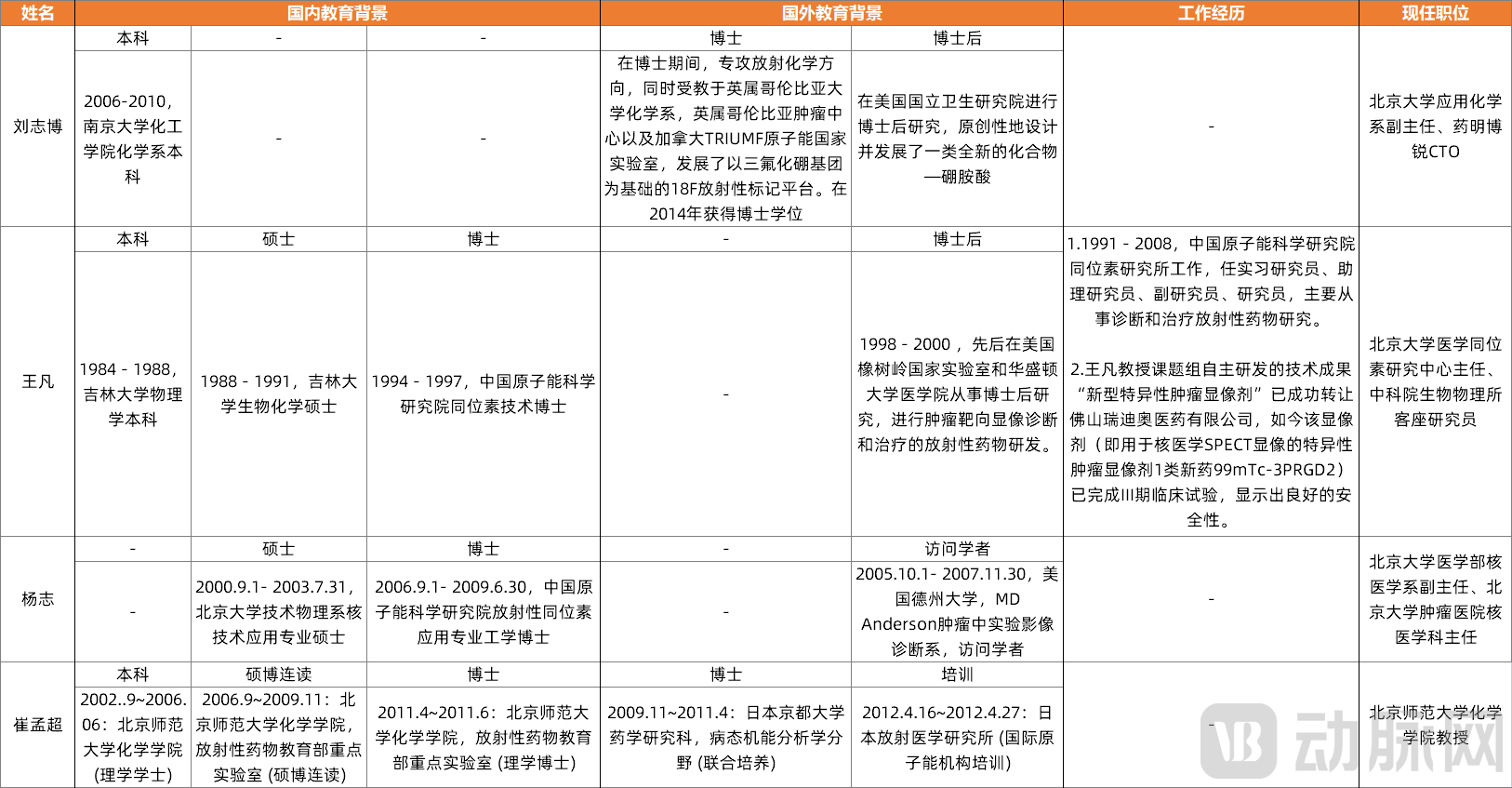 Educational and Professional Backgrounds of Four Professors
Due to their radioactivity, radiopharmaceuticals often involve multiple disciplines, including radiation dosimetry, radiation biology, radiochemistry, and pharmacy, making them a multidisciplinary field.In fact, the nuclear medicine field most urgently needs talent from radiology or radiochemistry specialties.Especially for talents with a background in pharmacy and radiochemistry.
Therefore, at this stage, the top-tier talents in China’s radiopharmaceutical industry—similar to Professors Liu Zhibo, Wang Fan, Yang Zhi, and Cui Mengchao—have almost all entered the field from other disciplines such as chemistry, physics, pharmacy, and clinical medicine. The China Institute of Atomic Energy has served as one of the key talent development hubs facilitating their transition into the radiopharmaceutical sector.
Furthermore, all four professors have overseas educational backgrounds and have brought back to China the latest knowledge in nuclear medicine acquired from institutions such as TRIUMF, Canada’s national laboratory for particle and nuclear physics; Oak Ridge National Laboratory in the United States; and the National Institute of Radiological Sciences in Japan.
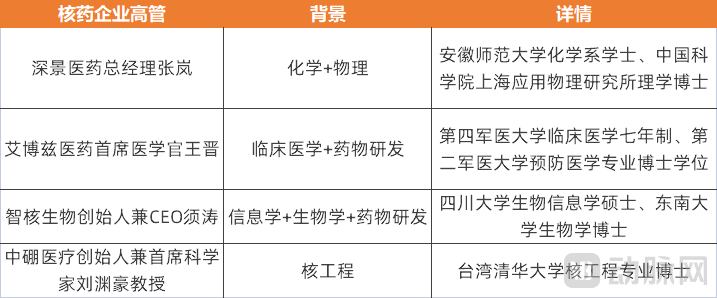
Educational Backgrounds of Executives at Select Radiopharmaceutical Companies
The primary reason is that there are very few universities in China offering programs in radiation medicine. According to incomplete statistics from VCBeat New Medicine, only eight institutions offer such programs: Jilin University, Soochow University, the Medical College of Inner Mongolia University of Science and Technology, Peking University, Anhui Medical University, Wenzhou Medical University, Nanjing Medical University, and Fujian Medical University.
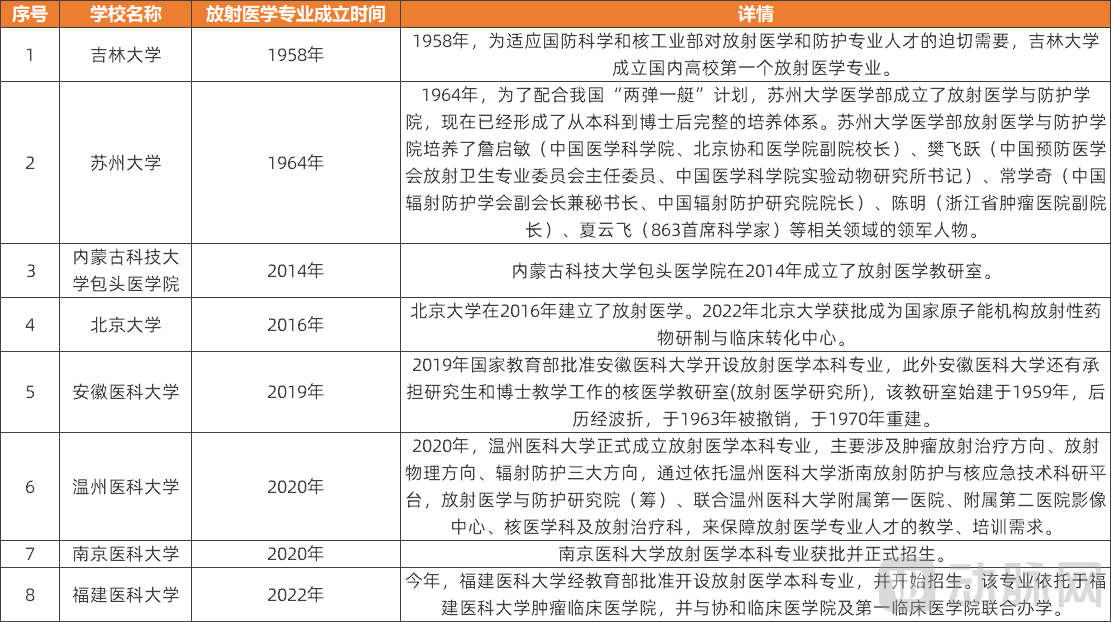
Universities in China Offering Majors in Radiation Medicine
As can be seen from the table, in recent years, especially after 2019, with the development of the nuclear medicine industry, more and more universities have begun to establish majors in radiation medicine.
In terms of the classification of academic disciplines in Chinese universities, even fewer institutions offer programs in radiopharmaceutical sciences, andUnder the traditional education system,Pharmacy and radiochemistry are often completely siloed disciplines; consequently, radiochemistry students frequently lack expertise in pharmaceutical development, while pharmaceutical scientists often lack knowledge of radiochemistry.
In summary, the talent cultivated by Chinese universities falls far short of market demand—China’s education system is not yet mature and fails to systematically supply talent to industry; whether graduates enter the industry currently depends largely on individual choice.
Where to Find Interdisciplinary Talents?
The Talent Question for Emerging Industries
Nowadays, with the renaissance of the radiopharmaceutical industry, an increasing number of universities are establishing disciplines related to radiopharmaceutical R&D, and more research institutes and laboratories have emerged as hubs for talent development.
Although the shortage of talent remains a significant challenge facing the development of the radiopharmaceutical industry, supply and demand sides have begun to mutually reinforce each other, and the scarcity of nuclear medicine professionals is gradually changing. In the future, continued efforts may focus on the following three aspects.
First, adopt a collaborative talent development model. In the short term, it is difficult for universities to train large numbers of the interdisciplinary professionals required by the radiopharmaceutical industry. Therefore, enterprises can collaborate with institutions such as universities, research institutes, and nuclear medicine departments in medical schools to jointly cultivate interdisciplinary talent.
For instance, newly recruited pharmaceutical talents can be sent to institutions such as the State Key Laboratory of Radiation Medicine and Protection at Soochow University’s Medical College, the Key Laboratory of Radiopharmaceuticals (Ministry of Education) at Beijing Normal University, the Center for Molecular Imaging and Translational Medicine at Xiamen University, and the Jiangsu Institute of Nuclear Medicine for training in radiation-related theory and practical operations. Although the joint training program requires a minimum duration of one year, it can still rapidly alleviate the current shortage of skilled personnel.
In the long term, it is most critical to reform the talent training system for nuclear medicine in higher education institutions to systematically supply professionals to the industry.
Some industry experts have suggested that “in the future, domestic schools of pharmacy could integrate the disciplines of pharmacy and radiochemistry to establish majors related to radiopharmaceuticals, while the Ministry of Education could expand the number of talent training bases.”
Ultimately, the industry can attract more talent only when it demonstrates promising development prospects. The market for therapeutic radiopharmaceuticals is vast; however, success in the current radiopharmaceutical sector has been limited to individual cases such as Lutathera and Pluvicto. If China’s radiopharmaceutical industry can disclose more impressive clinical data and launch several high-value therapeutic radiopharmaceuticals, it will further validate the value of this modality, thereby attracting greater attention from professors and their students to the field. Therefore, it is essential to continue increasing investment in technological innovation and drug R&D, secure policy support through industrial upgrading, and enhance talent attraction.
Nuclear medicine is not an entirely new field, but rather a resurging one. Yet, like many emerging industries such as AI-driven drug discovery and synthetic biology, it faces a similar talent shortage, urgently requiring interdisciplinary professionals. Where will such talent come from? It demands collaborative efforts among policymakers, academic institutions, and enterprises, as well as further consolidation of momentum within the nuclear medicine industry.