

United Imaging Healthcare Completes Largest IPO on STAR Market in 2022, Backed by PE Firms Since 2015
On August 22, Beijing time, the STAR Market welcomed its largest initial public offering (IPO) since 2022.
Shanghai United Imaging Healthcare Co., Ltd. (hereinafter referred to as “United Imaging Healthcare”) officially listed on the STAR Market of the Shanghai Stock Exchange, with an issue price of RMB 109.88 per share and a market capitalization approaching RMB 100 billion.
From “betting the farm” by pouring all capital and effort into product R&D and breakthroughs in core technologies, as described in a 2017 internal letter by Xue Min, Chairman of United Imaging Healthcare Group, to its current IPO, the company’s success has long been evident to private equity (PE) investors.
In 2017, United Imaging Healthcare secured the largest single private equity financing in China’s medical device industry at the time, raising RMB 3.333 billion. The round was co-led by China Life Health Industry Fund and SDIC Innovation Investment Management Co., Ltd., with participation from China State-Owned Capital Venture Investment Fund, CICC Zhide, CITIC Securities, CDB Kaiyuan, and China Merchants Bank Telecom, among other investors.
An industry insider once told VCBeat“Whether in judging financing milestones or selecting investment institutions, United Imaging Healthcare has undoubtedly made a smart decision.”
Following the completion of this funding round, Xue Min stated in an internal letter that fundraising is not merely about “raising capital,” but rather about forming a “community of shared destiny” with partners who share common values and offer complementary resources and technological advantages, thereby jointly achieving significant business success.
It was precisely due to the mutual appreciation and respect with Xue Min that SDIC Innovation led United Imaging Healthcare’s Series A financing round five years ago, embarking on a journey of collaborative growth. In this exclusive interview with SDIC Innovation (SDIC Merchants) Life Sciences Investment Team, we seek to address key questions: How can investors accurately assess market sectors and corporate value? How can investment institutions add value to companies throughout their growth trajectory? And how can they sustain the internal drive of management teams? Additionally, we share SDIC Innovation (SDIC Merchants)’s insights and observations on the healthcare sector.
SDIC Innovation (SDIC Merchants) is a “long-termist” in the healthcare sector.
In 2015, China’s medical imaging industry was just emerging, and United Imaging Healthcare had not yet disclosed any financing information to the market. Nevertheless, starting from that time, SDIC Innovation’s healthcare team began conducting in-depth industry research on high-end medical equipment—including CT, PET-CT, MR, DR, and linear accelerators—as well as several related subsectors. The team has continuously monitored United Imaging Healthcare’s development and maintained close communication with its senior management.
If in-depth industry research represents SDIC Innovation’s “immersion” in the art of investment, then maintaining close ties with enterprises and accompanying their long-term growth embodies its approach of “nurturing silently” through investment.
Lu Dazhong, Head of the Life and Health Team and Managing Director, told VCBeat.“We are not a team that is particularly eager for quick success; rather, we prefer to gradually build close ties with enterprises. On one hand, as a private equity (PE) firm, our fund has a longer operational horizon. We are accustomed to spending three to five years researching an industry and even up to ten years supporting the growth of our portfolio companies. On the other hand, the financing windows open to most companies are actually quite brief. If you aim to become a significant investor in a company, patience is essential.”
However, in Lu Dazhong’s view, investment is not as absolutely objective as one might imagine; rather, it is a judgment shaped by the combination of science and art, along with a touch of luck.
It is difficult to apply a uniform set of standards and frameworks to assess the value of companies across different sectors.
Moreover, investment is multifaceted. Investors need to assess whether a company’s development aligns with industry demands by analyzing industry needs and characteristics. This requires investors to draw on their accumulated experience, industry insights, market environment assessments, understanding of the company’s overall team and founders, as well as primary data to support their judgments. It also necessitates that investors engage deeply with enterprises to evaluate critical yet unquantifiable reference factors.
It is for this reason that Lü Dazhong describes investment decision-making as an art that cannot be measured solely by methodologies or standards.
Recalling his initial communications with United Imaging Healthcare, Lü Dazhong stated that many details remained vivid in his memory. He remarked,“United Imaging Healthcare’s management is exceptionally refined; even their cafeteria and restrooms are immaculately clean. The company’s campus consists of a complex of buildings, evoking an atmosphere nearly identical to that of Huawei’s Research Institute. Moreover, the overall layout and interior design within the campus are highly human-centric. I believe this reflects attention to managerial details, as well as the team’s cultural and humanistic spirit, which deeply impressed me at the time.”
Data is the report card of investment art.
Established in 2015, SDIC Innovation (SDIC Merchants) has designated life sciences as a key investment sector. Its life sciences investment team has invested in more than 50 leading biopharmaceutical and high-end medical device companies, including Innovent Biologics, Dizal Pharmaceutical, CanSino Biologics, Ascentage Pharma, BrightGene Bio-Medical Technology, United Imaging Healthcare, Peijia Medical, Tinavi Medical Technologies, and Novogene, with total investments exceeding RMB 10 billion.Among them, 12 companies have been listed on the capital markets and have demonstrated strong stock performance.
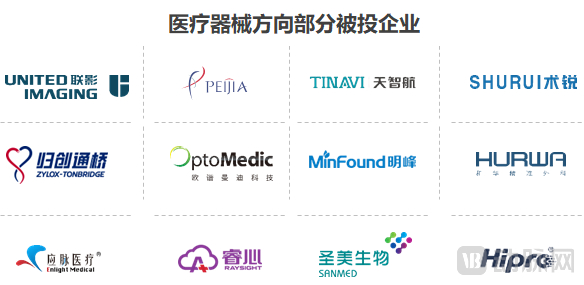
Selected Medical Device Portfolio Companies of SDIC Innovation (SDIC Merchants)
During the reporting period covered in United Imaging Healthcare’s prospectus, its operating revenues were RMB 2.035 billion, RMB 2.979 billion, RMB 5.763 billion, and RMB 3.085 billion, respectively, with total revenue surpassing that of established domestic medical imaging manufacturers such as Neusoft Medical and Wandong Medical.
Tianzhihang is the first surgical robotics company listed on the STAR Market.
Driven by the massive demand for “domestic substitution” and the continued rise of innovators committed to independent R&D, the life sciences investment team remains bullish on the development of the medical device industry.。It is believed that the trend of “domestic substitution” has become increasingly clear. Driven by “domestic substitution” and national policies supporting the procurement of domestically produced equipment, the size of China’s medical market will continue to expand. This will inevitably lead to the emergence of a large number of outstanding innovative technologies developed in China.
“The acceleration of ‘domestic substitution’ will further drive the emergence of industry leaders in niche sectors.”In the future, we will continue to focus our investment strategy on two key directions: independent innovation and "domestic substitution."
After anchoring the overarching strategic direction, it is essential to conduct an in-depth exploration of industry demands and maintain profound insights into the sector at all times.
“The healthcare industry is one that is constantly evolving. Amid rapid technological advancements, we used to evaluate projects over a five- or ten-year horizon; now, even a two-year gap can bring about dramatic changes,” said Xiao Zhi, Co-Head of Life Sciences and Managing Director, after a brief pause. “In an industry prone to frequent “outbreaks,” there is an even greater need for “long-termists” who meticulously study the industry’s development direction and accurately judge its trends.”
SDIC Innovation (SDIC Merchants) imposes higher requirements on industry research and demands a greater time commitment.The team has been divided internally for industry research.
The business team conducts conclusive analyses on specific sub-sectors and produces micro-level research briefs based on first-hand information. These briefs are used for internal sharing and discussion among team members, and are regularly distributed to investors and relevant government departments.
Leveraging its own channel and resource advantages, the investment team has a relatively in-depth understanding of policies, which can potentially help enterprises achieve greater project outreach.
Leveraging specific materials from project work and expert interviews, as well as the team’s own understanding and research of the industry, VBInsight produces research reports with a meso- and macro-level focus, helping the team rapidly gain industry insights and accurately assess development trends.
Market research was conducted with great rigor, yet Xiao Zhi appeared quite relaxed during our conversation.
“Life Requires Maintaining an "Empty Cup" Mindset.“In industry research and learning, we must never be complacent. Throughout the process, it is crucial to guard against overconfidence and maintain a ‘beginner’s mind.’ Spending too long immersed in one field can easily lead to being filled with entrenched perceptions. When new knowledge cannot take root, you risk falling behind the times, or even lagging behind the pace of industry development,” said Xiao Zhi.
In a diversified and rapidly evolving industry, investors need to hear diverse perspectives. SDIC Innovation (SDIC Merchants) fosters an egalitarian internal culture centered on respect for expertise, implements flat organizational management, and continuously incorporates diverse viewpoints.
“Our commitment to professionalism, continuous learning and updating of industry knowledge, and a focus on long-term trend analysis are among the primary reasons for the high proportion of IPOs in our investment portfolio.“In some projects, it is truly the minority that determines the project’s success,” said Xiao Zhi.
To date, the Life Sciences team comprises nearly 21 professional investors, including 7 PhDs and 14 Master’s degree holders. Seventy percent of them have overseas study or work experience, and more than 80% possess academic backgrounds in life sciences-related fields. Dr. He Ruyi, former Chief Scientist at the Center for Drug Evaluation of the China National Medical Products Administration (NMPA), joined the team in 2018 and serves as the Chief Scientist of SDIC Investment Promotion’s Life Sciences division, participating in the evaluation of new drug projects.
Since the second half of last year, the market capitalization of most healthcare and wellness companies has entered a downward trend across Hong Kong stocks, A-shares, and U.S. stocks. In the first half of this year, influenced by factors such as the pandemic, frequent occurrences included terminated IPOs, post-listing price drops below offering prices, halving of market capitalization, and continued declines in secondary market stock prices. From January to May, the STAR Market accepted only one healthcare and wellness company for listing—Genetron Health (Shihe Gene)—indicating a general slowdown in the pace of healthcare IPOs.
In the short term, the healthcare and wellness industry appears to be accelerating its decline. However, taking a longer-term perspective reveals that since the first dot-com bubble at the turn of the millennium, the sector has weathered several cycles of boom and bust, ultimately returning each time to its normal upward trajectory.
The acceptance of applications from 14 medical and healthcare companies on the STAR Market this June appears to corroborate this.
Driven by factors such as an accelerating aging population and rising overall household income, the demand for high-quality medical services continues to expand. In the post-pandemic era, the overall service volume of medical institutions is poised for growth, further stimulating the development of the healthcare and wellness industry. The healthcare and wellness market as a whole is experiencing a rebound.
As Xiao Zhi pointed out, in an industry prone to frequent upheavals, it is even more essential to anchor decisions in professional expertise, adhere to long-term trend assessments, engage in continuous learning, and maintain deep, mutual immersion with portfolio companies. If all else fails, a touch of artistry and a sense of ease may also help.