

Former Executives from Baxter and Stryker Return to China, Betting on Animal-Derived Collagen Market
2022 is destined to be a year that will go down in the annals of the commercial development of collagen.
Over the past eight months, major domestic hyaluronic acid players have acquired collagen companies, while Chinese recombinant collagen firms have sequentially launched initial public offerings (IPOs). The frequent capital market activities signal that the collagen industry is ushering in a new wave of growth.
The term “again” is used because collagen was already applied in the medical and healthcare fields as early as the last century. Its application in the medical aesthetics sector even predated that of hyaluronic acid, the current “leading contender,” by more than 20 years. Unfortunately, when collagen experienced its first wave of development driven by its excellent biodegradability and high biocompatibility, it also faced questions regarding its biosafety and antigenicity.
Coupled with immature technological development and limited production capacity, the commercialization of collagen in the medical aesthetics sector lagged behind that of hyaluronic acid, gradually falling into obscurity. However, driven by the tireless market education efforts of collagen enterprises and breakthroughs in related technologies, the collagen market began to revive around 2019, marking a turning point.
Changes have also occurred subtly: recombinant collagen has begun to take center stage and is widely regarded by various stakeholders as the mainstay of collagen’s future, while animal-derived collagen has often been saddled with negative labels such as “high allergy risk” and “low safety.”
Does this indicate that animal-derived collagen has no future prospects?
In this regard,Zhengzhou Kunpeng Health Technology Co., Ltd. (hereinafter referred to as “Kunpeng Health”)Founder Liu Xingzhou and Co-founder Han Kun originally held differing views, andFirmly centering on the independent production of animal-derived collagen and 3D printing technology, we are strategically positioning ourselves in the markets for cell culture, medical aesthetic fillers, and regenerative medicine.。
The resumes of the two founders of Kunpeng Health are nothing short of impressive.
Liu Xingzhou, founder of Kunpeng Health, was formerly a clinical orthopedic surgeon. He holds a Master of Medicine degree from Tongji Medical College of Huazhong University of Science and Technology in Wuhan and an MBA from Duke University in the United States.
More notably, Liu Xingzhou has also held key positions at globally renowned healthcare companies Baxter and Bayer Biologics.
During his tenure at Baxter, Liu Xingzhou was responsible for the global strategic planning, new product launches, R&D, and regulatory affairs collaboration for the human albumin product series, with annual sales reaching $300 million. As the Asia-Pacific Manager at Bayer’s Biological Products Division, he primarily oversaw distribution, market development, and brand management across nine countries and regions.
Moreover, Liu Xingzhou previously served as Marketing Director for China at BD Life Sciences, for Greater China at Bio-Rad Clinical Diagnostics, and for Asia-Pacific at Beckman Coulter Life Sciences. In these roles, he was responsible for formulating and implementing marketing strategies, as well as coordinating the research, development, and production of products tailored to local customer needs.
After more than two decades of navigating the healthcare industry, Liu Xingzhou has accumulated extensive experience in marketing and product development.
The professional background of Han Kunyuan, another co-founder of Kunpeng Health, shares similarities with that of Liu Xingzhou while also offering complementary expertise.
The similarity lies in that,Han Kunyuan also graduated from Duke University in the United States and joined Stryker, one of the world’s largest orthopedic medical device companies.
During his tenure at Stryker, Han Kunyuan not only received honors such as Stryker Operations’ “Global Quality First Award” and “General Manager’s Special Award,” but also served as the U.S. lead for the New Product Introduction (NPI) project that transferred Stryker’s orthopedics U.S. product line to manufacturing in China. He participated in and spearheaded the integration and management of the orthopedic implant product line following Stryker’s acquisition of Chuangsheng (a company listed on the Hong Kong Stock Exchange).
It is evident that Han Kunyuan primarily accumulated experience in R&D and operational management at Stryker, forming a complementary advantage with Liu Xingzhou.
Shared orthopedic backgrounds and complementary strengths brought the two together at an alumni event, where they instantly clicked and decided to launch a venture together.
The entrepreneurial direction was ultimately set on collagen. The reason is none other than optimism about the development of the collagen market.
From the perspective of application scenarios, collagen has diverse uses. It can serve as wound repair dressings, hemostatic materials, and drug carriers in the traditional pharmaceutical field; as injectable fillers and medical dressings in the medical aesthetics sector; and, due to its reparative, moisturizing, and skin-whitening properties, it is also widely used in skincare products.
Moreover, it is worth noting that the aforementioned commercialization process being overtaken by hyaluronic acid is limited to the medical aesthetics sector. In the traditional pharmaceutical field, collagen holds greater advantages over hyaluronic acid. Furthermore, beyond traditional applications in pharmaceuticals, medical aesthetics, and skincare products, collagen can also be utilized in the emerging field of regenerative medicine.
The wide range of application scenarios will inevitably lead to a substantial market size and promising development prospects.
According to Frost & Sullivan, the retail size of China’s collagen market reached RMB 28.8 billion in 2020, with a compound annual growth rate (CAGR) of 31% from 2017 to 2021. Among this, the animal-derived collagen market accounted for RMB 17.9 billion, representing 62% of the total market size, while the recombinant collagen market amounted to RMB 10.8 billion, accounting for 38%. This indicates that animal-derived collagen still dominates the current collagen market. However, Frost & Sullivan also predicts that by 2023, the market share of recombinant collagen will surpass that of animal-derived collagen for the first time.
However, against this backdrop, Kunpeng Health has chosen to enter the animal-derived collagen sector, aiming to achieve “cost reduction and efficiency improvement” in the production of animal-derived collagen raw materials through the innovative application of five key technologies.
“Industry perceptions of animal-derived collagen still seem stuck in the past.” Reflecting on the differences between animal-derived collagen and recombinant collagen, Liu Xingzhou, who has witnessed the safety debates surrounding blood-derived recombinant products and human plasma-derived products, offered this observation.
As previously mentioned, animal-derived collagen has been heavily questioned regarding safety and antigenicity. Many viewpoints hold that animal-derived collagen poses safety and immunological risks.In this regard, Liu Xingzhou stated, “The so-called safety and antigenicity issues of animal-derived collagen remain merely at the conceptual level and do not arise in practical applications.”
Currently, the primary sources of animal-derived collagen are bovine and porcine. Given the close structural similarity between porcine and human collagen, porcine-derived collagen presents virtually no antigenicity concerns.
Furthermore, although relevant data indicate that bovine collagen carries a 2%–3% risk of allergic reactions, Liu Xingzhou stated, “These data are from an early stage. Currently, the industry has developed relatively mature methods for removing telopeptides to reduce immunogenicity, which can effectively address the antigenicity issues associated with bovine collagen.”
More importantly, China has established clear guidelines for antigen detection methods, and animal-derived collagen products have been widely used in departments such as orthopedics, neurosurgery, and general surgery, with no reports of antigenicity-related issues in recent years.
andLiu Xingzhou’s explanation of the safety concerns surrounding animal-derived collagen can be summed up in one sentence: “Any discussion of toxicity without considering dosage is disingenuous.”
"In terms of dosage, 'non-vegetarian individuals consume dozens of kilograms of meat annually, whereas high-purity collagen products used in medical aesthetics and medical procedures are administered in amounts ranging from tens to hundreds of milligrams.'"
Furthermore, in terms of production and preparation, collagen-based medical products are subject to stringent traceability requirements. Manufacturing is conducted in GMP-certified sterile facilities, involving rigorous purification processes as well as defined and strict sterilization and viral inactivation procedures.
Therefore, Liu Xingzhou finds it somewhat baffling that external critics primarily question animal-derived collagen on the grounds of safety and antigenicity.
Not only that, but animal-derived collagen also has certain advantages compared to recombinant collagen. Among these, the most significant advantage is that animal-derived collagen can retain its complete triple-helix structure, which happens to be the "soul" of collagen's function and activity, as well as a prerequisite for Kunpeng Health's entry into the target market.
VCBeat has learned thatKunpeng Health has chosen to start with the production of collagen raw materials, gradually expanding into cell culture, medical aesthetic fillers, and regenerative medicine.
Addressing the root cause stems primarily from the two founders’ three observations of the industry:
First, collagen is currently expensive; high-molecular-weight collagen products for clinical use cost at least RMB 1 million per kilogram, while those for cell culture can reach tens of millions of RMB per kilogram.
Second, whether for imported or domestically produced collagen products, manufacturers or distributors hardly provide any technical support. Given that the research and application of collagen are inherently interdisciplinary, there is an urgent need for essential technical support.
Third, the commercialization experience of “new-generation” hyaluronic acid is worth learning from. The rapid progress in the commercialization of hyaluronic acid has largely been driven by technological breakthroughs achieved by manufacturers represented by Bloomage Biotechnology, which have significantly increased production capacity and substantially reduced costs. This points the way for the development of collagen.
However, as is well known,High production costs and low output represent the most formidable barrier in the current development of collagen, constituting a primary factor limiting its advancement.
In response, Kunpeng Health has developed its own solutions—namely, precision processing technology for raw material pretreatment, immunogenicity removal technology for animal-derived materials, specific enzyme extraction technology, collagen purification technology, and high-efficiency viral inactivation technology. The company has set an initial goal to reduce the market price of high-purity, high-activity macromolecular collagen (Type I) to RMB 400,000–500,000 per kilogram by 2023 at the latest, thereby benefiting a broader population.
“These five technologies are not entirely new; our greatest innovation lies in leveraging them to optimize the entire collagen production process, thereby significantly increasing output and reducing the price of collagen while ensuring quality.”Liu Xingzhou stated, “Of course, the specific applications of these five technologies were also summarized through extensive practical experience. We have experimented with various raw materials, such as rat tails, and the Achilles tendons and skin of pigs and cattle, and even compared raw hides with hair intact against pigskin purchased from supermarkets.”
Having mastered the industrial-scale preparation of collagen raw materials, Kunpeng Health has begun to explore product commercialization.
Regarding the commercialization plan for the product,Liu Xingzhou stated that Kunpeng Health will initially focus on the raw materials market for cell culture, food, and health supplements, with a particular emphasis on 3D cell culture.
The reason is that, first, traditional 2D cell culture differs significantly from the actual in vivo environment, whereas 3D culture more accurately recapitulates the complex tissue architecture and in vivo morphology, closely mimicking the physiological growth environment of normal cells, thereby fully revealing cellular activities and intercellular interactions. Therefore, 3D cell culture represents the future direction of cell culture technology, and collagen, as the primary component of the extracellular matrix, serves as an excellent natural scaffold for 3D cell culture;
Second, according to Liu Xingzhou, existing products in this market currently rely primarily on imports, which are not only expensive but also subject to highly uncertain lead times and essentially lack technical support. Kunpeng Health is well-positioned to address these pain points by leveraging its cost and supply chain advantages in raw materials, thereby enabling rapid market entry, gradually building user reputation and brand influence, and accumulating strength for expansion into the next market.
Aesthetic fillers and regenerative medicine constitute this “next market.”
The rationale for selecting the dermal filler market is straightforward: First, driven by consumption upgrades, the medical aesthetics industry is experiencing rapid growth. Second, as the injectable segment expands, the limitations of hyaluronic acid and botulinum toxin are becoming increasingly apparent. Meanwhile, collagen—particularly animal-derived collagen—offers distinct advantages for optimizing fillers in delicate areas such as the periorbital region and tear troughs, owing to its ability to retain an intact triple-helix structure. Furthermore, with only four products currently approved in China’s injectable filler market, the competitive landscape is relatively more favorable.
However, in an interview, Liu Xingzhou revealed to VCBeat thatKunpeng Health is highly willing to collaborate with relevant enterprises and institutions to explore the medical aesthetics market. In the field of regenerative medicine, Kunpeng Health will focus on niche segments such as cartilage injury, rotator cuff injury, and anterior cruciate ligament (ACL) injury.
Furthermore, in the field of orthopedics, leveraging its advantages in collagen production, Kunpeng Health will also expand into the 3D printing market.
Specifically, in the field of 3D printing technology, co-founder Han Kunyuan participated in the research and development (R&D) and commercialization of metal 3D-printed products during his tenure at Stryker. He continued to engage in the R&D of 3D-printed products after Stryker’s acquisition of Chuangsheng, thereby accumulating substantial expertise in 3D printing.
By materializing this accumulation, the team has secured one successful software copyright for biological 3D printing, two patents currently under substantive examination, and six invention patents expected to be granted this year.
Moreover, according to Han Kunyuan, collagen is a high-quality bioactive material that will play a significant role in related fields when combined with 3D printing technology.
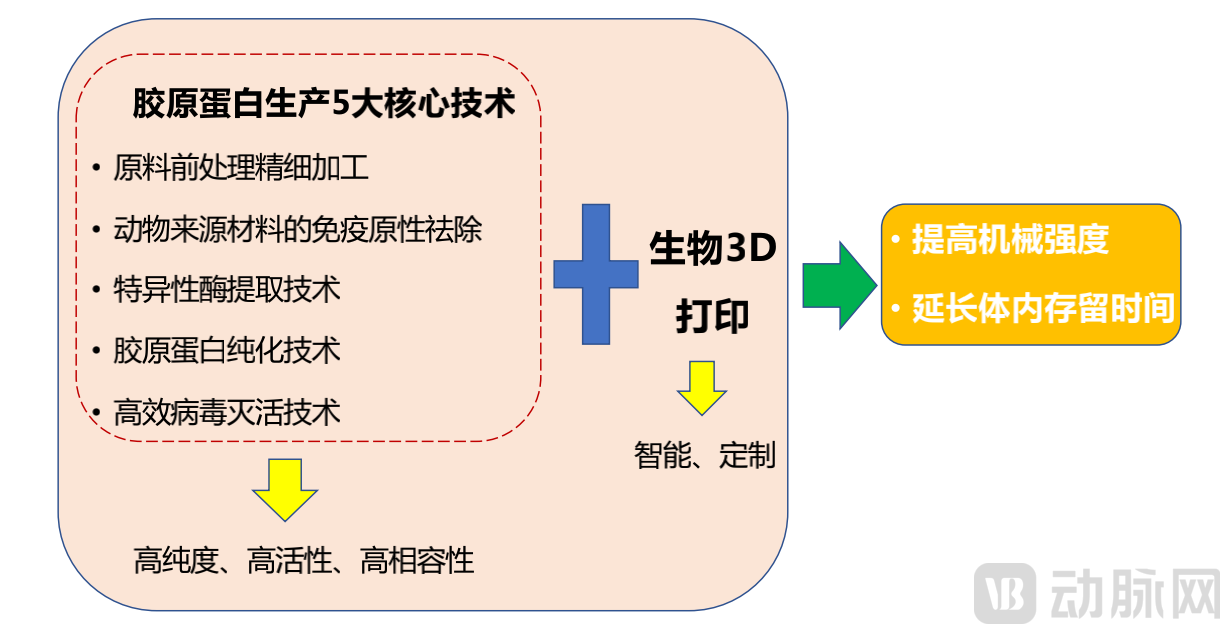
Unfortunately, due to the high cost of collagen, it accounts for only 5% of the formulations for 3D bioprinting materials on the market. “Using pure collagen would certainly be optimal.” In this context, Kunpeng Health’s competitive advantage in collagen production is once again highlighted.
However, it should be noted that while removing antigenicity, collagen also reduces the mechanical strength of its triple-helix structure. Although theoretically, combining it with 3D printing technology could enhance the mechanical strength of collagen while maintaining its bioactivity, Han Kunyuan frankly admitted that “there are still significant challenges, and further exploration is needed.”
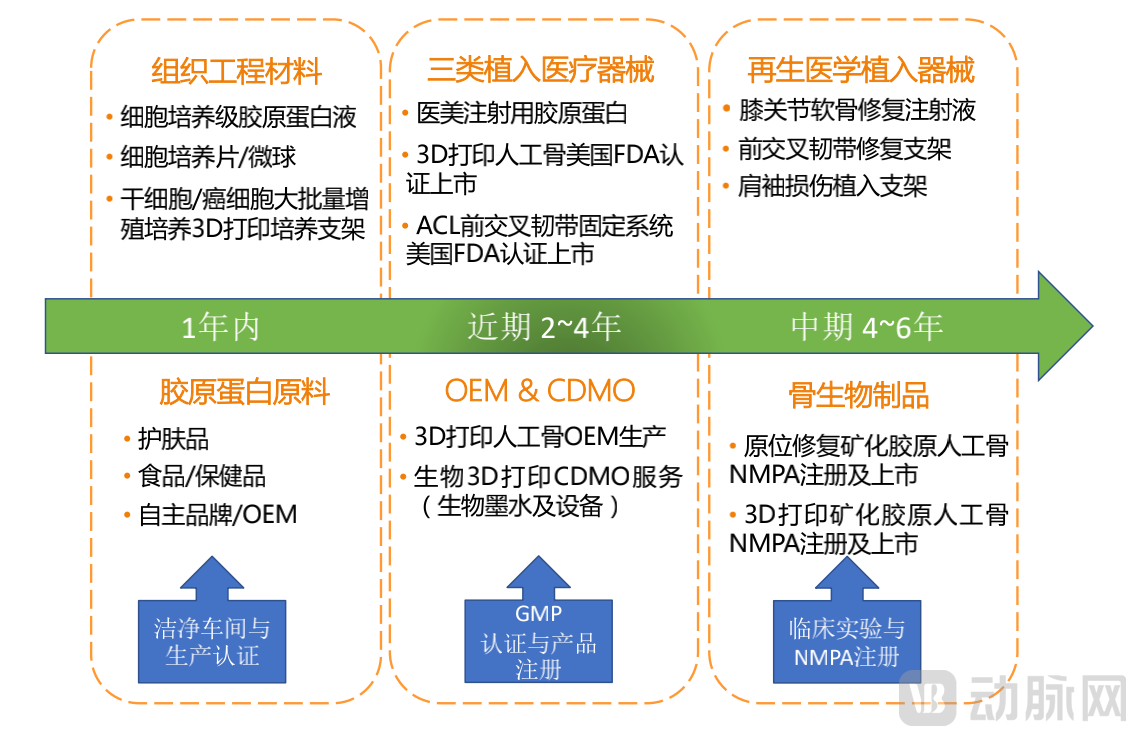
Overall,Leveraging in-house collagen production and 3D printing capabilities, the two founders have charted a steady and pragmatic development path for Kunpeng Health: within the first year, focus on the collagen raw materials and tissue engineering materials markets to build reputation and achieve positive cash flow in the short term; over years 2–4, target the Class III implantable medical device market as well as the 3D printing OEM and CDMO sectors to stabilize cash flow; and over years 4–6, steadily enter the medical implantable device and bone biologics markets.