

InnoNanoMed Advances as China's Pioneer in DNA Nanorobotics: Filing IPO to Accelerate Clinical Translation of Precision Drug Delivery and Vaccine Platforms
Einstein once remarked that the future of science would consist of continued advances into both the macroscopic and microscopic worlds. DNA nanorobots represent another breakthrough in microscopic research.
DNA nanorobots are nanostructures assembled from DNA molecules as building blocks, capable of performing various preset functions. Owing to the flexibility and precise controllability of DNA nanomaterial assembly, DNA nanorobots can theoretically be engineered into any structure, enabling the loading of arbitrary functional molecules onto their carriers, with precise control over physical parameters such as the quantity and spatial positioning of these functional molecules.
As a foundational tool-based technology, DNA nanorobots have become one of the most promising research and development directions for nanotechnology in the biomedical field, with theirIt holds application potential in drug delivery, vaccine preparation, and diagnostic reagents.。
On the path to leading the innovative R&D and industrialization of DNA nanorobots, a Chinese enterprise has taken the lead.
“China’s biopharmaceutical sector has moved beyond the fast-follow stage; we must proactively lead innovation and take the first step,” said Shi Quanwei, Co-founder of Junquan Zhiyao.
Junquan Zhiyao was founded just two years ago,It is the first startup in China dedicated to the research, development, and industrialization of intelligent medical nanorobots., with its core DNA nanorobots serving as an innovative bioproduct development platform based on DNA nanotechnology. Since its inception, the company has secured early-stage investment from Natong Technology Group and Inno Angel Fund.
Shi's mentor was a top scientist in the field of drug delivery technology in China.Prof. Guangjun Nie. Professor Nie Guangjun currently serves as the Chief Scientist at Junquan Zhiyao. Under his leadership, Junquan Zhiyao has achieved continuous breakthroughs and sustained innovation in the field of DNA nanotechnology.
DNA Nanorobots Target Diseases with Greater Precision
DNA: The “Artwork” of the Nanomaterials Field
First, by leveraging the Watson-Crick base-pairing principle that governs interactions between DNA molecules, DNA nanostructures exhibit high predictability, allowing for the pre-design of precisely controlled sizes and shapes as needed. Second, given that DNA molecules are relatively stable and easily modifiable in vitro, various forms of therapeutics—including small-molecule drugs, protein-based drugs, and nucleic acid drugs—can theoretically be conjugated to DNA molecules and subsequently attached to DNA nanostructures via strand hybridization. Finally, DNA molecules possess well-defined physical parameters (one helical turn per 10 base pairs, with a length of 3.4 nm), enabling precise control over the number and spacing of functional molecules.
Therefore, compared to other nanomaterials, DNA canMore precise placement of functional molecules to be loaded, in order to meet diverse drug delivery needs and achieve targeted release of therapeutic agents or precise antigen presentation.。
Leveraging the precisely controllable nature of DNA, the use of DNA nanorobots to deliver drugs specifically to tumor cells for efficient cancer cell destruction is regarded as one of the effective approaches in precision oncology.
Taking interventional embolization for tumor treatment as an example, traditional embolic agents are fusion proteins with suboptimal targeting capabilities and significant side effects. The research and development team led by Nie Guangjun at the National Center for Nanoscience and Technology, in collaboration with a research group at Arizona State University in the United States, proposed for the first time the concept of using nanorobots to precisely deliver thrombin to tumor tissues, marking a novel breakthrough in both the technology and strategic approach to cancer therapy.
Their research successfully achieved the precise structural construction of DNA nanomachines, including the design of DNA origami structures, DNA modification and conjugation with proteins along with their quantification, and the design of responsive “lock” DNA structures.
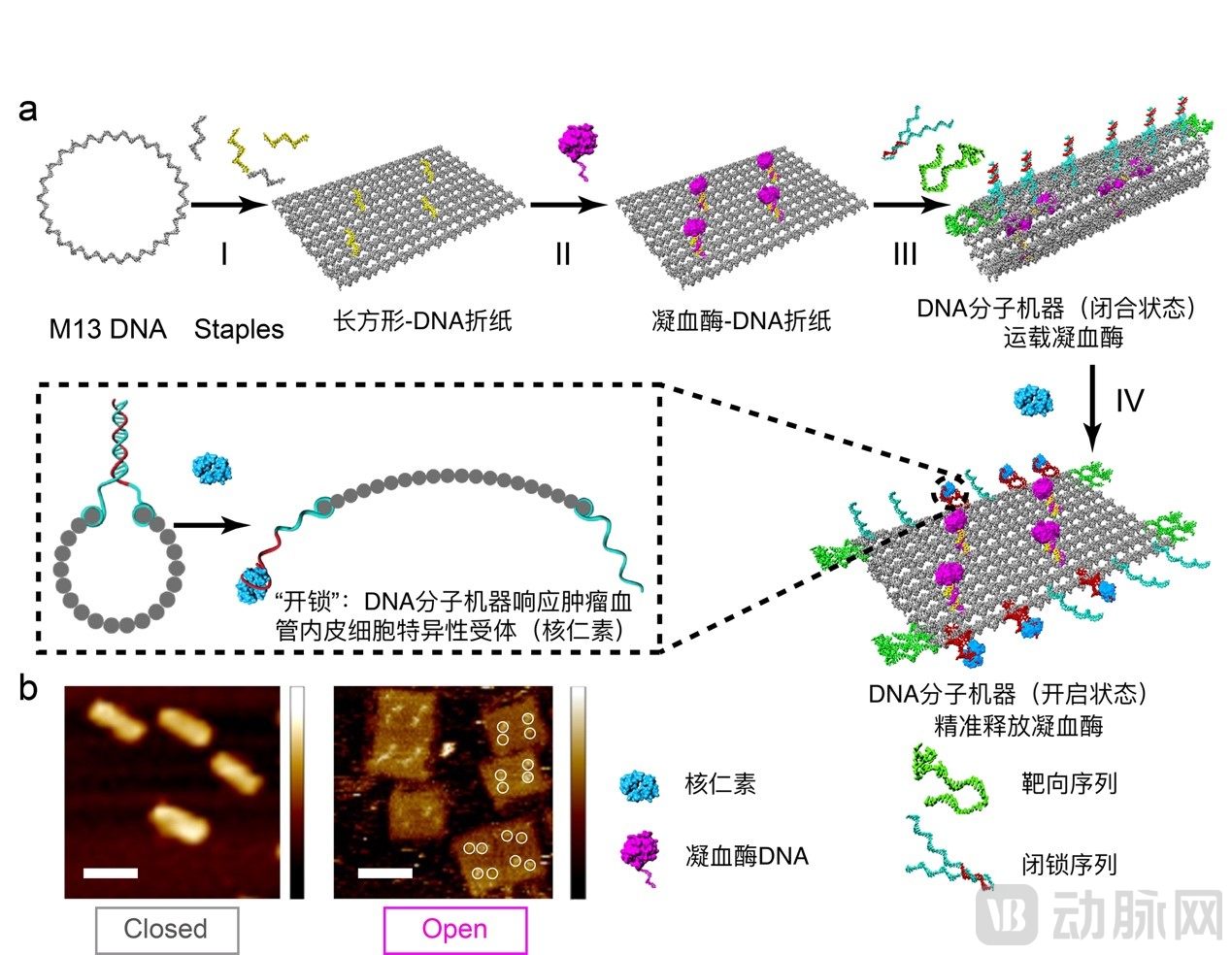
Design and Characterization of Thrombin-Functionalized DNA Nanorobots
The final DNA nanorobot features a tubular structure that encapsulates thrombin molecules within its lumen. Its diameter is smaller than the substrates targeted by thrombin in the blood, thereby ensuring safety during transport. Nucleolin-binding AS1411 aptamers extend from both ends of the tube to enable targeted localization to tumor vascular endothelium.
This technology has demonstrated promising results in various murine tumor models without eliciting significant immune responses, and theoretically holds therapeutic potential for any vascularized primary tumors or metastatic lesions.
This research was published in *Nature Biotechnology* in 2018, was named one of the “Top Technical Advances in 2018” by *The Scientist* magazine, and was selected as one of the “Top Ten Scientific Advances in China in 2018” by the Ministry of Science and Technology.
Broad Prospects for Translation Make Founding a Company a Natural Step
The scientific achievements in nanorobotics have been enthusiastically embraced by the academic community, and the precise delivery of thrombin is just one of the applications of DNA nanorobots in the biomedical field. Many investment institutions in the industry have also recognized the application potential of this research, and how to maximize the technical advantages of DNA nanorobots has attracted widespread attention in the industry.
In 2020, encouraged by national policies supporting innovative drug R&D, guided by the Beijing Matchmaking Conference for Excellent Projects of the National Natural Science Foundation of China, and with strong support from angel investment institutions, Beijing Junquan Zhiyao Biotechnology Co., Ltd. was officially established, marking a significant step forward in the research, development, and industrialization of intelligent medical nanorobots in China.
It is reported that Junquan Zhiyao has established a laboratory equipped with capabilities for the development of DNA nanotechnology production processes and quality research, and has completed process development for the batch preparation of various 2D and 3D DNA nanostructures.
Regarding the translational research of DNA nanorobots, Junquan Zhiyao targetsDrug DeliverywithInnovative VaccinesTwo Directions.
In terms of drug deliveryFor all pharmacotherapies, the goal of drug delivery is to maximize therapeutic efficacy and minimize off-target effects by transporting or releasing drugs to specific target sites within the body. Achieving precise drug delivery to enhance the safety and accuracy of drug action without interfering with other physiological functions remains a critical bottleneck in the field of drug development that requires continued breakthroughs.
DNA nanocarriers can self-assemble to carry monomers and combinations of various functional molecules, precisely regulating their size and shape. As mentioned earlier, thrombin "encapsulation" achieves targeting to different organs by installing hinges and targeting molecules, ensuring the safety and accuracy of drug release. Additionally, its inherent nanostructure offers the natural advantage of good biocompatibility.
DNA nanorobots not only represent a novel paradigm for future precision drug design but also overturn conventional perceptions of drug delivery. By undergoing structural transitions in response to microenvironmental changes, DNA nanorobots can enable next-generation logic-gated therapies.
Based on these characteristics, DNA nanorobots hold promise for the effective encapsulation and intelligent delivery of drugs that are otherwise unusable due to excessive systemic toxicity or insufficient potency, as well as substances that are difficult to formulate into drugs, thereby advancing the development of next-generation anticancer therapeutics in terms of drug formulation.
In addition to drug delivery, DNA nanorobots can also be used for innovative vaccine development.。
Virus-Like Particle (VLP) Vaccines: Complex Structures Formed by the Self-Assembly of Viral Structural Proteins. The key characteristics of VLPs are their morphological, biochemical, and size similarities to native viral particles; however, they lack viral genetic material, rendering them incapable of replication or causing infection. Consequently, VLP technology represents one of the most cutting-edge approaches in current vaccine development. Currently, the most successfully marketed products include HPV vaccines and hepatitis B vaccines.
However, not all pathogenic microorganisms are capable of producing native virus-like particle (VLP) structures.
For pathogenic microorganisms that cannot produce natural virus-like particles (VLPs), DNA nanotechnology can mimic the size and shape of viral particles through precise design and control. Subsequently, viral surface antigens are displayed on the carrier surface to assemble non-toxic “DNA-biomimetic viruses.” Further optimization of antigen quantity and density to the state most effective for immune system activation can better stimulate the human body to generate immune responses. Therefore, DNA nanotechnology holds significant application prospects in the field of vaccine development.
It is worth noting that Junquan Zhiyao has also applied DNA nanorobots to the development of detection methods, creating a range of assay reagents for evaluating the in vivo and in vitro efficacy of drug delivery products and DNA biomimetic vaccine products. Examples include reagents for detecting specific T cells and enzyme-labeled antibody reagents, which demonstrate significantly improved sensitivity compared to commercially available products.
"Strengthen Technology, Energize the Industry"
Shi Quanwei believes that robust products and technology are the prerequisites for commercialization, “The company prioritizes solidifying its technological foundation and developing benchmark products.”。
Currently, the advanced nature of the technology means that its application in the pharmaceutical manufacturing industry still requires further refinement. For instance, there are no approved DNA nanomaterial products on the market. Issues such as how to implement quality control and how to achieve large-scale production remain challenges that this emerging industry must continue to explore and resolve.
“As China’s first tech-driven innovator focused on DNA nanotechnology, Junquan Zhiyao has taken a leading role in the industrialization of this field. ‘Therefore, we must be the pioneers to blaze this trail,’ said Shi Quanwei. ‘We need to continue refining our technology, establish pilot-scale production facilities, scale up manufacturing, and deliver robust products to prepare for clinical trials.’”
Shi Quanwei stated that Junquan Zhiyao is currently concentrating its R&D efforts on one or two product candidates, such as an improved thrombin-delivery nanorobot, and will advance them to clinical trials as soon as possible.
While developing its flagship products, Junquan Zhiyao aims to provide technical services to the broader scientific research community. If research institutions have R&D concepts in the field of DNA nanotechnology verification but lack the capability for large-scale preparation, Junquan Zhiyao can offer them targeted technical support.
Meanwhile, Junquan Zhiyao’s R&D team continues to drive technological innovation and development. Going forward, it will closely track frontier advances in relevant fields and strategically lay out new pipelines and product categories aligned with the direction of cutting-edge technologies.
By prioritizing product development and clinical deployment, generating early revenue through technical support services, and staying at the forefront of technological advancements to sustain its innovative vitality, Junquan Zhiyao has identified a business model that enables faster and more sustainable growth in its startup journey.
On the other hand, as a pioneer in the industrialization of DNA nanorobots, Shi Quanwei hopes to see more peers join the race, “working together to invigorate the entire industry and gain broader recognition for the prospects and advantages of DNA nanotechnology.” It is understood that Junquan Zhiyao has established strong connections with multiple enterprises and hospitals, collaborating on product development and technical validation.
“We are currently first, and we aspire to become the best in the industry.” Shi Quanwei’s words reveal Junquan Zhiyao’s firm commitment to becoming a leader in the DNA nanotechnology sector.