

Ping An Health Deepens Strategic Transformation with Enterprise Health Management Emerging as Key Growth Driver

Ping An Healthcare
One-stop Solution Provider for Health Management
Employees are a valuable asset to enterprises. However, in recent years, with the accelerating pace of work, intensifying competition, and mounting pressure, workplace-related incidents such as sudden death from overwork and depression have frequently become trending topics online. With the COVID-19 pandemic persisting for nearly three years, the establishment of corporate employee health management systems has become increasingly critical, as it pertains not only to the daily health maintenance of individual employees but also to the safe and stable operation of enterprises.
However, traditional employee health management programs are limited in scope and fragmented, often requiring specific environments for implementation. They face inherent constraints even under normal circumstances, let alone during special situations such as the pandemic.
Targeting the employee health management market of 350 million people, internet healthcare has explored innovative pathways that transcend spatial limitations and leverage robust connectivity. On August 18, Ping An Healthcare released its interim results for the first half of 2022, revealing that the company is vigorously advancing its corporate employee health management business to seek new growth drivers.
In the first half of 2022, Ping An Healthcare reported total revenue of RMB 2.83 billion, with its gross profit margin rising to 27.3%. Notably, the gross profit margin for medical services reached 39.1%, representing a quarter-on-quarter increase of 13.3 percentage points. Revenue from medical services accounted for 40% of total revenue, making a significant contribution to the overall growth in gross profit margin. According to the performance report, the primary driver behind the quarter-on-quarter rise in the gross profit margin for medical services was the increased proportion of service-based products in total revenue.
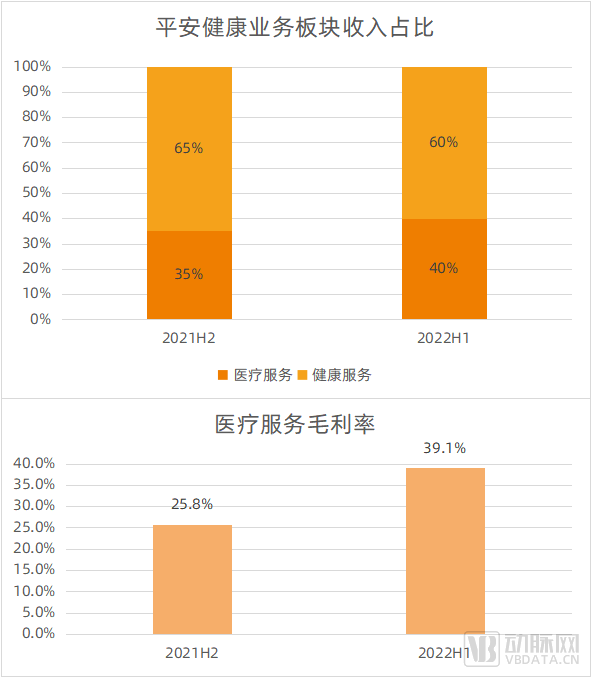
Ping An Healthcare’s H1 Performance Growth, Source: 2022 Interim Results Report
It is reported that Ping An Healthcare initiated the deepening of its Strategy 2.0 in the fourth quarter of 2021, placing greater focus on integrated financial channels and corporate client channels characterized by high willingness to pay and significant growth potential. By building a bridge between suppliers and payers within the medical and health industry chain, the company aims to establish a managed care model with Chinese characteristics.
Financial channel business has always been a strength of Ping An Healthcare, with over 33 million paying users on the financial side as of June 2022.
In this performance report, Ping An Healthcare also devoted significant space to showcasing the progress of its business expansion.
For corporate clients, Ping An Healthcare primarily provides managed care services centered on employee health management. Unlike tangible products such as pharmaceuticals and merchandise, these services benefit from stronger economies of scale due to the application of digital technologies and extensive resource integration.
Following the deepening of Strategy 2.0, particularly since 2022, Ping An Healthcare has optimized its corporate health management products and intensified customer acquisition efforts; over the past 12 months, the number of paying corporate employees and enterprise clients has exceeded 2 million.
It is evident that the integration of corporate health management with the “finance + healthcare” model has further expanded the scale effects of Ping An Healthcare’s service-oriented products, thereby reducing service costs and enhancing profitability.
Accelerating the strategic deployment of corporate health management is by no means accidental; this first requires a foundation built on Ping An Healthcare’s medical service capabilities.
Following the rapid growth in user base and service volume driven by the pandemic over the past two years, internet healthcare is entering a development phase driven by quality. In 2022, the Detailed Rules for the Supervision of Internet-Based Diagnosis and Treatment (Trial) (hereinafter referred to as the “Detailed Rules”) were implemented.
Ping An Healthcare recognized the importance of its medical attributes even before the introduction of the Detailed Rules, indeed from its inception. By leveraging its in-house medical team, it ensured timely responses to patient needs and reliable control over the quality of physicians’ services. Following the deepening of its Strategy 2.0, Ping An Healthcare further strengthened its medical attributes and quality assurance.
Building an "Online Tiered Diagnosis and Treatment" System to Efficiently Utilize Medical Resources
Ping An Healthcare is building a healthcare service ecosystem centered on family doctors and supported by specialists; meanwhile, it has contracted with renowned experts to establish specialist studios, focusing on the diagnosis and treatment of complex and critical conditions.
To date, the platform has assembled a team of nearly 49,000 internal and external physicians from 20 medical specialties, along with fitness coaches, nutritionists, and psychological counselors, comprehensively addressing users’ medical and health needs; it has also signed contracts with over 1,500 renowned experts.
To address high-demand specialty areas such as Traditional Chinese Medicine, Dermatology, and Obstetrics and Gynecology, Ping An Healthcare has established seven specialized disease centers. These centers cover scenarios including prevention, screening, treatment, and rehabilitation, and collaborate with large tertiary hospitals and external high-quality expert resources.
Thus, Ping An Healthcare has established an “online tiered diagnosis and treatment” system comprising family doctors, specialists, and renowned specialists, forming a referral and collaboration mechanism within the system.
Offline, the principle of tiered diagnosis and treatment can be understood as follows: each level performs its respective duties and leverages its specialized capabilities, ensuring that services are matched with patient needs as closely as possible.
Since internet-based healthcare entered a phase of rapid development in 2020, numerous physical hospitals and new enterprises have deployed online medical services, making doctors increasingly “in demand.” How can the efficacy of these medical resources be maximized? This also requires a “tiered diagnosis and treatment” system.
As patients, individuals can access medical services better matched to their conditions through “online tiered diagnosis and treatment,” with family physicians determining whether specialist care is needed and which specific specialties are required based on the actual clinical situation. Through resource coordination by family physicians, patients can also receive more continuous care or refined, whole-course management for specific diseases.
Therefore, from the perspectives of both patients and physicians, “online tiered diagnosis and treatment” facilitates the delivery of higher-quality medical services.
Expand the offline service network to meet multi-scenario demands
For a long time, internet healthcare has made significant efforts in online connectivity, which certainly holds important value; however, a purely online approach cannot address all medical and health issues.
Internet diagnosis and treatment policies also require that, if a patient’s condition changes, the attending physician determines the current visit to be an initial consultation, or other circumstances arise that make internet-based diagnosis and treatment inappropriate, the attending physician shall immediately terminate the internet diagnosis and treatment activities and guide the patient to seek care at a physical medical institution.
Ping An Healthcare has established and is continuously expanding its offline service network, which is integrated with its online services.
As of June 2022, Ping An Healthcare had partnered with over 3,000 hospitals, nearly 85% of which were tertiary hospitals; it collaborated with 208,000 pharmacies, offering one-hour medication delivery in more than 150 cities and 24/7 medication delivery services in 80 cities; additionally, it worked with over 100,000 health service providers.
Currently, internet hospitals affiliated with some large Grade 3A tertiary hospitals have already established integrated online-offline services leveraging their own resources.
For internet healthcare platforms, in addition to online service capabilities, offline services can cover a wider range of physical entities, including hospitals, pharmacies, health examination centers, and third-party medical testing laboratories. This means that patients have a broader range of choices and can even select providers across different regions based on their individual needs. This model also helps promote the optimization of healthcare service quality.
Emphasize Quality Management and Establish an Offline Physician Training System
It is essential to ensure and enhance medical quality through management systems. In accordance with policy requirements, medical institutions shall conduct regular training for personnel engaged in internet-based diagnosis and treatment activities as well as related management services, and establish corresponding management systems.
Family doctors are a major feature of Ping An Healthcare. Compared with externally partnered physicians, the company exercises greater control over its in-house physicians. To continuously enhance clinical capabilities, Ping An Healthcare provides offline learning opportunities for its physicians. The learning system primarily includes hospital-based advanced training programs and participation in specialty-specific academic exchange conferences. Additionally, personnel are selected to attend academic conferences and offline professional training sessions organized by authoritative medical organizations.
During the provision of physician services, Ping An Healthcare has established a comprehensive medical monitoring system. Within its evaluation framework, physician compensation is not linked to pharmaceutical sales; instead, medical quality assessment results are incorporated into physician performance management.
It is evident that Ping An Healthcare adheres to the objectives of strengthening medical attributes and enhancing medical quality, whether in terms of its physician team, service model, or management system.
From a regulatory perspective, compliance with regulatory policies constitutes the fundamental baseline that enterprises must adhere to; from an industry development perspective, strengthening medical attributes and quality is an inevitable path for corporate growth. Only on this foundation can internet healthcare platforms build their core competitiveness.
In the past, Ping An Healthcare had already been developing financial customers within the Ping An Group ecosystem, with substantial market potential remaining for the future. Following the deepening of Strategy 2.0, Ping An Healthcare has focused on exploring new growth channels by leveraging its medical capabilities to aggressively expand its corporate client base and designing health management products tailored to market demands.
In 2022, Ping An Healthcare launched the “Yi Qi Health” product suite for enterprises, featuring two core offerings—“Check-up+” and “Health Management+”—along with four customizable solutions: Flexible Configuration, Workplace Health, Smart Medical Rooms, and an Employee Benefits Redemption Platform. These services provide tailored health management plans for corporate employees of different genders and age groups, based on their specific needs.
When employees have medical needs, they can access services such as online consultations and medication purchases, outpatient appointment scheduling and accompaniment assistance, and hospitalization arrangements. For daily health maintenance, employees can obtain consulting services from nutritionists, fitness coaches, psychologists, and other professionals. The establishment of a welfare redemption platform enables broader employee participation in the corporate health management system.
Furthermore, Ping An Healthcare has partnered with a globally renowned smart device provider to integrate healthcare services into blood pressure monitoring watches. Through this strategic alliance, the watches collect users’ health metrics, perform regular data analysis, and deliver intelligent notifications, while Ping An Healthcare provides services such as personal health records, health improvement plans, physician recommendations, and medical consultation assistance.
Medical needs are inherently low-frequency. However, by integrating services of varying levels and types and equipping them with appropriate hardware and software, more frequent interactions can be fostered between employees and the corporate health management system, thereby enhancing their perception of corporate health care. The true value of a corporate health management system is realized only when employees personally experience the benefits of its health management services.
What Does the Expansion of Corporate Health Management Services Mean for Ping An Healthcare?
First, the corporate employee population is substantial, with 350 million participants in the employee basic medical insurance scheme as of 2021. Although enterprises vary in size and operational performance, leading to differing levels of willingness and capacity to implement employee health management programs, a clear trend has emerged: the adoption of employee health management is expanding from large enterprises to small and medium-sized enterprises (SMEs), and from first-tier cities to second- and third-tier cities, thereby creating significant market opportunities.
Secondly, the maintenance of employee health is a long-term need for enterprises. As companies place greater emphasis on the health status of their employees, this model demonstrates strong sustainability.
Finally, through high-frequency interactions with employees and leveraging their recognition of the platform’s medical attributes and quality, Ping An Healthcare can secure more opportunities for user conversion, turning them into paying users. As of June 30, 2022, Ping An Healthcare had cumulatively served 749 corporate clients, with over 2 million paying enterprise employees and corporate customers in the preceding 12 months.
It is an industry consensus that the consumer-paid model for internet healthcare is overly challenging, making business-to-business (B-end) payment a key focus for the sector. Currently, leading companies are continuously innovating and exploring along their respective development paths.
As previously mentioned, medical attributes and quality are undoubtedly the foundation for any enterprise. However, no matter how strong the medical capabilities of an internet healthcare platform may be, it cannot provide a variety of critical offline services. Therefore, it is difficult for platforms to achieve commercialization through the “online hospital” model. Instead, their commercialization strategy should focus on aggregating resources and providing solutions centered around users’ unmet medical and health needs, grounded in medical attributes and quality.
Based on Ping An Healthcare’s practices, addressing the medical and health needs of insurance customers represents one strategic direction, while corporate employee health management offers an additional viable approach.
According to the “2020 China Enterprise Management Report” released by the human resources management consulting firm Mercer, a survey of more than 200 enterprises across 25 industries in China revealed that 33% formulated health strategic plans in 2020; during the 2020–2021 period, nearly 80% of enterprises planned to increase their health management expenditures.
In other words, an increasing number of companies are taking additional measures to support employee health benefits; meanwhile, individual employees are facing the reality of chronic diseases affecting younger populations and having little time to attend to their health amidst fast-paced work environments.
It is projected that the corporate health management market in China has reached RMB 230 billion and continues to grow steadily.
The characteristics of internet-based healthcare—extensive connectivity and efficient service delivery—not only meet enterprises’ needs to establish employee health benefit systems but also enable secondary conversion based on more individualized employee demands. Of course, whether internet-based healthcare can generate sufficient willingness to pay among employees with adequate payment capacity remains a significant test for platforms’ capabilities in demand insight, medical and health service delivery, and resource aggregation and reconfiguration.