

Deweilan: 15 Years of Innovation Establishing China's Leading Hemostatic Medical Device R&D and Supply Platform
In emergency situations and hospital settings, uncontrolled bleeding poses significant risks of mortality and incurs substantial treatment costs.
To address these challenges, companies are racing to develop hemostatic powders capable of rapidly controlling bleeding, possessing antimicrobial properties, serving as adjuncts for intraoperative hemorrhage control, and managing bleeding when conventional methods fail. Deviceland is one such company.
Deviceland’s founders, Tian Mingming and Zhou Xiao, both have medical backgrounds. They met in 2005 while attending a U.S. medical device exhibition and, sharing the vision of introducing hemostatic powder devices—then lacking in the Chinese market—to China, they promptly established Deviceland. As a result, Deviceland has become a pioneer and cultivator of hemostatic powder products in China’s healthcare market.
During surgical procedures, large and medium-sized blood vessels require suturing, ligation, or the use of electrocautery or ultrasonic scalpels. In contrast, capillaries, where bleeding points are difficult to identify, necessitate hemostatic materials such as hemostatic sponges, hemostatic gauze, and hemostatic powders. Among these, hemostatic powder has a wide range of applications, particularly in cases of diffuse bleeding requiring rapid hemostasis, where it can replace traditional hemostatic sponges and gauzes currently available on the market.
Deviceland told VCBeat that, with the continuous rise in the proportion of minimally invasive surgeries, traditional hemostatic gauzes and sponges are no longer suitable for catheter-based procedures, as they cannot be fragmented and delivered through tubes with a diameter of less than 1 cm to reach the bleeding site.
Hemostatic powder, formulated with pure plant-based ingredients and exhibiting natural fluid properties, offers advantages such as rapid hemostasis, easy absorption and degradation, unobstructed surgical视野, and high clinical safety, making it more suitable for novel catheter-based and endoscopic procedures. As the proportion of minimally invasive surgeries in China continues to rise steadily, the utilization rate of hemostatic powder is increasing year by year.
According to Deviceland, China currently performs approximately 150 million surgical procedures annually, including over 70 million surgical operations and more than 60 million medical interventions. Among all procedures, the market size for hemostatic powders is around RMB 5 billion, while the overall hemostasis market is valued at approximately RMB 30 billion. With the advancing aging population, the volume of surgeries in China will continue to rise, driving expansion of the hemostasis market. In particular, the increasing proportion of minimally invasive surgeries will also contribute to the growth of the hemostatic powder market.
An excellent hemostatic powder product should meet the requirements of safety and efficacy, ease of use, reduction of surgical time and risks, substitution for imported products, and alleviation of the financial burden on patients. Therefore, the barriers to research and development of hemostatic powders are relatively high, primarily in three major aspects.
1. Material Selection. Facing over 2,000 types of medicinal plant polysaccharide powders, screening out the one or two categories of raw materials most suitable for producing hemostatic powder is a highly labor-intensive task that requires extensive trial-and-error time.
Second, Manufacturing ProcessTo endow hemostatic powder with superior hemostatic properties, it is necessary to fabricate numerous micropores on particles with a uniform diameter of 100–200 micrometers. The technology possessed by Deviceland is currently highly advanced in China.
Third, the time costs associated with R&D and clinical trials. Hemostatic powder is classified as a Class III implantable medical device. The processes involved, including project initiation, toxicological and pathological testing, animal studies, and clinical trials, are interlinked and must be conducted sequentially without overlap. Consequently, the combined duration for research and development and regulatory submission is generally no less than five years. Therefore, time cost is a significant factor that cannot be overlooked.
Deviceland’s two founders, Tian Mingming and Zhou Xiao, began by distributing American hemostatic powder and spearheaded the initial market education for hemostatic powder in China.In particular, Deviceland has shouldered nearly all the educational responsibilities for distributors and physicians on product operation. Over seven years, the company has cultivated its own professional hemostatic materials portfolio in China, along with dedicated R&D, production, and sales teams.
Deviceland’s R&D team is composed of highly educated professionals.The team includes one postdoctoral researcher, two PhD holders, and multiple master’s degree holders. The company’s product development consistently centers on the physician’s perspective, expanding and exploring applications to better align with the Chinese healthcare market and clinical usage scenarios. Meanwhile, the company has established robust scientific research collaborations with the Chinese Academy of Sciences, Shandong University, and Xiamen University, boasting a solid theoretical and practical foundation in research.
Deviceland’s production team consists of stable quality control personnel and professional technical staff.. The core production management team has an average tenure of over 8 years. Deviceland’s sales team is also composed of key personnel with medical backgrounds and more than 20 years of experience in China’s hemostatic materials industry. Despite a relatively lean staffing structure, the team demonstrates highly effective market expansion capabilities.
All Deviceland products are derived from plant sources., with efficacy and safety as its core keywords. Since its establishment, Deviceland has obtained dozens of invention patents and received its medical device registration certificate in the second half of 2019. Moreover, Deviceland’s new-generation hemostatic powder features a short in vivo degradation time and ease of clinical use, achieving highly efficient hemostasis within 3 seconds and an average water absorption capacity of 36 times its weight.
Deviceland’s hemostatic powder is available in a wide range of specifications., with 13 specifications ranging from 0.2 to 5 grams, the product has been widely adopted in multi-tier hospitals across China. Currently, nearly 500 hospitals are using Deviceland’s products. Additionally, Deviceland participated in tenders across 28 provinces and municipalities; among the 26 regions where bids have been opened, the company won all of them. With over 200 signed distributors, market promotion and terminal hospital expansion are progressing relatively rapidly.
Currently, Deviceland has established collaborations with various medical institutions and industry partners, including top-tier domestic healthcare providers such as the First Affiliated Hospital of Zhengzhou University, as well as medical distribution partners like Sinopharm and Neptunus.
Deviceland’s future business layout will be primarily based on two categories of raw materials: pure plant polysaccharides and high-molecular-weight biomaterials. The company will continue to focus on applications in medical scenarios, planning to expand its product line across four stages: hemostasis, packing and filling, infiltration and growth, and repair.
Currently, Deviceland has established a sales network across 26 provinces in China, with its products utilized in nearly 500 hospitals nationwide. The company’s production capacity exceeds 600,000 units of hemostatic powder per year, and it is currently expanding its production lines to achieve an annual capacity of 1.5 million units in the future.
In addition to the launch of its new-generation hemostatic products, Deviceland’s packing materials have entered clinical trials, with regulatory approval and commercial sales expected in 2023. These packing materials provide both hemostasis and cavity support, and are primarily used in resection surgeries of solid organs and packing/filling procedures. Deviceland’s packing products are among the first globally to be manufactured using pure plant-derived polysaccharides as raw materials.
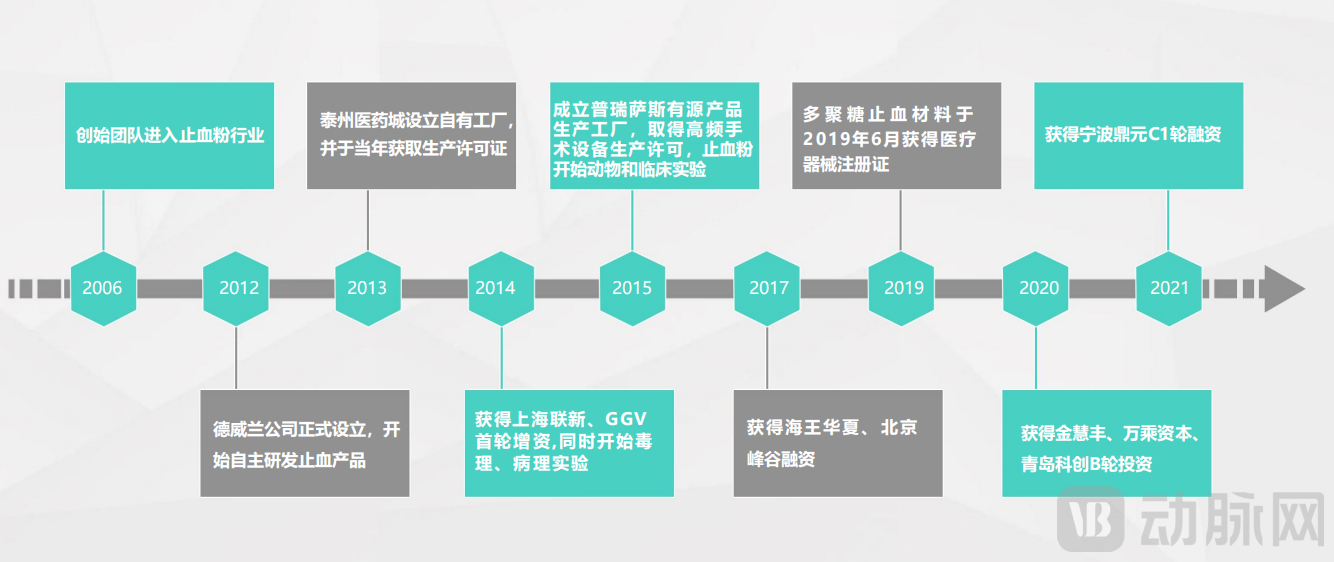
Deviceland stated that the current volume of surgeries in China is steadily increasing, and hemostatic materials will also experience stable growth. However, changes in the surgical landscape will significantly influence the types and properties of hemostatic materials. The current surgical trend has shifted from open surgery to minimally invasive surgery, and the next phase will see minimally invasive procedures evolving toward natural orifice transluminal endoscopic surgery (NOTES).
During these two transitions, hemostatic powder will have greater market application potential. In the more distant future, with technological advancements in new surgical approaches such as capsule surgical robots, hemostatic adhesives will enjoy broader market prospects.
It is reported that JiangSu Deviceland Medical Instrument Co., Ltd. plans to list on the Chinese capital market in the future and has already initiated a new round of financing. The funds will be primarily allocated to the research and development of new products, as well as to cover clinical trial costs for products that have entered the clinical stage. In terms of R&D and marketing promotion, the company also intends to gradually recruit fresh talent to strengthen its human resource advantages.